CTC Breakdown: Fixed Pay, Variable Pay and Benefits Compared
Two fictional offers share the same 12 lakh CTC but differ sharply in dependable cash: 9.00 lakh fixed against 10.20 lakh, and 75,000 versus 85,000 a month.
KnowledgeGate Team
Exam prep & CS education
Updated 10 Aug 20265 min read
Two offer letters can both show 12.00 lakh CTC yet provide very different dependable monthly gross cash. The headline hides how much is fixed, how much depends on performance, what sits in employer contributions, and what is a non-cash benefit. Rebuild each offer into four buckets, stress-test variable pay, convert only recurring fixed gross to a monthly view, and ask HR about every missing condition. CTC is not monthly take-home, and both offers below are fictional.
Related reading: salary negotiation and service-based company placements.
1. Rebuild CTC Into Four Buckets Before Comparing Offers
CTC is the employer's stated annual cost package, although labels vary. Recurring fixed gross cash is salary payable through regular payroll before employee-side deductions and tax. Variable cash depends on a target, rating, company result, attendance, tenure or another written condition.
Employer contributions and deferred provisions can add value without becoming current bank credit. Non-cash benefits, such as insurance or learning support, may be useful, but their stated value is not spendable cash. These four buckets make different labels comparable.
Put one-time cash, including a joining or retention bonus, on a separate line even when CTC includes it. It can be conditional, non-recurring or repayable. Never merge it into recurring fixed pay. Reading an offer letter this closely is the last stage of the wider journey from written rounds to interviews and offers.
2. Work Two 12.00 Lakh Offers Line by Line
Start with the annual components as written. Do not rename or move a line.
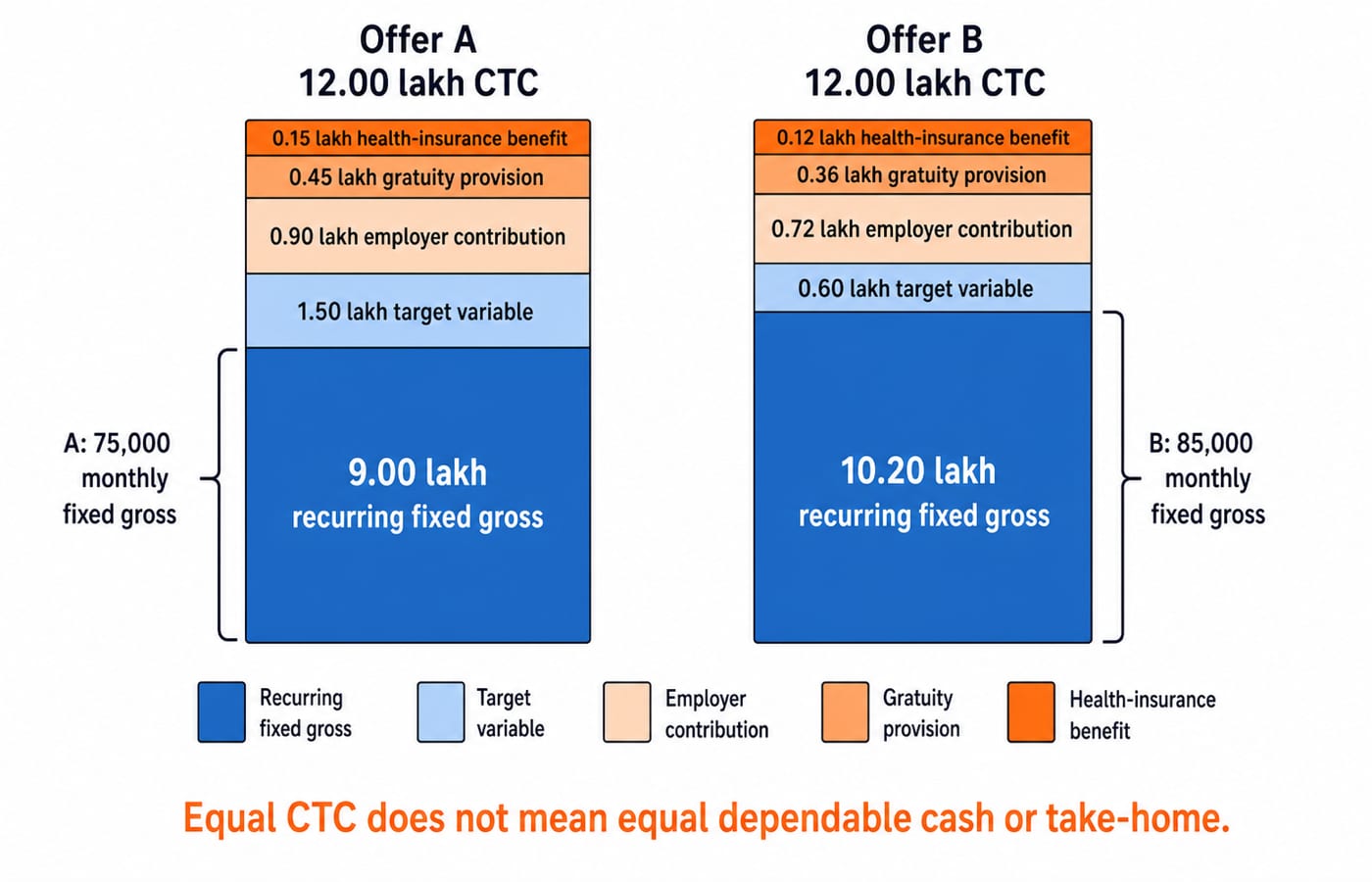
Component | Offer A | Offer B | How to read it |
|---|---|---|---|
Recurring fixed gross cash | 9,00,000 | 10,20,000 | Regular payroll before employee-side deductions and tax |
Target variable cash | 1,50,000 | 60,000 | Conditional cash at full target |
Employer contribution | 90,000 | 72,000 | Employer-side value, not current bank credit |
Gratuity provision | 45,000 | 36,000 | Deferred or conditional treatment |
Stated health-insurance benefit | 15,000 | 12,000 | Non-cash stated value |
Total CTC | 12,00,000 | 12,00,000 | Headline annual package |
Check every line in the total:
Offer A:
9,00,000 + 1,50,000 + 90,000 + 45,000 + 15,000 = 12,00,000.Offer B:
10,20,000 + 60,000 + 72,000 + 36,000 + 12,000 = 12,00,000.
The recurring fixed gross differs by 10,20,000 - 9,00,000 = 1,20,000 a year. B has 1.20 lakh more recurring fixed gross, while A places 90,000 more in target variable pay. Neither is automatically better because conditions and priorities matter.
3. Stress-Test Variable Pay at Zero, Half and Full Target
Compare a range instead of assuming the target will arrive. These annual gross-cash totals are before employee-side deductions and tax. They exclude employer contributions, deferred provisions and non-cash benefits.
Variable payout | Offer A annual gross cash | Offer B annual gross cash | Difference |
|---|---|---|---|
0% | 9,00,000 | 10,20,000 | B leads by 1,20,000 |
50% | 9,00,000 + 75,000 = 9,75,000 | 10,20,000 + 30,000 = 10,50,000 | B leads by 75,000 |
100% | 10,50,000 | 10,80,000 | B leads by 30,000 |
Before assigning a probability, ask for the metric, individual versus company weighting, minimum and maximum payout, review period, payment date, joining-date proration, eligibility on resignation, and the controlling document. If HR provides no historical payout rate, show the uncertainty. A target in CTC is not guaranteed income.
4. Convert Fixed Annual Gross to a Monthly View Without Guessing Take-Home
Calculate monthly fixed gross from recurring fixed gross:
Offer A:
9,00,000 / 12 = 75,000monthly fixed gross.Offer B:
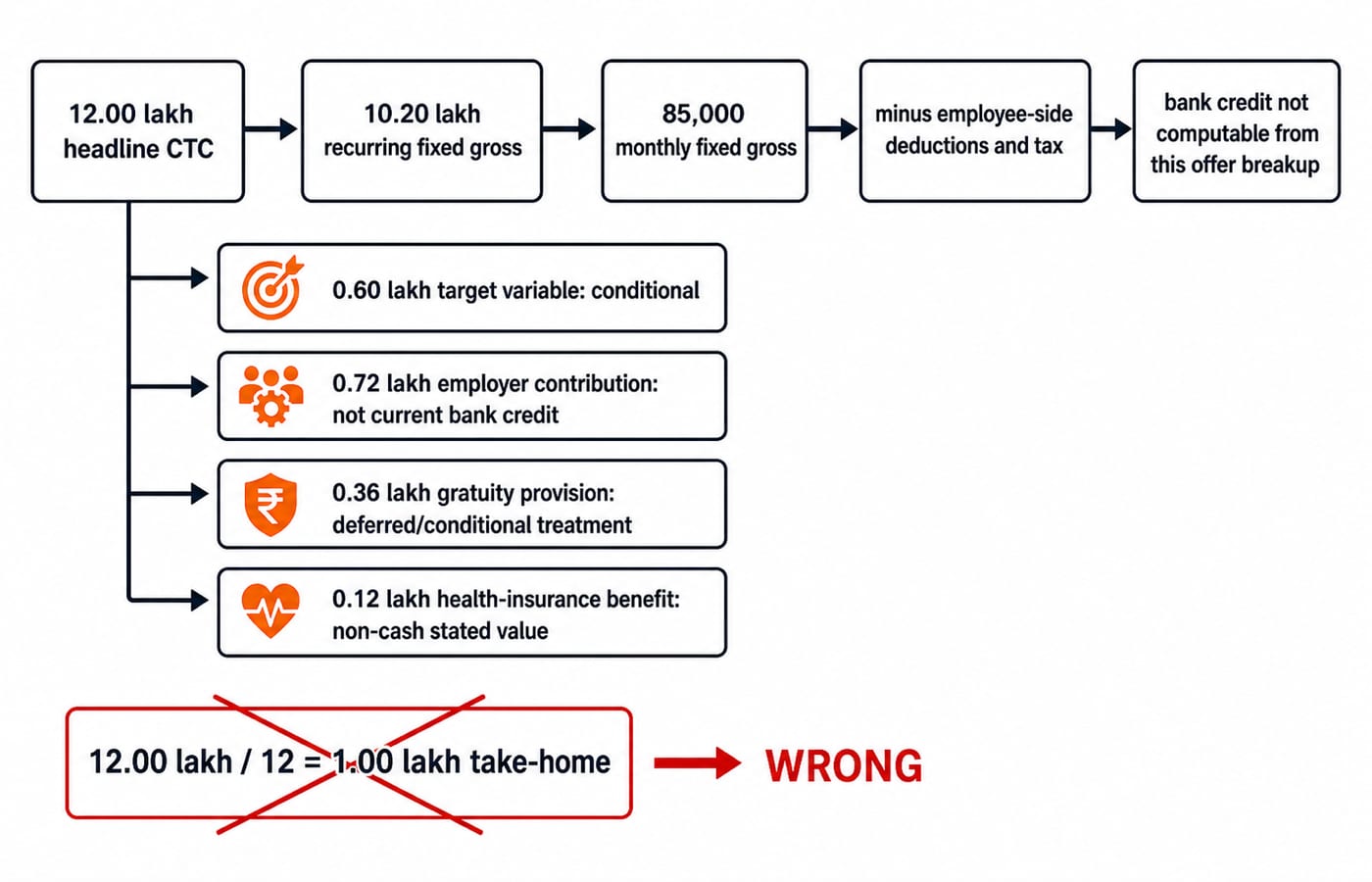
10,20,000 / 12 = 85,000monthly fixed gross.Monthly fixed-gross gap:
85,000 - 75,000 = 10,000.
Keep variable outside unless the letter states its payroll schedule. The bank-credit bridge is monthly fixed gross - employee-side deductions - tax - any other authorised deduction = bank credit.
Bank credit remains unknown without a salary-slip breakup, tax choice, location-specific deduction or employee contribution. Employer contributions and gratuity provisions are not added to that month's bank credit. Ask HR for an illustrative monthly breakup and match its names with the annual offer. The shortcut 12,00,000 / 12 = 1,00,000 take-home is wrong.
5. Value Benefits by Usefulness, Certainty and Access
Offer A states 90,000 + 45,000 + 15,000 = 1,50,000 across employer contribution, gratuity provision and insurance. Offer B states 72,000 + 36,000 + 12,000 = 1,20,000. These explain CTC but are not gross cash, so keep them out of variable-payout scenarios.
Test each benefit: Can I use it? When is it available? What can reduce or remove it? For insurance, ask who is covered, when coverage starts, what is excluded, and whether dependants cost extra. For contributions or gratuity provisions, rely on the offer, payroll explanation and written policy.
For stock, meals, transport, devices or learning support, record the stated value, vesting or access rule, and usefulness. Never relabel a notional amount as cash.
6. Catch the Six Comparison Traps That Inflate an Offer
Each trap below has a specific correction:
Divide total CTC by 12: divide recurring fixed gross only, giving 75,000 for A and 85,000 for B.
Assume 100% variable: compare zero, half and full target, where B's lead narrows from 1,20,000 to 30,000.
Mix employer and employee contributions: keep each on its own line and ask what reaches payroll.
Treat one-time cash as recurring: create separate first-year and later-year views.
Accept a benefit's stated value as cash: keep A's 15,000 and B's 12,000 insurance values in the non-cash bucket.
Compare labels instead of definitions: ask what each line contains.
One-time cash sits outside those six traps and needs a check of its own. For joining, retention or relocation cash, copy the service trigger, the repayment amount and the end date from the written terms. A verbal assurance is not a confirmed condition.
7. Test Your Understanding in the HR and Offer Conversation
The practical test is whether you can restate the offer accurately and ask precise, neutral questions about it. For Offer B, try this:
“I have understood the 12.00 lakh CTC as 10.20 lakh recurring fixed gross, 0.60 lakh target variable, 0.72 lakh employer contribution, 0.36 lakh gratuity provision and 0.12 lakh stated insurance benefit. Could you please confirm the variable conditions, payout timing, monthly salary breakup and whether any component is one-time or repayable?”
Fill this sheet only from the letter and written clarifications:
Headline CTC | Recurring fixed gross | Monthly fixed gross | Variable range and rules | One-time cash and clawback | Employer/deferred components | Non-cash benefits and access |
|---|---|---|---|---|---|---|
Your offer |
Then practise the wider HR conversation, including salary questions. Recruiters may not negotiate or disclose the same information, so ask without assuming an outcome.
8. The Short Version and the Next Useful Step
Compare five numbers: recurring fixed gross, monthly fixed gross, variable at zero and full target, first-year one-time cash, and benefits kept separate from cash. Here, the useful starting point is A: 9.00 lakh fixed and 1.50 lakh target variable versus B: 10.20 lakh fixed and 0.60 lakh target variable, not “12 lakh versus 12 lakh.”
Skipping written breakups is one of the common placement preparation mistakes. Copy the seven-column sheet and parse your next offer line by line. For structured resume, technical and HR interview, one-to-one resume review and mock-interview preparation, continue with the Interview & Resume Preparation Course.
Keep learning

Placement Mock Analysis: One Error Ledger Across Every Test Round
Use one error ledger without flattening unlike round results. This worked example shows how to find the first wrong step, prioritise repairs and close errors only after fresh retests.
Updated 4 Oct 20265 min readInterview Corner
Internship to PPO: Build a Weekly Evidence Trail Before the Final Review
Use a weekly outcome ledger to make your internship work visible before the final review. This practice model shows how to record delivery, feedback, effect and handoff honestly.
Updated 28 Sep 20265 min readInterview Corner

DSA Mock Interview Rubric: A 100-Point Scorecard for Reasoning, Code and Communication
A practical six-part scorecard for running comparable DSA mocks, grading visible evidence and turning weak areas into the next week's practice.
Updated 25 Sep 20265 min readInterview Corner

Campus Recruitment Timeline: Stage by Stage from Pre-Placement Talk to Written Offer
Follow a campus drive without guessing. Build an evidence sheet, verify eligibility, plan each preparation window and check the written offer before responding.
Updated 24 Sep 20265 min readInterview Corner