Resume-Based Interview Questions: Predict Every Follow-Up
Learn a repeatable, evidence-first method to turn each resume line into likely interview questions, rank weak answers and rehearse the claims that need work.
KnowledgeGate Team
Exam prep & CS education
Updated 6 Aug 20266 min read
An interviewer can use any noun, technology, number or result on your resume to begin a question. Revising a generic list of 100 questions can therefore leave you exposed on your own claims. A better method is to mark every line, generate factual, technical, trade-off and ownership questions, attach evidence, then rehearse the riskiest answers first. The aim is to defend what is already true, not manufacture detail after submission; start with resume and interview preparation, then work your own resume line by line.
Read the resume the way an interviewer can
Underline action verbs, box numbers, circle technologies, star results, and label ownership words such as built, led or designed. One line can open several threads; worked on backend gives no useful boundary.
Take this sample bullet, P1:
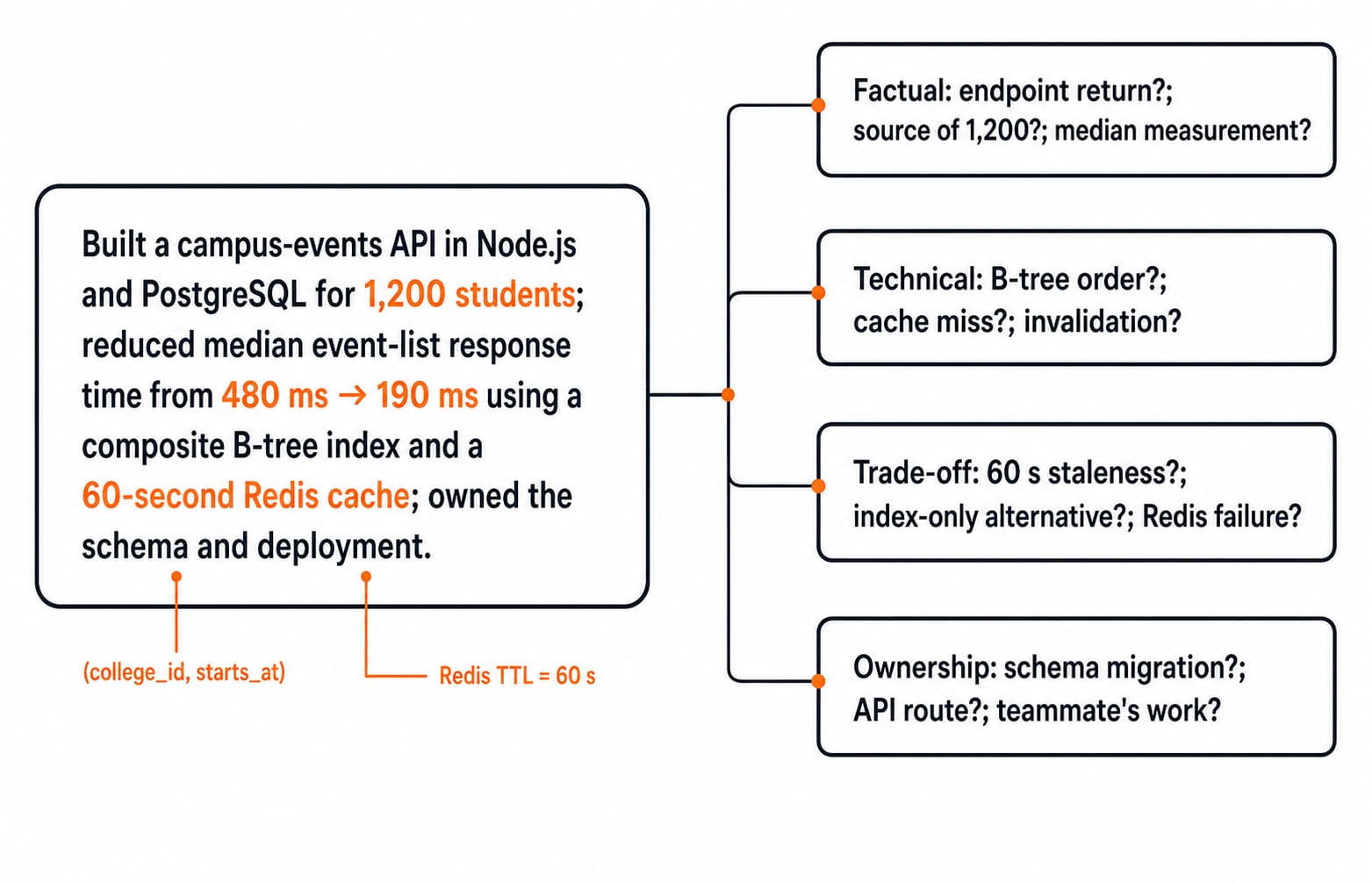
Built a campus-events API in Node.js and PostgreSQL for 1,200 students; reduced median event-list response time from 480 ms to 190 ms using a composite B-tree index and a 60-second Redis cache; owned the schema and deployment.
Claim inventory: built, campus-events API, Node.js, PostgreSQL, 1,200 students, median, 480 ms, 190 ms, composite B-tree index, 60-second Redis cache, schema, and deployment.
In 15 minutes, number every line by section (E1 for education, S1 for skills, P1 for the first project) and copy each line's claims into a worksheet. To improve bullets first, use Resume for Freshers: Clear the First Screen.
Generate four question families from every claim
Give every substantive bullet one prompt per family, plus a correctness check per named skill. For P1, write exactly 12:
Family | Three prompts |
|---|---|
Factual | What did the endpoint return? Where did 1,200 come from? How was median latency measured? |
Technical | Why was the index ordered that way? What happens on a cache miss? How did cache invalidation work? |
Trade-off | Why accept a 60-second TTL? Why use Redis rather than only an index? What happens if Redis fails? |
Ownership | Which schema migration was yours? Which API route did you write? What did your teammate own? |
Factual means what happened; technical, how; trade-off, why; ownership, what you did. Score each prompt 0 = cannot answer, 1 = partial, or 2 = clear with evidence. Revise a zero that day.
Work the sample from claim to defensible answer
In the sample project, the events table holds 50,000 rows across 8 colleges. The slow query is:
SELECT id, title, starts_at FROM events
WHERE college_id = 42 AND starts_at >= '2026-07-01'
ORDER BY starts_at LIMIT 20;
A 10-minute k6 test with 100 virtual users measured 480 ms median and 920 ms p95. CREATE INDEX idx_events_college_start ON events (college_id, starts_at); lowered median to 260 ms. Equality on college_id comes first; starts_at supports range and order. Caching lowered median to 190 ms and p95 to 410 ms. Only the median change belongs on the resume.
Key events:college:42:from:2026-07-01:limit:20 has a 60-second TTL. Creates, updates and cancellations delete affected college keys. Redis failure uses correct but slower PostgreSQL. The trade-off is up to 60 seconds of stale data.
Model 60 to 90-second answer:
“Our event-list query was slow on 50,000 rows across eight colleges. I measured it with 100 k6 virtual users for 10 minutes: 480 ms median and 920 ms p95. I added a
(college_id, starts_at)index, which brought median latency to 260 ms. I then cached repeated list requests for 60 seconds, reducing median to 190 ms and p95 to 410 ms. Writes invalidated affected college keys, while Redis failure fell back to PostgreSQL. That allowed up to 60 seconds of staleness. I wrote the table and index migrations, list route, k6 script, fallback and deployment configuration. My teammate built the React event-list screen.”
Apply the method to skills, internships and achievements
For Java, PostgreSQL, Redis, ask: How do HashMap collisions work, and where did you use a map? What is the leftmost-prefix rule, and why that P1 index order? What is cache invalidation, and what happens without Redis? Remove technology you cannot connect to real use or explain properly. Refresh exposed concepts with Technical Interview Prep: OS, DBMS, CN and OOP Answers.
A second sample line, this one from an internship: Automated a weekly sales report in Python and pandas across 18 CSV files and 240,000 rows, reducing manual preparation from 3 hours to 25 minutes. Prepare timing, pandas.concat plus groupby, why CSV beat a database, and personal contribution. Keep the script, redacted schema, run log and timing note. The reduction is (180 - 25) / 180 x 100 = 86.1%.
For Placed 2nd among 48 teams in a 24-hour campus hackathon, explain the product, criteria, team size, your decision and hardest failure.
Build a question bank that follows evidence
Use seven columns: Line ID | Exact claim | Question family | Likely prompt | Evidence | Confidence 0-2 | Revision action.
P1 | 480 ms to 190 ms | factual | How did you measure it? | k6, 100 VUs, 10 min, p50 | 1 | rerun test and explain median
With 12 bullets and 8 skills, create 20 anchors. Keep one question for 15, then expand the weakest five across four families: 15 + (5 x 4) = 35 questions. Scale it to your own resume: each extra anchor adds one question, and every anchor you decide to expand across all four families adds four. Evidence can be a repository, note, record or recollection. Redact private material.
Flag unsourced numbers, weakly understood tools, team results claimed alone, confidential data, and optimised without measures. Narrow or remove them; if submitted, correct them honestly.
Use a seven-hour week that survives a missed day
Use this 420-minute cycle:
Day 1, 60 minutes: mark lines and build 20 anchors.
Days 2 to 4, 60 minutes each: investigate a project, internship and skills.
Day 5, 60 minutes: draft 60 to 90-second answers for the weakest five.
Day 6, 90 minutes: run the 25-minute resume-only mock, then rewrite every answer it exposed.
Day 7, 30 minutes: correct answers scored 0 or 1.
Total: 60 + 180 + 60 + 90 + 30 = 420 minutes = 7 hours. If a weekday block is missed, move its riskiest 30 minutes to Day 7 and carry 30 forward. If two are missed, protect the mock and weakest five claims, accepting a six-hour week.
Each week, every claim needs a question, the riskiest five need four-family coverage, and no answer may contradict the resume. Accuracy precedes speed.
Run a resume-only mock and take the next step
Run 25 minutes: 90-second resume walk-through; four P1 questions; two internship and two skill questions; one trade-off; one ownership; then three minutes of feedback. The interviewer challenges vagueness with “What exactly do you mean?” and changes one premise, such as Redis being unavailable.
For a gap, state what you know, name the assumption, reason from fundamentals and say how you would check. Never bluff. Apply it to teamwork, weakness and conflict with HR Interview Questions for Freshers: How to Answer Honestly.
Final checklist: every line numbered; every number sourced; every technology explainable; weak bullets have four families; ownership separated from team work; trade-offs stated; corrections recorded; resume and spoken values identical.
The short version is claim -> four question families -> evidence -> rehearsal -> correction. For guided review and mock practice, use the Interview & Resume Preparation Course.
Keep learning
Placement Mock Analysis: One Error Ledger Across Every Test Round
Use one error ledger without flattening unlike round results. This worked example shows how to find the first wrong step, prioritise repairs and close errors only after fresh retests.
Updated 4 Oct 20265 min readInterview Corner
Internship to PPO: Build a Weekly Evidence Trail Before the Final Review
Use a weekly outcome ledger to make your internship work visible before the final review. This practice model shows how to record delivery, feedback, effect and handoff honestly.
Updated 28 Sep 20265 min readInterview Corner
DSA Mock Interview Rubric: A 100-Point Scorecard for Reasoning, Code and Communication
A practical six-part scorecard for running comparable DSA mocks, grading visible evidence and turning weak areas into the next week's practice.
Updated 25 Sep 20265 min readInterview Corner
Campus Recruitment Timeline: Stage by Stage from Pre-Placement Talk to Written Offer
Follow a campus drive without guessing. Build an evidence sheet, verify eligibility, plan each preparation window and check the written offer before responding.
Updated 24 Sep 20265 min readInterview Corner