Psychology for Teaching Exams: Core Concepts with Worked Examples
Learn how to identify psychological mechanisms in classroom vignettes, eliminate common traps and revise core concepts through worked examples.
KnowledgeGate Team
Exam prep & CS education
Updated 22 Sep 20266 min read
Many candidates can recite Piaget, Vygotsky, Skinner and Bandura, yet exam vignettes reward a different skill: reading evidence before naming a theory. Use a three-step chain: observe the learner's behaviour, identify the mechanism that best explains it, then choose the teacher action that follows. This chain works across learning, development, motivation, memory and individual differences. CTET, state TETs, UGC NET and recruitment tests set different scopes, so match every topic to the official syllabus for your exam.
Educational psychology: meaning, scope and the exam lens
Educational psychology examines how learners develop, think, feel, remember, interact and learn in educational settings. Separate four terms:
Growth is measurable physical change.
Development is broader qualitative and quantitative change.
Maturation is biologically guided readiness.
Learning is a relatively durable change associated with experience or practice.
For any vignette, ask: What behaviour is observed? What changed? Which process explains it? What teacher action follows?
A learner attempts 3 of 10 questions in Week 1 and 8 of 10 in Week 3. “Attempts increased by 5” is observation. “The learner is now intrinsically motivated” is an inference needing more evidence.
Learning theories and one worked reinforcement example
Approach | Focus | Vignette clue |
|---|---|---|
Behaviourism | Responses and consequences | Something follows behaviour |
Cognitive | Attention, memory, organisation, insight | Information processing changes |
Social learning | Models and their consequences | Behaviour follows observation |
Constructivism | New experience linked to prior knowledge | The learner builds meaning |
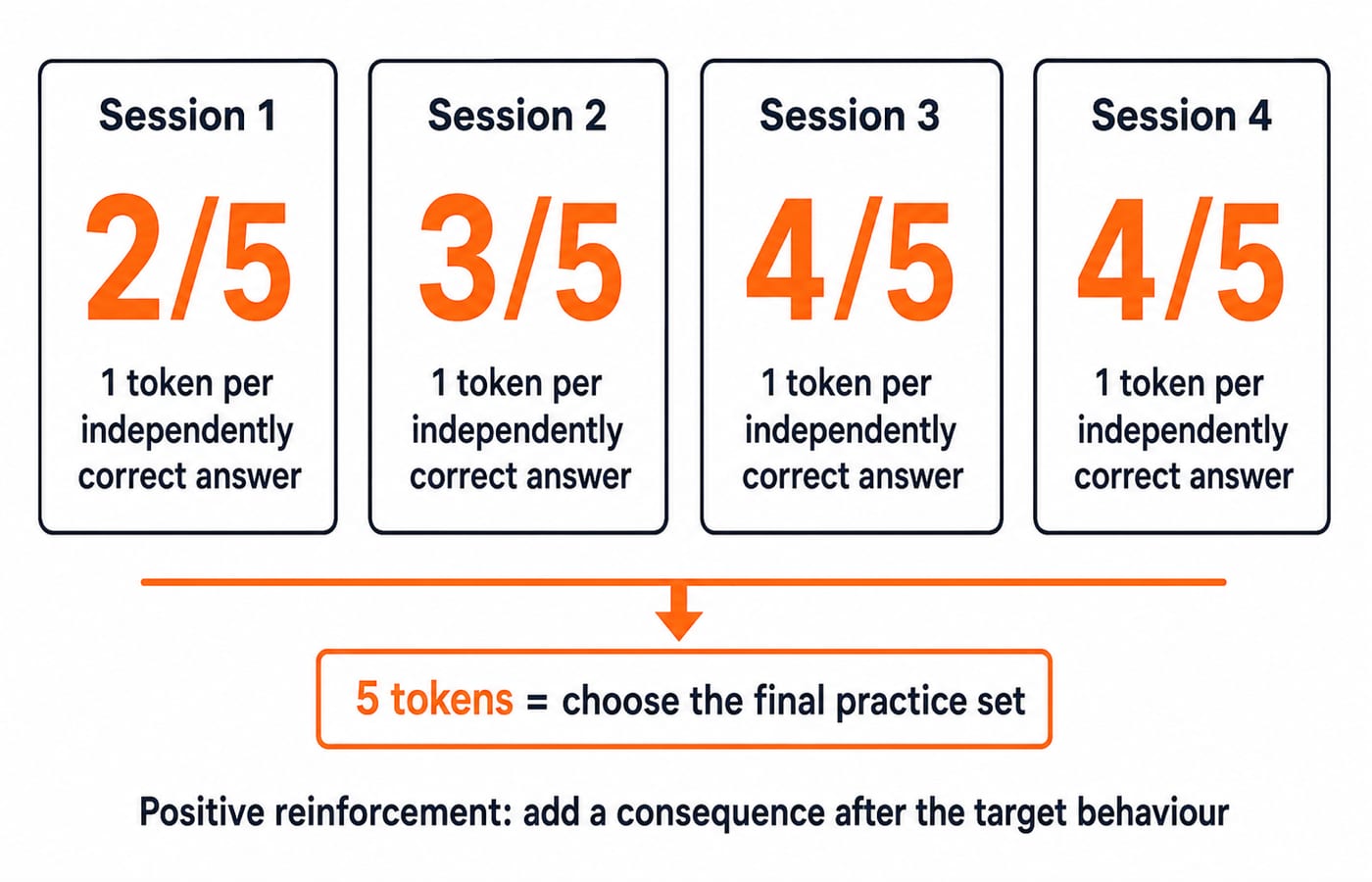
The Riya fraction record also appears in Learning and Motivation for Teaching Exams, where it compares learning theories, motivation sources and classroom actions. As an exam stem, the same record asks a narrower question: what kind of consequence follows the target behaviour? In a 10-minute practice block, Riya completes 2 of 5 fraction questions independently. The teacher adds one token immediately after each independently correct answer; 5 tokens earn a choice of final practice set. Across four sessions, Riya scores 2/5, 3/5, 4/5 and 4/5 independently.
The target behaviour is an independently correct answer. The teacher adds a desirable stimulus after it, and independent completions rise from 2 to 4. This is positive reinforcement. Positive means added, not morally good.
Nothing aversive is removed, so this is not negative reinforcement. Nothing reduces behaviour, so it is not punishment. A token is not automatically bribery. This pattern identifies the mechanism, not the sole cause.
Development, readiness and scaffolding
Development patterns vary by learner. Piaget explains changing reasoning, Vygotsky scaffolding, and Bandura attention, observation and modelling. Child Development for Teaching Exams is the broader map for stages, socialisation and inclusion. In a psychology vignette, separate the observed reasoning from any biography or age guess.
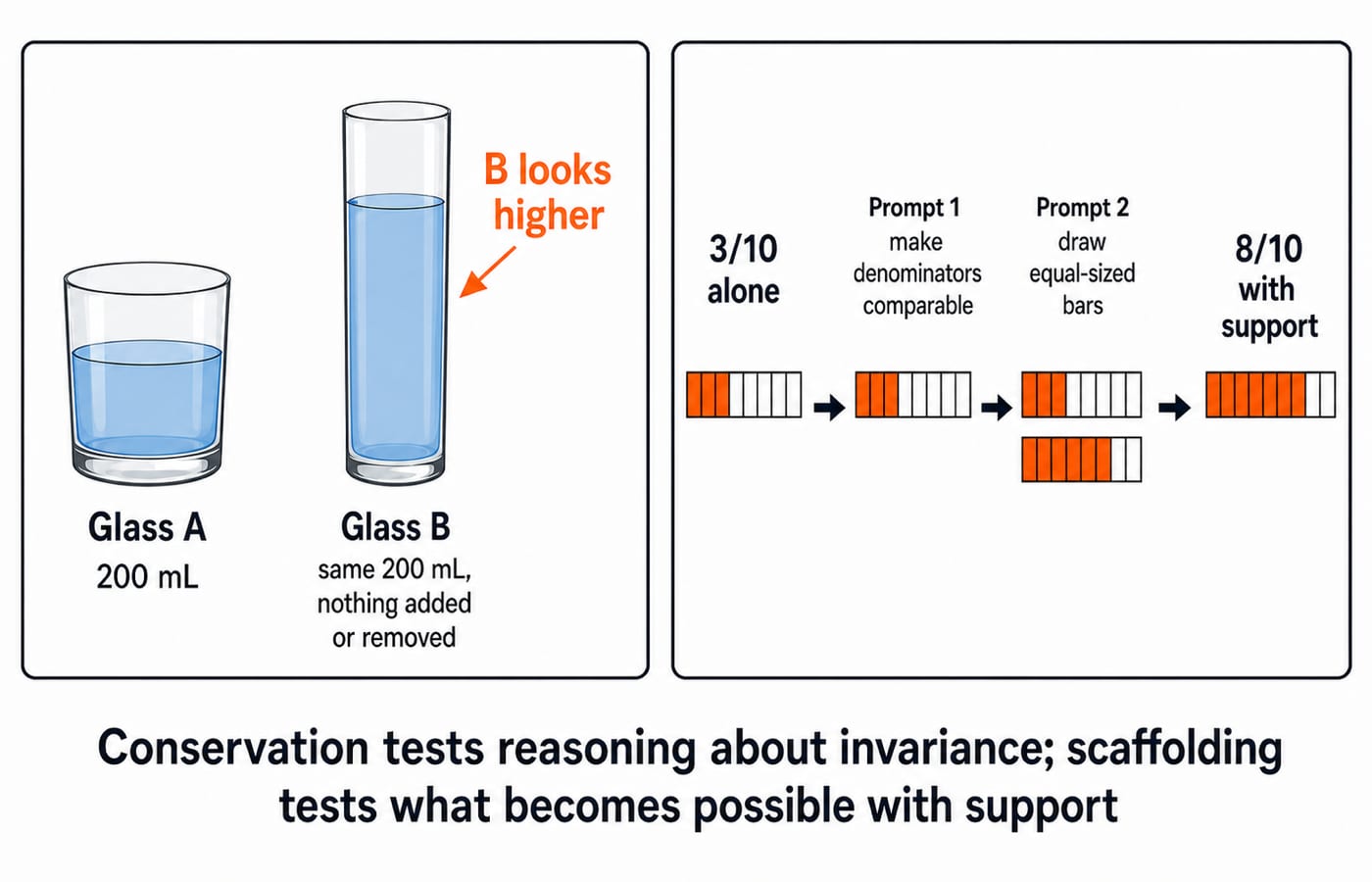
Short, wide Glass A contains 200 mL of water. The same 200 mL is poured into tall, narrow Glass B, with nothing added or removed. A learner says B has more because its level is higher. This is failure to conserve quantity and attention to one feature, height. Invite comparison, reverse the pour and ask for an explanation instead of merely saying “wrong”.
Aman answers 3 of 10 fraction comparisons alone and 8 of 10 after two prompts: “make the denominators comparable”, then “draw equal-sized bars”. The 5 additional correct responses illustrate appropriate help. The zone of proximal development is not formally the arithmetic gap 8 minus 3.
Memory, motivation and transfer without shortcut myths
Learners and Learning Process for Teaching Exams traces readiness, action, feedback and transfer across a full learning cycle. A single exam vignette needs sharper evidence boundaries: memory concerns encoding, storage and retrieval; motivation concerns why effort begins and persists; transfer concerns the effect of prior learning on a new task. Maintenance rehearsal repeats, meaningful organisation connects, and retrieval practice recalls without looking. Intrinsic motivation comes from the activity; extrinsic motivation involves an external consequence. Neither is a fixed learner type.
Positive transfer supports a new task, negative transfer interferes with it, and zero transfer has no meaningful effect.
In hypothetical revision data, both students study 20 concept cards for 40 total minutes. M studies all 40 minutes on Day 1, recalls 17/20 immediately and 9/20 after seven days: a drop of 17 minus 9, or 8. S studies 10 minutes on Days 1, 3, 5 and 7, recalls 15/20 immediately and 13/20 later: a drop of 15 minus 13, or 2.
Here, spacing gives better delayed retention. One hypothetical pair cannot estimate a universal effect size. A reward does not prove increased intrinsic motivation, and immediate recall does not establish durable learning.
Intelligence, individual differences and inclusion
Intelligence is assessed through performance patterns, not marks or a permanent verdict on potential. Personality, aptitude, achievement, creativity and intelligence are distinct. One result or behaviour cannot diagnose.
Individual differences should shape decisions: vary examples and response formats, activate prior knowledge, provide accessible materials, allow scaffolds and assess the intended construct. Do not sort learners into fixed visual, auditory or kinesthetic boxes or prescribe a separate curriculum for each learner.
To assess the water cycle, compare a 300-word handwritten-only response with the same four required stages shown through labelled diagrams plus 120 words. The second format reduces an irrelevant writing barrier while retaining the four-stage criterion. Accommodation changes access, not expectations. Apply the same test whenever you decide how a learner may show what they know.
How teaching exams turn psychology into questions
Common forms are definition or theorist matching, stage identification, classroom vignettes, best teacher action, and assertion-reason or statement sets. “Best action” requires applying a principle, not repeating a label.
For Riya, choose among (A) punishment, (B) negative reinforcement, (C) positive reinforcement and (D) extinction. Reject A because no aversive consequence follows, B because nothing aversive is removed, and D because reinforcement is not withheld. C fits.
CTET, state TETs, UGC NET and recruitment tests set different boundaries for psychology. Use the official syllabus, bulletin or notification for the exact scope. Marks, question counts, dates, fees, cut-offs and vacancies can change and must come from that source.
High-frequency traps and the correction for each
Trap | Why it fails | Correction |
|---|---|---|
Positive vs negative reinforcement | Good is confused with added | Check what is added or removed |
Maturation vs learning | Readiness is confused with practice | Check whether experience changed behaviour |
Observation vs inference | A label is treated as visible | State evidence before interpretation |
Rigid stage ages | A stage becomes an age guarantee | Use reasoning, not an absolute timetable |
Reward proves intrinsic motivation | External action cannot reveal interest | Seek more evidence |
Correlation proves causation | Co-occurrence cannot isolate cause | Separate mechanism from causal claim |
Accommodation lowers standards | Access is confused with criteria | Preserve the learning outcome |
Theorist without mechanism | Recall replaces application | Match evidence to process |
Self-check: underline behaviour, circle what is added or removed, box a prompt or model, and write one mechanism. For Riya: underline “2/5 to 4/5”, circle “token added”, box “immediately after”, write “reinforcement”.
Psychology for teaching exams: the short version and next step
Keep this six-line recall chain:
Observe the evidence.
Identify the process.
Match the theory.
Choose the learner-centred response.
Reject absolute wording.
Verify exam-specific scope officially.
Use a 30-minute loop: 12 minutes to rebuild a one-page concept matrix, 10 to solve five vignettes, and 8 to log why each wrong option failed. The total is 30 minutes. Next time, begin with the error log.
For structured UGC NET study, the NTA UGC NET Paper 1 course combines concept lessons with practice; the NET category groups the wider set of routes. CTET and state-TET readers should choose practice only after matching topics to their official syllabus.
Keep learning

सामान्य अशुद्धियाँ (Samanya Ashuddhiyaan): Complete Hindi Grammar Notes for CTET and TET Exams
Learn to identify and correct Hindi word-form, agreement, pronoun and redundancy errors through exact examples, a worked MCQ and a scored diagnostic.
Updated 6 Oct 20266 min readCTET & UPTET

Universities and Learning Programmes for Teaching Exams: Types, Modes and Solved Examples
Separate university status, delivery mode and programme purpose with a repeatable method, then test it on five UGC NET-style classification cases.
Updated 2 Oct 20265 min readCTET & UPTET

National Education Policy (NEP) 2020 Notes for Teaching Exams: 5+3+3+4, Reforms and MCQ Traps
Build an exam-ready map of NEP 2020, from the age-stage structure to pedagogy, language, PARAKH, B.Ed. routes and reliable distractor elimination.
Updated 26 Sep 20265 min readCTET & UPTET

Miscellaneous Pedagogy Topics for Teaching Exams: Complete Notes and Worked Examples
Turn a loose syllabus label into a five-part concept map, then use classroom evidence to distinguish sound pedagogy from attractive but incomplete options.
Updated 25 Sep 20266 min readCTET & UPTET