Noise Pollution and Waste Management for Teaching Exams: UGC NET Paper 1 Notes and Solved Examples
Build reliable Unit 9 concepts with noise-control logic, legal limits, waste segregation, solved decibel and mass-balance examples, and a quick correction table.
KnowledgeGate Team
Exam prep & CS education
Updated 21 Sep 20266 min read
Noise and waste questions look memory-based, but the paper often mixes logarithmic decibel arithmetic, source-effect-control matching, waste segregation, process choice and rule-based limits. Success depends on keeping the units, control sequence, legal limits and waste routes separate. In UGC NET, these concepts sit in Paper 1, Unit 9. The same environmental principles can appear in teaching examinations that include environmental studies, so check the syllabus for the examination you are preparing for.
Noise pollution for teaching exams: core terms, sources and effects
Sound is a physical pressure wave; noise is unwanted or harmful sound in context. Frequency in hertz describes oscillation rate, while intensity level in decibels uses a logarithmic scale. dB(A) applies human-ear weighting. Leq is an energy-equivalent level over an interval, not an arithmetic dB mean.
Source | Likely effect | First control |
|---|---|---|
Transport horns and engines | Sleep loss, stress, interference | Maintain engines; limit horns |
Construction equipment | Poor concentration, temporary threshold shift | Maintain or enclose equipment |
Industrial machinery | Tinnitus, hearing loss | Damp vibration; enclose machine |
Loudspeakers | Sleep and communication disturbance | Control volume and time |
Household appliances | Annoyance, poor concentration | Maintain or replace appliance |
Temporary threshold shift, tinnitus and hearing loss are auditory effects. Sleep disturbance, stress, poor concentration and communication interference are non-auditory. Control in the order source, transmission path, receiver. Maintain or enclose the source, add a barrier or distance, then reduce exposure or use hearing protection. Receiver protection does not replace feasible source control.
Decibel addition: a fully worked sound-level example
Sound intensity level is
L = 10 log10(I/I0), where I0 = 10^-12 W/m^2.
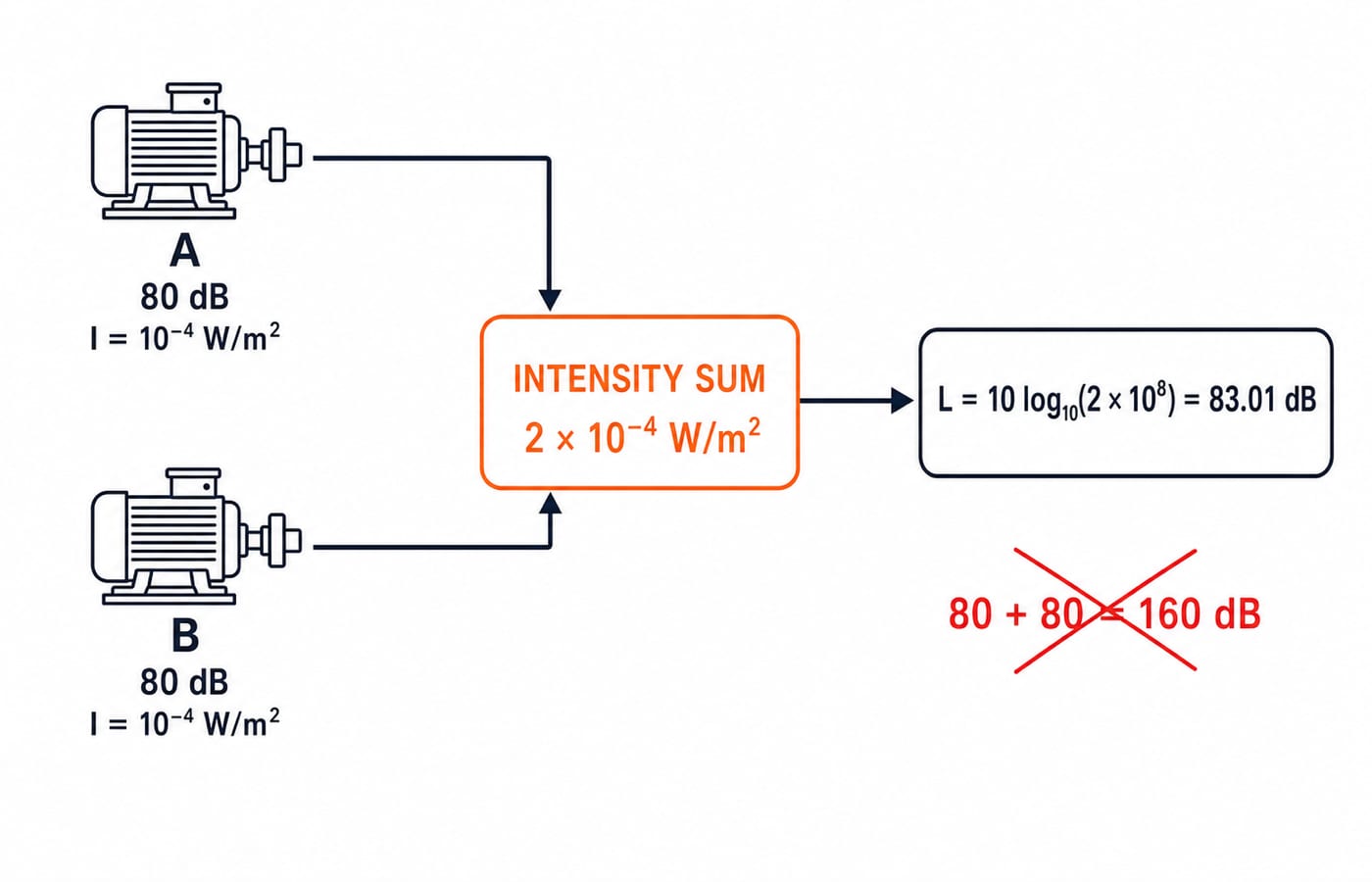
Take two independent machines, each producing 80 dB. For each machine:
I/I0 = 10^(80/10) = 10^8.I = 10^8 x 10^-12 = 10^-4 W/m^2.Intensities add, so
I_total = 10^-4 + 10^-4 = 2 x 10^-4 W/m^2.Therefore,
L_total = 10 log10(2 x 10^8).Using
log10(2) = 0.3010,L_total = 10(0.3010 + 8) = 83.01 dB, approximately 83 dB.
The answer is not 160 dB because decibel values are not added directly.
Now combine 90 dB and 80 dB. Their intensity ratios are 10^9 and 10^8, giving 1.1 x 10^9. Thus:
L_total = 10 log10(1.1 x 10^9) = 10(0.04139 + 9) = 90.41 dB.
The quieter source changes the total only slightly. Two useful shortcuts follow from the logarithmic scale: two equal independent sources add about 3 dB, while ten equal independent sources add 10 dB.
Noise standards and control: the table examiners turn into matches
The CPCB schedule under the Noise Pollution (Regulation and Control) Rules, 2000 sets these ambient noise limits.
Area category | Day limit, dB(A) Leq | Night limit, dB(A) Leq |
|---|---|---|
Industrial | 75 | 70 |
Commercial | 65 | 55 |
Residential | 55 | 45 |
Silence zone | 50 | 40 |
In that CPCB schedule, day means 6:00 a.m. to 10:00 p.m., and night means 10:00 p.m. to 6:00 a.m. A-weighting reflects human hearing. Leq is an energy mean over a specified period, not a simple average of dB values.
Under the rules, an area of not less than 100 metres around a hospital, educational institution or court may be declared a silence zone. The word may matters. Such an area is not automatically a silence zone merely because one of these institutions is present.
For a 90 dB machine near a classroom, first service, damp or enclose it. Next, increase distance or add an acoustic barrier. Use receiver protection where occupational exposure remains.
Waste management for teaching exams: types, segregation and hierarchy
Classify waste first, because its route follows its properties.
Waste type | Example | Correct route |
|---|---|---|
Biodegradable municipal waste | Vegetable peels | Composting or anaerobic digestion |
Recyclable dry waste | Clean paper or metal | Material recovery |
Special-care waste | Discarded paint or expired medicines | Authorised separate handling |
Biomedical waste | Used contaminated dressings | Biomedical-waste stream |
E-waste | Discarded circuit board | Authorised e-waste channel |
Inert waste or processing rejects | Non-recoverable inert material | Controlled final disposal |
Keep sewage or other liquid waste distinct from solid-waste segregation. The Solid Waste Management Rules, 2026 require four source-separated streams: wet, dry, sanitary and special care. Local collection instructions can vary, so identify the stream by the waste's properties rather than assuming a universal colour code.
Segregation comes before treatment. Follow the hierarchy: prevent or refuse, reduce, reuse or repair, recycle or compost, recover energy where appropriate, then dispose only residuals. Composting suits biodegradable matter. Sanitary landfill is controlled final disposal; open dumping is not treatment. Incineration is not a universal answer for wet mixed waste.
Waste-flow mass balance: a fully worked 1,000 kg/day example
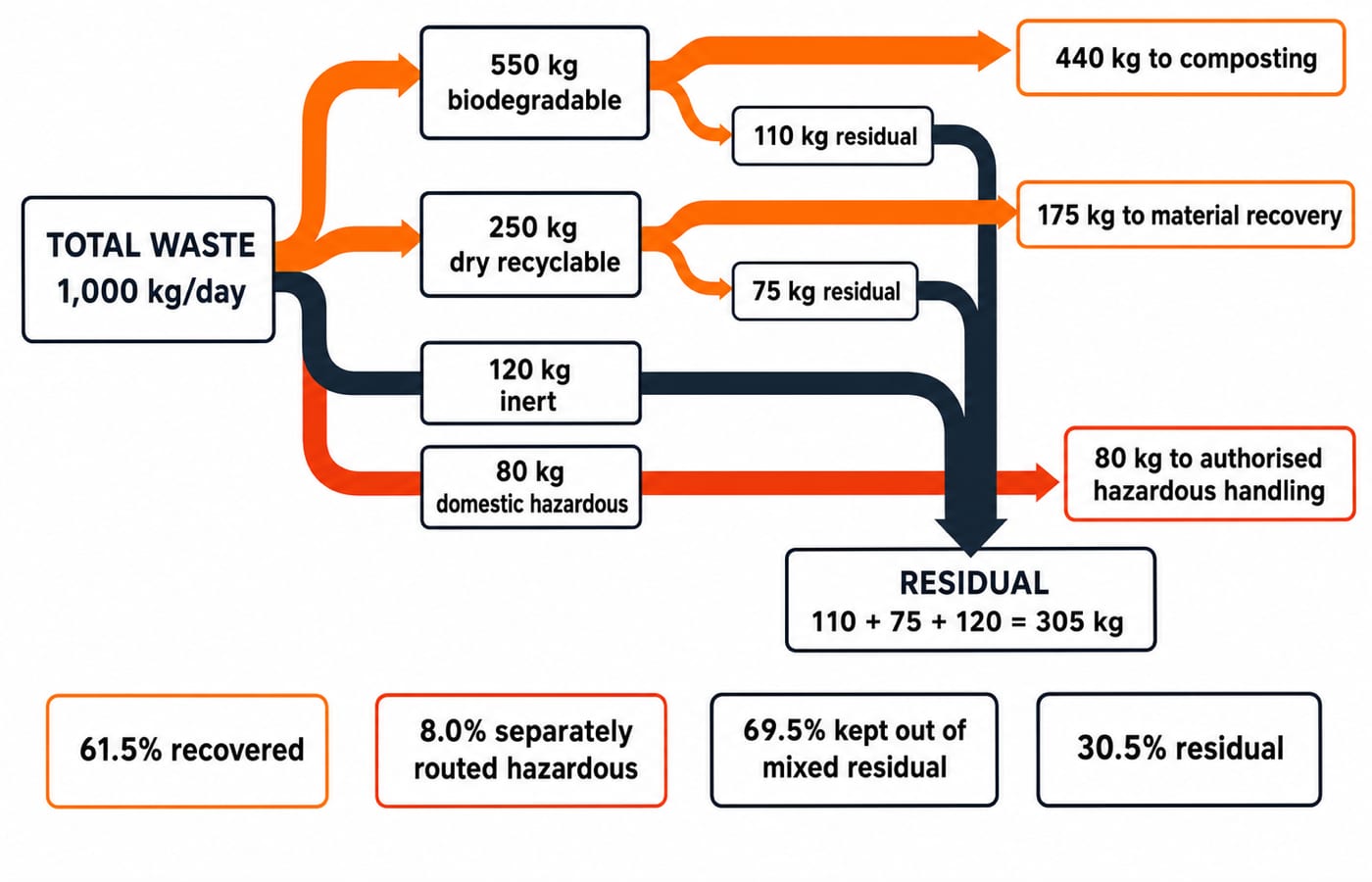
Consider a hypothetical 1,000 kg/day municipal stream: 550 kg wet biodegradable waste, 250 kg dry recyclable waste, 120 kg inert material and 80 kg domestic hazardous items handled through the special-care stream. The capture rates are exercise assumptions, not official performance rates.
Biodegradable waste captured for composting:
0.80 x 550 = 440 kg.Dry recyclables recovered:
0.70 x 250 = 175 kg.Special-care waste separately routed:
80 kg.Mixed residual:
1,000 - 440 - 175 - 80 = 305 kg.
Cross-check the residual: 110 kg uncaptured biodegradable plus 75 kg unrecovered dry plus 120 kg inert equals 305 kg.
Keep three percentages separate. Material or biological recovery is (440 + 175)/1,000 = 61.5%. Separately routed hazardous waste is 80/1,000 = 8.0%. Total kept out of mixed residual is 695/1,000 = 69.5%, leaving 305/1,000 = 30.5% residual.
Optionally assume finished compost is 40% of captured wet input: 0.40 x 440 = 176 kg. This is a scenario assumption, not a universal yield.
How teaching exams test noise pollution and waste management
Expect four question families: definition or unit identification, match-the-following for source-effect-control or waste-treatment pairs, sequence questions on the waste hierarchy, and numericals on logarithmic sound addition or waste mass balance.
Try three quick checks:
Two independent 80 dB sources combine to give approximately 83 dB.
The commercial-zone night limit in the CPCB table is 55 dB(A) Leq.
Vegetable peels, newspaper and discarded paint belong to wet, dry and special-care streams respectively.
Unit 9 belongs to Paper 1. The guide to UGC NET Paper 1 vs Paper 2 for Computer Science helps you decide where this material fits. Check the official NTA UGC NET portal for the current syllabus and bulletin.
During practice, maintain a short error log with four labels: unit confusion, dB arithmetic, rule-table recall and process-selection error. The UGC NET mock test strategy explains how to use full and sectional mocks, while the NTA UGC NET Paper - 1 Test Series provides a live practice option.
Noise and waste-management traps: a one-page correction table
Misconception | Correction |
|---|---|
dB values add directly | Add intensities, then convert back to dB. |
Frequency and intensity are the same | Frequency uses hertz; intensity level uses dB. |
Leq is an arithmetic dB mean | Leq is an energy-equivalent level. |
Every educational institution has a 100-metre silence zone | Such an area may be declared one under the rules. |
Biodegradable means recyclable | The properties and processes differ. |
All dry waste is recyclable | Dry rejects can remain. |
E-waste belongs in ordinary dry recycling | Use an authorised e-waste channel. |
Landfill equals open dumping | Sanitary landfill is controlled; dumping is not treatment. |
Incineration tops the hierarchy | Prevention, reduction, reuse and recovery come first. |
Use this 20-second recall chain: noise = source -> path -> receiver; waste = segregate -> select treatment -> recover -> dispose residual.
Noise pollution and waste management: the short version and next step
Remember five points: dB is logarithmic; equal independent sources add about 3 dB; noise control begins at the source; waste segregation precedes treatment; landfill is for residuals.
For the full Unit 9 learning sequence, use NTA-UGC-NET Paper - 1. To compare broader Paper 1 learning and practice routes, browse the UGC NET preparation courses and test series. Choose the route that matches the gaps shown in your error log.
Keep learning

सामान्य अशुद्धियाँ (Samanya Ashuddhiyaan): Complete Hindi Grammar Notes for CTET and TET Exams
Learn to identify and correct Hindi word-form, agreement, pronoun and redundancy errors through exact examples, a worked MCQ and a scored diagnostic.
Updated 6 Oct 20266 min readCTET & UPTET

Universities and Learning Programmes for Teaching Exams: Types, Modes and Solved Examples
Separate university status, delivery mode and programme purpose with a repeatable method, then test it on five UGC NET-style classification cases.
Updated 2 Oct 20265 min readCTET & UPTET

National Education Policy (NEP) 2020 Notes for Teaching Exams: 5+3+3+4, Reforms and MCQ Traps
Build an exam-ready map of NEP 2020, from the age-stage structure to pedagogy, language, PARAKH, B.Ed. routes and reliable distractor elimination.
Updated 26 Sep 20265 min readCTET & UPTET

Miscellaneous Pedagogy Topics for Teaching Exams: Complete Notes and Worked Examples
Turn a loose syllabus label into a five-part concept map, then use classroom evidence to distinguish sound pedagogy from attractive but incomplete options.
Updated 25 Sep 20266 min readCTET & UPTET