HCLTech Coding Questions: Solve 4 Core Patterns Step by Step
Learn a pattern-first method for coding rounds through four original problems. Trace hashing, sliding windows, stacks and interval scheduling from input to answer.
KnowledgeGate Team
Exam prep & CS education
Updated 27 Oct 20266 min read
Memorising a list labelled "HCLTech questions" breaks as soon as the input changes or the evaluator asks why your approach works. A reusable pattern is more useful because it comes with an invariant, a trace, complexity and edge cases. These four problems are representative practice, not an official or fixed HCLTech question bank. We will dry-run hashing, sliding windows, stacks and greedy selection, then build a timed answer method. Use Company-Specific Placement Courses to place this work inside wider company-wise preparation.
HCLTech coding questions: use a five-part answer
Clarify tie-breaking, duplicates, empty input, mutation permission and result type before coding. Use clarify output -> state simple approach -> identify the pattern -> trace one input -> give complexity and tests.
Prompt clue | Likely pattern | State to maintain | Invariant |
|---|---|---|---|
find a complement or frequency | hash map | value to index or count | stored state covers only processed items |
longest valid contiguous range | sliding window | left boundary plus last-seen index | current window satisfies the rule |
nested opening and closing symbols | stack | unmatched opening symbols | stack order matches nesting |
maximum number of compatible intervals | greedy after sorting | end time of last selection | chosen prefix leaves the most room |
Compare with TCS Coding Questions: 4 Patterns with Solved Dry Runs. Neither article defines an official employer topic list.
Hash-map pattern: return the first pair that sums to 10
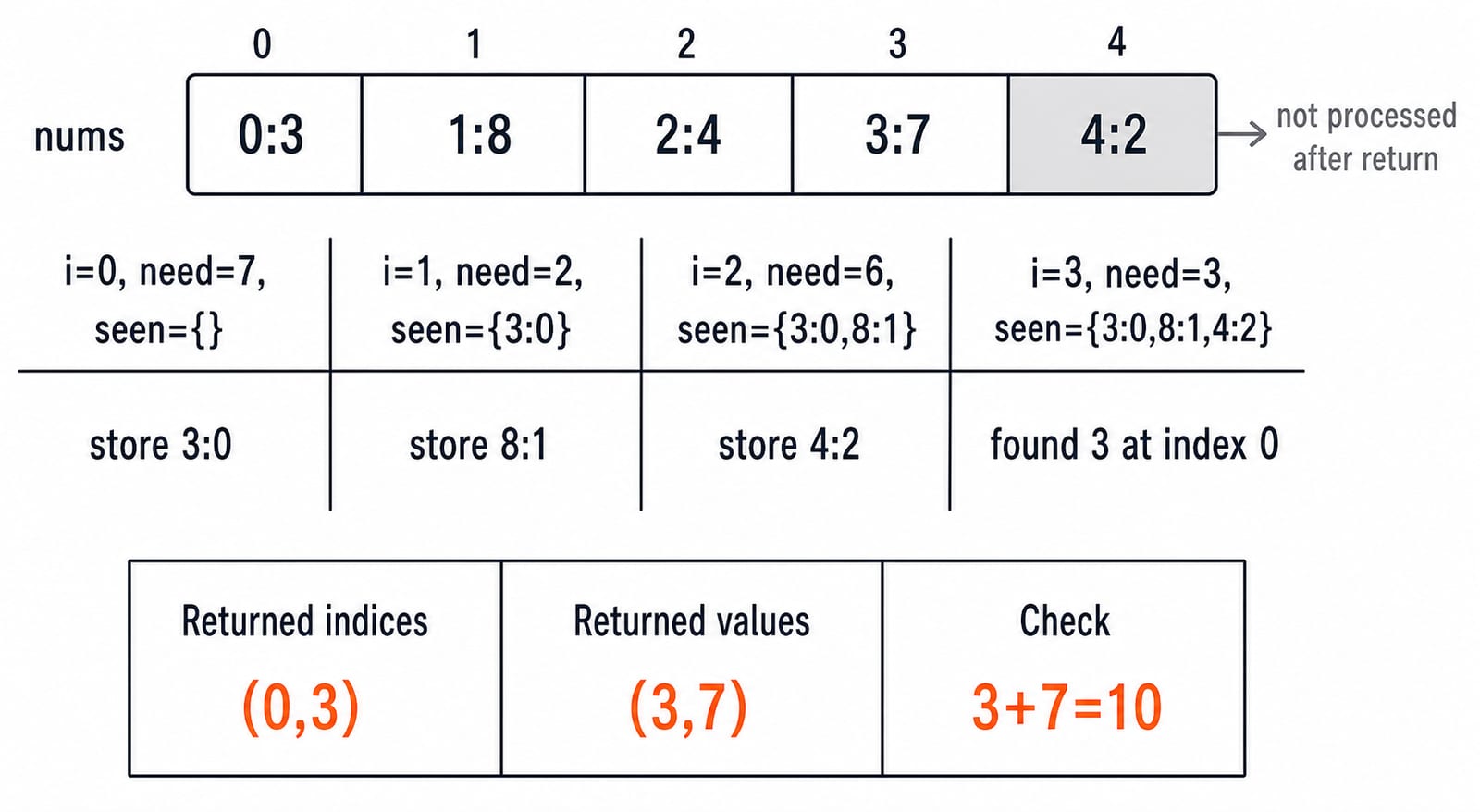
Prompt: Given [3, 8, 4, 7, 2] and target 10, return the indices of the first pair found by a left-to-right scan whose values sum to 10. Return immediately when the current value's complement has already appeared. This contract does not enumerate all pairs.
seen = {}
for each index i:
    need = target - a[i]
    if need exists in seen:
        return (seen[need], i)
    seen[a[i]] = i
The complete processed trace is:
i=0, value=3, need=7, store{3:0}.i=1, value=8, need=2, store{3:0,8:1}.i=2, value=4, need=6, store{3:0,8:1,4:2}.i=3, value=7, need=3, find index0.
Return indices (0,3) and values (3,7) because 3 + 7 = 10. Do not process index 4 after returning. Expected time is O(n) and worst-case auxiliary space is O(n). For [5,5] with target 10, lookup before insertion lets index 1 find index 0, giving (0,1). An all-pairs contract is different and would also include values 8 and 2 in the main input.
Sliding-window pattern: longest substring without repetition
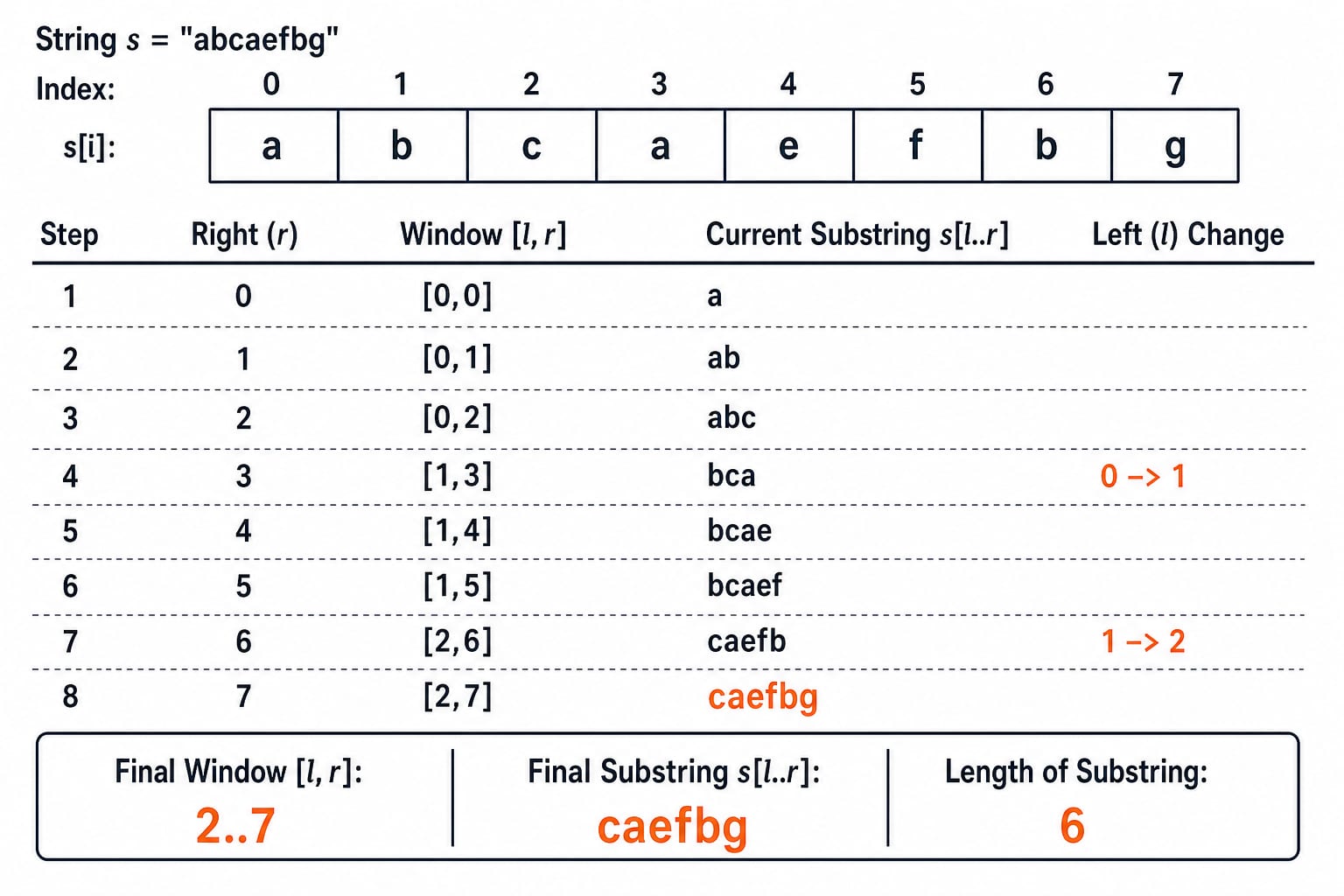
Prompt: For s = "abcaefbg", return the longest contiguous substring containing no repeated character. Ties retain the earliest best window because we update the answer only for a strictly longer window. Track left, right, a lastSeen map and the best window:
r=0 a -> [0,0] "a", best 1r=1 b -> [0,1] "ab", best 2r=2 c -> [0,2] "abc", best 3r=3 a, previous 0 -> left=1, window "bca", best 3r=4 e -> "bcae", best 4r=5 f -> "bcaef", best 5r=6 b, previous 1 -> left=2, window "caefb", best 5r=7 g -> "caefbg", best 6
The answer is substring "caefbg", indices 2..7, length 6. Update with left = max(left, lastSeen[ch] + 1), so a repeat outside the current window cannot move left backwards. Each character is processed once, giving O(n) time and O(min(n, alphabet size)) map space. An empty string returns length 0 and substring "". For "aaaa", strict updates retain the earliest "a" of length 1.
Stack pattern: validate nested brackets without losing order
Use input "{[()]}()" with mappings ')' -> '(', ']' -> '[' and '}' -> '{'. Read {, push, depth 1; read [, push, depth 2; read (, push, depth 3; read ), pop (, depth 2; read ], pop [, depth 1; read }, pop {, depth 0; read (, push, depth 1; read ), pop (, depth 0. The empty stack at the end means valid.
Now trace "([)]": push (, push [, then at index 2 the closing ) requires ( but the top is [, so return false immediately. A closing symbol also fails if the stack is already empty. A non-empty stack after the final character fails too.
The algorithm takes O(n) time and O(n) worst-case stack space. Its invariant is exact: after any processed prefix, the stack contains precisely the unmatched opening symbols in their nesting order.
Greedy pattern: schedule the maximum compatible tasks
Let tasks be half-open intervals, so a task ending at t is compatible with one starting at t: A=[1,3), B=[2,5), C=[4,6), D=[6,7), E=[5,8), F=[8,9). We need a maximum-size compatible subset. Sorting by end time gives A, B, C, D, E, F.
The full earliest-finish trace is:
Select
A; setlastEnd=3.Skip
Bbecause2 < 3.Select
Cbecause4 >= 3; setlastEnd=6.Select
Dbecause6 >= 6; setlastEnd=7.Skip
Ebecause5 < 7.Select
Fbecause8 >= 7; setlastEnd=9.
Return [A,C,D,F], count 4. Earliest finish is correct for unweighted interval scheduling: replace the first interval of any optimal solution with one that finishes no later, and the remaining room cannot shrink. Sorting takes O(n log n) time. The returned list uses O(n) output space, while selection needs O(1) extra state apart from sorting. Weighted intervals need dynamic programming, not this greedy rule.
Coding-round traps: test the invariant, not only the sample output
Pattern | Common wrong move | Counterexample | Fix |
|---|---|---|---|
hash map | insert before checking |
| check complement before insert |
sliding window | move left backwards | a repeat whose last index is before | use |
stack | compare against any opener |
| compare only with the top |
interval greedy | choose shortest duration | a short late task can block more future tasks | choose earliest finish for unweighted scheduling |
Author-designed, not an HCLTech rule: 5 minutes clarify both prompts + 15 minutes solve the first + 18 minutes solve the second + 7 minutes test and explain = 45 minutes. Coding Round Strategy: Triage, Time-Box, Bank Marks explains execution.
For oral drills, use DSA Interview Questions: 7 Patterns for Placements. Finish with normal, boundary and adversarial cases, plus spoken complexity.
HCLTech coding test context: separate official facts from practice patterns
Within the Ascend assessment route described on HCLTech's official campus-hiring page, the current page lists a coding or technical test lasting 60 to 90 minutes. It also says candidates who clear its cognitive and coding tests proceed to Versant, followed by technical and HR interviews.
That page does not turn these four practice problems into an HCLTech syllabus or promise that every role follows the same route. Read that route-specific scope narrowly. Check your current job description, recruiter mail, campus notice and test-platform instructions for permitted languages and libraries, input format, timing and sections. Those current instructions control your assessment.
HCLTech coding questions: the short version and next step
A complement or count suggests a hash map. A longest valid contiguous range suggests a sliding window. Nested matching suggests a stack. The maximum count of compatible unweighted intervals suggests earliest-finish greedy. Recognition is incomplete until you can state the invariant, trace an input, give complexity and test a failure case.
Use Coding For Placements if a guided C, C++, Java, Python and competitive-coding route helps. Otherwise, rerun these four examples from blank paper and change one input value in each.
Keep learning
HCLTech Placement Preparation: 6-Week, 84-Hour Test Plan
Build your HCLTech test preparation around 84 planned hours, measurable diagnostics, timed practice and a recovery rule that survives missed days.
Updated 26 Oct 20265 min readCompany-Specific Prep
Wipro Drive Mistakes: Stage-by-Stage Rejection Traps and Fixes
Preventable execution errors can waste solid preparation. Diagnose the risk at each Wipro drive step and replace it with a checkable habit.
25 Oct 20265 min readCompany-Specific Prep
HCLTech Recruitment Process and Test Pattern: Build Your Drive Map
Build a source-controlled HCLTech drive map from the current role page and invitation, then use worked diagnostics to prepare for each assigned stage.
Updated 23 Oct 20265 min readCompany-Specific Prep
Capgemini Coding Questions: 4 Patterns with Step-by-Step Solutions
Learn four transferable coding patterns through constructed Capgemini preparation examples. Each solution includes an invariant, complete trace, complexity and edge-case checks.
Updated 19 Oct 20266 min readCompany-Specific Prep