Mental Health and Life Skills for Teaching Exams: Complete Notes, Examples and Traps
Revise mental health, ten life skills and counselling approaches through clear contrasts, classroom examples and fast option-elimination rules.
KnowledgeGate Team
Exam prep & CS education
Updated 23 Sep 20265 min read
The terms sound familiar, but scenario questions demand exact distinctions between a life skill, temporary distress, counselling and the teacher's role. In CTET & UPTET Teaching Eligibility Test Prep, the decisive move is to match the observed evidence to one concept before judging the teacher's response.
Mental health in pedagogy: meaning, range and boundaries
The World Health Organization describes mental health as well-being that supports coping with life's stresses, realising abilities, learning, working and contributing to the community. It is more than the absence of a disorder. Ordinary short-term stress is not automatically a mental-health condition.
Term | Exam-ready meaning | Appropriate teacher stance |
|---|---|---|
Mental well-being | Functioning, learning and relating, with support where needed | Promote a safe, inclusive classroom |
Temporary distress | A reaction to a demand that may settle | Observe, listen and offer practical support |
Persistent or impairing difficulty | A pattern affecting daily functioning that needs trained attention | Follow the school's support and referral process |
These are not diagnostic thresholds. Teachers record observable changes, not labels. The teacher's boundary is: Promote, observe, support and refer; do not diagnose or provide clinical treatment.
The 10 life skills as five exam-ready pairs
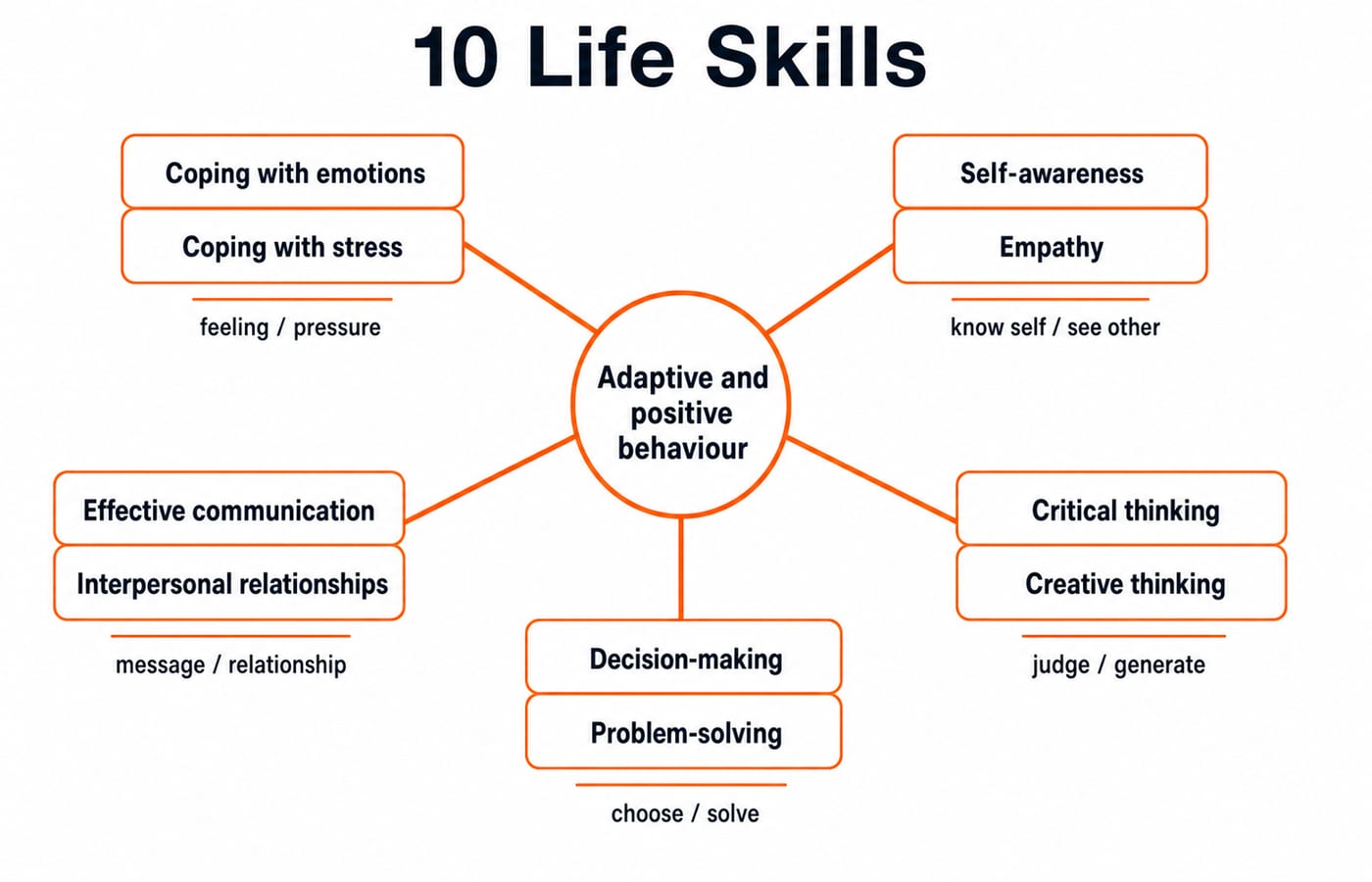
Learn the ten skills as five pairs, with one cue for each:
Pair | Classroom cues |
|---|---|
Self-awareness + empathy | Name one's own reaction; understand another person's perspective |
Critical thinking + creative thinking | Evaluate evidence; generate alternatives |
Decision-making + problem-solving | Select an option; carry out a solution |
Effective communication + interpersonal relationship skills | Express a message clearly; sustain a respectful relationship |
Coping with emotions + coping with stress | Regulate a strong feeling; manage pressure and the response over time |
Creative thinking generates, while critical thinking evaluates. Decision-making chooses, while problem-solving works through. Communication concerns the message, while interpersonal skill concerns the relationship. Coping with emotions starts with the feeling, while coping with stress addresses pressure over time. Link these contrasts to other CTET CDP: High-Yield Concepts & Theorists.
Worked classroom example: 75 minutes of work, 60 minutes available
A Class VIII learner has 60 minutes. Task A is a 30-minute worksheet due today, B is 20 minutes of revision due tomorrow, and C is a 25-minute model plan due in two days. Total time is 30 + 20 + 25 = 75 minutes. The gap is 75 - 60 = 15 minutes. The learner reports a non-diagnostic stress self-rating of 7/10.
Work through the response in sequence:
Self-awareness: Say "I feel overloaded" and record the 7/10 self-rating.
Critical thinking: Compare 75 needed with 60 available, a 15-minute gap.
Decision-making: Choose A + B because 30 + 20 = 50 minutes.
Problem-solving: The remaining time is 60 - 50 = 10 minutes. Outline C now, leaving 25 - 10 = 15 minutes for tomorrow.
Effective communication: Ask the teacher one specific question about C.
Coping with stress: Take five slow breaths before starting, then re-rate. This fictional learner reports 5/10, not a clinical result or guaranteed change.
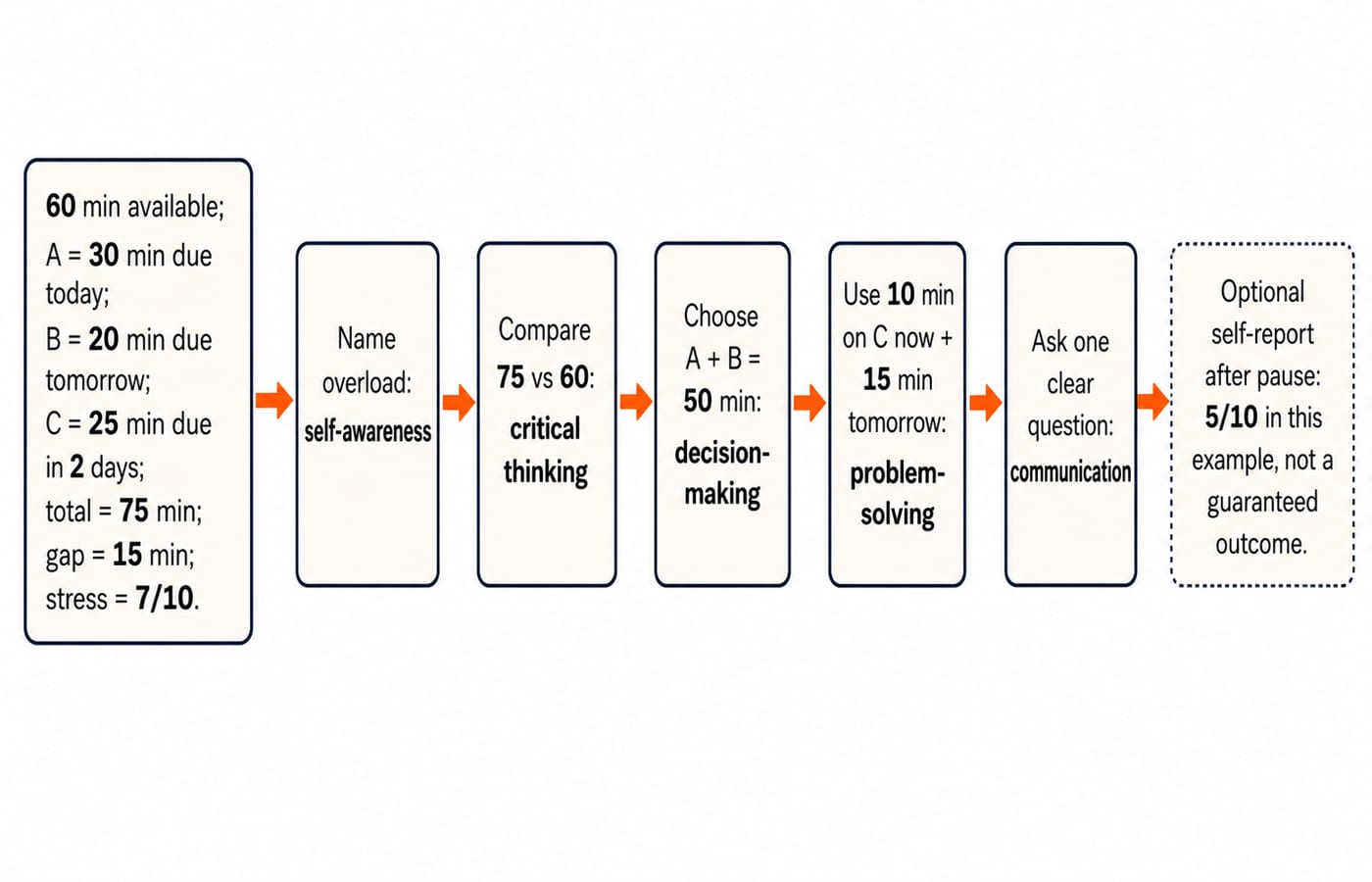
The sequence is the answer: recognise emotion, check facts, choose priorities, plan and communicate. "Ignore the feeling and work faster" misses self-awareness and coping.
Stress, anxiety and depression: observe patterns without labelling
Stress responds to demands or pressure. Anxiety can involve apprehension, worry and physical arousal. Depression is not ordinary sadness. Persistent or impairing difficulties require professional assessment, while a teacher provides support without diagnosis.
Use this five-step response ladder:
Observe a change.
Speak privately.
Listen without judgement.
Connect the learner to the school's designated counsellor or support process.
If there is immediate risk, follow the school's urgent safeguarding or emergency procedure.
Open with: "I noticed you missed three group activities this week. Would you like to tell me what is making them difficult?" Avoid public confrontation, instant diagnosis and promises to keep every disclosure secret. Privacy matters, but safeguarding duties and school policy govern escalation.
Guidance, counselling and a school mental-health programme
Guidance is broad help with educational, vocational or personal choices. Counselling is a structured helping relationship. In a life-skills question, both act as boundary concepts: guidance informs a choice, counselling explores a concern, and neither turns a classroom teacher into a clinician. The counselling cues are:
Directive: The counsellor leads and suggests a course.
Non-directive: The learner explores and chooses while the counsellor facilitates.
Eclectic: The approach blends methods to fit the need.
Three cases fix the distinction. A counsellor gives a six-step study schedule: directive. The counsellor reflects concerns and the learner chooses one of three options: non-directive. The counsellor listens, then jointly builds a two-week plan: eclectic.
A school programme layers whole-class promotion and stigma reduction, early observation, supportive conversation, trained counselling, caregiver coordination where appropriate, and referral. A two-minute mindfulness pause or classroom yoga may support well-being, but cannot replace professional care.
How teaching exams turn these concepts into questions
Questions commonly ask you to identify a life skill, separate close skills, match a counselling approach, or select a teacher response. Check the conducting body's current official syllabus or notification for inclusion and pattern. Use CTET EVS Pedagogy: 6 Themes and How It Is Tested as comparative practice, not evidence of an official pattern.
Mini-question: A learner has missed 3 of 5 group tasks and now avoids classmates. What should the class teacher do first?
A. Announce the issue to the class.
B. Diagnose depression.
C. Speak privately, record observations and follow the school's support route.
D. Remove all academic work indefinitely.
Answer: C. It uses observations and stays within the teacher's role. A breaches privacy, B exceeds competence, and D is an unsupported blanket response.
Traps and fast elimination rules
Trap | Why it fails | Better discriminator |
|---|---|---|
Mental health means no mental illness | Ignores well-being and functioning | Consider coping, learning and relating |
Creative equals critical thinking | Confuses producing ideas with judging them | Generate versus evaluate |
Decision equals problem-solving | Confuses choosing with implementation | Choose versus work through |
Teacher should diagnose | Exceeds the role | Observe, support and refer |
Non-directive means no help | Mistakes facilitation for absence | Facilitate without imposing |
Mindfulness cures a disorder | Replaces care with a quick remedy | Use only as supplementary practice |
For fast elimination, ask: Does the option stigmatise, diagnose, expose the learner, remove agency without a safety reason, or replace referral with a quick remedy? If yes, reject it. Choose the least intrusive supportive action consistent with school policy.
Short version and the next 15 minutes
Keep this revision box in mind:
Mental health: well-being that supports coping, abilities, learning, work and contribution.
Life skills: know self and see others; judge and generate; choose and solve; communicate and relate; manage feelings and pressure.
Teacher role: promote, observe, support and refer.
Counselling cues: leads, facilitates, blends.
Central trap: support is not diagnosis.
Spend 7 minutes rebuilding the five pairs from memory, 5 minutes replaying the 75-versus-60 case, and 3 minutes answering the mini-question and naming why each distractor fails.
Next, use CTET Paper 1 Course 2026 or CTET Paper 2 Course 2026. Both KnowledgeGate course pages include Child Development & Pedagogy. Then apply the same sequence: identify, distinguish, support and refer.
Keep learning
सामान्य अशुद्धियाँ (Samanya Ashuddhiyaan): Complete Hindi Grammar Notes for CTET and TET Exams
Learn to identify and correct Hindi word-form, agreement, pronoun and redundancy errors through exact examples, a worked MCQ and a scored diagnostic.
Updated 6 Oct 20266 min readCTET & UPTET
Universities and Learning Programmes for Teaching Exams: Types, Modes and Solved Examples
Separate university status, delivery mode and programme purpose with a repeatable method, then test it on five UGC NET-style classification cases.
Updated 2 Oct 20265 min readCTET & UPTET
National Education Policy (NEP) 2020 Notes for Teaching Exams: 5+3+3+4, Reforms and MCQ Traps
Build an exam-ready map of NEP 2020, from the age-stage structure to pedagogy, language, PARAKH, B.Ed. routes and reliable distractor elimination.
Updated 26 Sep 20265 min readCTET & UPTET
Miscellaneous Pedagogy Topics for Teaching Exams: Complete Notes and Worked Examples
Turn a loose syllabus label into a five-part concept map, then use classroom evidence to distinguish sound pedagogy from attractive but incomplete options.
Updated 25 Sep 20266 min readCTET & UPTET