

Teaching Methods and Strategies for Teaching Exams: Core Concepts and a Worked Lesson
Separate approach, method, strategy and technique, then use objective and evidence to choose well. A constructed lesson shows the complete decision cycle.
KnowledgeGate Team
Exam prep & CS education
Updated 30 Oct 20266 min read
Method names are easy to memorise, but a classroom vignette asks why a teacher chose a demonstration, discussion, project, discovery task or blended sequence. Approach, method, strategy and technique differ in scope and function; a 40-minute lesson can combine them with an elimination rule for exam options. No method is universally best; the best choice matches the learning objective, the learners, the content and the evidence required. The earlier Methods of Teaching notes own the method catalogue and close-option definitions. Strategy begins after method choice: sequence methods around evidence, then decide the next move.
Teaching methods and strategies: separate four levels before memorising names
An approach is a view of learning, such as learner-centred or constructivist teaching. A method is an organised route: demonstration, discussion, project or problem-solving. A strategy sequences methods, groups, resources and checks. A technique is a local move: wait time, probing questions, think-pair-share or an exit ticket. Since labels overlap, classify by scope and function.
A constructivist approach can support an inquiry method using predict -> investigate -> explain -> individual check. Techniques include 30 seconds of silent prediction, pairs comparing reasons and a four-item exit ticket. One changed technique need not change the method.
Teacher-centred is not automatically poor, and learner-centred does not remove the teacher. A six-minute safety demonstration may beat an unstructured 30-minute activity with no evidence. The Govt Teaching Eligibility Tests category organises the relevant CTET and UPTET preparation paths.
Major teaching methods: match each one to the job it does best
Method | Strongest use | Teacher action | Learner evidence | Main misuse |
|---|---|---|---|---|
Lecture/exposition | Concept map | Organise | Summary | Assumed mastery |
Demonstration | Visible process | Model | Reproduction | Watching |
Discussion/questioning | Reasons, misconceptions | Probe | Defence | Aimless talk |
Cooperative learning | Interdependence | Assign roles | Individual evidence | Seating |
Project | Sustained product | Set milestones | Justification | Decoration |
Problem-solving | Defined goal | Scaffold | Tested route | Teacher solves |
Discovery/inquiry | Hidden relationship | Give cases | Inferred rule | Guessing |
Experiential/activity-based | Structured experience | Debrief | Reflection, transfer | Movement |
Micro-examples: demonstrate iron filings and sand with a paper-sleeved bar magnet; discuss whether 3/4 or 2/3 is greater; give six groups of six facilitator, recorder, materials handler, checker, reporter and timekeeper roles; or audit one week's paper waste, total daily values and propose reductions. Group seating alone is not cooperative learning, and hands-on work alone is not experiential learning.
Use the table as a boundary map, not a ranking. Identify the intended learner performance first, then choose the method that makes that performance possible and observable.
Inductive, deductive, analytic and problem-solving routes
Induction starts with 2 + 6 = 8, 4 + 10 = 14 and 8 + 12 = 20. Learners infer that two even numbers sum to an even number; 2m + 2n = 2(m + n) secures it. Deduction applies the rule: 38 + 74 is even. Induction goes from cases to rule, deduction from rule to case.
An analytic route works backwards from the required result to known facts. For 3x + 5 = 20, ask what becomes 20 after adding 5 (15), then what becomes 15 after multiplication by 3 (5). A forward check gives 3 x 5 + 5 = 20.
Discovery infers a hidden relationship. Problem-solving seeks a route past a barrier, such as recovering salt from salt water. Watching a demonstration alone is neither.
Ask: What must the learner do? What evidence shows it? What prior knowledge or safety constraint matters? Which move gives enough support without doing the thinking? A blend may beat "always use discovery".
Teaching strategy selection: objective, learner, content, context and evidence
Factor | Decision |
|---|---|
Objective | Recall, explanation, performance, judgement or creation? |
Learner | Prior knowledge, language, pace, confidence, support? |
Content | Abstraction, procedure, risk, examples? |
Context | Class size, time, materials, space? |
Evidence | Response, product, explanation or transfer? |
A lecture can introduce six methods, but cannot prove choice for a new mixture. Replace "understand separation" with: "Given four mixtures, the learner will select the suitable separation method and justify the choice using magnetism, particle size, immiscibility or volatility." Match iron filings plus sand to magnetic separation, sand plus water to filtration, oil plus water to decantation or a separating funnel, and salt plus water to evaporation for salt recovery.
Keep the goal while offering bilingual property cards, labelled diagrams before equipment and safe roles. Everyone takes the same four-item check.
Worked teaching strategy: a 40-minute lesson on separating mixtures
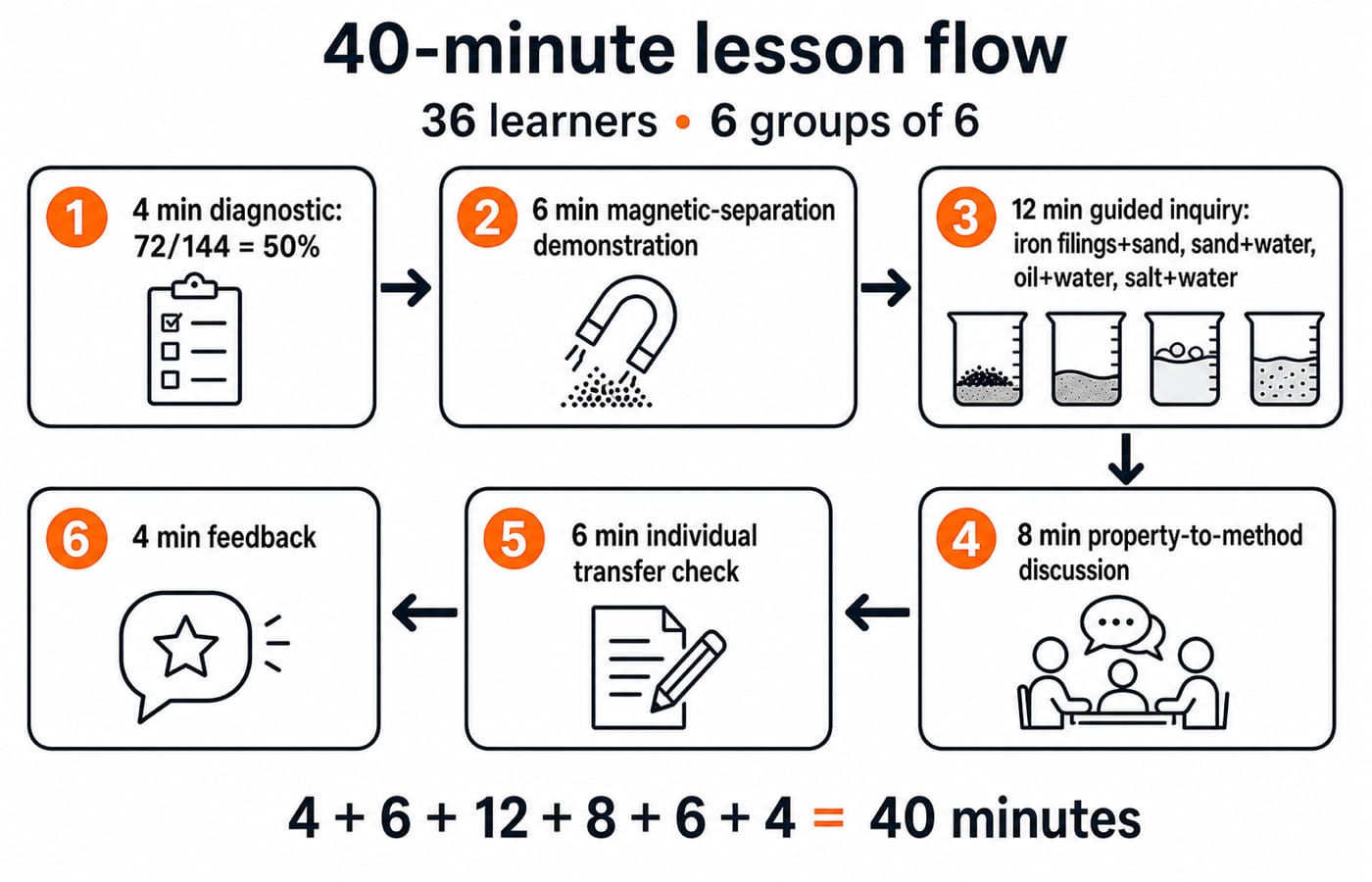
The lesson has 36 learners in 6 groups x 6 learners and uses the stated objective. Its diagnostic covers iron filings plus sand, sand plus water, oil plus water and salt plus water.
Scores are 2 learners score 0, 8 score 1, 16 score 2, 8 score 3 and 2 score 4. Thus (2 x 0) + (8 x 1) + (16 x 2) + (8 x 3) + (2 x 4) = 72; 36 x 4 = 144; and 72/144 = 50%.
Use 4 minutes for diagnosis, 6 minutes for demonstration, 12 minutes for guided inquiry, 8 minutes for discussion, 6 minutes for an individual check and 4 minutes for feedback and grouping. The demonstration uses a paper-covered magnet; evaporation uses safe before-and-after samples, not live heating. Total: 4 + 6 + 12 + 8 + 6 + 4 = 40 minutes.
Demonstration shows procedure, inquiry links property to method, discussion demands reasons, synthesis names the rule, and individual checking exposes gaps. Transfer pairs are paper clips plus sawdust with magnetic separation, chalk powder plus water with filtration, kerosene plus water with decantation or a separating funnel, and salt solution with evaporation to recover salt.
Assessment changes the strategy: read evidence, then reteach or extend
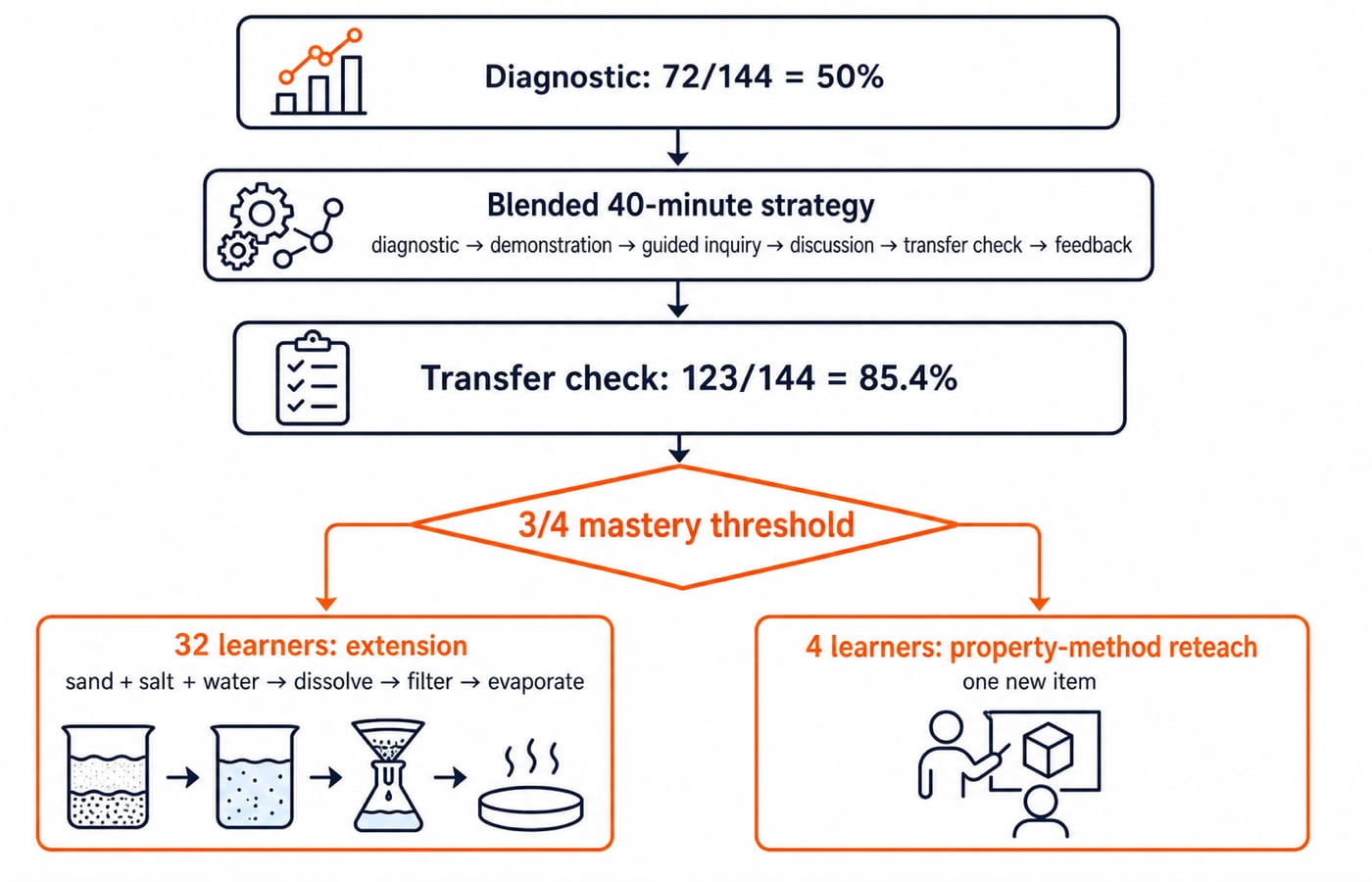
The transfer check has 1 learner scores 1, 3 score 2, 12 score 3 and 20 score 4, with no zero. Thus (1 x 1) + (3 x 2) + (12 x 3) + (20 x 4) = 123; 123/144 x 100 = 85.4%. Use the 85.4% result to choose the next teaching move; no universal threshold follows from it.
At 3 out of 4, 12 + 20 = 32 learners succeed and 1 + 3 = 4 need reteaching. The 32 add water to dissolve salt, filter out sand, then evaporate the filtrate. The 4 rebuild the missed property-method match with actual objects and a two-choice prompt, then retry a new item.
Diagnostic evidence selects the method, formative questions and observation adjust support, and the exit ticket shapes the next lesson. CTET EVS Pedagogy: Concepts & Pattern connects activity and observation with reflection and assessment.
How teaching exams test methods and the traps that lose marks
Questions may ask for the method in a sequence, induction versus deduction, the best method for an objective, a missing cooperative or project feature, or the next action from evidence. Confirm the current syllabus and pattern on the examining body's official site.
Solved vignette: "A Class VI teacher wants learners to select a separation method and justify the property used, not merely repeat four definitions. Which plan best matches the objective?"
(A)dictate the definitions and assign copying(B)demonstrate all four methods while learners watch(C)let groups investigate four mixtures, require a property-based explanation, then give each learner a new transfer item(D)allow an open discussion with no common question or individual check
Answer: C. A stops at recall, B makes processes visible but supplies no learner decision, and D lacks a defined objective and evidence.
Trap | Correction |
|---|---|
Learner-centred means teacher absent | Use purposeful guidance |
Lecture is always inferior | Judge objective and constraint |
Any activity is experiential learning | Require reflection and evidence |
Any group task is cooperative | Require interdependence plus individual accountability |
Discovery means no scaffolding | Prompt without supplying the inference |
One method must fill the whole lesson | Sequence complementary methods |
High class participation proves every learner learned | Collect individual evidence |
Teaching methods and strategies: the short version and next step
Revise this chain: define the objective, diagnose, choose the method, sequence techniques, collect individual evidence, then reteach or extend. Here, 36 learners give 144 responses; results move from 72/144 = 50% to 123/144 = 85.4%; 32 meet 3/4 and 4 receive support.
The best method is not the most fashionable one but the one that makes the intended learning possible, safe and visible.
Primary-level readers can use the CTET Paper 1 Course 2026. For NET teaching and research aptitude, use the NTA UGC NET Paper 1 Course.
Go deeper with the full courseCTET Paper 1 2026 — प्राथमिक शिक्षक (कक्षा 1–5)
Keep learning

Methods of Teaching for Teaching Exams: Complete Notes, Worked Lesson, and Exam Traps
Learn how lecture, demonstration, inquiry, project, flipped, blended, and cooperative methods differ. Then apply them in a worked lesson and exam elimination routine.
Updated 30 Oct 20266 min readCTET & UPTET
Psychology for Teaching Exams: Core Concepts with Worked Examples
Learn how to identify psychological mechanisms in classroom vignettes, eliminate common traps and revise core concepts through worked examples.
Updated 22 Sep 20266 min readCTET & UPTET

Air Pollution Notes for Teaching Exams: Pollutants, Smog, Control Methods and Worked Examples
Build air-pollution answers through the complete source-to-effect chain. Revise key distinctions, solve a data question, and evaluate a safe classroom activity.
Updated 30 Oct 20265 min readCTET & UPTET

MPPSC Teaching CS PYQs: Diagnose Concept Gaps, Slow Methods and Distractor Traps
Turn a PYQ score into precise next actions. Build a three-column review board, repair each failure differently and prove the repair on fresh questions.
Updated 30 Oct 20267 min readMPPSC Teaching