PSU Through GATE CS Syllabus: From Exam Core to Interview Readiness
Build a GATE CS core that supports both exam problem solving and later technical conversations. Use the worked crossover and 168-hour plan to track both kinds of readiness.
KnowledgeGate Team
Exam prep & CS education
Updated 29 Jul 20265 min read
You may be preparing for PSU recruitment through GATE CS but wondering whether to study only for the score or also for a later technical conversation. The ten official GATE CS sections regroup into three preparation layers, one worked scheduling problem shows what an explainable answer sounds like, and a 12-week, 168-hour allocation keeps every layer in the core. GATE publishes one official CS syllabus; there is no matching universal second syllabus that every PSU shares.
Related reading: ISRO and GATE syllabus overlap and GATE algorithm syllabus.
PSU Through GATE CS has an official exam core and a PSU-specific overlay
IIT Guwahati's completed GATE 2026 CS syllabus defined the exam core for that cycle. The recruiting PSU's applicable advertisement, shortlist notice and call letter define the accepted paper, selection stages and any later assessment.
For example, POWERGRID's completed Engineer Trainee 2025 Computer Science shortlist notice used GATE 2025 CS for shortlisting, followed by document verification, group discussion, psychometric assessment and personal interview. That historical case proves variation, not a permanent PSU template. Always read the documents for the recruitment you are pursuing. Use GATE CS Exam Preparation as the wider study route.
Regroup the ten GATE CS syllabus sections into three preparation layers
IIT Guwahati's 2026 syllabus named ten sections: Engineering Mathematics; Digital Logic; Computer Organization and Architecture; Programming and Data Structures; Algorithms; Theory of Computation; Compiler Design; Operating System; Databases; and Computer Networks. These three layers are KnowledgeGate's study organisation, not an IIT or PSU classification.
Preparation layer | Official GATE 2026 sections | Proof of readiness |
|---|---|---|
A, systems and problem solving | Programming and Data Structures, Algorithms, Operating System, Databases, Computer Networks, Computer Organization and Architecture | Compute the answer, then defend the design choice under one follow-up: why this structure, this policy, this index. |
B, formal and hardware precision | Digital Logic, Theory of Computation, Compiler Design | Derive the machine, grammar or circuit, then name the exact property the derivation rests on. |
C, quantitative foundation | Engineering Mathematics | Reach the number, then state the assumption or distribution that keeps it valid. |
Build Layer A from numerical answers into explainable decisions
Each Layer A section has a numerical half and an explanation half:
Programming and Data Structures: trace the code, then justify why that structure and not the obvious alternative.
Algorithms: compare the costs, then say which input pattern makes the cheaper choice lose.
Operating System: compute the schedule or the page-fault count, then explain the state transitions behind the number.
Databases: derive the keys and the normal form, then discuss what it costs a transaction or an index.
Computer Networks: calculate the subnet or the TCP value, then explain the protocol behaviour that produced it.
Computer Organization and Architecture: calculate cache or pipeline performance, then name the design trade-off the number is buying.
Use two passes. Pass 1 solves on paper with units, states and intermediate values. Pass 2 gives a 60 to 90 second explanation covering premise, method, answer and trade-off. A correct option is exam progress, but not recruitment readiness without a defensible explanation. Once a call letter fixes a date, the PSU Through GATE CS Interview: 14-Day Revision Map turns this same pass into a two-week rehearsal schedule; it is a rehearsal structure, not a universal PSU question list.
Worked crossover: solve CPU scheduling, then defend the policy
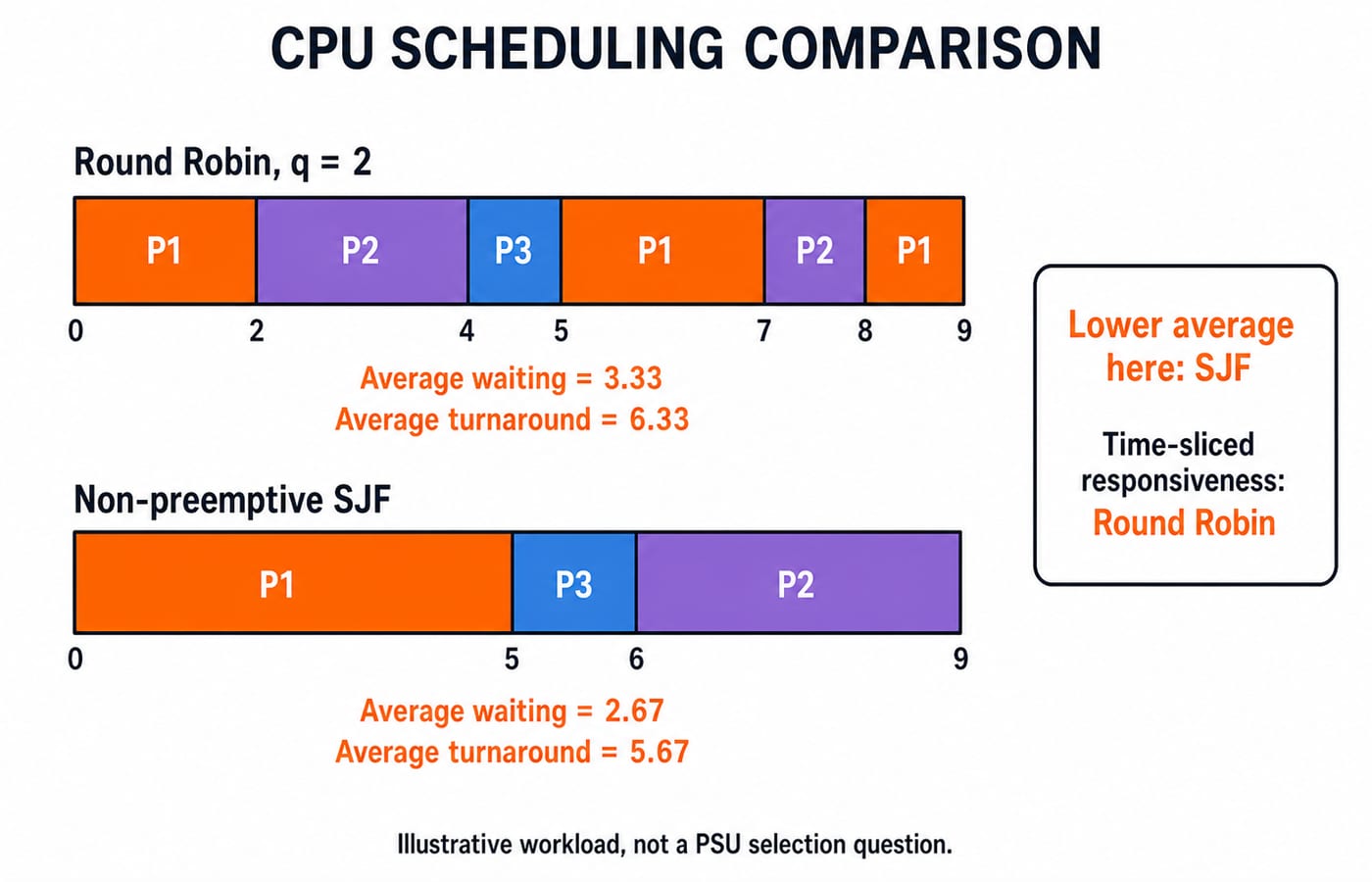
Take P1(arrival 0, burst 5), P2(arrival 1, burst 3) and P3(arrival 2, burst 1). With Round Robin quantum 2, the order is P1 0-2, P2 2-4, P3 4-5, P1 5-7, P2 7-8, P1 8-9. Completion times are 9, 8, 5. Turnaround times are 9-0=9, 8-1=7, 5-2=3. Waiting times are 9-5=4, 7-3=4, 3-1=2. Average turnaround is 19/3=6.33; average waiting is 10/3=3.33.
Under non-preemptive SJF, the order is P1 0-5, P3 5-6, P2 6-9. Completion times are 5, 9, 6; turnaround times are 5, 8, 4; waiting times are 0, 5, 3. The averages are 17/3=5.67 and 8/3=2.67. SJF lowers both averages here, while Round Robin offers time-sliced responsiveness without requiring an exact next-burst estimate. SJF can risk long-job starvation. Neither is universally best because the workload and objective decide.
Keep formal subjects and Engineering Mathematics in the core
Do not discard Digital Logic, Theory of Computation or Compiler Design because you expect a systems-heavy interview. They remain sections of the completed GATE 2026 CS syllabus and train precise reasoning about states, languages and transformations. That does not imply a PSU-specific question frequency.
Digital Logic makes the point in one line. Take F(A,B,C)=Σm(1,3,5,7). The minterms are 001, 011, 101 and 111. Every minterm has C=1 while A and B vary. One four-cell K-map group therefore cancels A and B, giving F=C. No listed minterm has C=0. Learners needing structured quantitative work can use Engineering Mathematics for GATE, Complete Course.
Use a 12-week, 168-hour plan instead of equal time for every section
Illustrative plan: 12 weeks x 14 hours = 168 hours.
Phase | Allocation | Check |
|---|---|---|
Weeks 1-4 | Programming and Data Structures plus Algorithms 18; Operating System 12; Databases 12; Computer Networks 8; retrieval and error review 6 | 18+12+12+8+6=56 hours |
Weeks 5-8 | Computer Organization and Architecture 12; Digital Logic 8; Theory of Computation 10; Compiler Design 8; Engineering Mathematics 12; review 6 | 12+8+10+8+12+6=56 hours |
Weeks 9-12 | Engineering Mathematics 8; General Aptitude 12; mixed GATE practice 20; oral technical explanations 8; error rework 8 | 8+12+20+8+8=56 hours |
Checks: each phase totals 56 hours; 56+56+56=168. This is illustrative planning, not official marks or predicted weightage. Shift towards weakness but retain all sections. Recover a missed 2-hour session from review or error rework within seven days, not by doubling tomorrow's load.
These 168 hours buy syllabus depth, nothing else: every block above sits in the score lane. Splitting a longer runway between score work and interview work is a different allocation problem, and the PSU Through GATE Preparation: 24-Week 432-Hour Plan sets that split; treat this 12-week core as what fills its score lane.
Track exam readiness and explanation readiness separately
Keep two weekly scorecards. Exam card: a 40-question mixed drill gives 31 correct, 5 wrong and 4 unattempted. Attempted accuracy is 31/36 x 100=86.1%; coverage is 36/40 x 100=90%. Without question types and marks, do not calculate a mock GATE mark. Log the five errors as 2 concept, 2 calculation and 1 misread.
Explanation card: 8 oral prompts, 6 clear within 90 seconds and 2 weak. Name the weak prompts as why an index may speed reads but slow writes, and TCP flow control versus congestion control. Schedule one repair example for each. Never combine the cards into an invented recruitment score. Use GATE CS Subject Weightage: Where Hours Pay Off to place the next block after confirming your cycle's official syllabus.
The short version: prepare for the score, then prepare to explain it
Map every section in the completed official syllabus. Solve with visible working. Explain the assumption and trade-off aloud. Read the current recruiting PSU's own notice before preparing for a later stage. A historical PSU example gives context, never a promise. For structured broad coverage, continue with GATE Guidance by Sanchit Sir.
Keep learning
DRDO Scientist B CS Exam Pattern and Marking Scheme: GATE and Interview Explained
Separate GATE paper marks from recruitment merit and interview qualification. Worked examples explain penalties, weighted arithmetic and a practical CS preparation split.
30 Sep 20264 min readPSU Through GATE
PSU Through GATE Choices: Compare Roles, Locations and Career Paths
Compare PSU opportunities through GATE using official evidence, a weighted decision matrix and a practical view of role fit, location and portable skills.
Updated 15 Aug 20265 min read69 viewsPSU Through GATE

PSU Through GATE Interview Preparation: Projects, Core Subjects and Role Fit
Prepare for a possible PSU interview with a notice-first framework, a defensible project story, worked CS drills and an honest role-fit audit.
Updated 13 Aug 20265 min readPSU Through GATE
PSU Through GATE Documents and Medical Checks: An Early-Readiness Checklist
Prepare a clean evidence trail before a PSU call letter arrives. Audit a 17-item file, resolve a name mismatch through the official route, and read medical instructions without guessing.
Updated 11 Aug 20265 min readPSU Through GATE