PSU Through GATE Documents and Medical Checks: An Early-Readiness Checklist
Prepare a clean evidence trail before a PSU call letter arrives. Audit a 17-item file, resolve a name mismatch through the official route, and read medical instructions without guessing.
KnowledgeGate Team
Exam prep & CS education
Updated 11 Aug 20265 min read
A shortlisted candidate may be ready with a GATE score but unable to reconcile the name on the application, degree record and identity proof. Document verification and medical assessment are separate gates, and there is no universal PSU checklist for either. The safest approach is to maintain one source-of-truth record, audit the file early and treat the recruiting PSU's official instructions as controlling.
Start with the notice, because there is no universal PSU checklist
Use five buckets: identity and personal data; academic eligibility; GATE and application trail; category, disability, employment or experience claims; and separate medical instructions.
Bucket | Prepare early | Verify from official instructions |
|---|---|---|
Identity and personal data | Photo identity record, plus every document that carries your name and date of birth | Which identity documents are accepted, and how a name or date-of-birth mismatch must be reported |
Academic | Semester marksheets and degree records | Accepted qualification, branch, result status and calculation method |
GATE and application trail | Scorecard, registration number and a printout of the submitted application | Accepted paper code, qualifying year and how long the score stays valid |
Category claim | The certificate currently held | Prescribed format, issuing authority and reference date |
Medical | Truthful history and existing reports | Tests, standards, venue and authorised board |
The recruiting PSU's notice or call letter alone makes a document mandatory. KnowledgeGate's PSU Exam Preparation category collects the PSU course line-up and GATE CS Preparation covers the paper itself. Neither sets a recruiter's verification or fitness policy.
Build one source-of-truth record before copying data into forms
Take one worked example. Before touching any form, Candidate K writes the record down once:
Field | Recorded value |
|---|---|
Names | Application: Kavya Rao; identity proof: Kavya R.; degree: Kavya Rao |
Personal and academic | DOB 14-08-2002; B.Tech Computer Science and Engineering; CGPA 8.12/10; completed 15-06-2025 |
GATE details | CS, 2025, CS25X0000001, marks 56.67, score 612, AIR 1,842 |
Category claim | OBC-NCL |
The DOB, programme, CGPA, completion date and all GATE fields match. Only Kavya R. against Kavya Rao does not.
Status | Source documents checked | Official clarification route | Supporting record if instructed | Owner | Deadline |
|---|---|---|---|---|---|
Open: name discrepancy | Identity proof, application and degree | Contact named in official instructions | Only the record the PSU asks for | Candidate K | Before document verification |
Never edit scans, expand initials without evidence or add new spellings. Only the PSU defines the accepted correction route.
Make the academic and GATE trail reproduce the submitted claim
Candidate K's worked base pack has 14 items:
8 semester marksheets + 1 provisional degree + 1 final degree + 1 GATE scorecard + 1 submitted application printout + 1 call letter + 1 photo identity record = 14.
Cross-check: 8 semester records and 6 single records give 8 + 6 = 14. Semester records support the CGPA, degree records support qualification and completion, and the scorecard with the submitted form shows the GATE paper, year and score used.
If the final degree has not been issued, do not assume a provisional degree will be accepted. If the institution reports only CGPA, do not invent a percentage conversion. Use institutional evidence if the official instructions require it. Apply the same restraint to branch equivalence, pending results, backlogs and score validity.
Use searchable working names: 01_ID, 02_GateScorecard_2025, 03_Sem1 through 10_Sem8, 11_ProvisionalDegree, 12_FinalDegree, 13_Application and 14_CallLetter. Preserve the original files separately.
Match every category or service claim to the exact instruction
For SC/ST, OBC-NCL, EWS, PwBD, ex-servicemen, a current-employer NOC or experience evidence, ask four questions:
Which claim did I make?
Which document supports it?
Does the notice prescribe a format or issuing authority?
Which reference date does it use?
Work the dates through. Suppose a notice requires an OBC-NCL certificate issued on or after 01-04-2025 and sets 30-06-2025 as the reference date. Candidate K holds two, dated 12-03-2024 and 18-04-2025. The first falls before the issue boundary, so it fails on the first condition. The second falls after 01-04-2025 and before 30-06-2025, so it satisfies both. Your own notice will print different dates; the two-condition test is the same.
Compare dates with the actual notice, not shortcuts such as one year or financial year. A pending renewal, affidavit, receipt or acknowledgement is no substitute unless official instructions allow it.
Rehearse document verification as a 17-item evidence audit
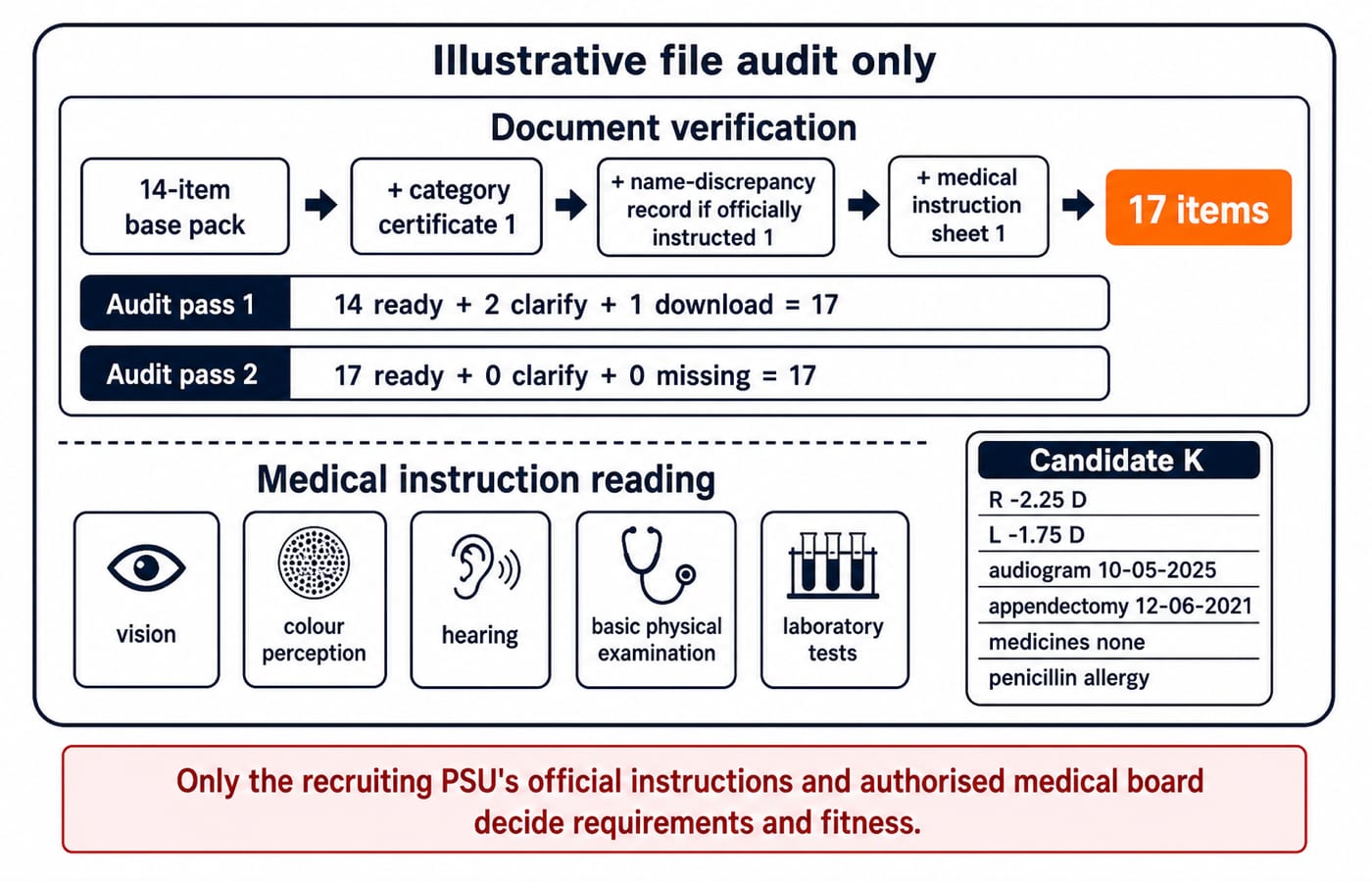
Add 1 category certificate + 1 name-discrepancy record if officially instructed + 1 medical instruction sheet to the base pack. Thus 14 + 1 + 1 + 1 = 17; grouped, 14 + 3 = 17.
Use these audit columns: item, claim supported, name/DOB match, original available, copy or upload available, official format/date checked, status, next action, owner, deadline.
Pass one is 14 ready + 2 need official clarification + 1 needs a fresh official download = 17. Clarify the abbreviated identity name and category-certificate condition; download the medical instruction sheet. Pass two can then read 17 ready + 0 clarification + 0 missing = 17.
A clean second pass means the file matches the checklist you copied out of the notice, not that the PSU has accepted it. Separate originals, copies and uploads. Official instructions control copy counts, self-attestation, file size and format.
Treat the medical stage as a post-specific assessment
The notice, call letter and designated medical authority determine tests, standards, venue, timing and the final fitness decision. Maintain an accurate medication list, spectacle or contact-lens details, past procedure records and existing specialist reports if instructed. Do not self-diagnose, hide a condition, stop prescribed medicine or try last-minute tricks.
Read the instruction sheet the same way. A sample sheet lists five areas: vision, colour perception, hearing, basic physical examination and laboratory tests. Against those, Candidate K's disclosure note records spectacles right -2.25 D and left -1.75 D, an audiogram dated 10-05-2025, an appendectomy dated 12-06-2021, current medicines none, and a penicillin allergy.
None proves fit or unfit. Copy the five official checks, carry only records requested or relevant to truthful disclosure, ask the named official contact about ambiguity, and attend the authorised assessment. Standards may differ by post and operational demands. Never generalise a limit from one PSU, discipline or completed recruitment to another.
The short version: use a 30-7-1 readiness calendar
At D-30, build the 17-row audit and open every clarification. At D-7, download the official call and medical instructions again, check all 17 rows, arrange the records and plan travel. At D-1, verify identity, call letter, venue, reporting time and the packed records, changing nothing you cannot evidence. D is the reporting date printed in your official communication.
Prepare records early, let the notice define the checklist, resolve mismatches through the official route and let the authorised board decide fitness. For the study side of the same call, the PSU Through GATE preparation plan sets the score and interview split, GATE Guidance by Sanchit Sir carries the taught syllabus, and the GATE Test Series supplies the timed practice.
Keep learning
DRDO Scientist B CS Exam Pattern and Marking Scheme: GATE and Interview Explained
Separate GATE paper marks from recruitment merit and interview qualification. Worked examples explain penalties, weighted arithmetic and a practical CS preparation split.
30 Sep 20264 min readPSU Through GATE
PSU Through GATE Choices: Compare Roles, Locations and Career Paths
Compare PSU opportunities through GATE using official evidence, a weighted decision matrix and a practical view of role fit, location and portable skills.
Updated 15 Aug 20265 min read69 viewsPSU Through GATE

PSU Through GATE Interview Preparation: Projects, Core Subjects and Role Fit
Prepare for a possible PSU interview with a notice-first framework, a defensible project story, worked CS drills and an honest role-fit audit.
Updated 13 Aug 20265 min readPSU Through GATE
PSU Through GATE Application Tracker: A Multi-Company System
Build one auditable sheet for multiple PSU applications through GATE. Track exact eligibility wording, deadlines, documents, status and proof without mixing company rules.
Updated 8 Aug 20265 min readPSU Through GATE