PSU Through GATE Preparation: Balance Your GATE Score Plan and Interview Readiness
Build one realistic PSU preparation cycle in which GATE work stays dominant while speaking practice, project proof, and document readiness continue every week.
KnowledgeGate Team
Exam prep & CS education
Updated 24 Jul 20266 min read

PSU preparation can feel like two competing jobs: improve the GATE result now, then somehow prepare spoken answers, project explanations and documents after a shortlist arrives. A better plan keeps GATE work dominant before the exam while maintaining a small, measurable interview base. No score is universally safe, because each recruiting PSU sets its own shortlisting rule in the notice it publishes for that cycle.
PSU Through GATE preparation needs two linked lanes, not a 50:50 split
Lane A covers concept repair, previous-year questions, timed sets, mocks and error analysis. Lane B covers explaining concepts aloud, project evidence, behavioural answers, resume proof and notice-led document checks.
Lane A dominates before GATE, but Lane B never reaches zero. After the exam, interview and application hours rise. Core revision serves both lanes at once. Not every recruiting PSU interviews its shortlisted candidates, so read the notice you are applying under before you budget Lane B hours. Compare routes on GATE CS Exam Preparation.
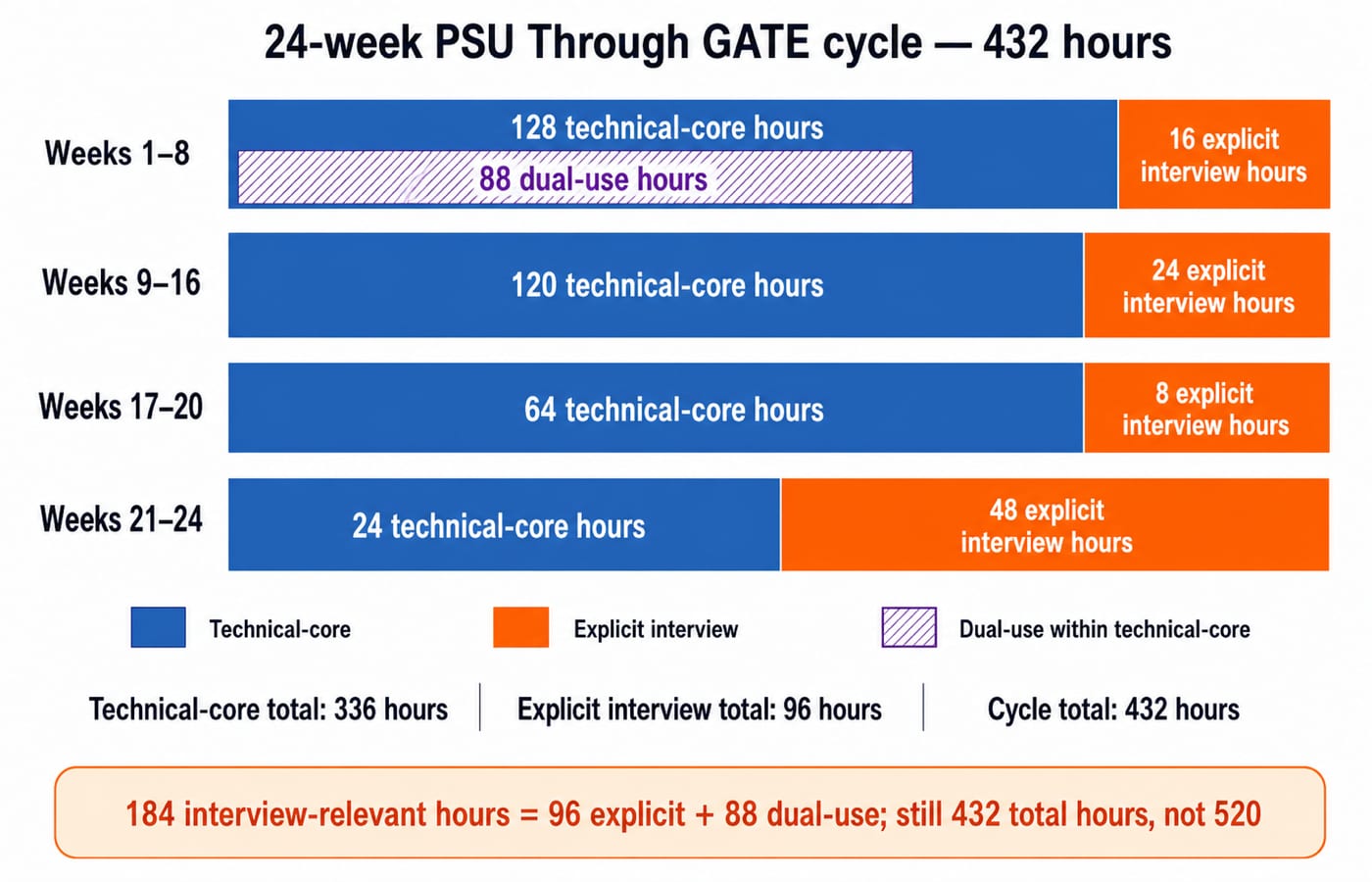
PSU Through GATE 24-week plan: allocate 432 honest hours
This example assumes 18 weekly hours.
Phase | Weeks | Score or technical-core hours/week | Explicit interview and application hours/week | Phase total |
|---|---|---|---|---|
Foundation | 1-8 | 16 | 2 | 128 + 16 = 144 |
Problem solving | 9-16 | 15 | 3 | 120 + 24 = 144 |
Exam-focus block | 17-20 | 16 | 2 | 64 + 8 = 72 |
Post-exam bridge | 21-24 | 6 | 12 | 24 + 48 = 72 |
Totals are 144 + 144 + 72 + 72 = 432 hours: 336 technical-core and 96 explicit interview or application hours.
Some Lane A work doubles as interview preparation without being counted twice. Say 4 of the 16 weekly technical hours in weeks 1-8 go to revising core subjects out loud, 3 of 15 in weeks 9-16, 2 of 16 in weeks 17-20, and all 6 in weeks 21-24: 4 x 8 = 32, 3 x 8 = 24, 2 x 4 = 8 and 6 x 4 = 24, which is 88 hours. So 96 + 88 = 184 hours feed the interview, of which only 96 are interview-specific. The week still costs 18 hours and the cycle still costs 432, not 520. See GATE CS in 6 Months: A Realistic Study Plan for sequencing. At 12 weekly hours, keep the phase order and scale each row by two-thirds, so weeks 1-8 become about 11 technical hours and 1 interview hour.
GATE score targets for PSU preparation: use a personal gap
Your GATE scorecard number and your practice-mock number are different things, and only the first one a recruiter ever sees. The official GATE 2026 website carries that cycle's examination and scorecard notices, and each recruiting PSU's own notice states which papers, which GATE cycles and which shortlisting rule it will use. Until those notices are out, plan against a target you set yourself.
Meera marks her own mocks out of 100 on a practice scale of her own making, and her last five come in at 48, 52, 50, 56 and 59. The sum is 265, and 265 / 5 = 53.0. Her personal target is 65, so the gap is 65 - 53 = 12 points. Sorted, the scores are 48, 50, 52, 56 and 59, making the median 52. The best score, 59, does not erase the unstable baseline underneath it.
She fixes the switch point before the mocks arrive, three marks under her target: 65 - 3 = 62. Two weekly hours move from Lane A to Lane B only when the mean of her last three mocks reaches 62 and no high-priority concept gap has repeated. Deciding it in advance is what stops one good score from triggering the shift.
PSU interview readiness starts with a two-hour weekly minimum
Use 45 minutes for five core questions aloud, 30 for one project evidence card, 30 to record one behavioural answer twice, and 15 to log vague claims, missed follow-ups and any resume or document item you still cannot prove. Total: 45 + 30 + 30 + 15 = 120 minutes. The technical interview guide to OS, DBMS, CN and OOP supplies oral-drill topics.
For one worked evidence card, safe test parallelisation cuts a suite from 18 minutes to 11. The saving is 18 - 11 = 7 minutes, or (7 / 18) x 100 = 38.9%. A 90-second answer gives 20 seconds to the problem, 35 to the change, 20 to the result and 15 to the trade-off, such as higher peak CPU use. Use your own measured before-and-after numbers here, because an invented saving collapses on the first follow-up question. The Interview & Resume Preparation Course provides a structured practice route.
A worked 18-hour week keeps the score lane visible
Day | Score-facing deliverable | Interview-facing deliverable | Hours |
|---|---|---|---|
Monday | CN concept repair | None | 2 |
Tuesday | 25 timed DBMS PYQs plus error log | None | 2 |
Wednesday | OS revision, 2 hours | Five oral OS answers, 1 hour | 3 |
Thursday | Engineering Mathematics mixed set | None | 2 |
Friday | Algorithms practice, 2 hours | Project evidence rehearsal, 1 hour | 3 |
Saturday | Self-designed practice mock, 2.5 hours, plus analysis, 1.5 hours | None | 4 |
Sunday | Repair the week's top error, 1 hour | Record behavioural answers, 1 hour | 2 |
Check: 2 + 2 + 3 + 2 + 3 + 4 + 2 = 18, split 15 score-facing and 3 interview-facing. Outputs are one error-log page, one mock analysis, five recorded technical answers, one project evidence card and one behavioural recording. A mock without analysis is incomplete. An extra lecture is not interview practice. GATE Guidance by Sanchit Sir offers an organised subject sequence.
Missed days: recover the priority, not every imaginary hour
Missing Wednesday removes 3 hours: 2 score-facing and 1 interview-facing. Add 30 minutes on Thursday, 30 on Friday and 60 on Sunday. This recovers 2 hours, closing at 18 - 3 + 2 = 17. Drop the last hour instead of treating the plan plus catch-up as a 21-hour obligation. Preserve one oral drill and the mock analysis.
Prioritise weak-concept repair, timed practice with analysis, one speaking drill, then optional content. If a mock falls from 63 to 54, classify the loss as conceptual, selection-related or careless. Resume the normal split next week without carrying a lecture backlog or sacrificing sleep.
Fortnightly checkpoints decide when the balance changes
Checkpoint | Trailing-three mock mean | Repeated error count | Core answers clean | Project answer | Open document or resume actions |
|---|---|---|---|---|---|
First | 55.0 | 6 | 4/10 | 125 seconds, no measured result | 3 unproved bullets |
Later | 64.0 | 1 | 8/10 | 90 seconds, test result 18 to 11 minutes | 0 proof gaps |
The later mean is (63 + 64 + 65) / 3 = 192 / 3 = 64. As 64 clears Meera's switch point of 62, she can test 13 score-facing + 5 interview-facing = 18 hours for a fortnight while retaining one mock and its analysis. If the mean falls below 62 because high-priority errors recur, return two hours to targeted repair but keep a one-hour interview floor. Move the hours back the way you moved them out, at the next checkpoint rather than after one bad mock.
The short version: earn the score and keep answers speakable
Choose a personal score target without calling it safe. Keep score work dominant, protect a small weekly speaking and project routine, and change the split only at a measured checkpoint. Before you act on any eligibility or selection detail, recheck the current PSU's official careers notice and your call letter. Use GATE Guidance for a structured score-preparation path, and the Interview & Resume Preparation Course when the interview lane needs guided practice. The score is the part of this you control, so keep it in front.
Keep learning

DRDO Scientist B CS Exam Pattern and Marking Scheme: GATE and Interview Explained
Separate GATE paper marks from recruitment merit and interview qualification. Worked examples explain penalties, weighted arithmetic and a practical CS preparation split.
30 Sep 20264 min readPSU Through GATE

PSU Through GATE Choices: Compare Roles, Locations and Career Paths
Compare PSU opportunities through GATE using official evidence, a weighted decision matrix and a practical view of role fit, location and portable skills.
Updated 15 Aug 20265 min read69 viewsPSU Through GATE

PSU Through GATE Interview Preparation: Projects, Core Subjects and Role Fit
Prepare for a possible PSU interview with a notice-first framework, a defensible project story, worked CS drills and an honest role-fit audit.
Updated 13 Aug 20265 min readPSU Through GATE
PSU Through GATE Documents and Medical Checks: An Early-Readiness Checklist
Prepare a clean evidence trail before a PSU call letter arrives. Audit a 17-item file, resolve a name mismatch through the official route, and read medical instructions without guessing.
Updated 11 Aug 20265 min readPSU Through GATE