PSU Through GATE Interview Preparation: Projects, Core Subjects and Role Fit
Prepare for a possible PSU interview with a notice-first framework, a defensible project story, worked CS drills and an honest role-fit audit.
KnowledgeGate Team
Exam prep & CS education
Updated 13 Aug 20265 min read

A GATE score may help you reach a PSU selection stage when the applicable notice says so. It cannot explain a project decision, repair a weak Operating Systems answer or prove interest in the advertised role. Those three are earned separately: one project you can defend line by line, core subjects rehearsed as follow-up questions rather than definitions, and evidence mapped phrase by phrase to the advertised duties. Selection stages differ by organisation, post and cycle, so read the current official recruitment notice before you rehearse anything.
1. Start with the PSU notice, not a generic interview checklist
Make a one-page fact sheet from your applicable official notice. Record the PSU and post, accepted engineering discipline or GATE paper, explicitly named selection stages, next-stage documents or instructions, and phrases from the role description. Attribute every entry to that notice and leave a field blank when it says nothing.
“PSU through GATE” is a recruitment route only when that organisation's current notice accepts the relevant score or paper. Do not reuse remembered cutoffs, ratios, marks or weightage. PSU Exam Preparation Courses cover PSU-specific written-exam routes, which can be different. GATE Guidance by Sanchit Sir builds the paper score that gets you in front of a panel in the first place.
2. Build a 90-second project answer with defensible numbers
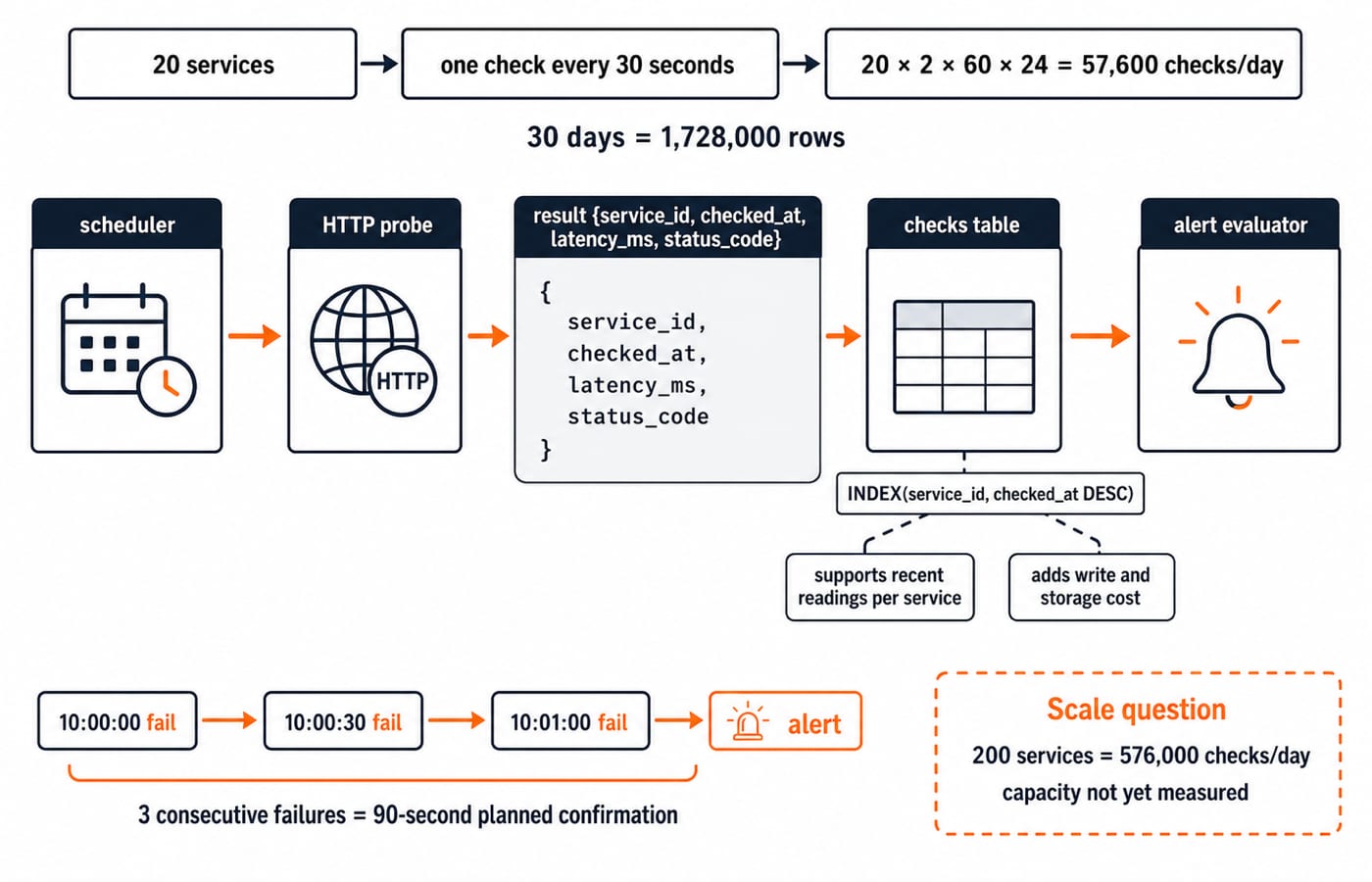
Use this fictional practice project: OpsPulse monitors 20 internal services once every 30 seconds. That means 2 checks per minute, so daily load is 20 × 2 × 60 × 24 = 57,600 checks.
Present it in this order: problem, personal ownership, design, evidence and limitation. One sentence each for problem, ownership and design, two for evidence and one for the limitation comes to roughly 150 spoken words, which fits inside 90 seconds at an unhurried pace. A clear ownership statement is: “I wrote the scheduler, probe logic and database schema; my teammate built the dashboard.” Each row stores service_id, checked_at, latency_ms and status_code. An alert needs three consecutive failures, so three check intervals of 3 × 30 = 90 seconds separate the last healthy result from the alert.
Evidence means the calculated volume and named tests, not an invented success claim. State the limit plainly: “Single-region classroom deployment; failover and production traffic were not tested.” Replace every fictional value with evidence from your repository, logs or test output.
3. Defend the design through data, failure and trade-offs
At 57,600 checks per day, 30-day raw retention contains 57,600 × 30 = 1,728,000 rows. For a query fetching one service's newest readings, propose (service_id, checked_at DESC). It matches the service filter and recent-time ordering. The trade-off is extra storage and an index update on every insert. Claim no speed-up without an execution plan and measured timings, and name what it does not serve: a query that sweeps every service inside one time window never touches the leading column, so it falls back to a scan.
Now trace failure behaviour. One failed check creates no alert. With the last healthy result at 09:59:30, failures at 10:00:00, 10:00:30 and 10:01:00 open one alert on the third result, 90 seconds after the service was last known good. A success at 10:00:30 resets the counter and the 90 seconds start again. This reduces one-off alerts but deliberately delays detection. Explain who chose the threshold of three and how you would validate it.
If asked about 200 services, recalculate: 200 × 2 × 60 × 24 = 576,000 checks/day. Then say capacity is unverified and propose a load test. Arithmetic describes offered load, not measured performance.
4. Turn project choices into core-subject follow-ups
Map each choice to revision topics. Scheduler and concurrent probes lead to processes, threads, scheduling and synchronisation. Storage leads to keys, indexes, transactions and normalisation. HTTP probes lead to DNS, TCP, timeouts and application-layer status. Dashboard classes lead to encapsulation and interfaces. Revise in that order, because a panel that has just heard your design reaches for the nearest concept, not the syllabus index.
For an OS drill, take Round Robin with quantum 2. P1 arrives at 0 with burst 5; P2 arrives at 1 with burst 3. The Gantt chart is P1 0-2 | P2 2-4 | P1 4-6 | P2 6-7 | P1 7-8. Thus C1=8, C2=7; turnaround is 8-0=8, 7-1=6; waiting is 8-5=3, 6-3=3. Continue with these OS interview questions for freshers.
For DBMS concurrency, let x=100. T1 adds 10 and T2 doubles x. Serial T1 then T2 gives (100+10)×2=220; serial T2 then T1 gives 100×2+10=210. If both read 100 before writing, a lost update may leave 110 or 200, neither a valid serial result. Use the DBMS interview questions for freshers for transaction and isolation follow-ups.
5. Answer core questions with a four-step speaking pattern
Use rule -> apply -> trade-off -> limit. For the index: “A composite index orders service and time; our query filters one service and asks for newest rows; writes and storage become costlier; I would verify with an execution plan and measured data.” This turns a definition into a bounded design argument.
Build 12 rehearsal questions around your project: four “why this design?” prompts, four core-CS derivations and four changed-assumption prompts. Score each answer 0 for bluff or incorrect, 1 for correct but ungrounded, and 2 for correct with project evidence. A result such as 17/24 tells you which of the three prompt types is weakest and nothing about anyone's selection bar. Include OS, DBMS, networks and OOP follow-ups.
6. Prove role fit from the job description
Use this hypothetical role card: monitor internal services, prepare SQL health reports, support incident handling and document changes. Map only defensible evidence. OpsPulse's 57,600-check daily design supports monitoring. Its indexed readings table supports SQL reporting. The three-failure logic partly supports incident handling. With no runbook, documentation remains a gap.
Score this private audit from 0 to 2 per phrase: monitoring 2, SQL reporting 2, incident handling 1, documentation 0, total 5/8. The two phrases scoring below 2 are your agenda: write one page on alert acknowledgement, rollback and escalation, then run one simulated failed-service incident and re-score.
Close honestly: “My project gives me relevant monitoring and database evidence. I still need stronger operational documentation, which is the gap I am now testing.” Avoid slogans, lifetime promises and invented claims about daily duties.
7. Rehearse, recheck the notice and choose the next step
Run six 45-minute sessions across six days: project opening, architecture trace, OS drill, DBMS drill, changed assumptions and a role-fit mock. That is 6 × 45 = 270 minutes. Keep the seventh day for recovery or for the single weakest answer. Score accuracy, ownership, evidence, trade-off and role fit from 0 to 2, and re-run any session that comes in below 8/10.
The short version: verify the notice, defend work you own, connect design choices to core concepts, quantify evidence, name one limit and map it to the role. Recheck the official notice before acting. Use the Interview & Resume Preparation Course for mock-interview practice, and GATE Guidance for the foundation.
Keep learning

DRDO Scientist B CS Exam Pattern and Marking Scheme: GATE and Interview Explained
Separate GATE paper marks from recruitment merit and interview qualification. Worked examples explain penalties, weighted arithmetic and a practical CS preparation split.
30 Sep 20264 min readPSU Through GATE
PSU Through GATE Choices: Compare Roles, Locations and Career Paths
Compare PSU opportunities through GATE using official evidence, a weighted decision matrix and a practical view of role fit, location and portable skills.
Updated 15 Aug 20265 min read69 viewsPSU Through GATE
PSU Through GATE Documents and Medical Checks: An Early-Readiness Checklist
Prepare a clean evidence trail before a PSU call letter arrives. Audit a 17-item file, resolve a name mismatch through the official route, and read medical instructions without guessing.
Updated 11 Aug 20265 min readPSU Through GATE
PSU Through GATE Application Tracker: A Multi-Company System
Build one auditable sheet for multiple PSU applications through GATE. Track exact eligibility wording, deadlines, documents, status and proof without mixing company rules.
Updated 8 Aug 20265 min readPSU Through GATE