PSU Through GATE CS Interview Preparation: A 14-Day Core-Subject Revision Map
Turn a broad CS syllabus into a focused interview plan. This 14-day map uses answer cards, whiteboard drills, diagnostics, and two feedback-led mocks.
KnowledgeGate Team
Exam prep & CS education
Updated 27 Jul 20265 min read
A GATE score gets you shortlisted; the recruiting organisation then puts you in front of a panel that wants spoken definitions, derivations, comparisons, and defences. Many subjects, little time: a syllabus pass is the wrong unit. Fourteen days and 36 scheduled hours are enough to rebuild oral recall, whiteboard reasoning, and the ability to survive a follow-up.
PSU Through GATE CS interviews: change the unit from chapters to answers
Answers need a definition, example, numerical or trace, assumptions, and follow-up. Rereading 40 pages may yield no clear 90-second answer.
Test two oral prompts per bucket, 12 total. Score each:
0: Cannot define the concept.
1: Can define, but not derive or defend.
2: Survives a follow-up.
Of 24: 0 to 8 means rebuild from definitions, 9 to 16 means targeted revision, 17 to 24 means spend the time on mock drills. Score the same 12 prompts again after Day 10 and let the new total set your Day 13 and 14 priorities.
PSU CS core-subject revision map: six buckets and the questions each must support
Bucket | Must-recall concepts | One panel-style prompt | Proof of readiness |
|---|---|---|---|
Operating Systems | Process versus thread, scheduling, synchronisation, deadlock, paging, virtual memory | Why does a TLB help even though the page table remains in memory? | Derive one address translation without notes. |
DBMS | Keys, normalisation, transactions, serialisability, indexing, joins, SQL | Choose an index for | Draw one precedence graph or write one correct query. |
Computer Networks | Layered model, subnetting, routing, TCP versus UDP, flow control, congestion control | Distinguish flow control from congestion control using sender, receiver, and network roles. | Solve one subnet or sequence-number calculation. |
COA and Digital Logic | Number representation, cache, pipelining, addressing modes, K-maps, flip-flops | Separate pipeline latency from throughput. | Compute one cache or pipeline value and name every assumption. |
DSA, Algorithms and C | Arrays, linked structures, trees, graphs, asymptotic complexity, recursion, pointers, memory | Select BFS or DFS for shortest paths in an unweighted graph and justify it. | Trace one algorithm and state time and space complexity. |
TOC, Compiler Design and Discrete Mathematics | Automata, grammars, parsing, logic, relations, graphs, probability | Why is every DFA an NFA, while not every NFA description is already a DFA? | Construct or trace one small machine, grammar, or counting argument. |
Order these buckets by your own weakness, by what your projects touch, and by which ones you explain worst aloud, not by one year's marks distribution. Weightage decides where written-paper hours go, and the GATE CS subject-weightage guide ranks it; a panel follows your answers and your resume instead.
PSU interview preparation plan: 14 days, 36 scheduled hours
Ten short 2-hour and four long 4-hour days total 10 x 2 + 4 x 4 = 36 hours. Days 6, 7, 13 and 14 are the long ones, so place them where four clear hours actually exist.
Day | Work | Time |
|---|---|---|
1 | OS diagnostic and repair | 2h |
2 | DBMS | 2h |
3 | Networks | 2h |
4 | COA and Digital Logic | 2h |
5 | DSA and C | 2h |
6 | OS second pass plus DBMS second pass | 2h + 2h |
7 | Networks second pass plus COA second pass | 2h + 2h |
8 | TOC and Compiler Design | 2h |
9 | Discrete Mathematics and probability | 2h |
10 | DSA and Algorithms | 2h |
11 | Resume and project claims mapped to core concepts | 2h |
12 | Mixed oral sprint across all six buckets | 2h |
13 | 60-minute mock, 90-minute review, 60-minute repair, 30-minute retest | 4h |
14 | Two weak buckets for 120 minutes, second 60-minute mock, 60-minute review | 4h |
Systems get second passes; bounded theory, one. Final four hours stay evidence-led, without new topics.
Core-subject revision method: make every two-hour block produce spoken evidence
Each 25-minute unit: 5 minutes closed-book definition and comparison, 10 numerical or trace, 5 follow-ups, 5 card correction. Four use 100 minutes; 20 remain for breaks and error log.
Cards need a prompt, 60 to 90-second answer, diagram or calculation, two follow-ups, and corrected misconception. Use the technical interview guide for OS, DBMS, CN and OOP to pick the comparisons panels keep returning to, then answer each one aloud against the clock.
PSU CS interview worked example: derive the answer, then state the assumptions
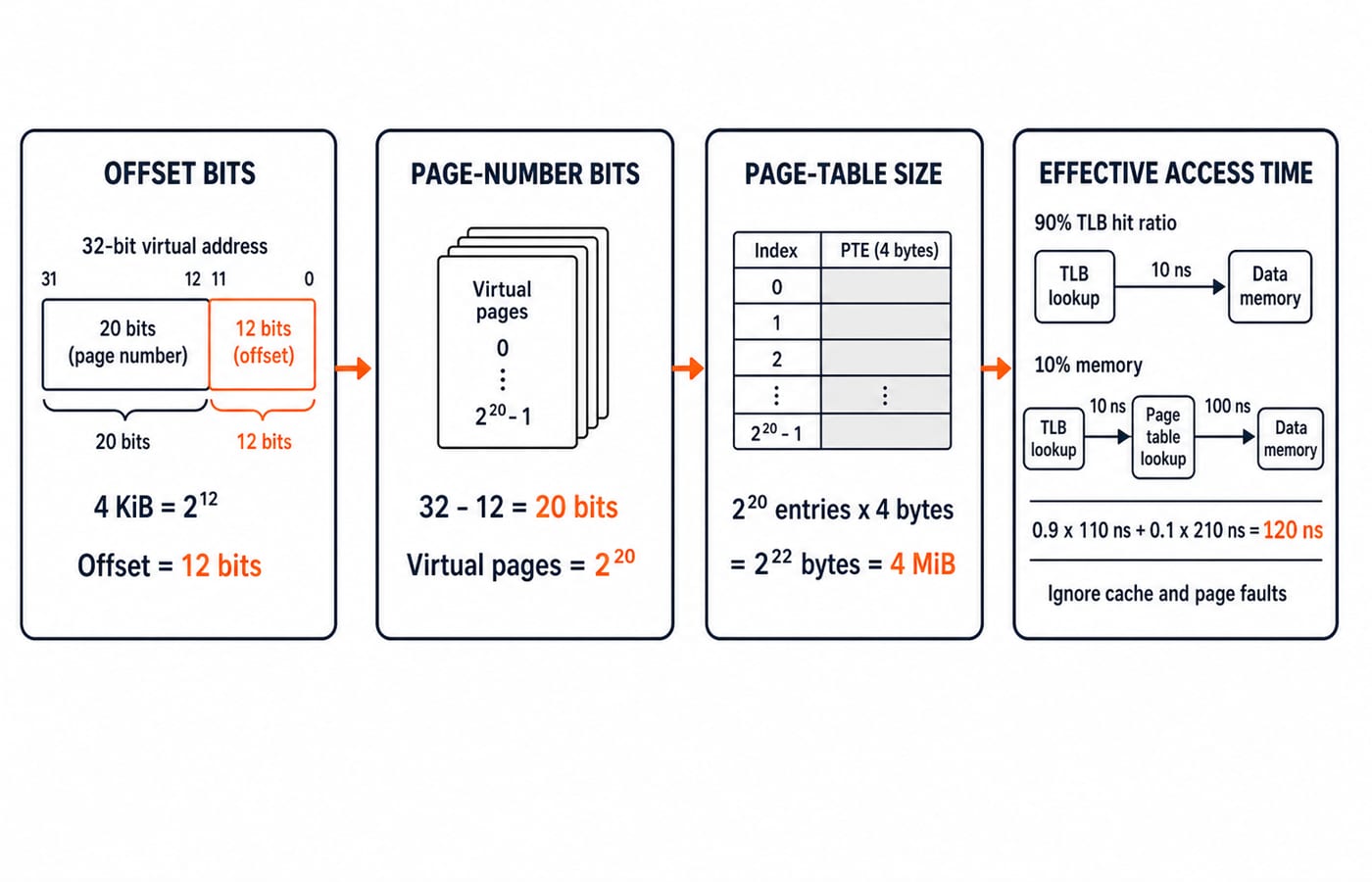
Whiteboard prompt: A system has a 32-bit virtual address, 4 KiB pages, and a single-level page table with a 4-byte page-table entry. How many offset bits are there, how many virtual pages exist, and how large is a fully populated page table?
4 KiB = 2^12 bytes, so the offset has 12 bits. 32 - 12 = 20 bits remain for the virtual page number, giving 2^20 pages. Table size is 2^20 x 4 bytes = 2^22 bytes = 4 MiB.
Given a 90% TLB hit ratio, 10 ns serial lookup, and 100 ns memory access, ignore cache and page faults. Effective time is 0.9 x (10 + 100) + 0.1 x (10 + 200) = 99 + 21 = 120 ns. A hit uses lookup plus one memory access; a miss, lookup plus page-table and data accesses.
Assumptions: single-level fully populated table, 4-byte entries, serial lookup, no page fault.
PSU-specific preparation: add only facts from the recruiting organisation
Build one page from your call letter, recruitment notice, role description, and official PSU careers portal. Attribute every format, stage, document, venue, role, and date. Two organisations recruiting in the same GATE cycle can run different stages, so treat a senior's account of the format as hearsay until your own notice repeats it.
Day 11: spend 30 minutes on organisation function and role, 20 linking project or coursework to that role, and 10 writing five honest questions. Use hour two to test resume claims against core concepts. Work the subject side of that mapping through the PSU courses category, and keep every stage, document and date on the page you built from the notice.
PSU interview mock loop: recover missed days without sacrificing feedback
A 30-minute mock asks eight: two definitions, two comparisons, two numericals or traces, one project-to-core connection, one role-motivation question. Spend 30 minutes labelling misses: recall, reasoning, communication, or unsupported resume claim. Repair on Days 13 and 14.
Miss one 2-hour day: use 60 minutes of the next long-day second pass for it; keep both mocks. Miss two short days: drop the lowest-scoring bucket's second pass and compress essentials into six cards. Keep Day 11 mapping and both mocks. Feedback changes priorities; rereading does not.
PSU Through GATE CS interview revision: the final 24-hour version
In the last 24 hours, work three of them and sleep the rest: error log 60 minutes, definitions and comparisons 45, project-to-subject links 45, and instructions, documents and travel setup 30. No new chapters, and nothing about the organisation that is not in your own notice.
For core-subject gaps, continue with GATE Guidance by Sanchit Sir. For answer delivery, resume defence, or mock practice, use the Interview & Resume Preparation Course.
Diagnose, retrieve, explain, repair. Run that loop for 14 days and the panel meets someone who can answer, not someone who has finished reading.
Keep learning
DRDO Scientist B CS Exam Pattern and Marking Scheme: GATE and Interview Explained
Separate GATE paper marks from recruitment merit and interview qualification. Worked examples explain penalties, weighted arithmetic and a practical CS preparation split.
30 Sep 20264 min readPSU Through GATE
PSU Through GATE Choices: Compare Roles, Locations and Career Paths
Compare PSU opportunities through GATE using official evidence, a weighted decision matrix and a practical view of role fit, location and portable skills.
Updated 15 Aug 20265 min read69 viewsPSU Through GATE

PSU Through GATE Interview Preparation: Projects, Core Subjects and Role Fit
Prepare for a possible PSU interview with a notice-first framework, a defensible project story, worked CS drills and an honest role-fit audit.
Updated 13 Aug 20265 min readPSU Through GATE
PSU Through GATE Documents and Medical Checks: An Early-Readiness Checklist
Prepare a clean evidence trail before a PSU call letter arrives. Audit a 17-item file, resolve a name mismatch through the official route, and read medical instructions without guessing.
Updated 11 Aug 20265 min readPSU Through GATE