Most GATE CS aspirants know Algorithms is important, but remain unsure about what the syllabus includes, how much of the paper it drives, and what to study first. Use the syllabus areas, current-paper weightage, common question styles and practical preparation order to plan without assuming a permanent marks quota.
What the GATE Algorithms syllabus actually covers
The Algorithms syllabus covers:
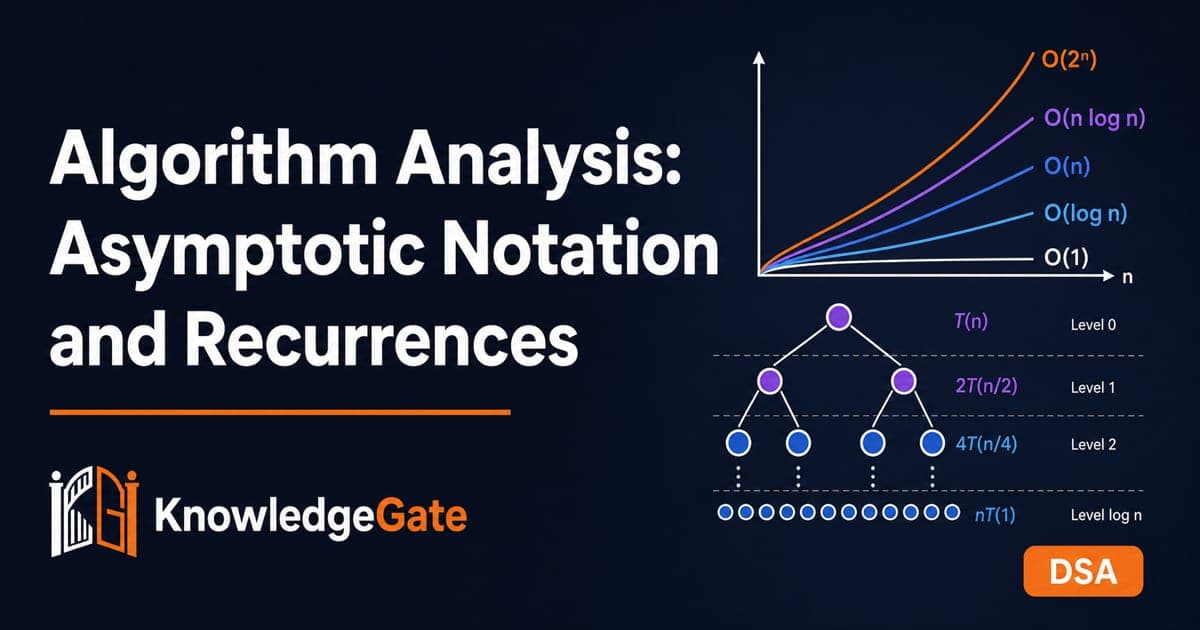
asymptotic worst-case, average-case and best-case analysis of time and space
recurrence relations
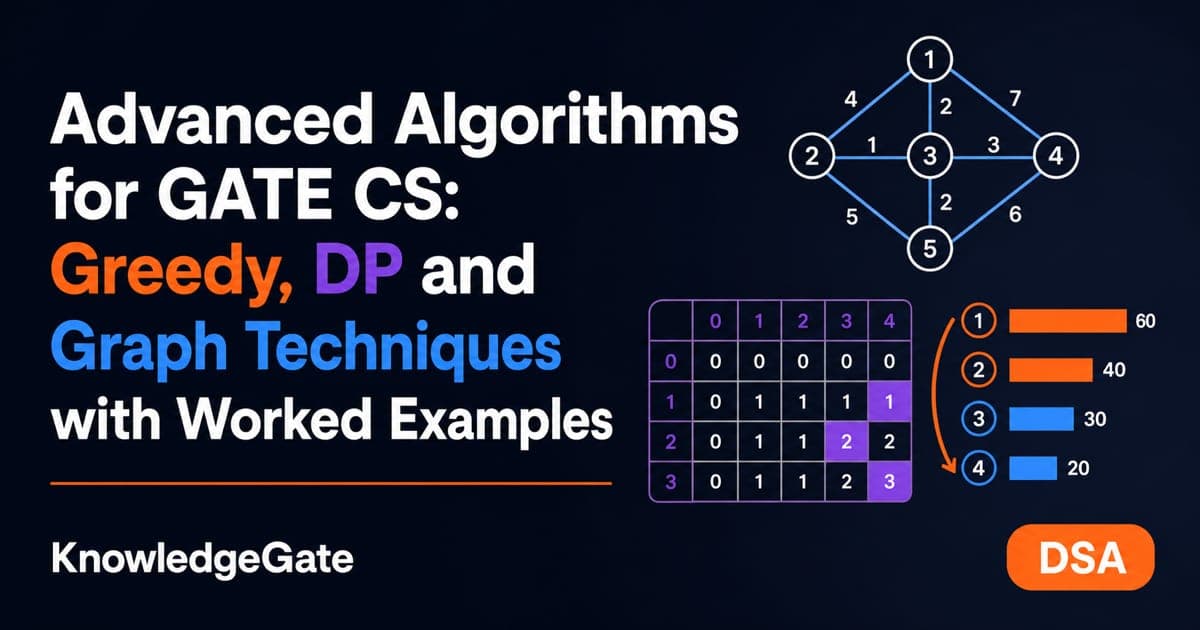
greedy, divide-and-conquer and dynamic programming paradigms
searching
sorting
hashing
graph traversals using BFS and DFS
minimum spanning trees using Prim's and Kruskal's algorithms
single-source shortest paths using Dijkstra's and Bellman-Ford algorithms
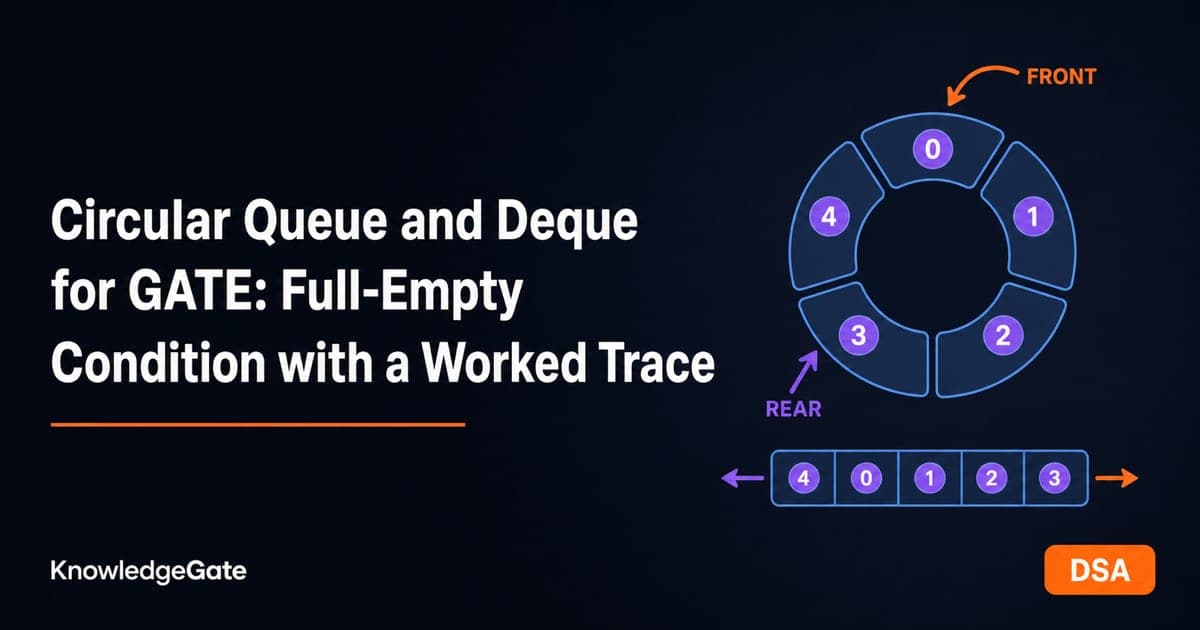
Algorithms sits beside Data Structures because algorithms operate on arrays, stacks, queues, linked lists, trees, heaps and graphs. Many questions deliberately blend the two. Recent GATE brochures and notifications have specified the exact syllabus wording, so use the official brochure to settle what is inside or outside the syllabus for your cycle.
What the 2026 papers show about Algorithms weightage
In a conservative algorithms-only classification of the official GATE 2026 CS papers, Algorithms accounted for 9 marks in CS-1 and 9 marks in CS-2. CS-1 tested recurrence analysis, shortest paths, MST properties, DFS timing and 2-colourability. CS-2 tested growth rates, recurrences, merge-sort execution, DAG shortest paths, linear-time recognition and dynamic-programming order. Questions shared with Data Structures or Discrete Mathematics were excluded from this count.
That 9-and-9 result is a current-paper anchor, not a permanent quota. Check the official GATE 2026 master question papers and answer keys, then use GATE CS Subject Weightage: Where Hours Pay Off to compare Algorithms with every other subject. For preparation, treat Algorithms as a regular scoring block, but let mixed-topic mocks adjust the hours you actually need.
Reading time complexity: count the loop before naming the class
The central micro-skill is turning code or a recurrence into a Big-O or Theta result. A question may ask for the growth class or, in NAT form, the exact number of operations for a given input.
count = 0
for i = 1 to n:
    for j = 1 to i:
        count = count + 1
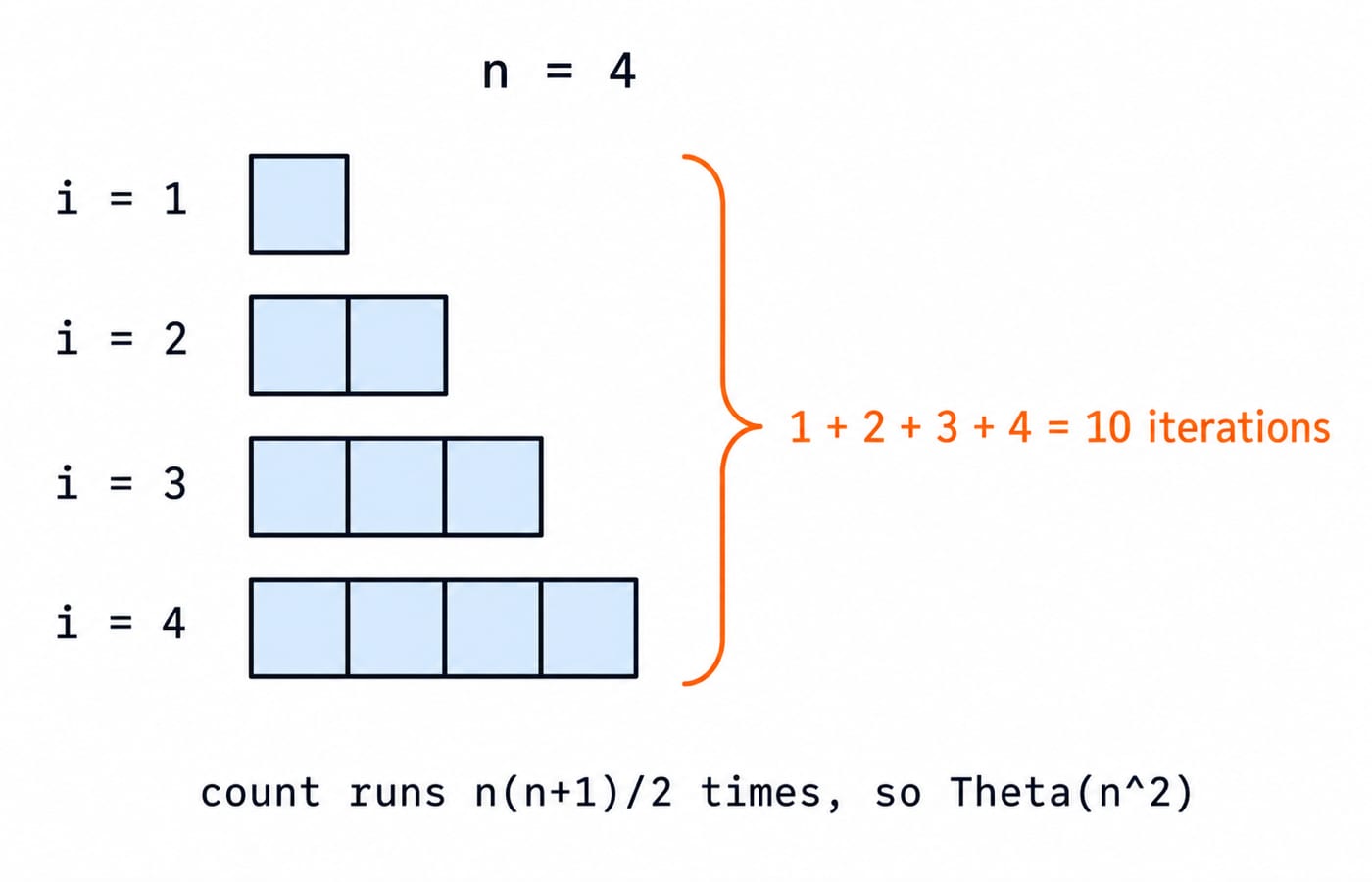
For each value of i, the inner loop runs i times. Therefore, the total is:
1 + 2 + 3 + ... + n = n(n+1)/2
For n = 4, the count is 1 + 2 + 3 + 4 = 10 iterations. Since n(n+1)/2 grows like n²/2, the running time is Theta(n²).
Now solve T(n) = 2T(n/2) + n with the Master theorem. Here a = 2, b = 2 and f(n) = n. Then n^(log_b a) = n^(log_2 2) = n^1 = n. Since f(n) = Theta(n^1), this is the balanced case, so T(n) = Theta(n log n). This is Merge Sort's recurrence.
Always check which case the question names. Quick Sort is Theta(n log n) on average but Theta(n²) in the worst case. Merge Sort is Theta(n log n) in all cases.
Graph algorithms: trace Dijkstra without skipped relaxations
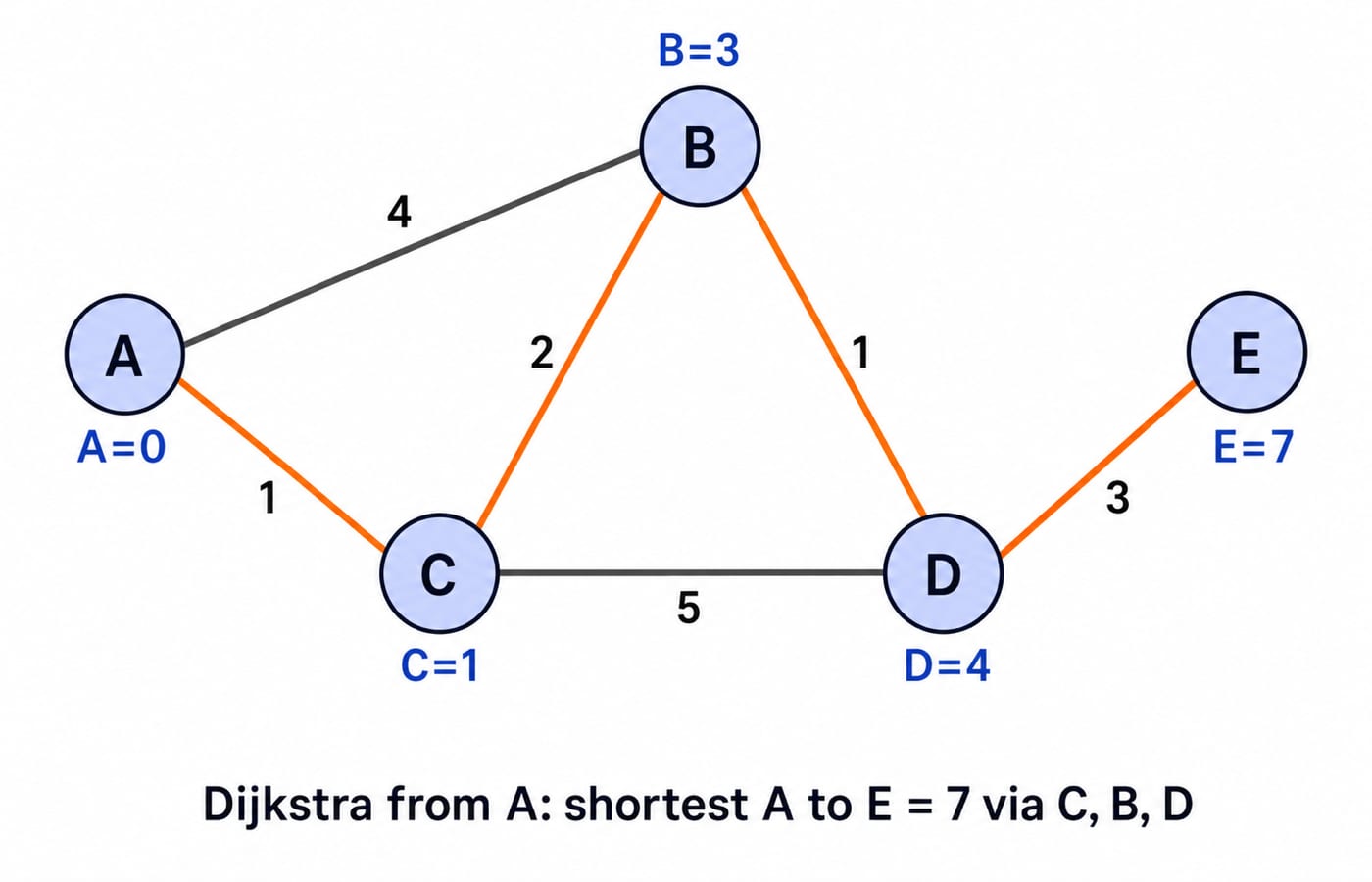
Graph algorithms are procedural, which makes a small graph useful for questions about final distance, edge-selection order or relaxations. Consider an undirected graph with source A and edges A-B = 4, A-C = 1, C-B = 2, C-D = 5, B-D = 1 and D-E = 3.
Start Dijkstra with dist(A) = 0 and every other distance infinite. From A, set B to 4 and C to 1. Pick C at 1: B becomes min(4, 1+2) = 3, while D becomes 1+5 = 6. Pick B at 3: D becomes min(6, 3+1) = 4. Pick D at 4: E becomes 4+3 = 7. Pick E at 7.
The final distances are A = 0, C = 1, B = 3, D = 4 and E = 7. The shortest A-to-E path is A to C to B to D to E, costing 1+2+1+3 = 7. The tempting A to C to D to E route costs 1+5+3 = 9.
Dijkstra requires non-negative edge weights. If an edge is negative, expect Bellman-Ford instead. This difference is a classic MCQ discriminator.
The order to study Algorithms in
Start with asymptotic analysis and recurrences: Big-O, Theta, Omega and the Master theorem.
Study sorting and searching: Merge, Quick and Heap sort, their case-wise complexity and stability, then binary search.
Learn divide-and-conquer, followed by greedy methods and dynamic programming.
Finish with BFS, DFS, Prim, Kruskal, Dijkstra and Bellman-Ford.
Study Data Structures alongside the first two stages. Heaps and adjacency lists appear as soon as sorting and graphs begin. Operating Systems for GATE shows the same subject-by-subject sequencing approach. For Algorithms, drill each finished topic with past-year questions before moving to fresh unseen problems.
Where aspirants lose easy marks
Off-by-one counting: The inner loop runs
itimes, not alwaysntimes. Write the summation before answering.Misusing the Master theorem: It does not directly fit uneven splits or subtract-type recurrences. Check the
a,b,f(n)form, then use a recurrence tree or substitution if needed.Answering for the wrong case: Quick Sort's average and worst cases differ. Mark the case named in the question.
Using Dijkstra with a negative edge: Switch to Bellman-Ford when a negative weight appears.
The short version and where Algorithms fits
Algorithms is a broad, high-return subject built on complexity reasoning and a compact set of procedural techniques. Study it in the order above, keep Data Structures beside it, and practise past questions until every step becomes routine.
The full subject, arranged in GATE order with worked PYQs, is part of GATE Guidance by Sanchit Sir. Use the GATE Test Series for exam-style Algorithms sets, and browse the wider subject line-up on GATE CS Exam Preparation. Confirm the current cycle's marks, question structure and dates in the official GATE brochure, never from a blog.