PSU Through GATE Choices: Compare Roles, Locations and Career Paths
Compare PSU opportunities through GATE using official evidence, a weighted decision matrix and a practical view of role fit, location and portable skills.
KnowledgeGate Team
Exam prep & CS education
Updated 15 Aug 20265 min read69 views
After a GATE result, several PSU applications or offers can look equally attractive by organisation name. Yet the jobs may differ sharply in daily work, posting certainty and skills built. No choice is universally best, so use an evidence-first comparison instead of a brand ranking.
Compare the notified post, not the PSU brand
Recruitment through GATE is not one common process. Each employer's current notice controls the accepted GATE paper, eligibility, shortlisting, post, discipline, selection stages and service conditions. Do not borrow details from another PSU, an aggregator or a future-dated document.
Check the route as well as the employer. Some public sector recruiters fill technical posts through their own written papers rather than a GATE score: the ISRO Scientist/Engineer ‘SC’ and Coal India Management Trainee (Computer Science) recruitments in our PSU Exam Preparation Courses category are both of that kind. A shortlist can therefore mix routes, and only each notice says which one applies.
Build a six-field evidence card for each option:
Exact post and discipline
Work or department clues
Initial posting information
Transfer or mobility clause
Training, probation or bond clause
Selection and document requirements
Label every entry confirmed in notice, confirmed by employer page or unknown. Use specifics only when the current notice or official careers page states them. A blank stays unknown.
Turn the job title into a likely work profile
A post title names a grade and a discipline, not a work profile. “Management Trainee (Computer Science)” and “Scientist/Engineer” tell you where you sit and which paper shortlisted you, never whether you will write code, run an ERP rollout or manage a vendor. So translate the title into questions. Does evidence point to software development, enterprise IT, data, cybersecurity, networks, operations support or general management? Is the work linked to headquarters, a plant, a project site or a regional office? Which tools and systems are named?
For hands-on systems work, give one point each for evidence of coding, database ownership, network or cloud exposure, security work and technical mentoring. Evidence for coding, databases, security and mentoring scores 4/5. A vague “IT support as assigned” remains unknown, not 1/5.
A prestigious employer cannot repair poor role fit. If a selection stage is still ahead of you, PSU Through GATE Interview Preparation shows how to map project and core-CS evidence to the duties an advertisement actually lists.
Treat location as a working condition
Separate the location named in the advertisement or offer, the employer's network of establishments and the transfer policy. The first is a confirmed initial posting only when explicitly stated. A headquarters address proves nothing about job location.
Score location fit with defined meanings:
5: confirmed acceptable location and mobility pattern4: acceptable region with manageable uncertainty3: location open but manageable2: likely family, health or language strain1: violates a non-negotiable constraint
A missing posting clause stays unknown. Apply hard filters before scoring, such as essential medical access within 60 km, weekly support for a dependent, or no field rotations. These are personal constraints, not PSU facts.
Build one weighted decision matrix
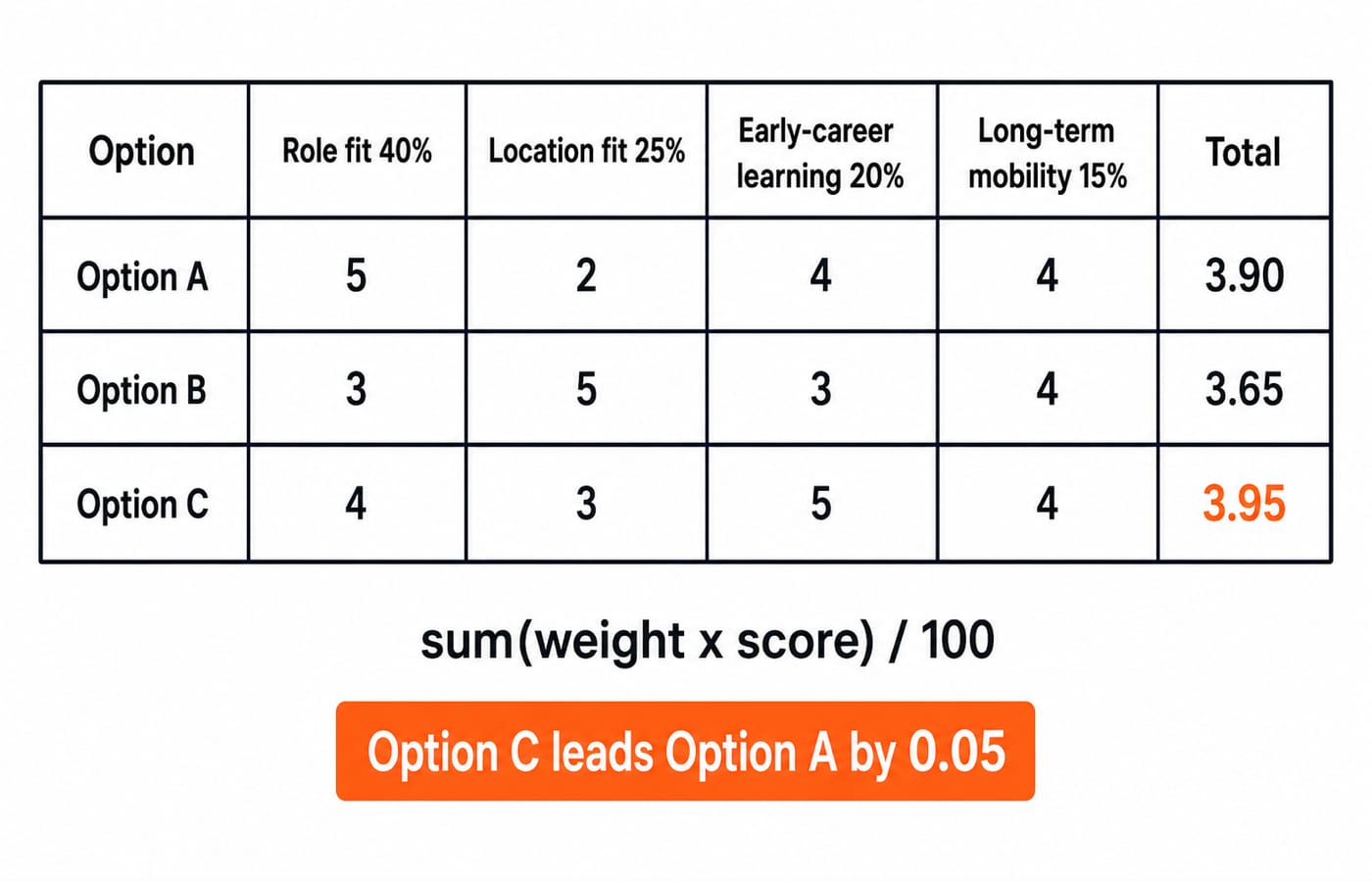
Take a candidate holding three offers: Option A, a development-heavy post far from home; Option B, an operations support post in the preferred city; Option C, a plant systems post in an acceptable region. Set the weights before looking at any score: role fit 40%, location fit 25%, early-career learning 20% and long-term mobility 15%, adding to 100. Scores run from 1 to 5 and come from the evidence cards.
Option | Role 40% | Location 25% | Learning 20% | Mobility 15% | Weighted score |
|---|---|---|---|---|---|
A | 5 | 2 | 4 | 4 | 3.90 |
B | 3 | 5 | 3 | 4 | 3.65 |
C | 4 | 3 | 5 | 4 | 3.95 |
Use weighted score = sum(weight x score) / 100.
Option A:
(40x5 + 25x2 + 20x4 + 15x4) / 100 = (200 + 50 + 80 + 60) / 100 = 3.90Option B:
(40x3 + 25x5 + 20x3 + 15x4) / 100 = (120 + 125 + 60 + 60) / 100 = 3.65Option C:
(40x4 + 25x3 + 20x5 + 15x4) / 100 = (160 + 75 + 100 + 60) / 100 = 3.95
Option C leads A by 0.05, calling for a stress test, not an automatic decision.
Stress-test the result when priorities change
Suppose family circumstances make location more important. Use role 30%, location 40%, learning 15% and mobility 15%, keeping the scores unchanged.
Option A:
(30x5 + 40x2 + 15x4 + 15x4) / 100 = (150 + 80 + 60 + 60) / 100 = 3.50Option B:
(30x3 + 40x5 + 15x3 + 15x4) / 100 = (90 + 200 + 45 + 60) / 100 = 3.95Option C:
(30x4 + 40x3 + 15x5 + 15x4) / 100 = (120 + 120 + 75 + 60) / 100 = 3.75
Option B now leads. When reasonable weights flip the result, resolve unknowns before accepting. Replace every unsupported score with a conservative 2, then an optimistic 4. If the winner changes, contact the employer through its official recruitment channel.
Compare the three-year skill path
Do not predict a lifetime career. Ask what training and tasks are stated for the first 12 months, which skills could be demonstrated by year 3, and which remain useful elsewhere.
Test portability across problem solving, technical depth, ownership, stakeholder work and exposure to large systems. Give 1 when role evidence supports a check and 0 when absent, for a total out of 5. Career direction comes from role design plus the projects and learning an employee pursues. Avoid “stable” or “fast growth” unless policy and personal goals make them meaningful.
Run the three offers through it, counting only checks the notice or employer page supports:
Option A: problem solving, technical depth and ownership are evidenced; stakeholder work and large-systems exposure are not.
3/5.Option B: ownership and stakeholder work are evidenced; the other three are not.
2/5.Option C: problem solving, technical depth, ownership and large-systems exposure are evidenced; stakeholder work is not.
4/5.
The order C, A, B matches the learning column of the matrix. When the portability count contradicts the learning score, one of the two came from a brand impression rather than an evidence card.
Make the final choice with one evidence sheet
Reject options that fail a hard constraint. Complete the cards, score the matrix, run both stress tests, then ask: “Which option would I still choose if the organisation names were hidden?”
Write: “I choose Option __ because it leads on __ and __, while its uncertainty on __ is acceptable because __.” Name the evidence and one risk.
The short version is role first, location honestly, career path through verifiable skill opportunities, and brand last.
If the GATE attempt itself is still ahead of you, the GATE Guidance by Sanchit Sir course builds the score that creates these choices, and the GATE strategy and roadmap sets the sequence around it. Practise the timing with the GATE Test Series.
Keep learning

DRDO Scientist B CS Exam Pattern and Marking Scheme: GATE and Interview Explained
Separate GATE paper marks from recruitment merit and interview qualification. Worked examples explain penalties, weighted arithmetic and a practical CS preparation split.
30 Sep 20264 min readPSU Through GATE

PSU Through GATE Interview Preparation: Projects, Core Subjects and Role Fit
Prepare for a possible PSU interview with a notice-first framework, a defensible project story, worked CS drills and an honest role-fit audit.
Updated 13 Aug 20265 min readPSU Through GATE
PSU Through GATE Documents and Medical Checks: An Early-Readiness Checklist
Prepare a clean evidence trail before a PSU call letter arrives. Audit a 17-item file, resolve a name mismatch through the official route, and read medical instructions without guessing.
Updated 11 Aug 20265 min readPSU Through GATE
PSU Through GATE Application Tracker: A Multi-Company System
Build one auditable sheet for multiple PSU applications through GATE. Track exact eligibility wording, deadlines, documents, status and proof without mixing company rules.
Updated 8 Aug 20265 min readPSU Through GATE