

Channelization MCQs: 11 Solved Questions on FDM, TDM, CDMA and WDM
Solve 11 channelization MCQs with clear reasoning for resource splits, guard bands, TDM rates, propagation delay, duty cycle and packet backlog.
KnowledgeGate Team
Exam prep & CS education
Updated 4 Nov 20268 min read
Channelization questions switch quickly between classification and arithmetic. Confusing bandwidth with bit rate, slots with frames, duty cycle with on-time, or signals with guard bands changes the answer. Solve each item before reading its explanation; a wrong answer should reveal whether the gap is classification, unit conversion or load modelling.
Channelization MCQs: use one classification table before solving
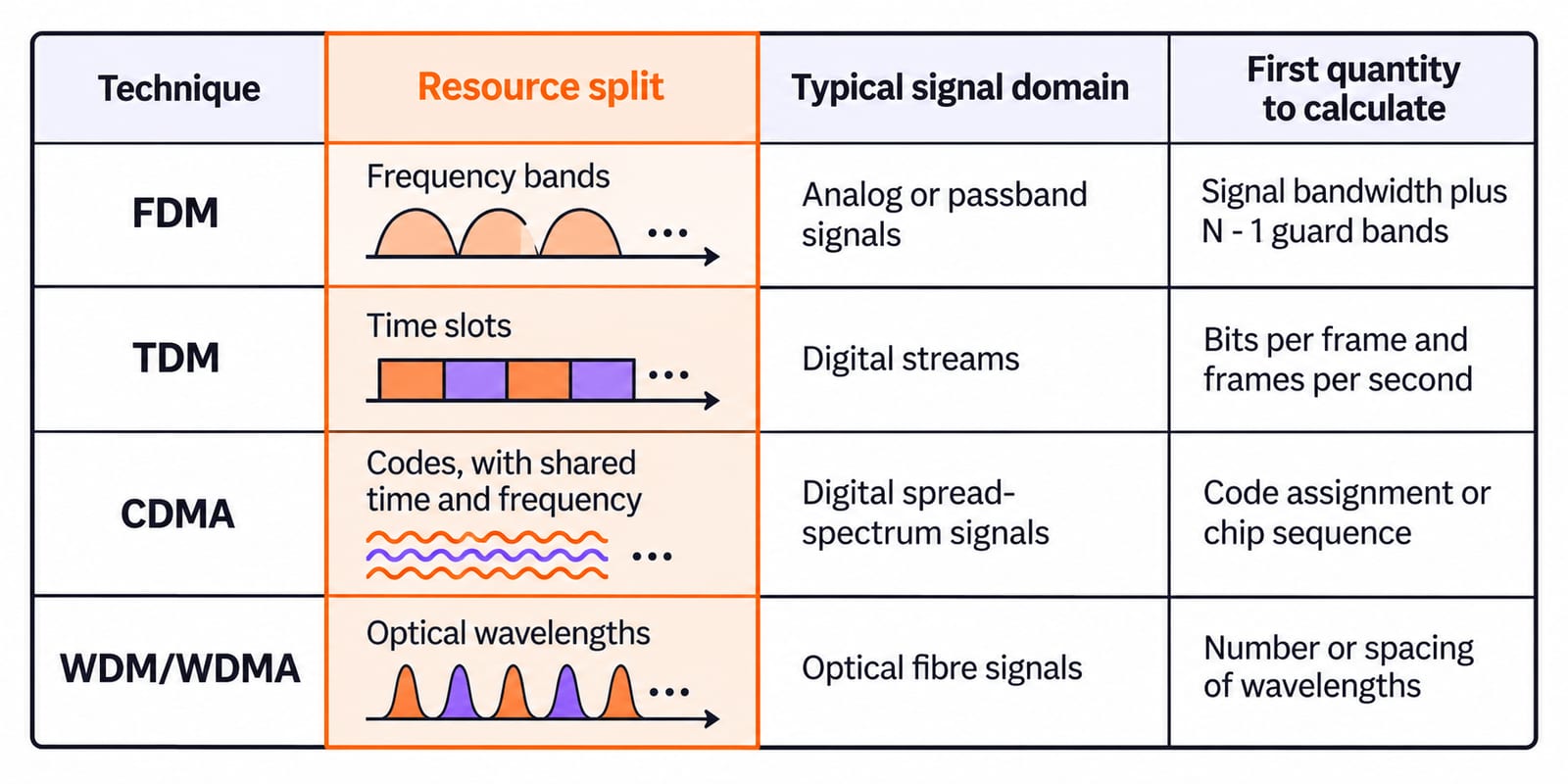
Technique | Resource split | Typical signal domain | First quantity to calculate |
|---|---|---|---|
FDM | Frequency bands | Analog or passband signals | Signal bandwidth plus |
TDM | Time slots | Digital streams | Bits per frame and frames per second |
CDMA | Codes, with shared time and frequency | Digital spread-spectrum signals | Code assignment or chip sequence |
WDM/WDMA | Optical wavelengths | Optical fibre signals | Number or spacing of wavelengths |
Use one routine: identify the divided resource, convert every rate to one unit, decide whether the multiplexer is synchronous or statistical, then calculate before checking options. GATE Guidance by Sanchit Sir provides a structured route through the wider Computer Networks sequence.
FDM, WDM, CDMA and WDMA concept MCQs
Question 1, UGC NET 2018
The Third Generation mobile phones are digital and based on
A. AMPS
B. D-AMPS
C. CDMA
D. Broadband CDMA
Answer: D. Broadband CDMA. AMPS is analog, while D-AMPS is a digital 2G system based on TDMA. Earlier CDMA systems were narrowband, but the broadband or wideband CDMA family is associated with 3G mobile systems.
Question 2, UGC NET 2016
Given the following statements:
(A) Frequency Division Multiplexing is a technique that can be applied when the bandwidth of a link is greater than the combined bandwidth of signals to be transmitted.
(B) Wavelength Division Multiplexing (WDM) is an analog multiplexing technique to combine optical signals.
(C) WDM is a digital multiplexing technique.
(D) TDM is a digital multiplexing technique.
Which of the following is correct?
A. (A), (B), (C) and (D) are true.
B. (A), (B), (C) and (D) are false.
C. (A), (B) and (D) are false; (C) is true.
D. (A), (B) and (D) are True; (C) is false.
Answer: D. Statement A is true because FDM needs enough link bandwidth for all signal bands and their separation. WDM separates optical signals by wavelength or carrier, so it is conventionally treated as analog multiplexing rather than strictly digital. TDM assigns time slots to digital streams, making D true and C false.
Question 3, DSSSB 2021 (module page; question link unavailable)
What is the full form of WDMA protocol?
A. Wide Division Multiple Access Protocol
B. Wide Digital Multiple Access Protocol
C. Wavelength Digital Multiple Access Protocol
D. Wavelength Division Multiple Access Protocol
Answer: D. Wavelength Division Multiple Access Protocol. WDMA lets separate users or channels occupy distinct optical wavelengths. It divides the wavelength resource, whereas TDM divides transmission time into slots.
FDM bandwidth MCQ with guard bands
Question 4, UGC NET 2014
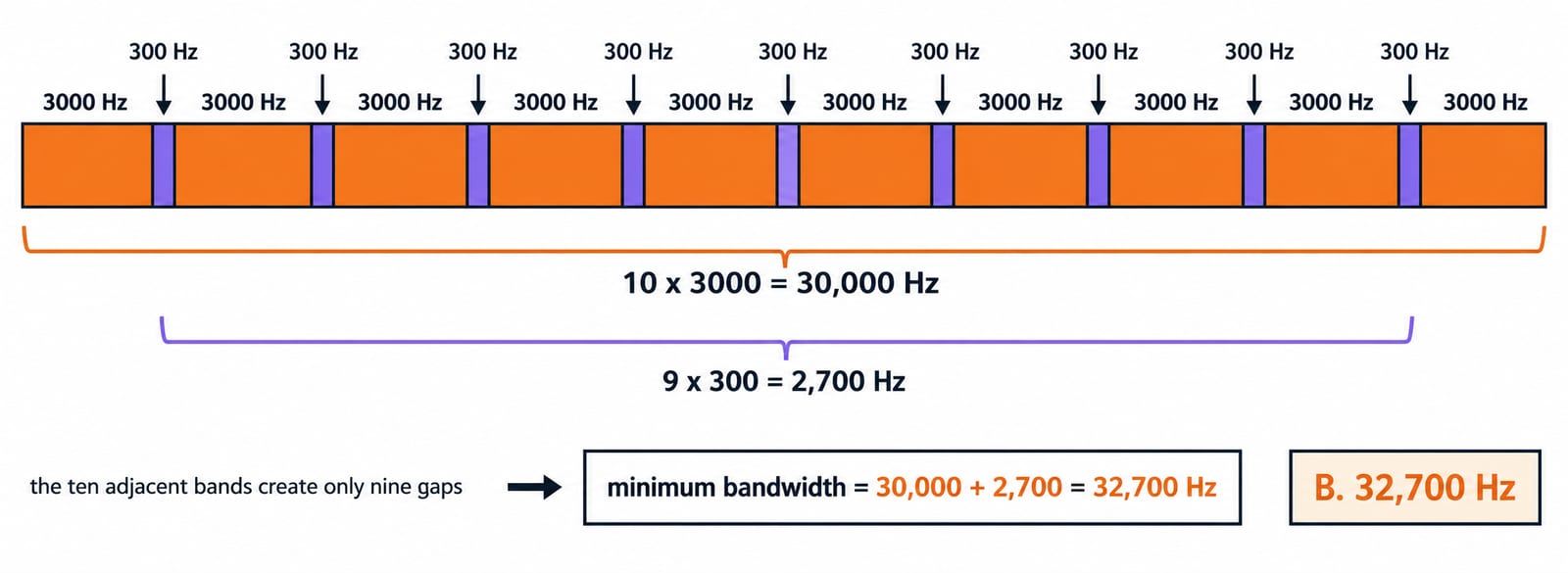
Ten signals, each requiring 3000 Hz, are multiplexed on to a single channel using FDM. How much minimum bandwidth is required for the multiplexed channel ? Assume that the guard bands are 300 Hz wide.
A. 30,000
B. 32,700
C. 33,000
D. None of the above
Answer: B. 32,700 Hz. Ten signal bands require 10 x 3000 = 30,000 Hz, and the ten adjacent bands create only nine gaps, requiring 9 x 300 = 2,700 Hz. Therefore, minimum bandwidth is 30,000 + 2,700 = 32,700 Hz; the common trap is multiplying the guard-band width by 10 instead of N - 1.
TDM frame rate, slot size and link-rate MCQs
Question 5, UGC NET 2016
A multiplexer combines four 100-Kbps channels using a time slot of 2 bits. What is the bit rate ?
A. 100 Kbps
B. 200 Kbps
C. 400 Kbps
D. 1000 Kbps
Answer: C. 400 Kbps. Each input needs 100,000 / 2 = 50,000 frames/s, because it contributes 2 bits per frame. Each frame has 4 x 2 = 8 bits, so the link rate is 50,000 x 8 = 400,000 bps = 400 Kbps; the 2-bit slot changes frame frequency, not the sum of the four equal input rates.
Question 6, UGC NET 2016
If link transmits 4000 frames per second and each slot has 8 bits, the transmission rate of circuit of this TDM is ______.
A. 64 Kbps
B. 32 MbpS
C. 32 Kbps
D. 64 MbpS
Answer: C. 32 Kbps. One circuit contributes one 8-bit slot in each frame, so its rate is 4000 x 8 = 32,000 bps = 32 Kbps. The number of channels is irrelevant because the question asks for one circuit's rate.
Question 7, UGC NET 2015
Four channels are multiplexed using TDM. If each channel sends 100 bytes/second and we multiplex 1 byte per channel, then the bit rate for the link is
A. 400 bps
B. 800 bps
C. 1600 bps
D. 3200 bps
Answer: D. 3200 bps. Taking 1 byte from each channel per frame gives 100 frames/s, and every frame carries 4 bytes. The link therefore carries 100 x 4 = 400 bytes/s, which becomes 400 x 8 = 3200 bps after converting bytes to bits.
Question 8, UGC NET 2014
A terminal multiplexer has six 1200 bps terminals and ‘n’ 300 bps terminals connected to it. If the outgoing line is 9600 bps, what is the value of n ?
A. 4
B. 8
C. 16
D. 28
Answer: B. 8. The six fast terminals use 6 x 1200 = 7200 bps, leaving 9600 - 7200 = 2400 bps. At 300 bps for each remaining terminal, n = 2400 / 300 = 8.
TDM slot timing, propagation delay and station throughput MCQ
Question 9, GATE 2005
In a TDM medium access control bus LAN, each station is assigned one time slot per cycle for transmission. Assume that the length of each time slot is the time to transmit 100 bits plus the end-to-end propagation delay. Assume a propagation speed of 2 x 10^8 m/sec. The length of the LAN is 1 km with a bandwidth of 10 Mbps. The maximum number of stations that can be allowed in the LAN so that the throughput of each station can be 2/3 Mbps is
A. 3
B. 5
C. 10
D. 20
Answer: C. 10. Transmission time is 100 / 10,000,000 = 10 microseconds, while propagation delay is 1000 / (2 x 10^8) = 5 microseconds, so one slot lasts 15 microseconds. Solving 100 / (N x 15 microseconds) = 2/3 Mbps gives N = 10. A back-check gives 100 / (10 x 15 microseconds) = 666,666.67 bps, which is 2/3 Mbps.
Statistical multiplexing, duty cycle and backlog MCQs
Question 10, GATE 2006
A link of capacity 100 Mbps is carrying traffic from a number of sources. Each source generates an on-off traffic stream; when the source is on, the rate of traffic is 10 Mbps, and when the source is off, the rate of traffic is zero. The duty cycle, which is the ratio of on-time to off-time, is 1 : 2. When there is no buffer at the link, the minimum number of sources that can be multiplexed on the link so that link capacity is not wasted and no data loss occurs is S1. Assuming that all sources are synchronized and that the link is provided with a large buffer, the maximum number of sources that can be multiplexed so that no data loss occurs is S2. The values of S1 and S2 are, respectively,
A. 10 and 30
B. 12 and 25
C. 5 and 33
D. 15 and 22
Answer: A. 10 and 30. With no buffer, the peak constraint is S1 x 10 = 100, so S1 = 10. An on-to-off ratio of 1:2 means the source is on for 1/3 of the cycle, giving an average of 10/3 Mbps per source. With buffering, S2 x 10/3 <= 100, so the largest stable value is S2 = 30.
Question 11, GATE 2007
Let us consider a statistical time division multiplexing of packets. The number of sources is 10. In a time unit, a source transmits a packet of 1000 bits. The number of sources sending data for the first 20 time units is 6, 9, 3, 7, 2, 2, 2, 3, 4, 6, 1, 10, 7, 5, 8, 3, 6, 2, 9, 5 respectively. The output capacity of multiplexer is 5000 bits per time unit. Then the average number of backlogged of packets per time unit during the given period is
A. 5
B. 4.45
C. 3.45
D. 0
Answer: B. 4.45. The output handles 5000 / 1000 = 5 packets/time unit, so from B_0 = 0 apply B_t = max(0, B_(t-1) + arrivals_t - 5). The complete backlog row is 1, 5, 3, 5, 2, 0, 0, 0, 0, 1, 0, 5, 7, 7, 10, 8, 9, 6, 10, 10. Its sum is 89, and 89 / 20 = 4.45 packets per time unit.
Channelization MCQ patterns and the next practice step
A channelization error usually begins at one of four steps: identifying the divided resource, counting FDM gaps, building a TDM frame or separating peak, average and queued load.
Classify a missed answer by its first incorrect step:
Resource-identification error: redraw the map and label frequency, time, code and wavelength.
Guard-band error: sketch ten bands and count the nine gaps between them.
Frame-rate error: write the frame rate, bits per slot and transmission or propagation time with units.
Load-model error: trace peak input, average input, service capacity and backlog in separate columns.
For adjacent practice, Subnetting MCQs: 12 Solved IP Addressing Questions owns address and mask arithmetic, while TCP and UDP MCQs: 12 Solved Transport Layer Questions owns transport-protocol behaviour. Channelization allocates one shared link by frequency, time, code or wavelength, and its arithmetic follows those allocation rules.
Use the GATE Test Series after you can reproduce FDM guard-band, TDM propagation and statistical-backlog calculations without the options. For a broader subject sequence, choose a route from GATE CS Exam Preparation Courses & Test Series and return to the failed question group.
Keep learning
Channelization in Computer Networks: FDMA, TDMA and CDMA with Solved Numericals
Learn how frequency, time and code divide a shared medium. Three worked examples calculate FDMA bandwidth, TDMA useful throughput and CDMA correlation decoding.
Updated 6 Nov 20266 min readComputer Networks

Mobile Technology in Computer Networks: Cellular Concepts, GSM, CDMA and Handoff with Worked Examples
Build a clear picture of cellular networks, GSM roles, CDMA decoding, handoff and Mobile IP, then test it with two fully worked numericals.
Updated 19 Aug 20266 min readComputer Networks

Basics & Delay Analysis MCQs: 11 Solved Flow-Control Questions with Explanations
Work through 11 flow-control and network-delay problems using formulas, unit conversions and timelines for transmission, propagation, RTT and router links.
Updated 11 Nov 20267 min readComputer Networks MCQs
Congestion Control Policy MCQs: 11 Solved Questions with Explanations
Work through 11 published congestion-control questions covering TCP window growth, timeout recovery, AIMD and token-bucket calculations, with every step shown.
Updated 21 Sep 20268 min read54 viewsComputer Networks MCQs