

Channelization in Computer Networks: FDMA, TDMA and CDMA with Solved Numericals
Learn how frequency, time and code divide a shared medium. Three worked examples calculate FDMA bandwidth, TDMA useful throughput and CDMA correlation decoding.
KnowledgeGate Team
Exam prep & CS education
Updated 6 Nov 20266 min read
FDMA, TDMA and CDMA all let multiple users share one medium, but they separate those users along different dimensions. Memorising the expansions does not tell you what to subtract or correlate in a numerical. The calculations are FDMA bandwidth after guard bands, TDMA payload throughput after header and guard overhead, and CDMA recovery from a received chip sequence. Channelization sits inside Computer Networks, one strand of the wider CS Fundamentals syllabus. The models assume no FDMA edge guards, a fixed TDMA link rate and ideal orthogonal CDMA codes.
Channelization means dividing one shared link before users transmit
Channelization is a planned multiple-access method in the data-link layer's medium-access-control discussion. It divides a shared medium by frequency, time or code. Random-access stations contend for the resource; channelized users receive a planned band, slot or spreading code.
FDMA separates simultaneous transmissions into non-overlapping frequency bands.
TDMA gives users repeating, non-overlapping time slots on the same carrier.
CDMA lets users overlap in time and frequency, then distinguishes them through chip codes.
Method | What is divided | Can users transmit at the same instant? | Main overhead or requirement | Typical numerical |
|---|---|---|---|---|
FDMA | Frequency range | Yes, in separate bands | Guard bands | Bandwidth allocation |
TDMA | Repeating frame time | No, in the simplified single-carrier model | Frame synchronisation and guard time | Payload goodput |
CDMA | Code space | Yes | Code orthogonality and correlation | Correlation decoding |
The Data Link Layer Access Control guide owns the broader choice among random access, controlled access and channelization. The calculations below stay inside channelization, where planned bands, slots and codes replace contention.
FDMA worked example: allocate a 1 MHz band among four users
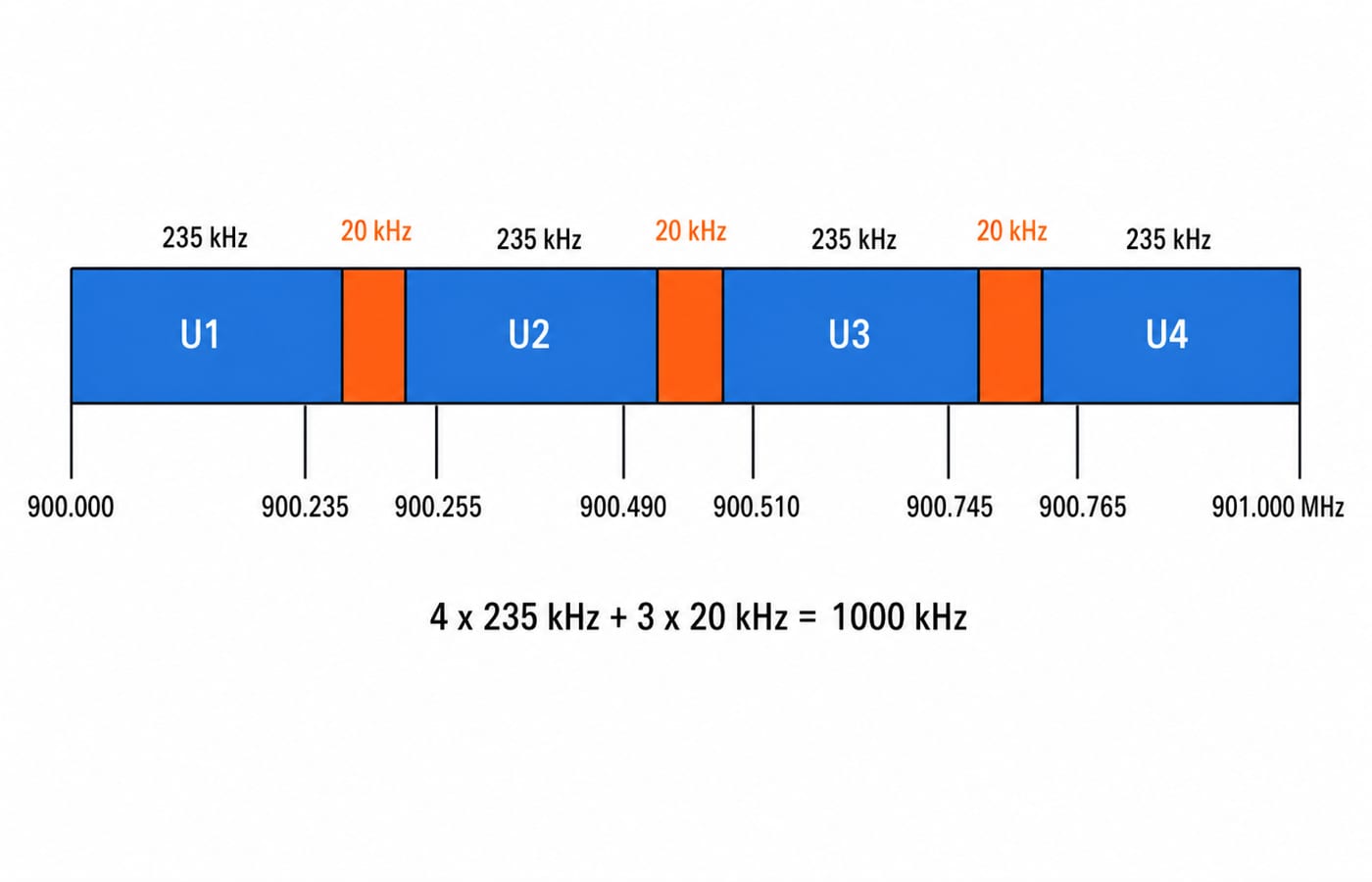
The total band is 900.000 MHz to 901.000 MHz, so B_total = 1 MHz = 1000 kHz. Four equal user channels need 20 kHz between adjacent pairs. There are no edge guards.
Four channels create three internal gaps:
(4 - 1) x 20 = 60 kHz
Usable traffic bandwidth is:
1000 - 60 = 940 kHz
Bandwidth per user is:
940 / 4 = 235 kHz
The exact plan is:
Segment | Frequency range | Width |
|---|---|---|
User 1 |
|
|
Guard 1 |
|
|
User 2 |
|
|
Guard 2 |
|
|
User 3 |
|
|
Guard 3 |
|
|
User 4 |
|
|
Check: 4 x 235 + 3 x 20 = 940 + 60 = 1000 kHz. The shortcut 1000 / 4 = 250 kHz wrongly leaves no guard space. If edge guards are specified, subtract them too.
TDMA worked example: find useful throughput after slot overhead
A 12 Mb/s link serves four active users in a repeating 1 ms frame. Each user gets one 250 microsecond slot containing a 200-bit header and synchronisation field plus a 10 microsecond guard. The link rate is constant.
Raw capacity per slot:
12 x 10^6 bit/s x 250 x 10^-6 s = 3000 bits
Guard cost in bit-times:
12 x 10^6 bit/s x 10 x 10^-6 s = 120 bits
Payload per user per frame:
3000 - 200 - 120 = 2680 bits
Total payload per frame is 4 x 2680 = 10,720 bits. Aggregate useful throughput is 10,720 / 0.001 = 10.72 Mb/s; each user averages 2680 / 0.001 = 2.68 Mb/s.
The raw frame holds 12,000 bits, so efficiency is 10,720 / 12,000 = 0.8933, or about 89.33%. Dividing the link rate by four gives a raw 3 Mb/s per user, not payload throughput.
CDMA worked example: decode two users from one chip sequence
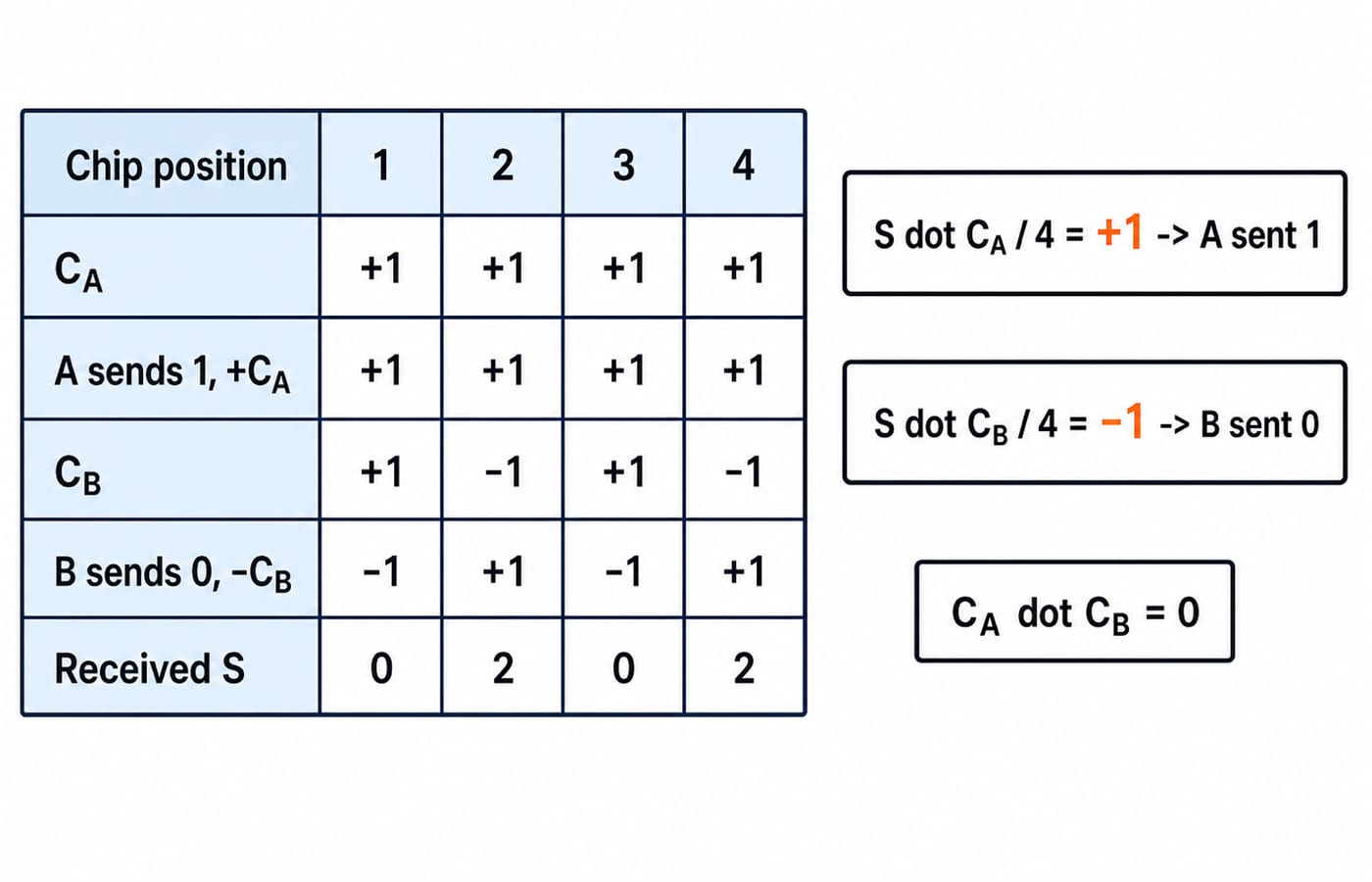
A chip is one element of a spreading code. Under the bipolar convention, bit 1 sends +C, bit 0 sends -C, and an inactive user contributes zero. Use these length-four codes:
C_A = [+1, +1, +1, +1]
C_B = [+1, -1, +1, -1]
They are orthogonal: C_A dot C_B = 1 - 1 + 1 - 1 = 0. Each self-dot-product is 4.
A sends bit 1, contributing +C_A = [+1, +1, +1, +1]. B sends bit 0, contributing -C_B = [-1, +1, -1, +1]. Their chipwise sum is:
S = [0, 2, 0, 2]
Decode A by normalised correlation:
(S dot C_A) / 4 = (0 + 2 + 0 + 2) / 4 = +1
Thus A sent bit 1. For B:
(S dot C_B) / 4 = (0 - 2 + 0 - 2) / 4 = -1
Thus B sent bit 0. This ideal model assumes perfect synchronisation, orthogonal codes, equal received power and no noise. Real systems need power control and tolerate non-ideal correlation.
How to choose the method from the wording of a question
Circle the separating coordinate.
Sub-bands and guard bands signal FDMA; total spectrum stays fixed.
Frames, slots, synchronisation bits or guard time signal TDMA; frame duration and link rate matter.
Spreading codes, chips, inner products or correlation signal CDMA; code vectors and length matter.
There is no universal winner. FDMA loses spectrum to guards and can waste an idle user's band. TDMA loses capacity to framing and guards and can waste an empty slot. CDMA needs suitable codes, receiver correlation and received-power control while user signals remain superposed.
The same code pair also appears in Mobile Technology in Computer Networks, where it connects CDMA decoding to cellular reuse, GSM and handoff. Here it isolates correlation decoding within a three-method channelization comparison.
How exams turn FDMA, TDMA and CDMA into questions
Recurring question forms include counting internal and edge guards, finding per-channel bandwidth or maximum users, converting slot duration into raw bits, subtracting overhead, and reporting aggregate or per-user goodput. For CDMA, expect to test code orthogonality, add simultaneous chip vectors, or recover a bit from the sign of normalised correlation.
Use this five-step checklist:
Sketch the divided resource.
Convert units into Hz, seconds and bits.
Count gaps, not channels, for internal FDMA guards.
Keep raw rate separate from payload rate.
Write the CDMA bit-to-sign convention before forming vectors.
Channelization traps and their corrections
Four FDMA channels means four internal guards. No. Four consecutive channels create three internal gaps unless edge guards are specified separately.
One-fourth of a TDMA link rate is always payload throughput. No. Deduct header, synchronisation and guard-time capacity first.
CDMA bit 0 is an all-zero vector. Under this bipolar convention, bit
0sends the negative code. Only an inactive user contributes zero.A raw dot product of
-4is the decoded value. Divide by code length4to get-1, then map the sign to bit0.CDMA separates users by frequency, or TDMA users transmit continuously. Name the coordinate first: frequency, time or code.
Channelization is the same problem as TCP/UDP or subnetting. Identify the layer and shared resource before selecting a formula.
Channelization in the short version, then the next study step
FDMA asks, "which frequency band?" TDMA asks, "which time slot?" CDMA asks, "which code?" The worked results are 235 kHz per FDMA user, 10.72 Mb/s aggregate TDMA goodput with 2.68 Mb/s per user, and CDMA correlations +1 for A and -1 for B.
For retrieval practice, redraw both diagrams without looking. Then change only the TDMA guard interval from 10 to 5 microseconds: guard cost becomes 60 bit-times, payload becomes 3000 - 200 - 60 = 2740 bits per user per frame, aggregate goodput becomes 4 x 2740 / 0.001 = 10.96 Mb/s, and efficiency becomes 10,960 / 12,000 = 0.9133, or about 91.33%.
Choose Zero to Hero - Complete CS Course for a broader semester and fundamentals path, or CS Fundamentals for Placements by Sanchit Sir when your immediate goal is placement-oriented revision.
Keep learning
Channelization MCQs: 11 Solved Questions on FDM, TDM, CDMA and WDM
Solve 11 channelization MCQs with clear reasoning for resource splits, guard bands, TDM rates, propagation delay, duty cycle and packet backlog.
Updated 4 Nov 20268 min readComputer Networks MCQs

Mobile Technology in Computer Networks: Cellular Concepts, GSM, CDMA and Handoff with Worked Examples
Build a clear picture of cellular networks, GSM roles, CDMA decoding, handoff and Mobile IP, then test it with two fully worked numericals.
Updated 19 Aug 20266 min readComputer Networks
Computer Interfaces in COA: Registers, Handshaking and I/O Mode Numericals
Learn how an I/O interface decodes addresses, uses data, status and control registers, coordinates handshakes, and changes CPU occupancy across polling, interrupts and DMA.
Updated 30 Oct 20267 min read74 viewsComputer Organization & Architecture
Encoding and Modulation in Computer Networks: Worked Examples and GATE Traps
Separate encoding from modulation with a four-path map, then work through line coding, 8-PSK baud, PCM sampling, quantisation, AM and FM bandwidth.
Updated 18 Nov 20266 min readComputer Networks