TCP vs UDP: the transport layer explained, with the exam angle
TCP vs UDP explained: the transport layer's job, connection-oriented vs connectionless, reliability, congestion control, headers, and when to use each.
KnowledgeGate Team
Exam prep & CS education
10 Jul 20265 min read129 views
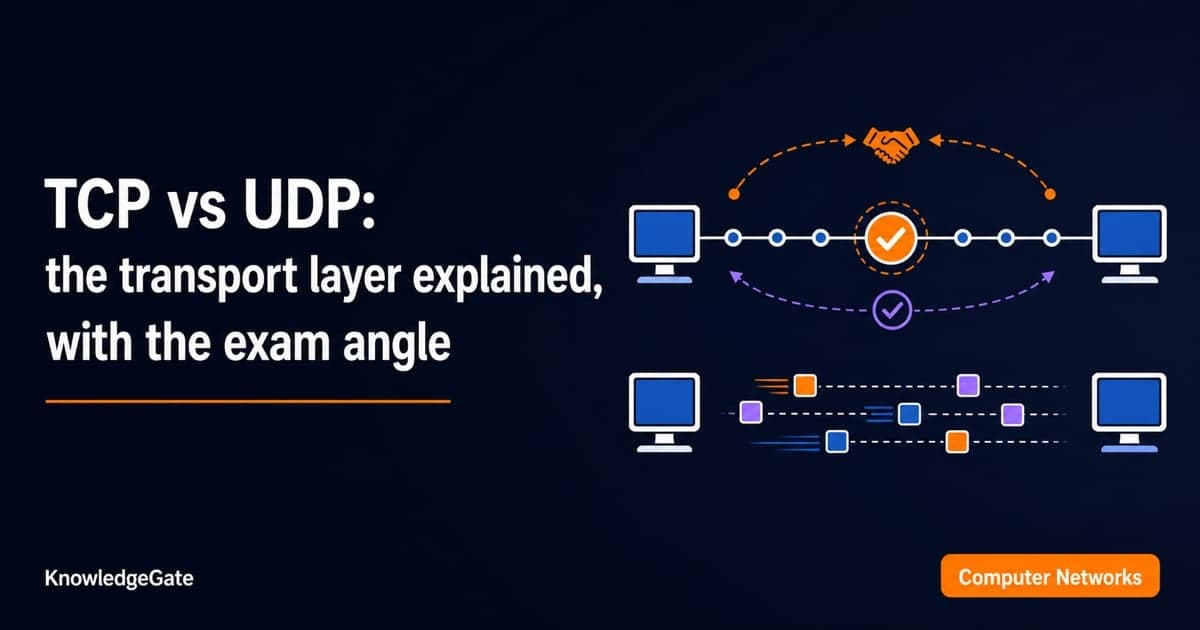
The transport layer is the layer that turns host-to-host delivery into process-to-process delivery, so the right data reaches the right application on the right machine. Two protocols share this job and make opposite trade-offs: TCP buys reliability at the cost of overhead, and UDP buys speed at the cost of guarantees. Knowing exactly where each fits is one of the most reliably tested ideas in Computer Networks.
Both run over the same IP layer, so every difference between them comes down to what the transport layer chooses to add on top.
What the transport layer does
The network layer, using IP, gets a packet from one host to another. It does not know or care which program on that host should receive it. The transport layer closes that gap with four responsibilities:
Multiplexing and demultiplexing using port numbers. A port identifies an endpoint on a host, so a browser using ephemeral port 49152 and an email client can share one IP address without mixing up their data.
Segmentation and reassembly of the application's byte stream into transport units.
Error detection through a checksum.
Optionally, reliability, ordering, flow control, and congestion control, which is exactly the set of features that separates TCP from UDP.
An address at this layer is really a pair: the IP address picks the host, the port picks the process.
TCP: connection-oriented and reliable
TCP (Transmission Control Protocol) is connection-oriented. Before any data flows, the two ends establish a connection with a three-way handshake (SYN, then SYN-ACK, then ACK). Only then does data move, and at the end the connection is torn down cleanly. On top of that connection TCP layers four guarantees:
Reliability. Every byte is acknowledged. If an acknowledgement does not arrive within a timeout, the sender retransmits, so lost data is recovered automatically.
In-order delivery. Each byte carries a sequence number, so the receiver reassembles the stream in the exact order it was sent even if packets arrive scrambled.
Flow control. A sliding window advertised by the receiver stops a fast sender from overwhelming a slow receiver's buffer.
Congestion control. Algorithms such as slow start and congestion avoidance make TCP back off when the network is congested, protecting the whole path, not just the receiver.
All of this costs round trips, state, and header bytes, but it means the application receives a clean, complete, ordered byte stream.
UDP: connectionless and lightweight
UDP (User Datagram Protocol) is connectionless. There is no handshake, no sequence numbers, no acknowledgements, and no congestion control. A UDP sender simply wraps the data in a datagram and sends it. If it is lost, duplicated, or reordered, UDP does not notice or care; recovery, if any, is the application's problem.
That sounds worse until you remember the payoff: almost no overhead and no waiting. For a live voice call, a packet that arrives late is useless anyway, so retransmitting it would only add delay. UDP is the right tool precisely when speed and low latency matter more than perfect delivery.
TCP and UDP headers at a concept level
The header sizes tell the whole story. A TCP header is at least 20 bytes and carries source and destination ports, a 32-bit sequence number, a 32-bit acknowledgement number, control flags (SYN, ACK, FIN, RST, PSH, URG), a receive-window size for flow control, and a checksum. Every one of those fields exists to support a guarantee.
A UDP header is just 8 bytes: source port, destination port, length, and checksum. That is all it needs, because it makes no promises. The header comparison is itself an exam favourite: TCP's fat header is the price of reliability, UDP's thin header is the reward for going without.
Worked example: TCP versus UDP header overhead
Suppose an application sends a 100-byte message. Compare the transport-layer overhead alone: TCP's minimum 20-byte header against UDP's 8-byte header.
For TCP, the total is 100 + 20 = 120 bytes. The header's share of the transmitted total is (20 / 120) x 100 = 16.67%.
For UDP, the total is 100 + 8 = 108 bytes, so its header share is (8 / 108) x 100 = 7.41%.
TCP therefore sends 120 - 108 = 12 more bytes for this one message, and the overhead gap is 16.67% - 7.41% = 9.26 percentage points.
That gap matters most when many small messages are sent. With payloads as small as a DNS query, the header is a large share of every message.
TCP vs UDP at a glance
Feature | TCP | UDP |
|---|---|---|
Connection | Connection-oriented (handshake) | Connectionless |
Reliability | Guaranteed, with retransmission | Best-effort, no guarantee |
Ordering | In-order via sequence numbers | No ordering |
Flow control | Yes, sliding window | No |
Congestion control | Yes | No |
Header size | 20 bytes minimum | 8 bytes |
Speed and overhead | Slower, more overhead | Faster, minimal overhead |
Typical use | Web, email, file transfer | DNS, VoIP, streaming, gaming |
When each is used
Reach for TCP whenever correctness beats speed: web pages over HTTP and HTTPS, email (SMTP), and file transfer all demand that every byte arrive intact and in order. Reach for UDP whenever timeliness beats completeness: DNS lookups (one small quick query), voice and video calls, live streaming, online gaming, and DHCP. The one-line rule examiners want: TCP when you cannot afford to lose data, UDP when you cannot afford to wait.
TCP and UDP questions in GATE, UGC NET and placements
GATE CS tests this both conceptually and numerically. Expect header-field questions, three-way-handshake sequencing, sliding-window and throughput numericals, and direct TCP-versus-UDP comparisons. The transport layer sits on top of the addressing covered in IP addressing and subnetting, and our GATE CS exam category sequences the two together.
UGC NET Computer Science favours the comparison table and definitions: connection-oriented versus connectionless, which protocol carries DNS, what each header field means. Crisp recall scores.
Placement and company tests ask the applied version, "difference between TCP and UDP", "why does video streaming use UDP", and "walk me through the three-way handshake". These are near-guaranteed in networking rounds.
KnowledgeGate's question bank carries over two thousand Computer Networks questions, and the transport layer is one of its densest sub-areas, so there is ample drill on exactly these patterns.
Practise it, do not just read it
The comparison sticks once you can justify every row of that table from first principles.
Work the full topic with solved questions on the Transport Layer Services learn module.
For GATE-depth Computer Networks across the whole syllabus, GATE Guidance by Sanchit Sir sequences the transport layer with routing and the application layer.
Learn the four transport-layer jobs, read the two headers as a story about guarantees, and be able to place any application on the TCP or UDP side and say why. Do that, and this comparison becomes marks you can count on.
Ready to test yourself? Work through our solved TCP and UDP transport layer MCQs, each answered in a couple of lines, to see exactly how these ideas are examined.
Keep learning
Computer Networks for GATE: An 8-Week Topic-by-Topic Preparation Plan
Use a 96-hour Computer Networks plan that moves from delay and flow control to subnetting, TCP and timed sets, with worked numericals and recovery rules.
Updated 24 Oct 20265 min readComputer Networks
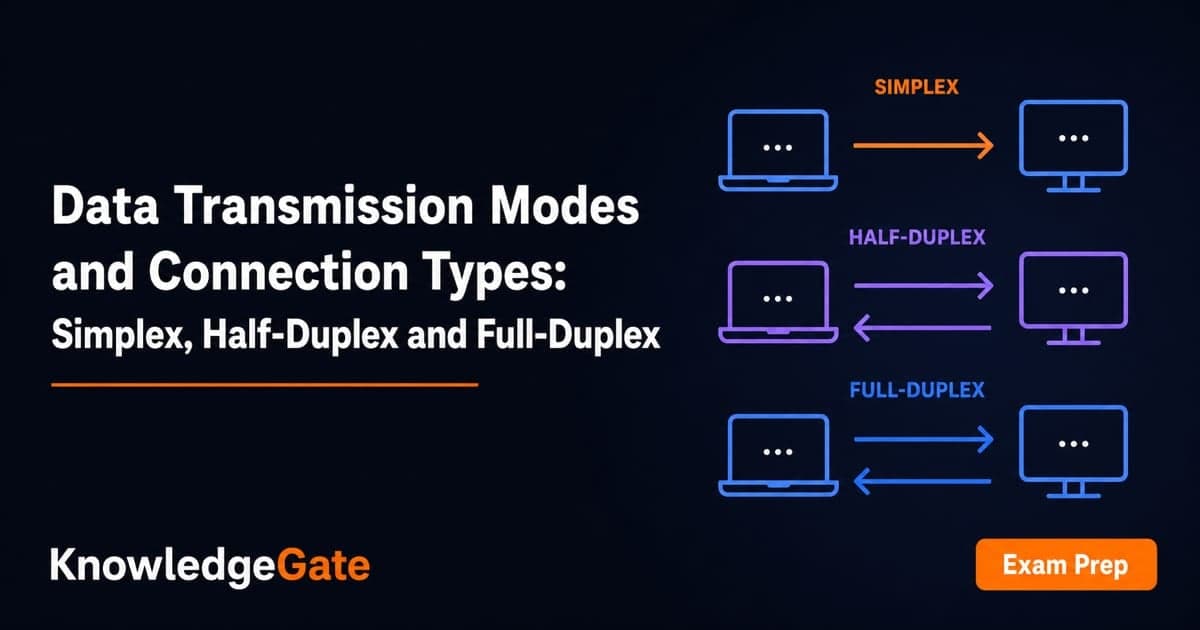
Data Transmission Modes and Connection Types: Simplex, Half-Duplex and Full-Duplex
Learn to classify simplex, half-duplex, full-duplex, point-to-point and multipoint links, then calculate completion time without relying on memorised examples.
Updated 22 Oct 20265 min readComputer Networks
Computer Networks Interview Questions: Trace OSI, TCP/IP and Routing Step by Step
Follow one synthetic web request across DNS, ARP, TCP, NAT and longest-prefix routing, then turn each step into a strong interview answer.
Updated 18 Oct 20266 min readComputer Networks
Basics of Cyber Security: CIA Triad, Risks and a Worked Defence
Learn a consistent security vocabulary, connect common attack paths to suitable controls, and calculate how two defensive layers reduce account takeovers.
Updated 14 Oct 20266 min readComputer Networks