MCA Entrance Eligibility: NIMCET vs CUET PG Degree Rules and Admission Routes
Check whether your degree fits the NIMCET route or only clears the first CUET PG gate, then map the documents, paper code and counselling path you need.
KnowledgeGate Team
Exam prep & CS education
Updated 28 Jul 20265 min read80 views
Being allowed to write an entrance test is not always the same as being eligible for the MCA seat behind it. Five things decide which side of that line you fall on: your degree type, your Mathematics or Statistics history, how the aggregate is calculated, the colleges you are targeting, and who runs the counselling. NIMCET settles all five in one centrally stated eligibility gate. CUET PG splits them, with an NTA test gate first and university-specific admission gates after it. Use MCA Entrance Exam Preparation as a route hub while you work through them.
Related reading: CUET PG MCA paper map and NIMCET syllabus.
MCA entrance eligibility starts with the destination, not the exam name
List target institutes, map each to an exam, then test your degree against current rules. "MCA entrance" is not one national eligibility standard.
For each route, check five things in the official documents: which institutes you can actually be admitted to (the participating list changes every cycle), who sets the eligibility to sit, who sets the eligibility for admission, how the score or rank is handed over, and who runs counselling. NIMCET answers all five centrally in its information brochure. For CUET PG, the NTA bulletin answers the test-side questions and each university's MCA page answers the rest.
The NIMCET 2026 Information Brochure places its participating institutes on a single rank and central-counselling route; the exact list of participating institutes changes by cycle, so take it from the current brochure. The CUET PG Information Bulletin works the other way round: NTA supplies the scores, and each university checks the programme rules and runs its own counselling. So the shortlist of colleges comes first. Once you know which universities you are aiming at, the CUET PG MCA Pattern: Mathematics, Reasoning and Computer Topic Map tells you what the paper itself will ask of you.
NIMCET eligibility applies one central degree-and-marks gate
The 2026 NIMCET brochure required Indian nationality plus either a minimum three-year undergraduate programme with Mathematics or Statistics, or a recognised B.E./B.Tech. It specified 60% or 6.5/10 CGPA, relaxed to 55% or 6.0/10 for SC, ST and PwD candidates.
Two things follow from the way that gate is written. A high BCA percentage cannot repair a missing subject, because Mathematics or Statistics sat on a separate branch of the rule that marks could not offset; a B.E./B.Tech candidate qualified on the engineering branch instead, so the subject condition was not applied separately. And the aggregate was taken over every subject in every year, language, optional and additional subjects included, not over your core papers alone.
Candidates still waiting on a qualifying-examination result could apply, with the claim staying conditional until proof was produced. Sitting the paper was never a seat in itself: the rank it earns is an entry ticket to central counselling, where documents are verified against the rules of that cycle before anything is allotted.
CUET PG eligibility has two gates, NTA first and the university second
In 2026, CUET PG allowed bachelor's degree holders or equivalent and final-year candidates to appear. It set no test age limit, but universities could apply age and programme rules.
Permission from NTA to sit the paper does not certify that you are eligible for any particular MCA programme. Universities can add their own degree, subject, minimum-marks, age, reservation and programme conditions on top of it, and each one counsels from the NTA scorecard on its own timetable.
The bulletin assigns subject paper codes each cycle, and the code relevant to Computer Science and IT candidates can change between cycles. Not every MCA programme accepts the same code, so verify the exact paper code your target university's MCA page names against the current CUET PG bulletin.
For each target university, note five things from its official MCA admission page: the exact programme name, the accepted test-paper code, the degree and subject rule, the minimum-marks rule, and the counselling portal.
MCA eligibility worked examples: the same profile can split
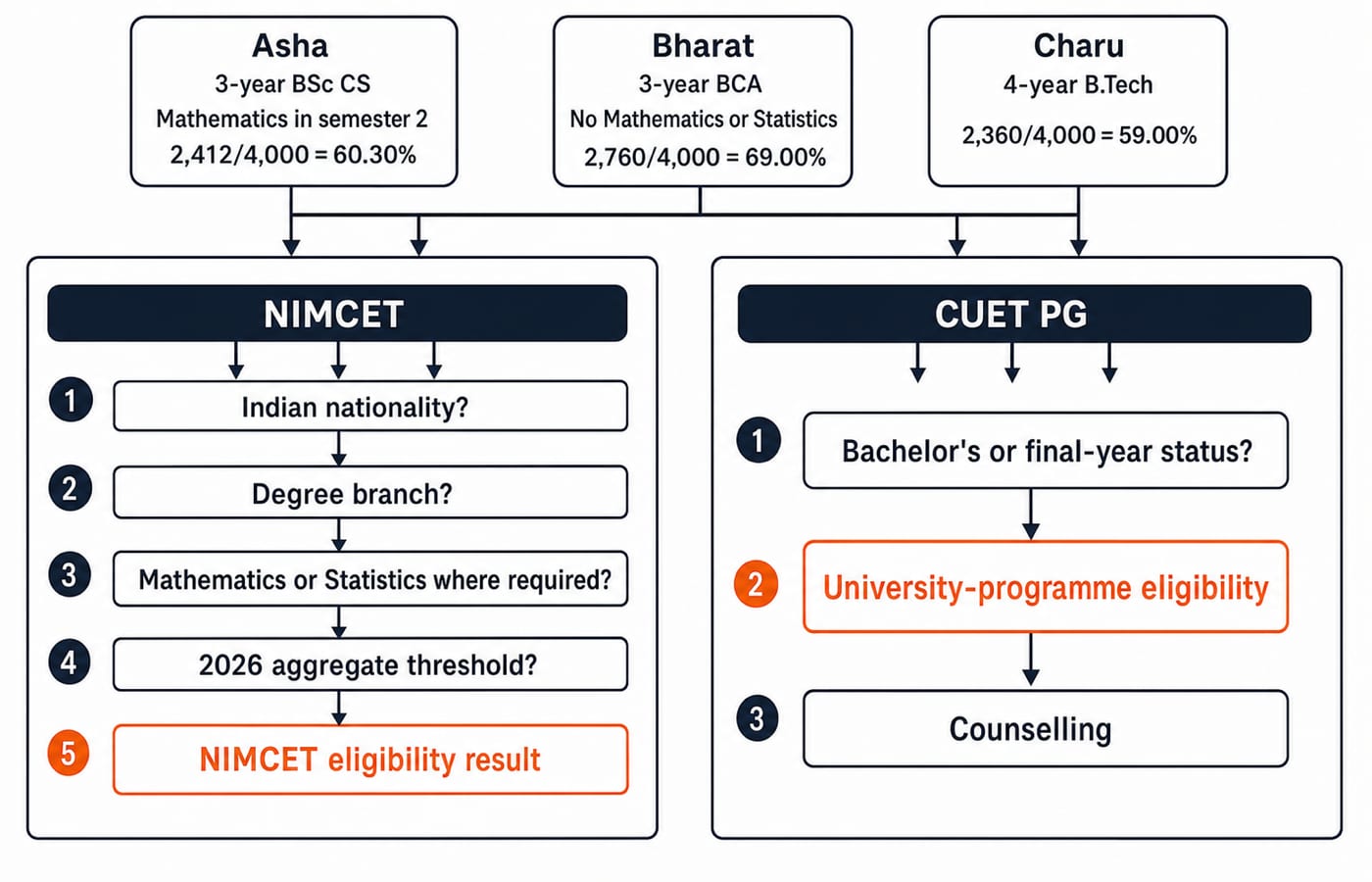
Asha: Indian, general category, three-year BSc Computer Science, Mathematics in semester 2. Her all-subject result is 2,412 / 4,000 x 100 = 60.30%. She clears the 2026 NIMCET degree, subject and percentage checks. She also clears the CUET PG test gate, but not yet a university's MCA gate.
Bharat: Indian, general category, three-year BCA, no Mathematics or Statistics. 2,760 / 4,000 x 100 = 69.00%. He fails the 2026 NIMCET subject branch despite higher marks. He clears the CUET PG test gate, but is unresolved until university eligibility is checked.
Charu: Indian, general category, four-year B.Tech. 2,360 / 4,000 x 100 = 59.00%. The engineering branch solves the subject question, but she misses the 2026 NIMCET general threshold. She clears the CUET PG test gate, subject to university MCA criteria.
NIMCET vs CUET PG application routes need different evidence maps
Prepare this evidence sheet before you open either form. The documents overlap almost completely; the place each one gets checked does not.
Evidence | Asha's record | Where it is checked |
|---|---|---|
Exact degree title | BSc Computer Science | NIMCET brochure, and every university MCA page |
Duration and completion status | Three years, completed | Both routes |
Mathematics/Statistics evidence | Mathematics, semester 2 transcript | NIMCET gate; only some university rules |
All-subject aggregate method | 2,412 of 4,000 across six semesters | NIMCET percentage check |
Target-programme eligibility page | Add one official page per university | CUET PG universities only |
For NIMCET, map one rule set through application, rank and counselling. For CUET PG, track the NTA application and code, scorecard, and each university's process.
Ask the official helpdesk or university if subject evidence or aggregate method is unclear, or the MCA page names another code. SSC CGL Eligibility 2026: Age, Attempts, Education offers another evidence checklist, but its rules do not transfer.
MCA preparation overlaps, but eligibility and syllabus do not become identical
Preparation block in the MCA entrance course | Why it transfers | What still needs an official filter |
|---|---|---|
Quantitative Aptitude and Math | Shared numerical base | NIMCET syllabus and accepted CUET PG code |
Logical and Analytical Reasoning | Shared reasoning | Route syllabus |
Computer Awareness and CS Fundamentals | Common CS base | Programme and code syllabus |
English Language and Comprehension | Shared language practice | Route requirements |
The course organises common work for NIMCET, CUET PG, MAH CET, JECA and other entrances. It cannot decide eligibility, choose a code or replace counselling instructions.
If Asha keeps both routes, she builds one base across all four blocks, then keeps the NIMCET checklist and one for each CUET PG university and accepted code.
MCA entrance eligibility: the short route check before preparation
Before planning preparation:
Write your target colleges.
Map each accepted exam.
Classify your degree branch.
Find Mathematics or Statistics evidence.
Calculate the aggregate by the current official method.
Verify CUET PG programme and paper-code rules university by university.
Identify who runs counselling on each route you are keeping.
NIMCET asks whether one qualification gate and counselling route fit your profile. CUET PG asks whether you may sit, then whether each university accepts your degree and code.
After both checks, use the MCA Entrance Exam 2026 Course to organise Mathematics, reasoning, CS and English. Settle unresolved checks with the official documents before planning.
Keep learning
CUET-PG CS vs NIMCET: One Shared-Core Plan for MCA Entrance Prep
Prepare for both MCA entrances with one shared core and two thin exam-specific wrappers: an overlap sheet built from the official documents, a coverage-and-accuracy diagnostic, and a twelve-hour week that survives missed days.
Updated 22 Aug 20266 min readMCA Entrance
CUET PG Computer Science Mock Analysis: Build a Study Plan From Every Error
A mock score cannot tell you what to revise next. Use an error log, timed re-solves, priority weights and fresh-question retests to build a practical seven-day repair plan.
Updated 20 Aug 20266 min readMCA Entrance
NIMCET vs CUET PG MCA: Choose One Exam or Prepare for Both
Compare the two MCA entrance routes, calculate mock scores correctly, and use a personal decision matrix plus a 168-hour bridge plan to choose one or both.
Updated 18 Aug 20265 min read52 viewsMCA Entrance
CUET PG Computer Science Preparation: 12-Week BCA Bridge Plan
Turn familiar BCA subjects into an entrance-ready system with a baseline audit, two maths routes, mixed objective sets and a realistic recovery calendar.
Updated 16 Aug 20266 min readMCA Entrance