CUET PG Computer Science Preparation: 12-Week BCA Bridge Plan
Turn familiar BCA subjects into an entrance-ready system with a baseline audit, two maths routes, mixed objective sets and a realistic recovery calendar.
KnowledgeGate Team
Exam prep & CS education
Updated 16 Aug 20266 min read

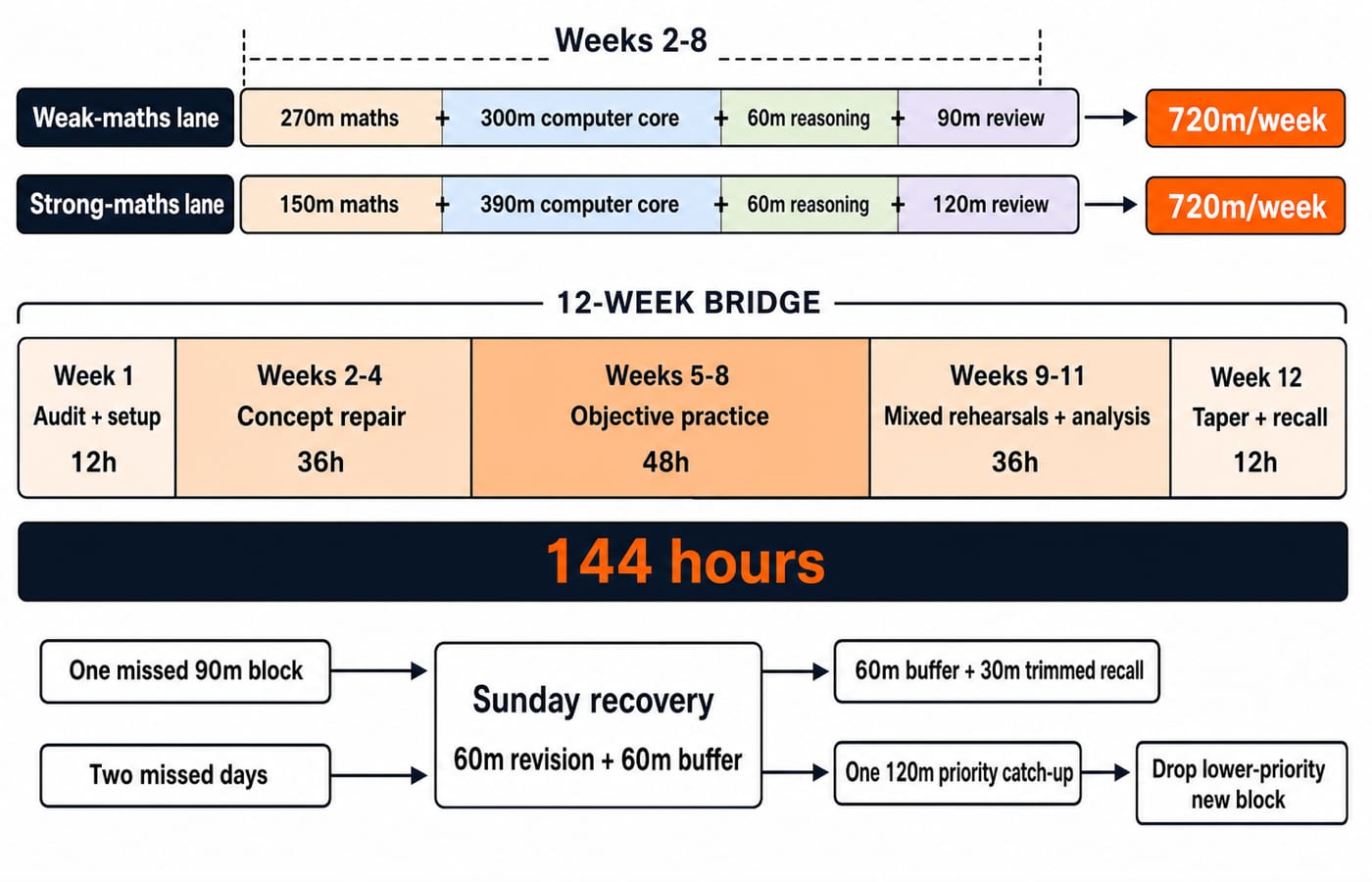
Familiar BCA subjects do not guarantee entrance-ready recall. Uneven mathematics, forgotten fundamentals and chapter-by-chapter practice hide the gaps until a timed paper finds them. Twelve weeks at twelve hours a week is 144 hours, enough to audit, repair and rehearse once each. Mathematics runs in two lanes inside that, because a solid probability score and a shaky one need different weeks.
Map your BCA baseline to the official SCQP09 syllabus
SCQP09 is the Computer Science and Information Technology code, published by the National Testing Agency. It runs to five buckets: Thinking and Decision Making, Mathematics, Operating Systems, Data Structures and Digital Fundamentals. Mathematics there is sets, probability and statistics, algebra, coordinate geometry and calculus. DBMS, Computer Networks and object-oriented programming sit outside it, which is where a BCA syllabus and this one part company; confirm it for your cycle. CUET PG MCA Pattern lays the same syllabus out section by section.
Take a 90-minute, 30-question diagnostic: 4 reasoning, 8 mathematics and 6 from each computer bucket. Label each bucket green at 80% or more, amber from 50% to 79% and red below 50%. Keep the labels per bucket; one averaged percentage hides the bucket you most need to find.
Example: reasoning 3/4 = 75% (amber), mathematics 3/8 = 37.5% (red), Operating Systems 5/6 = 83.3% (green), Data Structures 4/6 = 66.7% (amber), Digital Fundamentals 2/6 = 33.3% (red), and overall 17/30 = 56.7%. In Week 1, share 360 minutes across the red buckets, 240 across the amber ones and 120 across green. Check: 360 + 240 + 120 = 720 minutes = 12 hours. Run the same split on your own scores.
Choose the weak-maths or strong-maths route
Both routes stay at 12 hours weekly:
Route | Mathematics | Computer core | Reasoning | Error review | Total |
|---|---|---|---|---|---|
Weak maths | 270 min | 300 min | 60 min | 90 min | 720 min |
Strong maths | 150 min | 390 min | 60 min | 120 min | 720 min |
The strong route requires at least 6/8 in the baseline maths set plus the ability to explain every correct method without notes. Below that you are on the weak route, which works through sets and counting, probability and statistics, algebra and progressions, coordinate geometry, then limits, differentiation and integration. The strong route uses two mixed maths sets weekly. Three or more related errors trigger 60 minutes of concept repair.
A bag has 3 red and 2 blue balls; draw 2 without replacement. P(two red) = (3/5)(2/4) = 6/20 = 3/10. One of each can be red then blue or blue then red: P(one of each) = (3/5)(2/4) + (2/5)(3/4) = 6/20 + 6/20 = 12/20 = 3/5. Reproduce both paths after 48 hours, twice correctly, before moving probability from repair to mixed practice.
Repair the computer core in Weeks 1 to 4
Week 1 spends its audit hours on diagnosis and on the prerequisites that diagnostic exposes; the 36 repair hours run across Weeks 2 to 4. Week 2 pairs OS processes and CPU scheduling with arrays, stacks, queues, number systems and Boolean algebra. Week 3 combines synchronisation and deadlocks with trees, search structures, logic gates and combinational circuits. Week 4 joins memory and file systems with graphs, sorting, hashing, flip-flops, registers and counters. SCQP09 lists its topics without an order, so this one follows prerequisites: scheduling before synchronisation, gates before flip-flops.
Each 90-minute repair block has 35 minutes relearning from one source, 20 writing a closed-book recall sheet, 25 solving 10 objective questions and 10 logging errors. Finish only after stating the rule and solving one fresh item without notes.
For FCFS, P1 arrives at 0 with burst 5, P2 at 1 with burst 3 and P3 at 2 with burst 1. Sequence: P1: 0-5, P2: 5-8, P3: 8-9. Waiting times are 0, 5 - 1 = 4 and 8 - 2 = 6; average (0 + 4 + 6) / 3 = 10/3 = 3.33 units. Turnarounds are 5 - 0 = 5, 8 - 1 = 7 and 9 - 2 = 7; average (5 + 7 + 7) / 3 = 19/3 = 6.33 units. For the OS repair blocks, Operating Systems for GATE carries the concept explanations for scheduling, deadlock and memory; take the teaching and skip its GATE-pattern sections.
Shift to objective practice in Weeks 5 to 8
Set four weekly mixed blocks, each 25 questions with 40 minutes to attempt and 50 to analyse. The attempt clock is deliberately tight, so you practise leaving an item rather than sinking eight minutes in it; the analysis half is where the marks come from. Every block carries mathematics, reasoning and all three computer buckets.
If 17 answers are correct and 8 incorrect, accuracy is 17/25 = 68%. Classify the errors as 3 concept gaps, 2 forgotten formulas, 2 calculation or trace errors and 1 unsupported guess. Re-solve all 8 without solutions after 48 hours. If 7 are correct and only deadlock fails, schedule one 60-minute deadlock block, not the whole OS unit. Why PYQs Beat Buying Another Question Bank explains source-aware review. Count a question as a CUET PG previous-year item only when it names the year and paper it came from.
Put the 12 weeks on a calendar that survives missed days
Study 90 minutes Monday to Thursday, 60 Friday, 180 Saturday and 120 Sunday: 90 + 90 + 90 + 90 + 60 + 180 + 120 = 720 minutes = 12 hours. The first four days carry concept and objective blocks, Friday recall, Saturday mixed practice plus analysis, and Sunday 60 minutes each for revision and recovery.
Phases are Week 1 audit, 12 hours; Weeks 2 to 4 repair, 36; Weeks 5 to 8 objective practice, 48; Weeks 9 to 11 rehearsals and analysis, 36; Week 12 taper, 12. Total: 12 + 36 + 48 + 36 + 12 = 144 hours.
Recover one missed 90-minute block with Sunday's 60-minute buffer plus 30 minutes trimmed from recall. For two missed days, do one 120-minute catch-up on the highest-priority red or amber bucket and drop a lower-priority new block. Never stack three sessions next day. Below 10 hours for two consecutive weeks means repeating the phase.
Analyse mixed rehearsals in Weeks 9 to 11
SCQP09 sets 75 compulsory questions, so build the rehearsal at that length and confirm the count on the current bulletin. It publishes no sectional weightage, so the mix is yours: 10 reasoning, 20 mathematics and 15 each from OS, Data Structures and Digital Fundamentals loads the paper toward the buckets that take longest to rebuild.
Scores of 8/10, 11/20, 12/15, 10/15 and 8/15 total 49/75 = 65.3%, leaving 26 errors. Read that as an error map, not a score; marks and rank turn on the marking scheme and on the size of the year's field. Review for 120 minutes on 9 maths errors, 90 on 7 Digital Fundamentals, 60 on 5 Data Structures, 45 on 3 OS, 30 on 2 reasoning and 15 on a mixed redo. Check: 120 + 90 + 60 + 45 + 30 + 15 = 360 minutes. Log each topic, cause, correct rule, untimed result and 48-hour result.
Use a Week 12 readiness check and take the next step
Compare 44/75 = 58.7%, 49/75 = 65.3%, then 55/75 = 73.3%. A rising count with every error reviewed supports tapering. Flat or falling results with repeated causes mean repeating the repair week. The direction across the three is the signal, not the level of any one of them; no rehearsal score is a cut-off.
Final checklist: recheck the current SCQP09 syllabus; mark every topic green, amber or red; analyse three mixed rehearsals; retest red errors after 48 hours; verify next-cycle dates, duration, marking and instructions only through NTA. Week 12 needs recall sheets, selected error re-solves and one final mixed rehearsal, not a new book or unreviewed question pile.
For structure, use the MCA Entrance Exam course or browse the MCA Entrance Exam preparation category.
The short version: audit against SCQP09, pick the right maths lane, repair for three weeks, run mixed sets for four, then analyse three weeks of rehearsals before you taper.
Keep learning
CUET-PG CS vs NIMCET: One Shared-Core Plan for MCA Entrance Prep
Prepare for both MCA entrances with one shared core and two thin exam-specific wrappers: an overlap sheet built from the official documents, a coverage-and-accuracy diagnostic, and a twelve-hour week that survives missed days.
Updated 22 Aug 20266 min readMCA Entrance

CUET PG Computer Science Mock Analysis: Build a Study Plan From Every Error
A mock score cannot tell you what to revise next. Use an error log, timed re-solves, priority weights and fresh-question retests to build a practical seven-day repair plan.
Updated 20 Aug 20266 min readMCA Entrance
NIMCET vs CUET PG MCA: Choose One Exam or Prepare for Both
Compare the two MCA entrance routes, calculate mock scores correctly, and use a personal decision matrix plus a 168-hour bridge plan to choose one or both.
Updated 18 Aug 20265 min readMCA Entrance

NIMCET Mathematics Topic Priority: A Weekly Revision System
Stop revising whichever chapter feels urgent. Use dependencies, diagnostic errors, recall checks, and an eight-week loop to decide what to study next.
Updated 14 Aug 20266 min readMCA Entrance