CUET-PG CS vs NIMCET: One Shared-Core Plan for MCA Entrance Prep
Prepare for both MCA entrances with one shared core and two thin exam-specific wrappers: an overlap sheet built from the official documents, a coverage-and-accuracy diagnostic, and a twelve-hour week that survives missed days.
KnowledgeGate Team
Exam prep & CS education
Updated 22 Aug 20266 min read
If you are preparing for CUET-PG CS and NIMCET together, you may already be keeping two sets of notebooks, playlists and mock routines. That means revising the same foundation twice while still missing the differences that actually decide an application. There is a cheaper shape: build the common foundation once, then hang two small exam-specific wrappers on it. Eligibility, paper codes and marking rules come from each exam's current official notification, never from a shared summary.
CUET-PG CS vs NIMCET: define the shared core carefully
Our MCA Entrance Exam course groups preparation into four lanes: Quantitative Aptitude, Logical and Analytical Reasoning, Computer Awareness and CS Fundamentals, and English Comprehension. Those four make sensible shared buckets because the course is built for both entrances, not because either exam publishes a common syllabus. Confirm against the current official documents which of them genuinely overlap.
Settle the prior question first, because a shared core is only worth maintaining while both exams stay on your list. NIMCET vs CUET PG MCA: Choose One Exam or Prepare for Both sets the two paper shapes, marking rules and admission routes side by side and gives a weighted way to pick between them.
Where the two routes actually differ
The two exams sit in different administrative worlds. NIMCET is conducted by the NITs, with a host NIT running the exam each cycle, and one centralised counselling turns your rank into an MCA seat at a participating institute. CUET-PG is conducted by the National Testing Agency, which issues the score and stops there; each participating university then runs its own admission process against it. So one exam gives you a single queue to stand in, and the other as many queues as you have shortlisted universities.
The papers pull in different directions too. NIMCET has historically leaned heavily on mathematics alongside reasoning, computer awareness and English, while the CUET-PG computer science paper is a single domain-focused test. Question counts, section timings, marking rules and paper codes reset each cycle, so take those from the current NIMCET notification and the current CUET-PG information bulletin.
Eligibility works differently as well. NIMCET has historically applied one central degree-and-marks gate, including a mathematics requirement at 10+2 or degree level. CUET-PG has two gates, the NTA's and then the admitting university's, which means a strong score can still leave you ineligible for a particular MCA programme. MCA Entrance Eligibility: NIMCET vs CUET PG Degree Rules works that through profile by profile. Read the clauses for your own degree and your own target institutes before you commit a year of study hours.
Build a CUET-PG and NIMCET overlap sheet from official documents
Before assigning hours, build one sheet of your own. Give it a row for each preparation area and three columns: what the current NIMCET notification says, what the current CUET-PG bulletin and your target universities' pages say, and whether the area is shared or exam-specific. Next to every entry about eligibility, question counts, marks, penalties, duration, topics or seats, write which document it came from and the date you read it. A claim you cannot re-find is a claim to drop. Where a current-cycle document is not out yet, leave that row blank and dated rather than filling it from last year's coaching summary; the blank rows tell you which parts of your plan are still guesses.
Run a baseline diagnostic across the four lanes
Start with a diagnostic of your own: a fixed set of fresh questions spread across the four lanes, weighted towards quantitative aptitude and CS fundamentals. Score it twice. Coverage is the share of the whole set you got right; accuracy is the share of your attempts that were right. Say the set runs to 40 questions, you attempt 30, and 21 are correct: coverage is 21 / 40 = 52.5% and accuracy is 21 / 30 = 70%. High accuracy on low coverage means you are leaving too much untouched; low accuracy on high coverage means you are attempting past the edge of what you know. Then sort every wrong answer into a concept gap, a setup error or a careless slip. The lanes with the weakest coverage and the most concept gaps get the first claim on your hours; a lane full of careless slips needs a pacing fix, not more theory.
Use a repeatable weekly plan
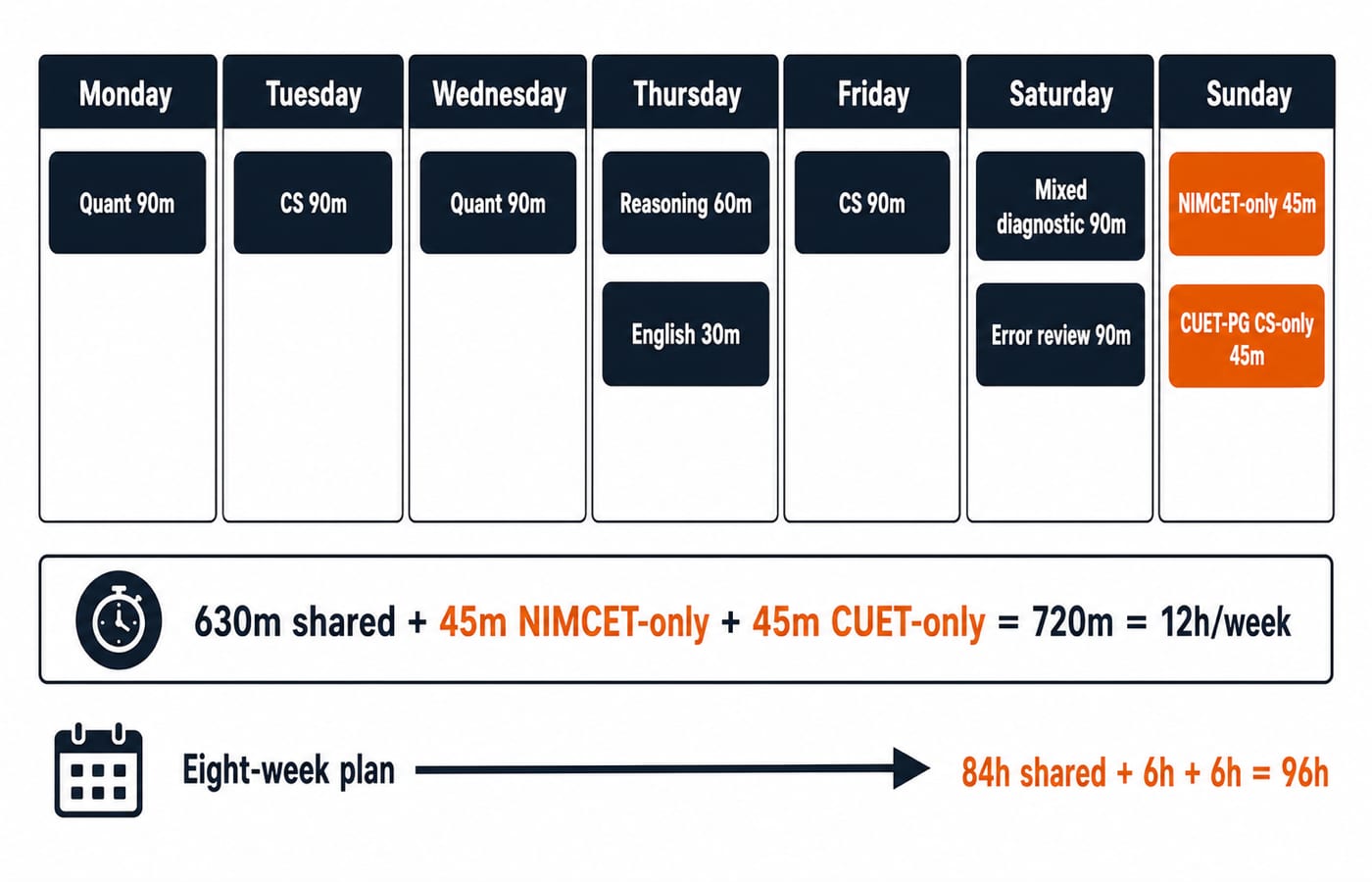
One workable weekly rhythm, repeated for eight weeks or so:
Monday: 90 minutes quantitative
Tuesday: 90 minutes CS
Wednesday: 90 minutes quantitative
Thursday: 60 minutes reasoning and 30 minutes English
Friday: 90 minutes CS
Saturday: 90 minutes mixed diagnostic and 90 minutes error review
Sunday: 45 minutes NIMCET-only and 45 minutes CUET-PG CS-only, both filled only from the official overlap sheet
That comes to 630 shared minutes plus 45 minutes on each exam's own material: twelve hours a week, and 96 hours across the eight weeks. Miss one weekday block and you use Saturday's diagnostic slot for that subject, keep the error review, and mark the diagnostic as missed. Miss two and you recover only the weaker one, then start the next week with the other. Never stack both onto a single day.
Learn each concept once, then change the wrapper
Give each shared topic one concept note, one solved example, one error log and one spaced-revision sequence. The wrapper cards hold only what genuinely differs between the two exams in format, scope or marking instructions, and you fill them from the overlap sheet rather than from memory. A wrapper card that starts growing explanations has stopped being a wrapper: move that material back into the shared note.
For example, a quantity rises from 240 to 276. The increase is 276 - 240 = 36, so the percentage increase is 36 / 240 x 100 = 15%. A later 15% fall gives 276 x 0.85 = 234.6, not 240, because the second percentage works on a different base. That reasoning is identical in both papers; only the wrapping changes, and the wrapping is what belongs on the card. When you rebuild the CS side, revise in prerequisite order rather than subject by subject: CUET PG CS: Revise Subjects in Prerequisite Order sets out that sequence.
Review progress after four weeks
Around the halfway mark, run a fresh diagnostic on the same blueprint but not the same questions, and set its coverage and accuracy against the baseline. Better numbers on comparable practice mean the routine is working. Keep NIMCET and CUET-PG mocks in two separate ledgers, each scored under its own exam's current rules, and never add their raw scores into one figure: the papers differ in question count, marking scale and maximum, so a combined total measures nothing at all. Compare each ledger only against your own earlier attempts at that same format.
Five dual-exam mistakes and their replacements
Assuming the two papers are basically the same saves planning time and hides the differences that cost marks. Keep the overlap sheet current.
Two complete plans feel thorough but duplicate shared concepts. Use one concept note and two thin wrappers.
An old pattern table feels concrete and goes stale without announcing it. Recheck the current notification before planning around any number.
One combined mock score looks simple but makes unlike rules incomparable. Keep two score ledgers.
Dropping a lane after one small sample feels efficient but distorts priorities. Repeat with fresh, comparable questions before reallocating hours.
Short version and next step
Verify both current official documents, build the overlap sheet, run a baseline diagnostic, then run the weekly rhythm with Sunday reserved for the wrappers. The whole idea is one core revised deeply, plus two thin layers kept accurate. If you would rather not assemble that yourself, the MCA Entrance Exam 2026 Course covers both papers in one place, and PG Entrance Exams collects the wider MCA and MBA route. Start the overlap sheet this week: an hour spent there saves the weeks that go into preparing for a paper your target institute does not accept.
Keep learning

CUET PG Computer Science Mock Analysis: Build a Study Plan From Every Error
A mock score cannot tell you what to revise next. Use an error log, timed re-solves, priority weights and fresh-question retests to build a practical seven-day repair plan.
Updated 20 Aug 20266 min readMCA Entrance
NIMCET vs CUET PG MCA: Choose One Exam or Prepare for Both
Compare the two MCA entrance routes, calculate mock scores correctly, and use a personal decision matrix plus a 168-hour bridge plan to choose one or both.
Updated 18 Aug 20265 min readMCA Entrance

CUET PG Computer Science Preparation: 12-Week BCA Bridge Plan
Turn familiar BCA subjects into an entrance-ready system with a baseline audit, two maths routes, mixed objective sets and a realistic recovery calendar.
Updated 16 Aug 20266 min readMCA Entrance

NIMCET Mathematics Topic Priority: A Weekly Revision System
Stop revising whichever chapter feels urgent. Use dependencies, diagnostic errors, recall checks, and an eight-week loop to decide what to study next.
Updated 14 Aug 20266 min readMCA Entrance