MCA Entrance Computer Science Prep Map: Programming, DSA and DBMS in the Right Order
Study MCA entrance computer science as a dependency chain, not a list. Trace C, reason about DSA, and carry one data set through hashing, normalisation and SQL.
KnowledgeGate Team
Exam prep & CS education
Updated 25 Jul 20266 min read
Computer science may look like one block on an MCA entrance preparation list, but programming, data structures and DBMS depend on one another. Random topic hopping creates recognition without reliable recall. Programming comes first because the ability to trace a C array by hand is what later makes a hash table and a normalised relation readable rather than memorised. One set of five marks carries that whole chain, from the loop that filters them to the SQL that groups them.
MCA entrance computer science prep map: the dependency chain
Block | Core ideas | Exit check |
|---|---|---|
Programming foundations | Data types, operators, control flow, functions, arrays, strings and structures | Trace a loop and state every value change |
DSA and algorithms | Linear structures, trees, hashing, search, sort and complexity | Draw the structure and compute the operation |
DBMS and SQL | Relational model, keys, dependencies, normalisation, queries and transactions | Identify the key, decompose the relation and trace a query |
Supporting fundamentals | Number systems, digital logic, computer organisation, operating systems and networks | Explain one mechanism rather than recall a label |
C tracing makes array and pointer behaviour concrete. DSA shows how records are organised and accessed; DBMS formalises persistent records, relationships and retrieval. Supporting fundamentals can run in parallel once programming is stable. The MCA Entrance Exam Preparation hub collects the mathematics, reasoning and eligibility strands that sit alongside computer science.
MCA entrance programming foundation: trace before memorising syntax
Build the programming block in this order: values and types; arithmetic, relational and logical operators; if and loops; functions and scope; arrays and strings; pointers; then structures. At every statement, ask three questions: what value exists before it, what operation runs, and what value exists after it.
Keep prefix and postfix separate. After int x = 5; int y = x++;, y = 5 and x = 6. Reset and run int x = 5; int y = ++x;, both variables are 6. Never combine multiple unsequenced modifications of the same variable in one expression. C Programming for Teaching CS Exams: Key Concepts works through the same operators, scope rules and array behaviour in more detail.
MCA entrance DSA and algorithms: connect representation to cost
Study arrays and linked lists before stacks and queues, followed by trees, hashing, searching, sorting and asymptotic comparison. Pair every representation with its operation and its cost: an array reaches any index in constant time but shifts the tail on an insertion, a linked list inserts in constant time once you hold the node but walks n links to reach position n, and a stack removes the latest pushed item while a queue removes the earliest enqueued one, both in constant time. A hash table maps a key to a slot in constant time on average and still needs a collision rule, which is what drags the worst case back towards a linear scan.
Reason from the stated input instead of recalling a chart. Scanning [72, 55, 83, 60, 67] for an absent value examines all five elements, the linear case in full. Binary search would settle the same question in about three comparisons, but only after an ordering condition is established. If two keys produce the same initial slot, a collision has occurred, but hashing has not failed. Apply the stated resolution method. Hashing and Collision Resolution develops that distinction further.
MCA entrance DBMS and SQL: model data before writing the query
Learn DBMS in this sequence: relation, tuple and attribute; superkey and candidate key; functional dependency; 1NF, 2NF, 3NF and BCNF; relational operations; SQL filtering, joins, grouping and aggregation; then transaction basics. Tie every term to actual records instead of collecting dictionary definitions.
A candidate key minimally identifies a tuple, and a primary key is the candidate key chosen for the design. A foreign key expresses a relationship between relations. Functional dependencies tell you what determines what, and normalisation uses those dependencies to repair redundancy. SQL answers a question over the resulting design, but a clever query does not repair a poor schema. Review the boundaries in Normalization in DBMS: 1NF to BCNF before attempting decompositions.
Programming to DBMS worked example: trace, hash and normalise the same values
Start with this C data and state:
int marks[5] = {72, 55, 83, 60, 67};
int sum = 0, count = 0;
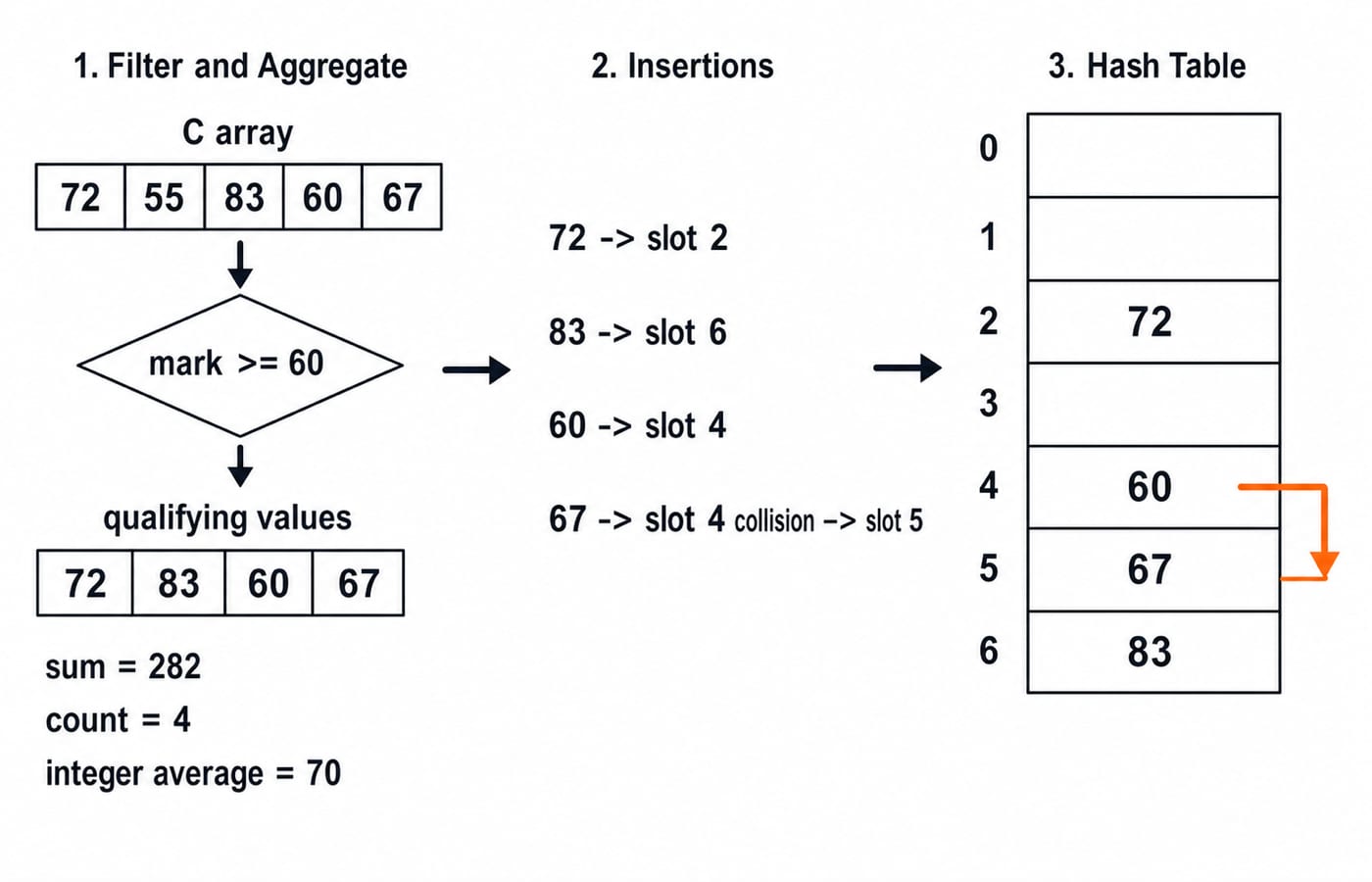
Loop through all five positions. When marks[i] >= 60, add the mark to sum and increment count. The trace is exact:
72qualifies, so(sum, count) = (72, 1).55does not qualify, so the state remains(72, 1).83qualifies, giving(155, 2).60qualifies, giving(215, 3).67qualifies, giving(282, 4).
Printing count and integer sum / count produces 4 70. Integer division truncates 282 / 4 to 70, with remainder 2; the mathematical average is 70.5.
For a seven-slot hash table with h(k) = k mod 7 and linear probing, compute 72 mod 7 = 2, 83 mod 7 = 6, 60 mod 7 = 4, and 67 mod 7 = 4. The last value collides with 60 and moves to slot 5. The final table is 0 empty, 1 empty, 2:72, 3 empty, 4:60, 5:67, 6:83.
Store all five scores in Attempt(StudentID, StudentName, TopicCode, TopicName, Score):
StudentID | StudentName | TopicCode | TopicName | Score |
|---|---|---|---|---|
101 | Asha | C01 | C Programming | 72 |
103 | Meera | C01 | C Programming | 55 |
101 | Asha | D01 | DBMS | 83 |
102 | Ravi | C01 | C Programming | 60 |
102 | Ravi | D01 | DBMS | 67 |
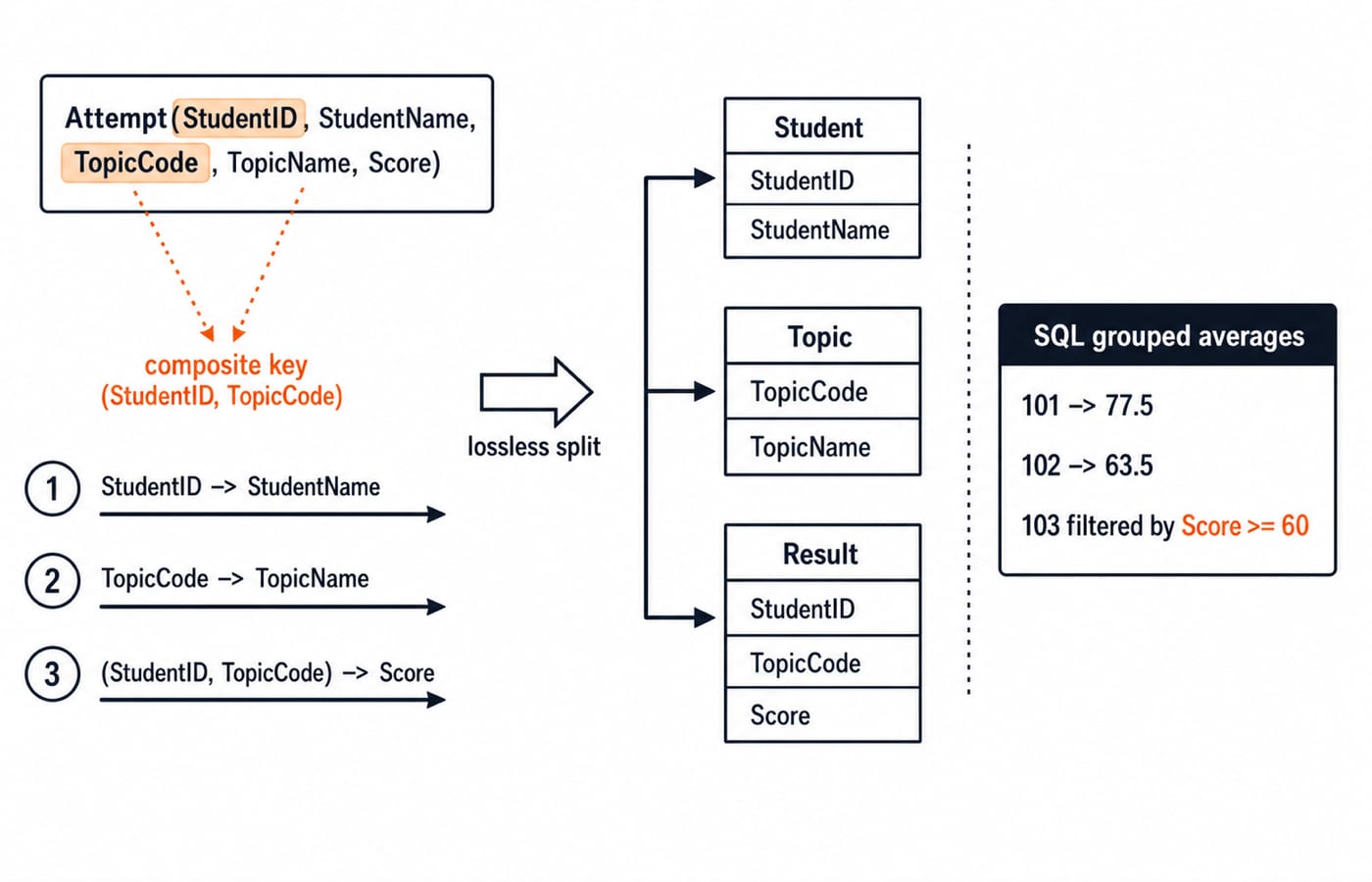
The dependencies are StudentID -> StudentName, TopicCode -> TopicName, and (StudentID, TopicCode) -> Score; the candidate key is (StudentID, TopicCode). Each name depends on only part of the key, so the relation violates 2NF. Decompose it into Student(StudentID, StudentName), Topic(TopicCode, TopicName) and Result(StudentID, TopicCode, Score).
For SELECT StudentID, AVG(Score) FROM Result WHERE Score >= 60 GROUP BY StudentID, student 101 gets (72 + 83) / 2 = 77.5, student 102 gets (60 + 67) / 2 = 63.5, and student 103 is filtered out by score 55.
MCA entrance computer science traps: what a weak study order hides
Syntax recognition without tracing. A familiar loop looks understood, so the learner skips the state table. Skip the filter and the rejected 55 joins the total, so the answer comes out 5 67 instead of 4 70. Forget that C truncates the division and it comes out 4 70.5. Keep a line-by-line (i, value, sum, count) table until every change is explicit.
Complexity and hashing by slogan. Memorising that hashing is constant-time can replace the actual calculation. The collision between 60 and 67 then disappears from the answer. Compute every initial slot, apply the stated collision rule and draw the final table.
SQL before keys and dependencies. Queries feel practical, so repeated student and topic names may look harmless. That hides the partial dependencies and the 2NF violation. Mark the candidate key and every functional dependency before decomposing or querying.
How MCA entrances test computer science concepts
Common tasks ask you to trace output, infer a structure from its operations, compare growth rates, compute a hash slot, choose a key, identify a normal form or evaluate a query. The mix differs by entrance and cycle, so use the current official bulletin for all official details.
Build your own 12-item diagnostic with three C traces, three DSA or complexity tasks, three DBMS or SQL tasks and three supporting-fundamentals questions. Give one diagnostic point per item. A result such as C 3/3, DSA 1/3, DBMS 2/3, fundamentals 2/3 says to revise DSA representations and operations first. Label each error as definition, trace, calculation, representation or query logic; revise the most frequent label, then repeat the diagnostic.
MCA entrance computer science preparation: the short version
Trace programs confidently, connect each data structure to its operations and cost, then model keys and dependencies before writing SQL. Three numbers tell you the chain is holding: 4 70 from the C program, 67 at hash slot 5 after the collision, and grouped averages 77.5 and 63.5 after normalisation. For the broader syllabus arranged as one plan, the MCA Entrance Exam 2026 Course sequences mathematics, reasoning and computer science into a single preparation route.
Keep learning
CUET-PG CS vs NIMCET: One Shared-Core Plan for MCA Entrance Prep
Prepare for both MCA entrances with one shared core and two thin exam-specific wrappers: an overlap sheet built from the official documents, a coverage-and-accuracy diagnostic, and a twelve-hour week that survives missed days.
Updated 22 Aug 20266 min readMCA Entrance

CUET PG Computer Science Mock Analysis: Build a Study Plan From Every Error
A mock score cannot tell you what to revise next. Use an error log, timed re-solves, priority weights and fresh-question retests to build a practical seven-day repair plan.
Updated 20 Aug 20266 min readMCA Entrance
NIMCET vs CUET PG MCA: Choose One Exam or Prepare for Both
Compare the two MCA entrance routes, calculate mock scores correctly, and use a personal decision matrix plus a 168-hour bridge plan to choose one or both.
Updated 18 Aug 20265 min readMCA Entrance
CUET PG Computer Science Preparation: 12-Week BCA Bridge Plan
Turn familiar BCA subjects into an entrance-ready system with a baseline audit, two maths routes, mixed objective sets and a realistic recovery calendar.
Updated 16 Aug 20266 min readMCA Entrance