MCA Entrance Logical Reasoning: A 6-Week Speed-Building Practice Plan
Build reasoning speed without rushing accuracy. This six-week plan moves from a measured baseline to pattern cards, mixed drills, error repair and missed-day recovery.
KnowledgeGate Team
Exam prep & CS education
Updated 31 Jul 20267 min read
A familiar series at home can be hard to recognise inside a mixed set, and timing yourself before you can name the family only teaches you to guess faster. MCA admission runs through more than one entrance, NIMCET and CUET PG among them, and both put reasoning alongside mathematics, so the section rewards naming the family fast and then trusting one notation for it. So the clock comes last. The figures below are one worked log; your own diagnostic replaces them. The MCA Entrance Exam Preparation hub carries the eligibility and pattern posts for each route.
1. MCA entrance logical reasoning speed starts with a measured baseline
Take an uninterrupted 20-question diagnostic, recording time and confidence:
Family | Result | Time |
|---|---|---|
Series/coding | 4/5 | 6 min |
Analogy/classification | 4/5 | 7 min |
Syllogism/directions | 3/5 | 10 min |
Arrangements/puzzles | 2/5 | 12 min |
Five questions per family is a diagnostic convenience, not a claim about any paper's section mix: that comes from your exam's official notification.
Total: 13/20 = 65% in 6 + 7 + 10 + 12 = 35 minutes. Average: 35 x 60 / 20 = 105 seconds per question.
Now build the grid that sets priority, accuracy against seconds per question: series/coding, 4/5 at 6 x 60 / 5 = 72 seconds; analogy, 4/5 at 84; syllogism/directions, 3/5 at 120; arrangements, 2/5 at 144. Arrangements are both least accurate and slowest, so they take the first repair slots. Syllogism and directions are accurate enough but slow, a notation problem rather than a knowledge gap. Bank PO Reasoning: High-Yield Topics sorts the same families by puzzle type.
2. Use a six-week, seven-hour plan instead of daily random questions
Each week holds six blocks: Monday, 60 minutes to learn and label a family; Tuesday, 75 untimed with the reason written out; Wednesday, 45 repairing Tuesday's errors; Thursday, 75 timed on the repaired families; Friday, 45 of mixed retrieval; Saturday, 120 for a mixed set, review and one clean retry. 60 + 75 + 45 + 75 + 45 + 120 = 420 minutes = 7 hours. Sunday is rest, or the recovery slot below.
Phase | Hours | Main job | Exit evidence |
|---|---|---|---|
Week 1 | 7 | Baseline; label families | Diagnostic plus grid |
Weeks 2 to 3 | 14 | Solve untimed | 8/10 with reasons in two consecutive fresh sets |
Week 4 | 7 | Reduce time | Accuracy holds |
Week 5 | 7 | Mix; skip | Three-pass log |
Week 6 | 7 | Simulation on your exam’s format | Two review cycles |
Total: 7 + 14 + 7 + 7 + 7 = 42 hours. That is a budget, not a score, and it buys one thing: no family reaches Week 6 untested. Aptitude for Placements: A 30-Day Practice Routine runs the same loop day by day; borrow the routine, not its placement question mix.
3. Build a pattern library before reducing the timer
One card per pattern, four fields: the visual cue, the first operation you try, the proof it holds across every term or clue, and the false pattern it is confused with. The fourth field saves the marks.
For 3, 8, 15, 24, 35, ?, differences are +5, +7, +9, +11, rising by 2, so the next is +13 and 35 + 13 = 48. Reject 46: it repeats +11, which explains the last gap and none of the others.
For MIND to NJOE, verify +1 on every letter: M to N, I to J, N to O, D to E. All four hold, so the same shift on LOGIC gives L to M, O to P, G to H, I to J, C to D, that is MPHJD. Two matching letters are not proof; a rule checked on two breaks on the third.
“All programmers are problem-solvers” plus “No problem-solver is careless” gives “No programmer is careless”: draw programmers wholly inside problem-solvers, then careless as a circle touching neither, so nothing inside can reach the disjoint one. That conclusion reverses safely, no careless person is a programmer, but the first premise does not: “All problem-solvers are programmers” was never stated, and assuming it is where most syllogism marks go. Sketch until stable.
4. Worked seating example: convert sentences into anchors and blocks
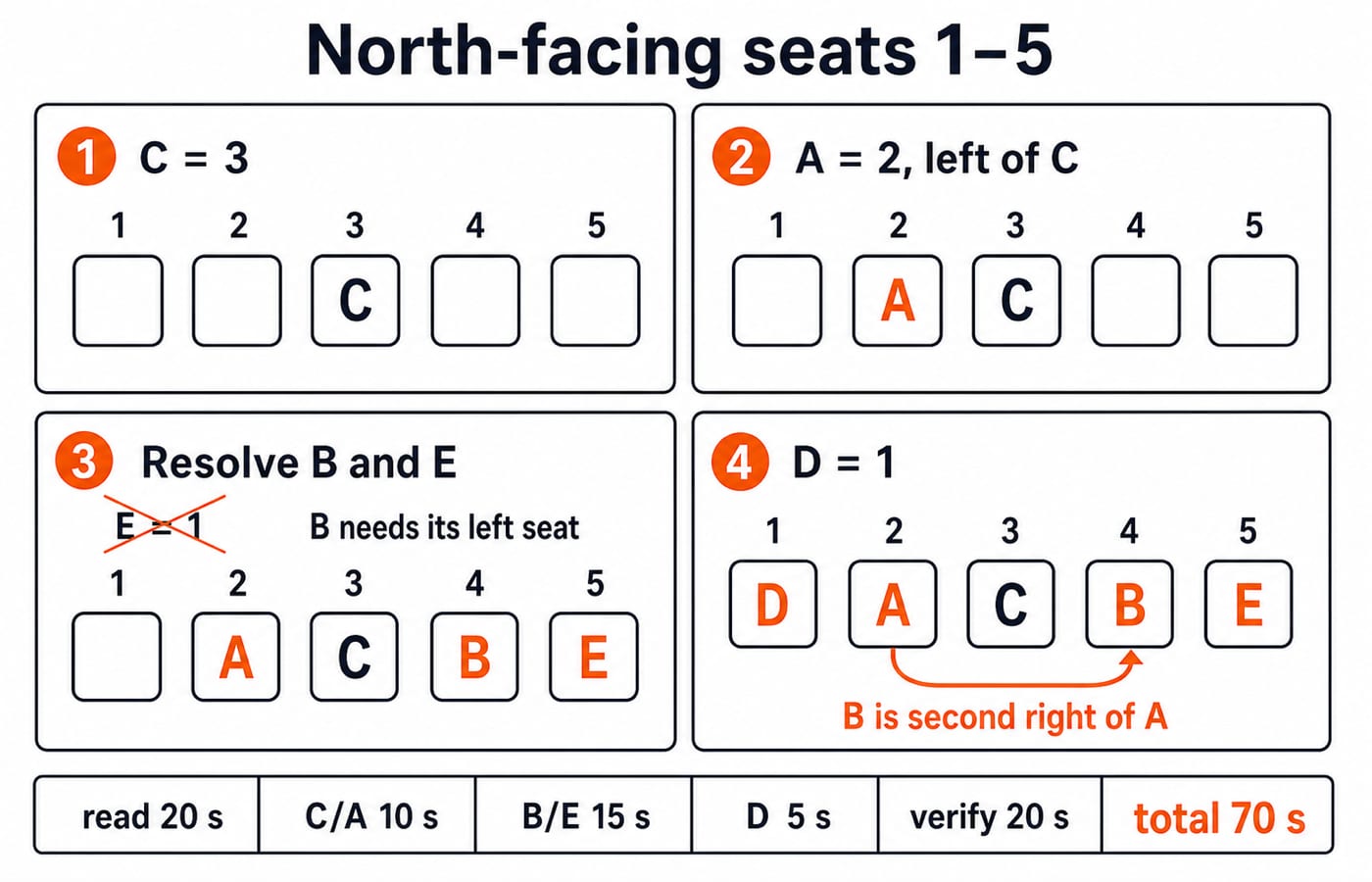
Five people face north in seats 1-5: Asha (A), Bharat (B), Charu (C), Deepak (D), Esha (E). C is middle; A immediately left of C; E at an end; B immediately left of E.
Set C = 3, then A = 2. E cannot be 1, since B needs its left seat. Thus E = 5, B = 4, and remaining D = 1: D, A, C, B, E. All clues check on a read-back. D is leftmost, and the person second to A's right sits at 2 + 2 = 4, which is B.
Log: 20 seconds reading, 10 placing C/A, 15 placing B/E, 5 filling D, 20 verifying/answering. 20 + 10 + 15 + 5 + 20 = 70 seconds, of which verifying owns 20. A long reading stage means slow notation; a long verifying stage means you did not trust your placements. Shrink verifying last.
5. Reduce time in controlled steps, then practise a three-pass mixed set
Complete two fresh sets at 8/10 or better, stating each rule/diagram. Times 18, 16, 17 minutes have median 17, and ten per cent off that median is 17 x 0.9 = 15.3 minutes, or 15 minutes 18 seconds. That is the next target, not a jump to 10: a time you can only reach by guessing is not a speed gain.
Then run the set in three passes. Pass 1, 8 minutes for eight series/coding/analogy questions; Pass 2, 10 for seven syllogism/direction/classification; Pass 3, 8 for one arrangement with five linked questions; checks, 2. Thus 8 + 10 + 8 + 2 = 28 minutes and 8 + 7 + 5 = 20 questions.
After 75 seconds without a deduction, flag it, preserve your notation and move on. You return inside the same pass, so nothing is abandoned and the half-built diagram saves you the second reading.
6. Turn every wrong answer into a repair and a fresh retest
Label the seven baseline errors by cause: two pattern-selection, two diagram or placement slips, two rushed guesses, one missed qualifier such as “only” or “at least”. “Silly” prescribes no drill. “Counted people instead of seats” does.
Family | Question cue | Chosen answer | Correct answer | Cause | Repair drill | Retest date |
|---|---|---|---|---|---|---|
Series |
| 46 | 48 | No difference row | Solve five first-difference series; verify each jump | After 4 days |
Seating | Second right of A in | E | B | Counted people | Mark A=2; move to seat 4 | After 4 days |
Retest fresh questions after four days. 17/20 = 85% in 28 minutes means 28 x 60 / 20 = 84 seconds each. Accuracy rises 85% - 65% = 20 percentage points; time falls 105 - 84 = 21 seconds, or 21/105 = 20%. Both have to move: speed gained while accuracy slips is a failed repair, not progress. Below 8/10, return untimed.
7. Recover from missed days without creating a catch-up marathon
Miss up to 60 minutes: recover at most 60 on Sunday. Miss 75 to 120: recover 60 on Sunday, then carry the remaining 15 to 60 into next week's matching block, and if something has to go, drop an extra fresh set before you drop error review. Miss at least three days: do not resume mid-plan, take a 10-question untimed check on the two weakest families and rebuild the phase.
Keep the order: learn/repair, solve fresh, review, time. Never merge missed timed sessions into a three-hour speed day; fatigue distorts accuracy and the log.
Before Week 6, settle your paper's shape. NIMCET and CUET PG do not share a section layout, so take the reasoning question count, marking scheme and time limit from your target exam's own notification and build the simulation on those numbers: a mock at the wrong length trains the wrong pacing. If your route tests mathematics alongside reasoning, CUET PG MCA Pattern: Mathematics, Reasoning and Computer Topic Map shows how the two sit together.
8. The short version: recognise, represent, verify, then accelerate
Name the family; represent it with differences, shifts, sets or seats; verify; accelerate. Run that order and the log here moves from 13/20 in 35 minutes to 17/20 in 28: 20 percentage points of accuracy bought alongside 21 seconds a question. Your numbers will differ. The order will not.
Today, take the 20-question diagnostic, work out accuracy and seconds per question, mark the least accurate family and the slowest, and calendar six blocks. If one family is both, retrace anchor, block, fill and verify on a fresh puzzle of your own.
If you would rather not assemble the six weeks yourself, the MCA Entrance Exam 2026 Course sequences the Logical and Analytical Reasoning topics this plan drills: series, coding-decoding, data sufficiency, syllogisms, seating arrangements and puzzles. Start at whichever family your grid put in the worst quadrant.
Keep learning

CUET-PG CS vs NIMCET: One Shared-Core Plan for MCA Entrance Prep
Prepare for both MCA entrances with one shared core and two thin exam-specific wrappers: an overlap sheet built from the official documents, a coverage-and-accuracy diagnostic, and a twelve-hour week that survives missed days.
Updated 22 Aug 20266 min readMCA Entrance

CUET PG Computer Science Mock Analysis: Build a Study Plan From Every Error
A mock score cannot tell you what to revise next. Use an error log, timed re-solves, priority weights and fresh-question retests to build a practical seven-day repair plan.
Updated 20 Aug 20266 min readMCA Entrance

NIMCET vs CUET PG MCA: Choose One Exam or Prepare for Both
Compare the two MCA entrance routes, calculate mock scores correctly, and use a personal decision matrix plus a 168-hour bridge plan to choose one or both.
Updated 18 Aug 20265 min readMCA Entrance

CUET PG Computer Science Preparation: 12-Week BCA Bridge Plan
Turn familiar BCA subjects into an entrance-ready system with a baseline audit, two maths routes, mixed objective sets and a realistic recovery calendar.
Updated 16 Aug 20266 min readMCA Entrance