CUET PG MCA Pattern: Mathematics, Reasoning and Computer Topic Map
Sort the current SCQP09 syllabus into practical revision folders, test each bucket with a solved checkpoint, then turn diagnostic errors into the next study block.
KnowledgeGate Team
Exam prep & CS education
Updated 23 Jul 20266 min read68 views
Your notes may already be divided into Mathematics, Reasoning and Computer Science, but that does not tell you which CUET PG MCA topics belong in each study queue or where to begin. NTA's current SCQP09 syllabus settles that in three content groups, and each group breaks into a handful of revision folders you can finish, test with one solved checkpoint, and tick off. Once the folders exist, a 30-question tally decides which of them earns your next 10 study hours. Start from the wider MCA Entrance Exam Preparation hub if you are still choosing between MCA entrance routes.
1. CUET PG MCA pattern starts with the SCQP09 syllabus map
The current NTA SCQP09 syllabus page identifies SCQP09 as Computer Science and Information Technology. Its linked syllabus groups the teachable content under Thinking and Decision Making, Mathematics, and Computer. Those three group names are the ones to plan around, so make them your top-level revision folders.
That map is the part of the pattern you can lock down today: one subject code, one syllabus, three content groups to revise. What moves between cycles is the paper's own arithmetic, so read NTA's current information bulletin and paper instructions for the question count, the marks per question, the time allowed and the negative-marking rule before you fix an attempt order. NTA's list is not a ranking either, so the folder order below is yours to choose.
The MCA entrance course further down spans several entrances, so it carries topics SCQP09 never asks for. Filter its lessons through the current SCQP09 list rather than assuming that every module belongs to this paper.
2. CUET PG MCA Mathematics topics: build five revision folders
NTA's current Mathematics list splits cleanly into five revision folders. The third column is the task that proves a folder is done, so treat it as the checkpoint rather than the reading list.
Folder | First checkpoint | One proof of readiness |
|---|---|---|
Sets and counting | Sets, union, intersection, cardinality, permutations, combinations | Count without duplication |
Probability and statistics | Probability, averages, events, distributions, central tendency, dispersion | Classify event dependence |
Algebra | Factorisation, equations, indices, logs, progressions, determinants, matrices | Solve a signed two-variable system |
Coordinate geometry | Lines, circles, conics | Find a line from two points |
Calculus | Limits, continuity, differentiation, maxima, minima, integration, area | Differentiate; evaluate an integral |
Solve x + y = 7 and 2x - y = 5. Add: 3x = 12, so x = 4. Substitute: 4 + y = 7, so y = 3. Check: 2(4) - 3 = 5. Thus (x, y) = (4, 3).
3. CUET PG MCA Reasoning topics: train rules, not memorised answers
NTA calls this group Thinking and Decision Making. Use three practice families: patterns and series, including missing terms and odd-one-out; relationships and selection using letters, words, numbers and figures; and logic, including verbal reasoning, syllogisms, unfamiliar relationships and figure-based assessment. Each family rewards a different drill: series work trains speed at finding the rule, selection work needs a written grid rather than mental juggling, and logic work means testing a conclusion against both premises before you accept it.
For 2, 6, 12, 20, 30, ?, use 1 x 2, 2 x 3, 3 x 4, 4 x 5, 5 x 6. Next is 6 x 7 = 42. Accept only rules explaining every term.
For a syllogism check, “All databases are software” and “Some projects are databases” prove “Some projects are software”, not “All projects are software”. Use Aptitude for Placements: Quant, Reasoning, Verbal to organise reasoning practice, then check its topic names against the current SCQP09 list.
4. CUET PG MCA Computer topics: organise OS, data structures and digital fundamentals
NTA's Computer list falls into three buckets, each with its own revision action:
Bucket | Scope from the current NTA list | Revision action |
|---|---|---|
Operating systems | Processes, threads, communication, concurrency, synchronisation, deadlock, scheduling, memory, virtual memory, files, I/O | Trace each mechanism |
Data structures | Arrays, sparse matrices, stacks, queues, linked lists, trees, graphs, sorting, searching, hashing, functions, recursion | Track cost and state change |
Digital fundamentals | Data types, number systems, representations, arithmetic, error codes, gates, Boolean algebra, combinational and sequential circuits, registers, counters, memory | Convert representation or trace output |
DBMS, networks and software engineering sit outside this list, so leave them out of CUET PG revision even where the course teaches them. For decimal 45, 45 = 32 + 8 + 4 + 1. At places 32, 16, 8, 4, 2, 1, the bits are 1, 0, 1, 1, 0, 1, giving 101101₂. Verify by summing. Use Computer Fundamentals for CS Teaching Exams to revise these fundamentals, keeping the SCQP09 list as your scope check.
5. CUET PG MCA diagnostic: turn 30 questions into the next 10 hours
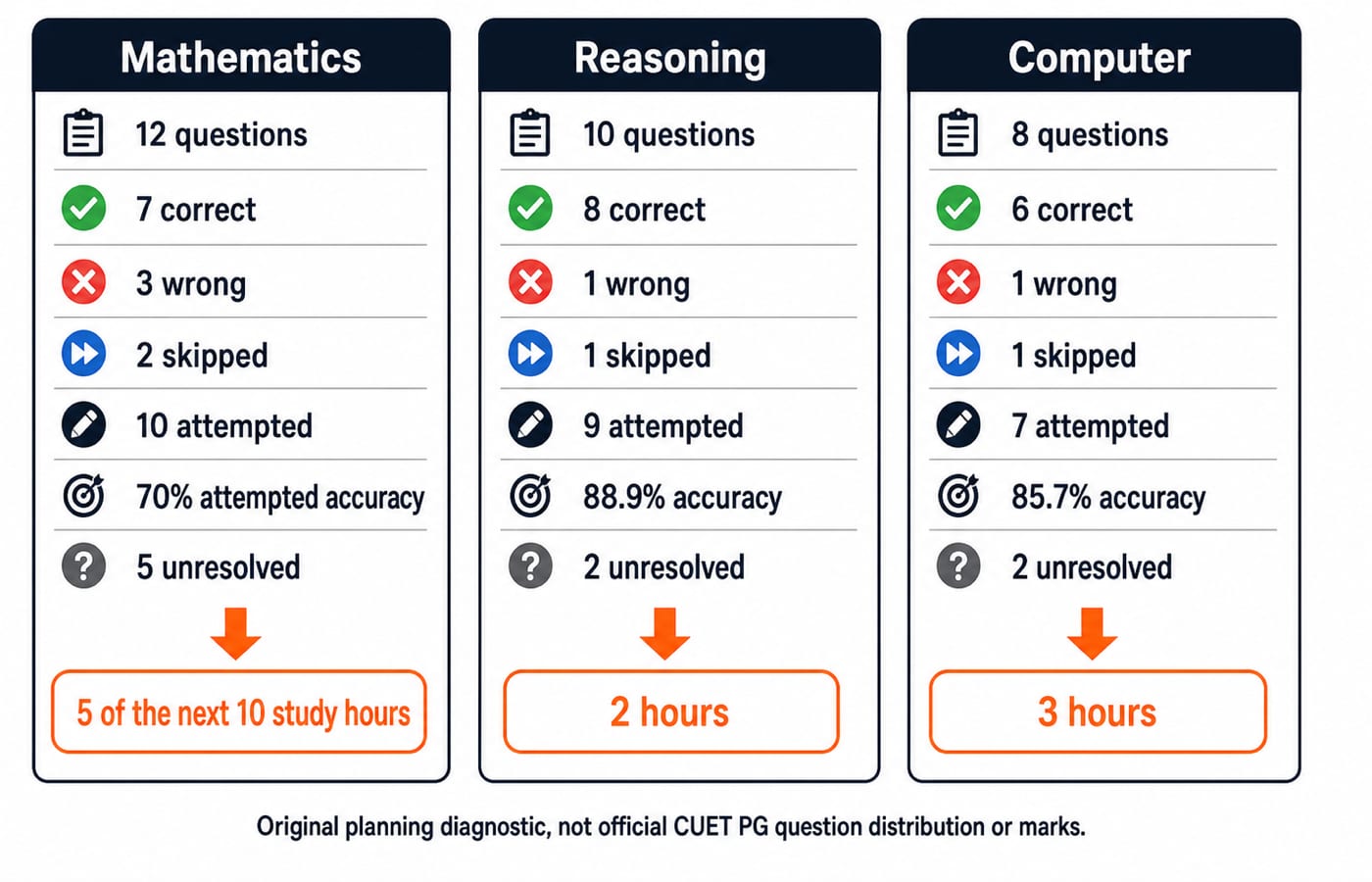
Sit a mixed 30-question set of your own, then tally it the way this worked example does: split the result by bucket, and keep what you got wrong separate from what you never attempted.
Bucket | Result | Attempted accuracy | Unresolved |
|---|---|---|---|
Mathematics | 7 correct, 3 wrong, 2 skipped |
|
|
Reasoning | 8 correct, 1 wrong, 1 skipped |
|
|
Computer | 6 correct, 1 wrong, 1 skipped |
|
|
Accuracy shows reliability on attempted questions. Wrong plus skipped shows how much repair remains. Give the next 10 hours as 5 hours Mathematics, 2 hours Reasoning and 3 hours Computer. Mathematics has the largest repair load. Computer gets three hours because two unresolved items may sit across a wide concept bucket. Reasoning gets maintenance and error review. Then take a fresh 30-question diagnostic instead of assuming improvement.
6. MCA Entrance Exam course mapping: use SCQP09 as the filter
Each SCQP09 bucket has a matching section in the course. The third column is what to open first inside it.
Current SCQP09 bucket | Matching course section | Use now |
|---|---|---|
Mathematics | Quantitative Aptitude and Math | Select NTA subtopics |
Thinking and Decision Making | Logical and Analytical Reasoning | Practise listed forms |
Computer | Operating System, Data Structures, Digital Electronics | Match NTA's list |
The MCA Entrance Exam 2026 Course covers CUET PG, NIMCET, MAH CET, JECA and more. Its extra English and CS sections earn their keep at those other entrances, so park them while you are working to SCQP09. Track two numbers separately: how far you are through the course, and how much of NTA's list you have actually covered. A topic counts as covered only once the concept and its checkpoint are both done.
7. CUET PG MCA topic map: the short version and weekly next step
Follow this loop: official map, three buckets, diagnostic, error-led hours, fresh diagnostic. Anchors are (x, y) = (4, 3), series answer 42, and 101101₂ for decimal 45.
Adjustable sample: study Mathematics for 90 minutes on Monday, Wednesday and Friday (4.5 hours), Computer for 90 minutes on Tuesday and Thursday (3 hours), Reasoning for 2 hours on Saturday, and a mixed diagnostic plus error log for 2.5 hours on Sunday. Total: 4.5 + 3 + 2 + 2.5 = 12 hours.
Work through the course with the SCQP09 list as your filter, and if NTA revises that list, update your checklist rather than keeping a topic the paper no longer asks for.
Keep learning
CUET-PG CS vs NIMCET: One Shared-Core Plan for MCA Entrance Prep
Prepare for both MCA entrances with one shared core and two thin exam-specific wrappers: an overlap sheet built from the official documents, a coverage-and-accuracy diagnostic, and a twelve-hour week that survives missed days.
Updated 22 Aug 20266 min readMCA Entrance
CUET PG Computer Science Mock Analysis: Build a Study Plan From Every Error
A mock score cannot tell you what to revise next. Use an error log, timed re-solves, priority weights and fresh-question retests to build a practical seven-day repair plan.
Updated 20 Aug 20266 min readMCA Entrance
NIMCET vs CUET PG MCA: Choose One Exam or Prepare for Both
Compare the two MCA entrance routes, calculate mock scores correctly, and use a personal decision matrix plus a 168-hour bridge plan to choose one or both.
Updated 18 Aug 20265 min readMCA Entrance
CUET PG Computer Science Preparation: 12-Week BCA Bridge Plan
Turn familiar BCA subjects into an entrance-ready system with a baseline audit, two maths routes, mixed objective sets and a realistic recovery calendar.
Updated 16 Aug 20266 min readMCA Entrance