

Logical Sequence of Words: Step-by-Step Method, Shortcuts and Solved Examples
Learn to identify the relation and direction in word-sequencing questions, join forced pairs, and verify every link through four worked patterns.
KnowledgeGate Team
Exam prep & CS education
Updated 22 Nov 20265 min read
All five words may look related, yet the correct answer depends on identifying both the relationship and its direction before arranging anything. Guessing a familiar story or merely grouping associated words is not enough. A reliable solution names the relation, direction, endpoints, forced pairs and final checks, then tests the chain against concrete examples. It fits naturally into broader placement aptitude and reasoning preparation.
What a logical sequence of words question is testing
A logical sequence question asks you to place given words or stages in an order where every adjacent move follows one consistent rule. You must make two decisions:
Relationship: Is the set about chronology, production, containment, rank or another clear connection?
Direction: Must it run first to last, raw to finished, small to large, or large to small?
Consider seed -> seedling -> plant. The relationship is growth, and the direction is earlier to later. Its reverse still contains related words, but it answers a different instruction. A valid sequence must justify both arrows, not only the first pair.
This topic is different from alphabetical order, number or letter series, and sentence rearrangement. Those use spelling, changing patterns or grammar. This task uses a conceptual relationship among words.
Recognise the main pattern families before checking options
Pattern | Question to ask | Exact mini-chain |
|---|---|---|
Chronology | What happens first? |
|
Production | What is made from what? |
|
Containment | What forms or contains what? |
|
Scale or hierarchy | Which level contains the next? |
|
For the hierarchy chain, assume the prompt states largest to smallest in the Indian administrative context.
One rule must cover every term. “Connected with writing” is too weak; verbs such as research informs drafting and proofreading precedes publishing establish the order.
If direction is missing or relation types are mixed, everyday knowledge may allow several stories. Do not invent extra events. Use the wording and choices, and flag genuine ambiguity.
The five-step shortcut: relation, direction, endpoints, pairs, check
Use this routine in the same order each time:
Name one relationship in two or three words.
Write its direction.
Find the unmistakable start and finish.
Join forced pairs or short chunks.
Read every arrow aloud as a factual sentence.
Apply it to the publication chain. The relationship is a document-production workflow. The direction is earliest work to public release. The endpoints are research and publishing. A forced chunk is editing -> proofreading -> publishing. Drafting belongs after research and before editing, giving research -> drafting -> editing -> proofreading -> publishing.
Only now should you use the options. Treat them as a checking tool: reject an option at its first impossible adjacent pair instead of rereading its whole line. You can build logical-reasoning speed from patterns because speed comes from repeatable classification, not rushed reading.
Fully worked example: build bread from its source
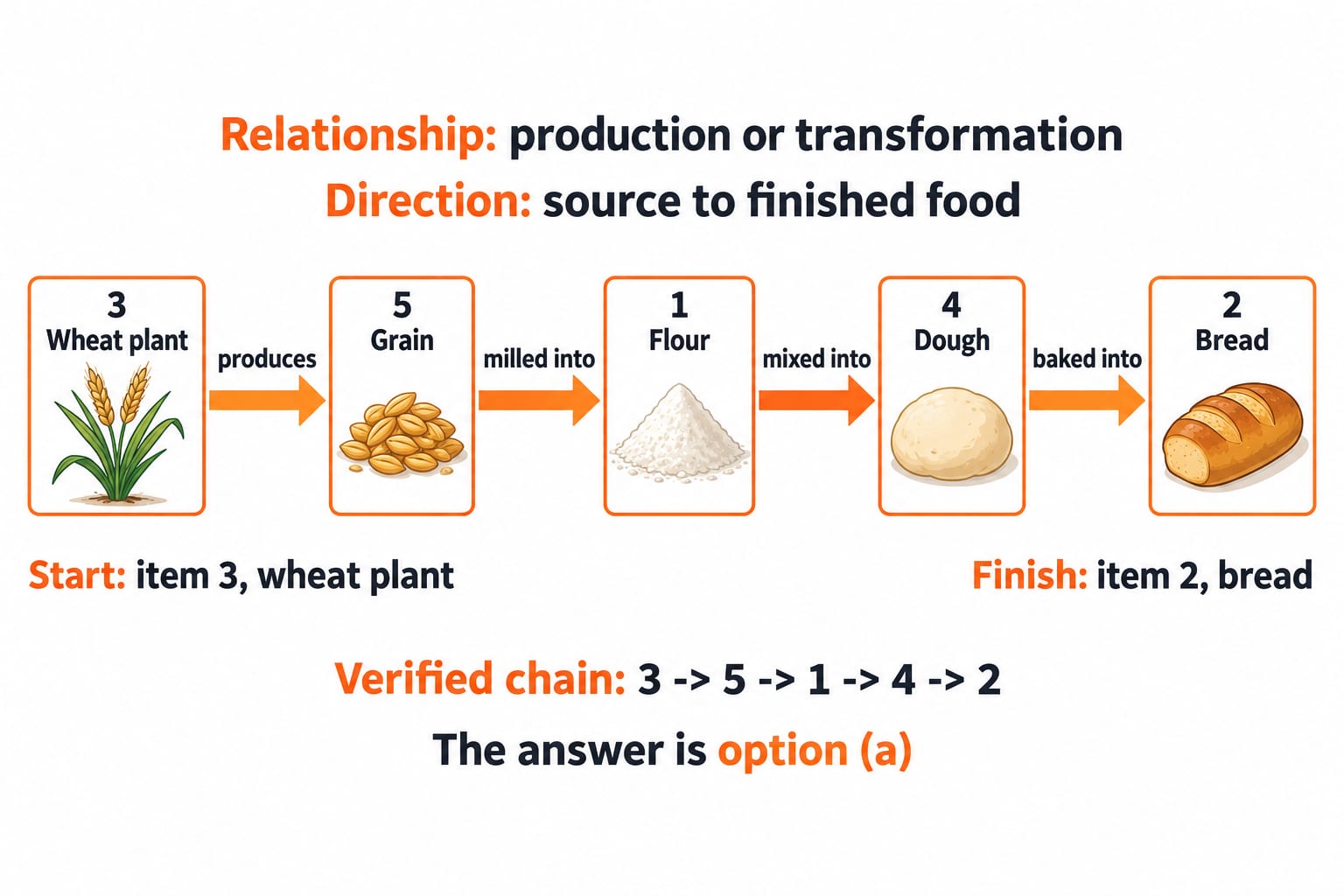
“Arrange the words in the most logical production order: (1) Flour, (2) Bread, (3) Wheat plant, (4) Dough, (5) Grain.”
(a)
3-5-1-4-2(b)
5-3-1-4-2(c)
3-1-5-4-2(d)
3-5-4-1-2
Apply the method first:
Relationship: production or transformation
Direction: source to finished food
Start: item 3, wheat plant
Finish: item 2, bread
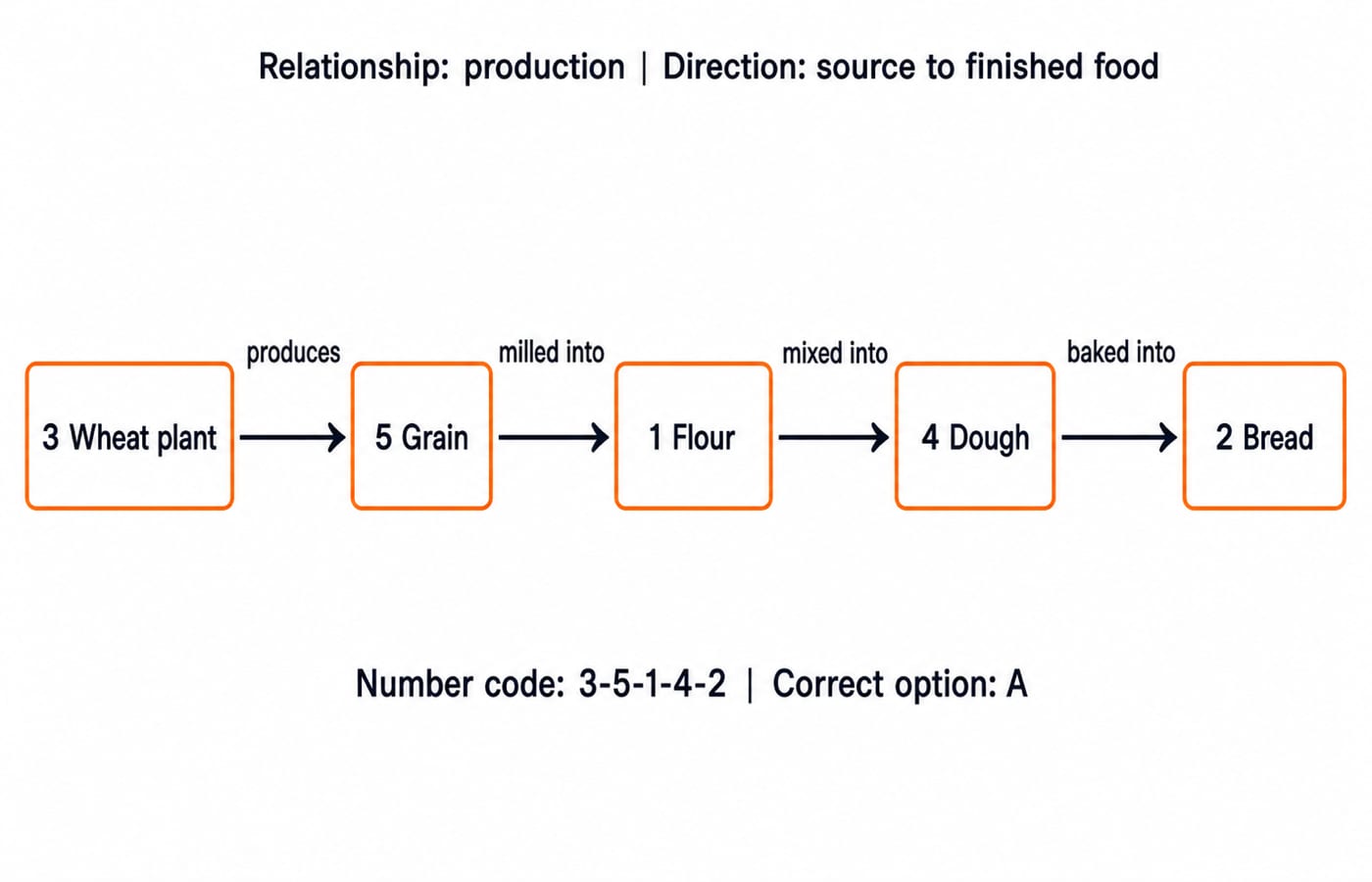
Build the forced links. A wheat plant produces grain: 3 -> 5. Grain is milled into flour: 5 -> 1. Flour is mixed into dough: 1 -> 4. Dough is baked into bread: 4 -> 2.
The verified chain is:
3 -> 5 -> 1 -> 4 -> 2
The answer is option (a). Option (b) reverses the source relationship at grain -> wheat plant. Option (c) reverses flour -> grain. Option (d) skips flour at grain -> dough, then places flour after dough.
Checking endpoints is unsafe: all four options finish with bread, and three start with the wheat plant. Only option (a) makes every adjacent conversion factual.
Three solved patterns and how their directions change
1. Containment, smallest to largest
Arrange (1) Tissue, (2) Organism, (3) Cell, (4) Organ, (5) Organ system. Cells form tissues, tissues form organs, organs work in organ systems, and organ systems make up an organism. The sequence is cell -> tissue -> organ -> organ system -> organism, so the code is 3-1-4-5-2.
2. Document workflow, earliest to latest
Arrange (1) Proofreading, (2) Publishing, (3) Research, (4) Editing, (5) Drafting. The chain is research -> drafting -> editing -> proofreading -> publishing, so the code is 3-5-4-1-2. In this stated workflow, editing structure and content comes before final proofreading.
3. Hierarchy with reversed directions
For (1) District, (2) Village, (3) Country, (4) State, (5) House, largest to smallest gives 3-4-1-2-5. If the instruction changes to smallest to largest, reverse the complete chain to 5-2-1-4-3. The words support both answers only because the requested direction changes. Do not rebuild the chain by guesswork.
Common traps and competitive-test question forms
Trap | Correction |
|---|---|
Arranging by word length or alphabet | Identify the conceptual relationship. |
Finding only one correct pair | Verify every adjacency. |
Choosing familiar events without reading direction | Write the direction first. |
Skipping an intermediate word | Use every supplied item exactly once. |
Forcing a personal story | Prefer the minimal relation supported by every word. |
The skill can be presented as a direct numbered arrangement with answer codes, a hierarchy stated in ascending or descending order, a process with one missing middle stage, or a question asking which word comes immediately before or after another. In the last form, build the full sequence first. A locally plausible pair can mislead you if its place in the complete chain is wrong.
Final check: one relation, one direction, all items used once, each adjacent arrow explainable, and the number code copied accurately.
When you combine short sequencing topics with longer puzzle practice, use the Bank PO reasoning topic guide and this timed route from reasoning basics to puzzles to organise the next stage of practice.
The short version and the next practice step
Remember five lines: name the relation; fix the direction; lock the endpoints; join forced pairs; verify every arrow. In the main example, wheat plant to bread becomes 3-5-1-4-2 because four explicit transformations support that code.
Now cover the answers in the three-pattern section and rebuild the containment and document-workflow chains from their relationship and direction. Say every adjacent link aloud. If a link cannot become a clear factual sentence, revise the chain before consulting the options.
For structured continuation across logical sequence of words and the wider reasoning syllabus, use the Aptitude for Placement course.
Keep learning
Data Sufficiency: A 5-Step Method, Shortcuts and Solved Examples
Learn to test each statement independently, prove insufficiency with two valid cases, and stop as soon as the target becomes unique. Three worked problems make the method concrete.
Updated 15 Nov 20266 min readAptitude & Reasoning

Sequence and Series: AP, GP and HP Shortcuts with Solved Examples
Learn how to recognise AP, GP and HP, choose the right term or sum formula, and check your answer through fully worked examples.
Updated 2 Nov 20266 min readAptitude & Reasoning
Logical Reasoning for Placement Tests: A Solving Method for Puzzles, Syllogisms and Series
Stop solving reasoning questions by instinct. Use one dependable procedure each for Venn syllogisms, number series and row-seating puzzles.
Updated 27 Jul 20265 min read53 viewsAptitude & Reasoning
Fallacy in Logical Reasoning: Types, Shortcuts and Solved Examples
Learn to test fallacy questions by separating the conclusion, evidence and hidden bridge. Includes conditional, survey, analogy, causation and language examples.
Updated 18 Nov 20266 min readAptitude & Reasoning