

Sequence and Series: AP, GP and HP Shortcuts with Solved Examples
Learn how to recognise AP, GP and HP, choose the right term or sum formula, and check your answer through fully worked examples.
KnowledgeGate Team
Exam prep & CS education
Updated 2 Nov 20266 min read
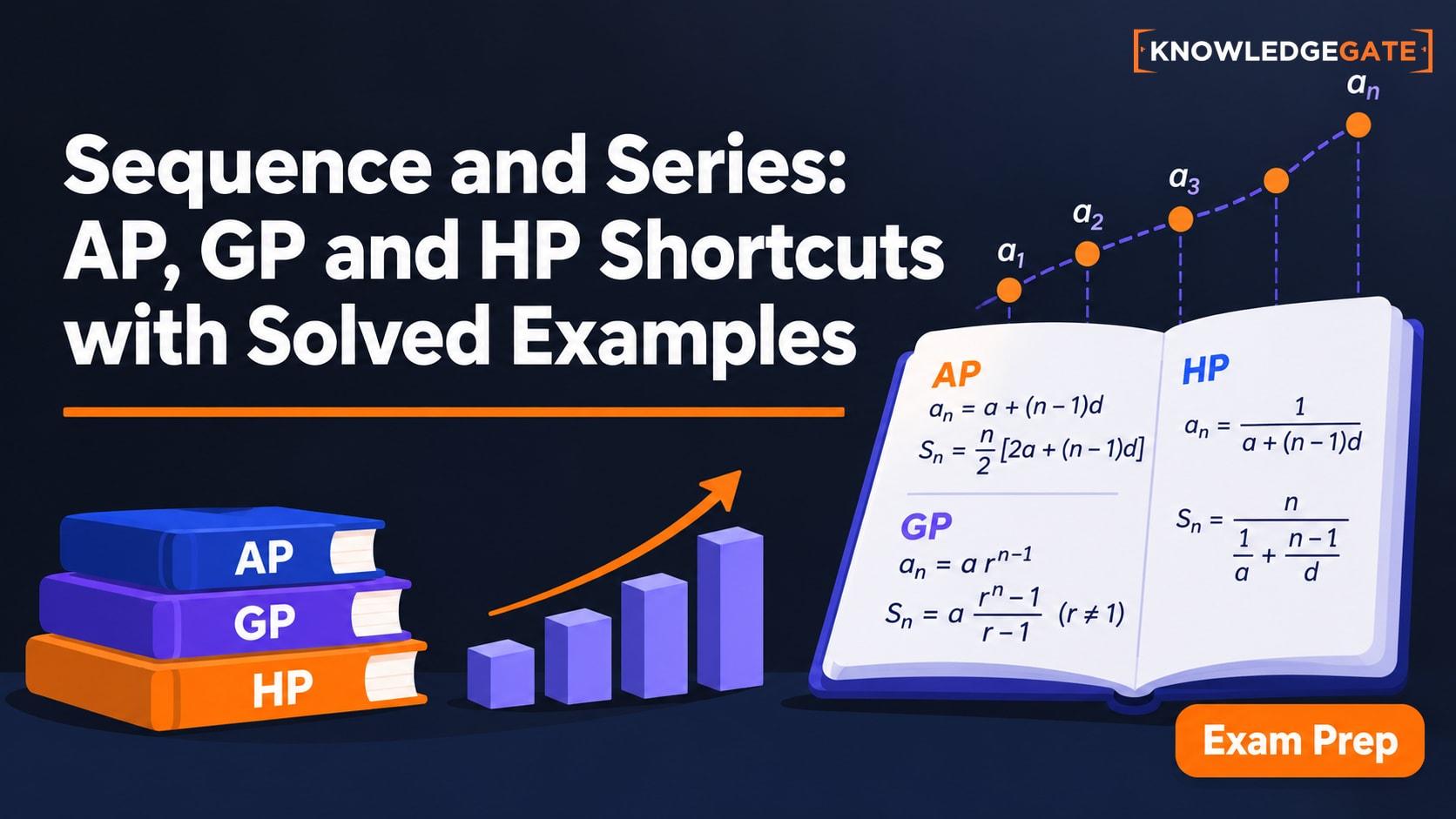
Learners often memorise separate AP and GP formulas, then lose time deciding which pattern a question contains and whether it asks for a term or a sum. A quicker method is to identify the changing quantity, choose the smallest useful formula, and check the answer against the terms. Sequences list terms; series add them. Competitive aptitude questions then ask you to recognise AP, GP or HP, select a term or sum formula, and verify the result. Reasoning-style letter series and visual series are separate topics.
1. Sequence, series and progression: make the distinction first
A sequence is an ordered list, such as 4, 7, 10, 13. A series adds its terms, so the corresponding finite series is 4 + 7 + 10 + 13 = 34.
Use a for the first term, a_n for the nth, d for common difference, r for common ratio, l for last term, and S_n for the first n terms' sum.
Type | Example | Recognition test |
|---|---|---|
AP |
| Every difference is |
GP |
| Every ratio is |
HP |
| Reciprocals |
Neither |
| Differences are |
Test equal differences, then non-zero ratios, then reciprocals for an AP. Visual plausibility does not prove a rule.
2. Arithmetic progression: nth term and sum without off-by-one errors
An AP starts a, a + d, a + 2d, .... The nth term is n - 1 jumps from the start, giving a_n = a + (n - 1)d. Its sum is S_n = n[2a + (n - 1)d]/2; with the last term, use S_n = n(a + l)/2.
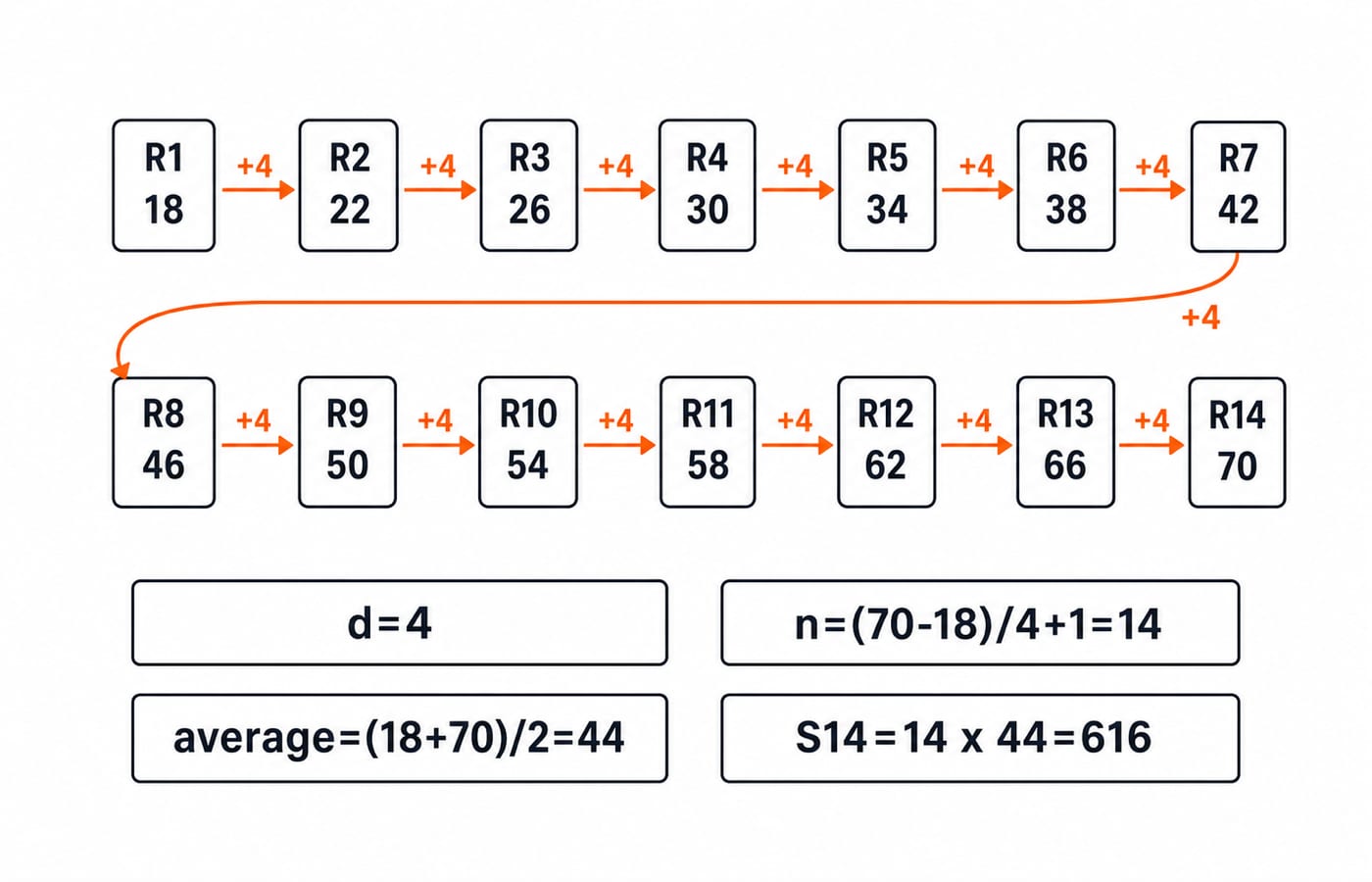
An auditorium has 18 seats in row 1, 4 more in every later row, and 70 in the last row. Then
n = (70 - 18)/4 + 1 = 14.
The rows contain 18, 22, 26, 30, 34, 38, 42, 46, 50, 54, 58, 62, 66, 70. Therefore,
S_14 = 14(18 + 70)/2 = 7 × 88 = 616 seats.
The average check, (18 + 70)/2 = 44 and 14 × 44 = 616, confirms it.
For a reverse check, 5, 8, 11, ... with S_n = 258 gives
n[10 + 3(n - 1)]/2 = 258
3n² + 7n - 516 = 0 = (n - 12)(3n + 43).
Reject the negative root -43/3; hence n = 12.
3. Geometric progression: finite growth and the infinite-sum condition
A GP begins a, ar, ar², ..., so a_n = ar^(n - 1). For r != 1, its finite sum is a(r^n - 1)/(r - 1) or a(1 - r^n)/(1 - r). Use one form to avoid mixed signs.
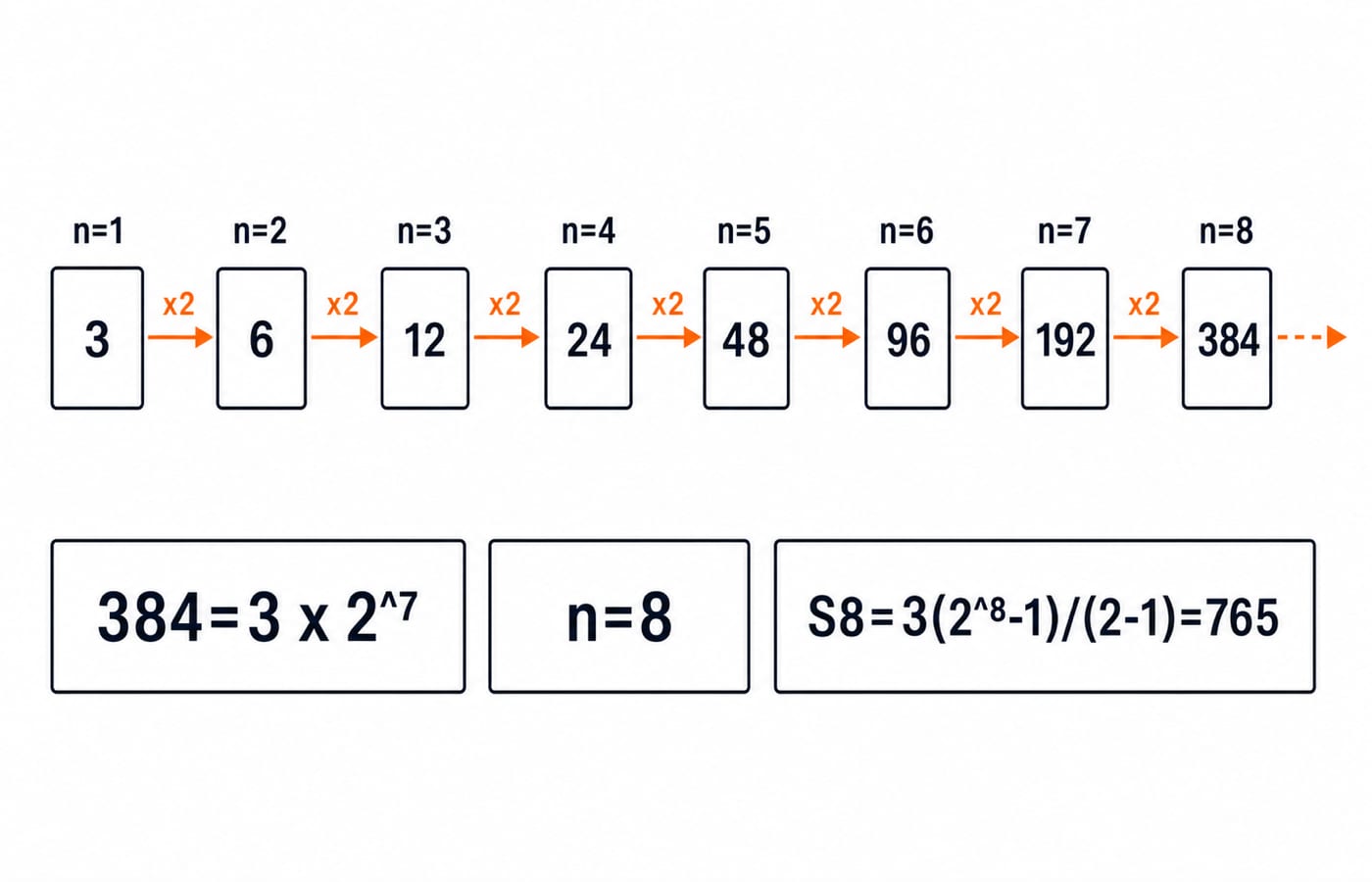
For 3 + 6 + 12 + ... + 384, a = 3 and r = 2. Since 384 = 3 × 2^(n - 1), we get 2^(n - 1) = 128 = 2^7, hence n = 8. Thus
S_8 = 3(2^8 - 1)/(2 - 1) = 3 × 255 = 765.
Check: 3 + 6 + 12 + 24 + 48 + 96 + 192 + 384 = 765.
An infinite GP needs |r| < 1. For 12 + 6 + 3 + ..., r = 1/2, so S_infinity = 12/(1 - 1/2) = 24. The r = 2 doubling GP has no finite infinite sum.
4. Harmonic progression and the AM-GM-HM bridge
Handle an HP through reciprocals, not visible differences. For 1/3, 1/7, 1/11, ..., reciprocals 3, 7, 11, ... form an AP with d = 4. Its fourth reciprocal is 15, making the fourth HP term 1/15.
For positive numbers 4 and 36:
Arithmetic mean:
A = (4 + 36)/2 = 20Geometric mean:
G = sqrt(4 × 36) = 12Harmonic mean:
H = 2 × 4 × 36/(4 + 36) = 288/40 = 7.2
Check 20 >= 12 >= 7.2 and AH = 20 × 7.2 = 144 = 12² = G². Inserting one mean between positive numbers differs from summing a progression.
5. Shortcuts that save steps without hiding the method
From 21 through 80, there are 80 - 21 + 1 = 60 integers. Their average is (21 + 80)/2 = 50.5, so the sum is 60 × 50.5 = 3030.
In 4, 9, 14, ..., 99, the seventh term from the end is 99 - (7 - 1) × 5 = 69. From the front, there are (99 - 4)/5 + 1 = 20 terms. The target is term 20 - 7 + 1 = 14, and a_14 = 4 + 13 × 5 = 69.
Three identities are:
1 + 2 + ... + n = n(n + 1)/2, so1 + ... + 20 = 210.The first
nodd numbers sum ton², so1 + 3 + ... + 39 = 20² = 400.1³ + ... + n³ = [n(n + 1)/2]², so1³ + 2³ + 3³ + 4³ = 10² = 100.
6. How competitive exams turn the concept into questions
Common tasks include recognising a progression, finding a missing or nth term, recovering n, calculating a finite or convergent infinite sum, inserting means, and translating row, instalment or growth stories.
Exam patterns can change. Check the current official notification or syllabus for your exam rather than assuming a fixed question distribution.
Try this speed drill:
The 25th term of
13, 18, 23, ...is13 + 24 × 5 = 133.For
2 + 6 + ... + 1458,1458 = 2 × 3^6, son = 7; the sum is2(3^7 - 1)/(3 - 1) = 2186.Two arithmetic means between
8and20give8, 12, 16, 20.If positive
xmakes6, x, 24a GP, thenx² = 6 × 24 = 144, sox = 12.
For extra mixed practice, use the Placement Preparation & Coding for practice. For wider preparation, see the placement aptitude guide and SSC CGL quantitative aptitude strategy.
7. Traps that turn a correct formula into a wrong answer
Off-by-one counting:
5, 9, 13, ..., 41has(41 - 5)/4 + 1 = 10terms, not9. Division counts jumps;+1counts the starting term.Term versus sum: for
2, 6, 18, 54,a_4 = 54, whileS_4 = 80. Writea_norS_nbefore substituting.Wrong progression test: do not use visible differences for an HP.
Invalid infinite sum: use it only when
|r| < 1.Formula drift: do not mix finite-GP sign conventions or replace
n - 1withn.
To repair these errors, state the progression test and requested quantity, list a, d or r, and n, substitute, then check whether the result fits.
8. The short version and the next practice step
Equal difference means AP, equal ratio means GP, and reciprocals forming an AP means HP. Then decide whether the question wants a term or a sum. This beats trying several formulas.
Redo the seating and doubling examples without looking, then use the 30-day aptitude routine to schedule mixed practice. For guided coverage of aptitude, reasoning and verbal ability, explore Aptitude for Placement.
Keep learning
Alphabet Series Reasoning Questions: Position, Gap and Reverse-Alphabet Methods
Learn a fixed method for alphabet-series questions, with forward and reverse positions, gap patterns, alternating streams, letter pairs, and checked examples.
Updated 30 Oct 20266 min read98 viewsAptitude & Reasoning
Logical Reasoning for Placement Tests: A Solving Method for Puzzles, Syllogisms and Series
Stop solving reasoning questions by instinct. Use one dependable procedure each for Venn syllogisms, number series and row-seating puzzles.
Updated 27 Jul 20265 min read53 viewsAptitude & Reasoning
TCP Header Fields MCQs: 12 Solved Questions on Sequence Numbers, Windows and Checksums
Solve 12 TCP header questions with the original stems and options, then check clear explanations for fields, sequence space, windows, checksums and payload size.
Updated 18 Nov 20267 min readComputer Networks MCQs
Go-Back-N Protocol MCQs: 12 Solved Questions on Windows, Sequence Numbers and Utilisation
Attempt 12 published Go-Back-N questions, then check every unit conversion, window calculation, retransmission step and answer against a worked explanation.
Updated 13 Nov 20268 min readComputer Networks MCQs