

Inequality Reasoning: Concepts, Shortcuts and Solved Examples
Turn inequality statements into reliable conclusions. Learn how to connect chains, preserve the guaranteed relation, decode symbols, and test doubtful cases with values.
KnowledgeGate Team
Exam prep & CS education
Updated 21 Nov 20265 min read
Inequality symbols are easy, yet they cost marks when relations are joined without a valid path or a possible conclusion is treated as definite. Use one sequence: translate, form a continuous chain, retain the guaranteed sign, and test doubtful conclusions with values. Reasoning inequalities compare ordered relations without solving algebraic equations.
Inequality symbols and what each one guarantees
The five basic relations are:
A > B: A is greater than B.A < B: A is less than B.A >= B: A is greater than or equal to B.A <= B: A is less than or equal to B.A = B: A and B are equal.
The signs > and < are strict because equality is excluded. The signs >= and <= are weak because equality is allowed. Equality can pass through a chain without changing its direction.
You can reverse a relation if you also reverse its sign. A > B means the same as B < A. With A=8 and B=5, both statements are true. Similarly, C >= D is equivalent to D <= C. If C=D=6, both weak relations hold.
The governing test is simple: a conclusion is definite only when every assignment satisfying the statements also satisfies that conclusion. One valid counterexample is enough to reject it as definite.
Build one continuous chain before judging conclusions
Consider:
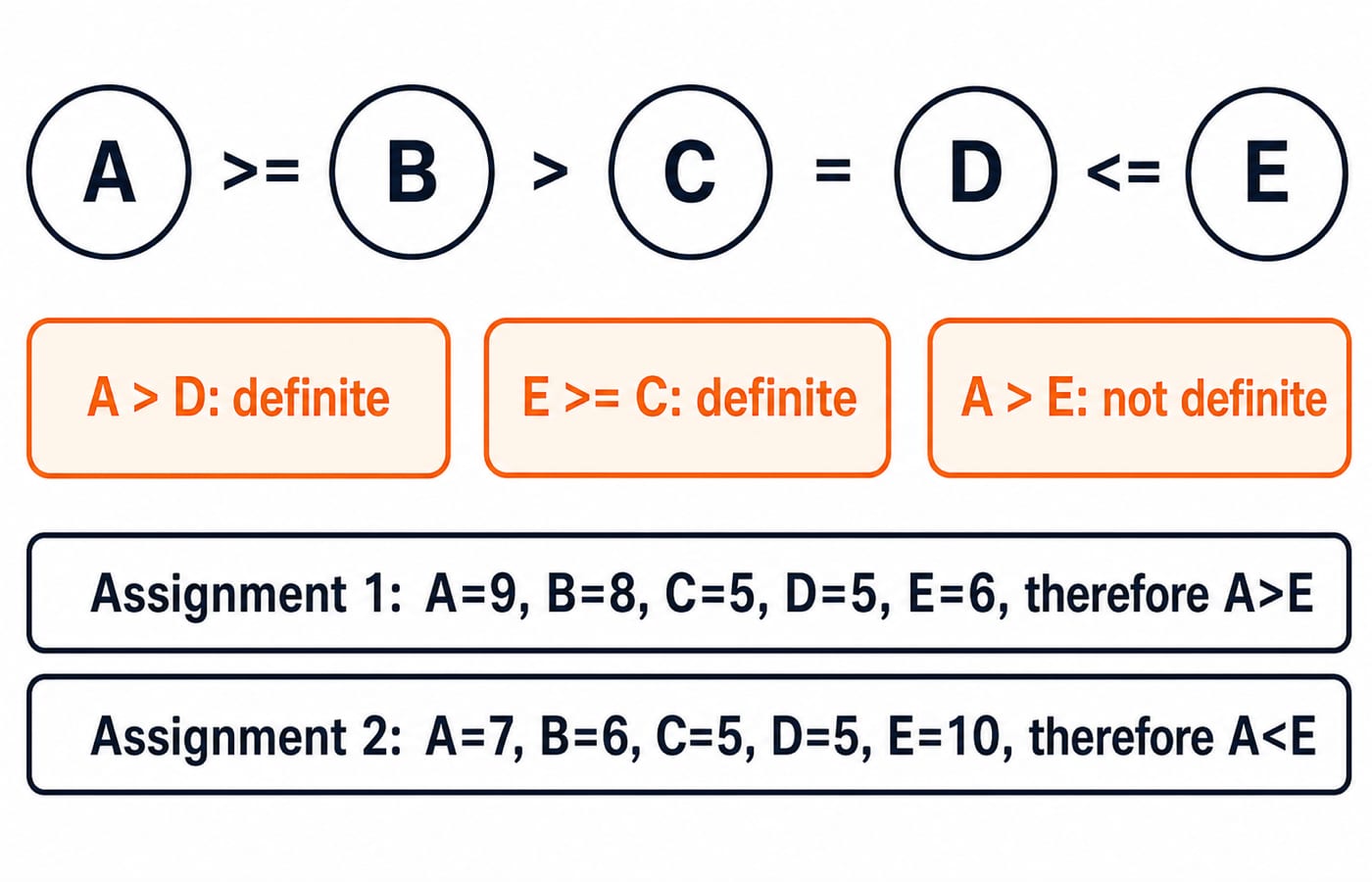
A >= B > C = D <= E
A > Dis definite. FromA >= B,B > C, andC = D, A must be greater than D.E >= Cis definite. SinceC = DandD <= E, E must be greater than or equal to C.A > Eis not definite. The direction changes at D, so the chain gives no fixed comparison between A and E.
Prove the last result with two assignments. For A=9, B=8, C=5, D=5, E=6, every relation holds and A > E. For A=7, B=6, C=5, D=5, E=10, every relation still holds but A < E. Neither outcome is guaranteed.
The speed shortcut: follow one direction and keep the weakest sign
Arrange the required letters in order, then combine only relations pointing consistently in one direction. If one link is strict, the final relation is strict. If every link is weak or equal, retain the weak sign.
For example, K >= L = M > N gives K > N. K may equal L, and L equals M, but M is strictly greater than N. That one strict link makes the end-to-end conclusion strict.
Now consider M < N <= O = P > Q. You can conclude M < O, and P > Q is already stated. You cannot compare M with Q because the direction reverses after P.
Three witnesses confirm that the pair is unknown:
M=2, N=4, O=7, P=7, Q=5satisfies the chain and givesM < Q.M=6, N=7, O=9, P=9, Q=1satisfies the chain and givesM > Q.M=3, N=4, O=7, P=7, Q=3satisfies the chain and givesM = Q.
When less than, greater than, and equality can all occur, no single relation follows.
Decode coded inequalities before solving them
Coded questions change the symbols, not the logic. Rewrite them in ordinary signs before checking conclusions.
Code | Meaning |
|---|---|
|
|
|
|
|
|
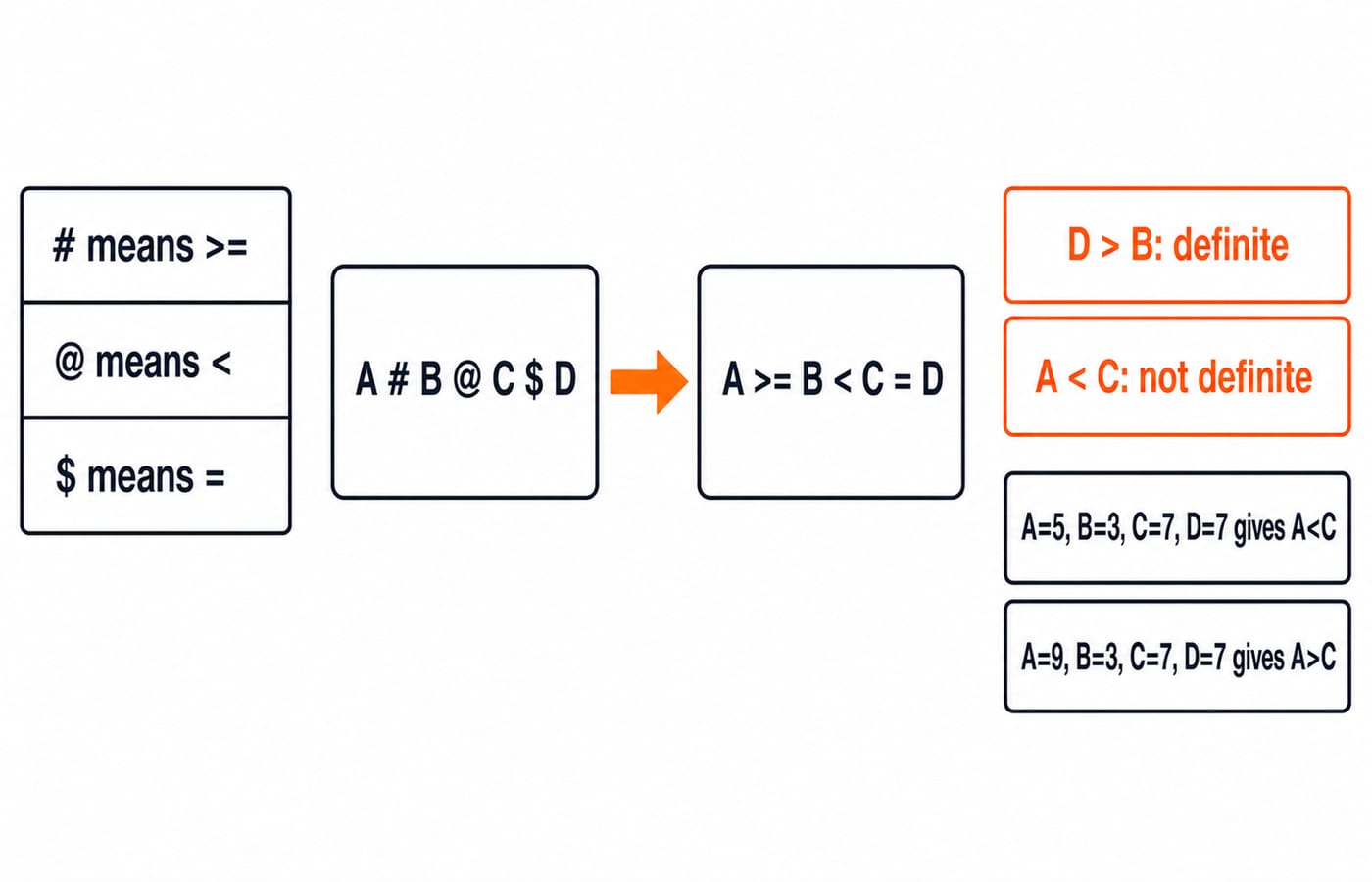
Decode A # B @ C $ D as:
A >= B < C = D
The conclusion D > B is definite because B < C and C = D. However, A < C is not definite. With A=5, B=3, C=7, D=7, the decoded statement holds and A < C. With A=9, B=3, C=7, D=7, it still holds, but now A > C. The second valid assignment breaks the proposed definite conclusion.
Definite, possible, and either-or conclusions
Suppose K >= L. The relation K >= L is definite. The stricter conclusion K > L is only possible, as shown by K=8, L=5. Equality is also only possible, as shown by K=L=5. Neither K > L nor K = L is definite on its own.
An either-or pair works only when its alternatives are mutually exclusive and together cover every allowed case. Given H <= J, the conclusions H < J and H = J cannot both hold, but one of them must hold. They form an exhaustive pair.
By contrast, H > J and H = J are not exhaustive. The valid assignment H=4, J=7 fits neither. Follow the actual test's instructions for possibility and either-or labels because conventions differ.
Four inequality traps to catch before they cost a mark
Trap | Quick counterexample or check | Correction |
|---|---|---|
Upgrading |
| Retain the weak sign |
Joining across |
| Mark R versus T unknown |
Reversing a sign incorrectly |
| Reverse it as |
Comparing disconnected letters |
| Do not infer a relation |
Before selecting an answer, run a ten-second audit:
Does the compared pair share a continuous path?
Does the direction reverse anywhere on that path?
Has a weak sign been silently strengthened?
Can one valid assignment break the conclusion?
How competitive tests package inequality questions
Stable question formats include direct symbol chains, coded symbols, multiple statements that must be merged, and paired conclusions that test definite against possible relations.
Exact section names, scoring rules, and answer conventions vary by exam or recruiter. Confirm them from the current official notification or the instructions shown with that test.
For the wider quant, reasoning, and verbal map, read Aptitude for Placements. MCA Entrance Logical Reasoning gives a broader route for building speed from patterns, while Reasoning Chapters for Banking places inequalities within banking-reasoning preparation.
Practise in three passes. Solve five chains untimed while writing each translation. Then solve five with a time cap. Finally, review comparisons where the direction changed or a weak sign appeared. This targets the decisions most likely to cause an error without inventing a universal time target.
The short version and the next practice step
Use this five-step routine:
Decode every symbol.
Orient the required pair in one direction.
Connect only a continuous chain.
Preserve the weakest guaranteed relation.
Disprove a doubtful conclusion with valid assignments.
Remember the essential distinction: can be true is not the same as must be true.
KnowledgeGate's question bank has more than 50 published Reasoning questions across Basic and Advance Inequality. If you want a structured next route, explore the Aptitude for Placement course or browse the broader Aptitude category. Both are optional ways to organise further study and practice.
Keep learning

Non-Verbal Reasoning: Spatial Aptitude Shortcuts and Solved Examples
Turn visual questions into compact feature records, then solve an arrow-and-dots series, coordinate reflections, matrices and an 8 cm square paper fold.
Updated 23 Nov 20266 min readAptitude & Reasoning
Fallacy in Logical Reasoning: Types, Shortcuts and Solved Examples
Learn to test fallacy questions by separating the conclusion, evidence and hidden bridge. Includes conditional, survey, analogy, causation and language examples.
Updated 18 Nov 20266 min readAptitude & Reasoning
Cubes and Dice Reasoning: Concepts, Shortcuts and Solved Examples
Learn cubes and dice through ordered face positions, anchored net folding, and disjoint painted-cube counts, with shortcuts and fully checked examples.
Updated 10 Nov 20265 min readAptitude & Reasoning
Clock Reasoning for Competitive Exams: Concepts, Shortcuts and Solved Examples
Clock questions become easier when you treat both hands as moving objects. Derive the core formulas, solve angle and meeting problems, and handle mirrors and faulty clocks without guesswork.
Updated 1 Nov 20266 min readAptitude & Reasoning