

Data Sufficiency: A 5-Step Method, Shortcuts and Solved Examples
Learn to test each statement independently, prove insufficiency with two valid cases, and stop as soon as the target becomes unique. Three worked problems make the method concrete.
KnowledgeGate Team
Exam prep & CS education
Updated 15 Nov 20266 min read
Data Sufficiency looks like a calculation question, so it is tempting to combine both statements immediately and solve everything. That wastes time and can hide the fact that one statement already settles the target. Use a decision-first method instead: define what must be known, test each statement alone, combine only when required, and challenge weak information with counterexamples. The x squared = 49, divisibility-by-6 and marked-price examples below show how.
1. What Data Sufficiency asks: decide uniqueness, not just truth
A statement is sufficient when it forces one unique numerical value or one definite yes/no answer within the stated domain. For a yes/no target, a definite no is as sufficient as yes. A true statement can still leave several admissible answers.
Every standard Data Sufficiency problem leads to one of five logical outcomes:
Only Statement 1 is sufficient.
Only Statement 2 is sufficient.
Either statement alone is sufficient.
Neither alone is sufficient, but both together are sufficient.
Even both statements together are insufficient.
Classify the result in words before matching it to an option because exams may use different codes.
The Placement Preparation & Coding: Exams, Eligibility & Courses hub covers quantitative aptitude, logical reasoning and verbal ability. The Placement Preparation & Coding hub links quantitative aptitude, logical reasoning and verbal ability; use its Data Sufficiency practice when you want more questions.
2. The 5-step Data Sufficiency method
Use the same sequence on every problem:
Rewrite the target and note the domain, such as integer, positive or real.
Test Statement 1 alone.
Clear Statement 1, then test Statement 2 alone.
Combine the statements only if neither works alone.
Stress-test with a second valid value, then state the logical outcome before checking its option code.
A compact scratch layout is enough:
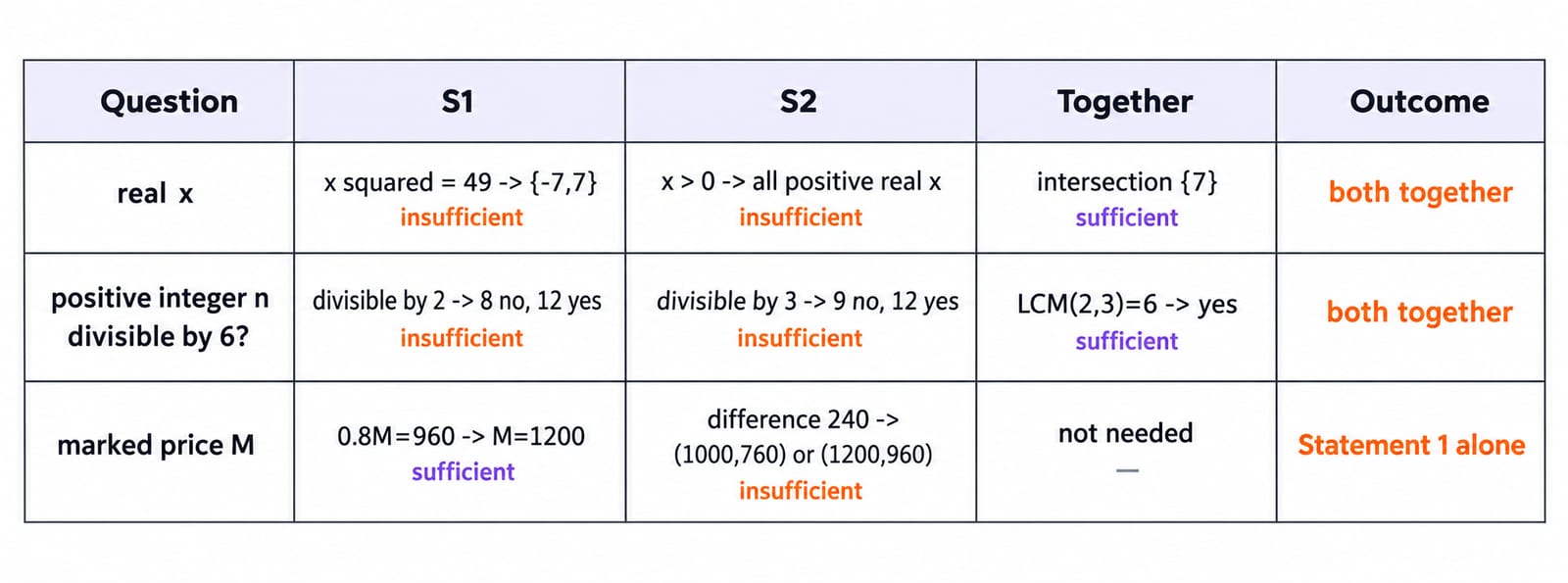
Target | S1: unique or two examples? | S2: unique or two examples? | Together: unique or two examples? | Outcome
For insufficiency, find two values that satisfy the statement but answer the target differently. For sufficiency, show why every allowed case gives the same answer.
Stop a branch once one statement fixes the answer. Equation counting is only a clue: a nonlinear equation may have two roots, while two equations may duplicate one constraint.
3. Solved example 1: two weak statements can become sufficient together
Problem: x is a real number. What is x?
Statement 1:
x squared = 49Statement 2:
x > 0
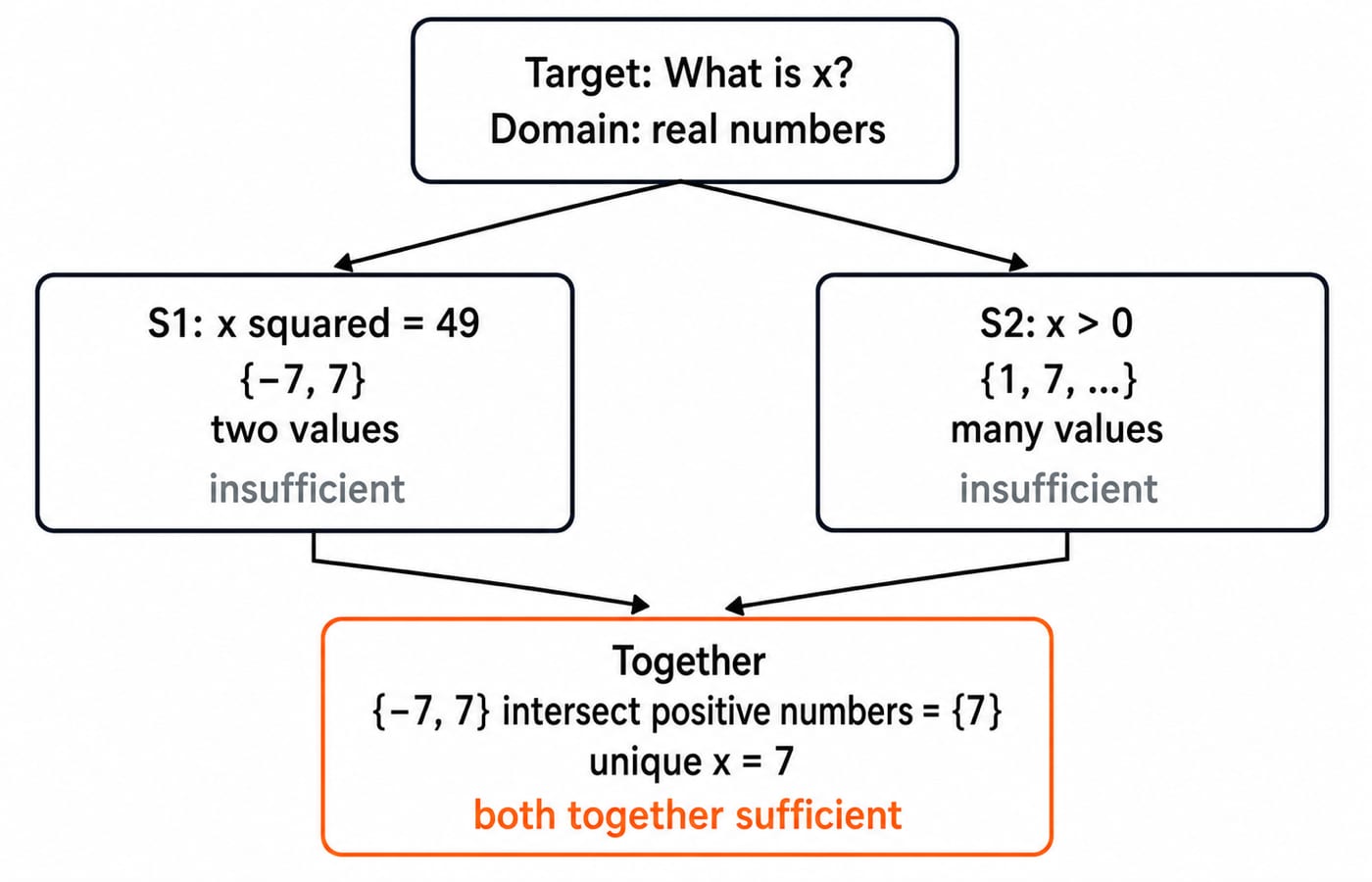
Test Statement 1 alone. It gives exactly x = -7 or x = 7. Because two values remain, Statement 1 is insufficient. The counterexample pair -7 and 7 settles this immediately.
The real-number domain matters: you cannot assume positivity before a statement supplies it. Now reset and test Statement 2 alone. Resetting means it cannot inherit x squared = 49 from Statement 1. It permits infinitely many positive values, including x = 1 and x = 7, so it is insufficient.
Only now combine them. Statement 1 restricts the candidates to {-7, 7}. Statement 2 removes -7, leaving the unique value x = 7.
The precise outcome is: neither statement alone is sufficient, but both together are sufficient. The counterexample shortcut exposed each weak branch before the final intersection established uniqueness.
4. Solved example 2: use factors for a yes/no target
Problem: n is a positive integer. Is n divisible by 6?
Statement 1:
n is divisible by 2Statement 2:
n is divisible by 3
For Statement 1, compare n = 8 with n = 12. Both are divisible by 2, but 8 is not divisible by 6 while 12 is. The yes/no answer changes, so Statement 1 is insufficient.
Reset. For Statement 2, compare n = 9 with n = 12. Both are divisible by 3, but only 12 is divisible by 6. Statement 2 is also insufficient.
Together, n is divisible by both 2 and 3. These factors are coprime, so LCM(2, 3) = 6. Every admissible n is therefore divisible by 6. The answer is a definite yes, and both statements together are sufficient.
Definite no works too. For Is m > 10?, the statement m <= 10 is sufficient because every permitted value makes the answer no.
5. Solved example 3: stop when one statement already determines the value
Problem: An article has marked price M rupees. What is M?
Statement 1:
After a 20% discount, the selling price is 960 rupees.Statement 2:
The discount amount is 240 rupees.
Test Statement 1 alone. After a 20% discount, the selling price is 80% of the marked price:
80% of M = 960
0.8M = 960
M = 960 / 0.8 = 1200
It fixes one value, so Statement 1 is sufficient.
Test Statement 2 separately. It gives only M - selling price = 240. Both (M, selling price) = (1000, 760) and (1200, 960) satisfy that equation, so Statement 2 is insufficient.
The outcome is Statement 1 alone is sufficient. Do not perform an unnecessary combined calculation. The shortcut is to translate a percentage into a multiplier, then stop as soon as the sufficiency decision is secure.
6. Shortcuts by question family, with their limits
For equations, test independence instead of counting equations. x + y = 10 and 2x + 2y = 20 are the same constraint. For What is x?, both (x, y) = (3, 7) and (4, 6) satisfy them, so even together they are insufficient.
Ratios need scale. Neither A:B = 3:2 nor A + B = 25 alone fixes A. Together they give five parts, one part 25 / 5 = 5, A = 3 x 5 = 15 and B = 2 x 5 = 10.
For inequalities, test both sides of the decision boundary. For real y, y >= 8 settles Is y > 5? with yes. But y >= 4 is insufficient: y = 4 gives no and y = 6 gives yes.
Use divisibility, parity, factors and remainders for number properties, and form one equation for percentages or rates. Every shortcut still requires the stated domain and a second-value check.
7. Common traps and how competitive exams frame the task
Turn each common mistake into a repair:
Combining statements at the start: test them independently.
Proving one working value: search for a conflicting value.
Assuming positivity or integrality: use only the stated domain.
Calculating after uniqueness is clear: stop.
Treating a definite no as insufficient: yes/no targets require certainty, not necessarily yes.
Memorising option letters: classify the outcome in words first.
Questions may ask for an exact value, a yes/no decision, an algebra result or a logical conclusion. The decision process remains the same.
Marks, timing, negative marking, answer-code order and section placement vary by exam. Check the current official notification and test instructions before mapping the logical outcome to an option.
For banking preparation, use the SBI PO Reasoning: 8-Week Puzzle and Sufficiency Plan to place these questions inside a practice schedule. For company assessments, Logical Reasoning for Placement Tests: 3 Solving Methods shows how the method fits a wider reasoning framework.
8. Data Sufficiency short version and next practice step
Remember: target and domain -> Statement 1 -> reset -> Statement 2 -> combine only if needed -> counterexample -> outcome words -> exam code. In the examples, x = 7 needs both statements, divisibility by 6 needs both, and marked price 1200 rupees needs Statement 1 alone.
Try a 12-question drill: three basics, three algebra, three arithmetic or number-system, and three logical-condition questions. Record two counterexamples for each insufficient branch and the uniqueness reason for each sufficient one. Use the Aptitude for Placements: Section Topics and Weekly Plan to schedule it, then study with Aptitude for Placement.
Keep learning
Data Arrangement Questions: Concepts, Shortcuts and Solved Examples
Turn names, cities, roles and scores into a clean grid. This guide shows safe shortcuts and solves one complete arrangement from clues to answer.
Updated 11 Nov 20266 min readAptitude & Reasoning
Data Interpretation for Competitive Exams: Concepts, Shortcuts and 4 Solved Sets
Learn a repeatable way to read Data Interpretation sets, choose the correct base, calculate efficiently, and check your answer. Four worked sets cover table, bar, pie and line data.
Updated 23 Sep 20266 min read186 viewsAptitude & Reasoning
SBI PO Reasoning Preparation: An 8-Week Plan for Puzzles, Seating Sets and Data Sufficiency
Build reasoning speed through an eight-week solve-review-retry plan. It includes a worked seating set, a data-sufficiency method and a missed-day rule.
Updated 30 Oct 20265 min readSBI Exams
Coding-Decoding Concepts and Shortcuts with Solved Examples
Identify, validate and reverse coding-decoding rules through letter shifts, rearrangements, number codes and sentence substitution.
Updated 9 Nov 20265 min readAptitude & Reasoning