

Non-Verbal Reasoning: Spatial Aptitude Shortcuts and Solved Examples
Turn visual questions into compact feature records, then solve an arrow-and-dots series, coordinate reflections, matrices and an 8 cm square paper fold.
KnowledgeGate Team
Exam prep & CS education
Updated 23 Nov 20266 min read

A visual question can feel ambiguous because the eye sees the whole picture, while the answer may depend on one controlled change: a 90-degree rotation, an extra dot, a reflection or a fold. Convert each figure into a short feature record, test one transformation at a time and predict before checking options. The method becomes concrete in an arrow-and-dots series, coordinate reflections and an 8 cm by 8 cm paper fold.
Non-Verbal Reasoning Concepts: Turn Pictures into Features
Non-verbal reasoning, spatial aptitude and visual reasoning overlap. These questions are solved mainly through shapes, positions, orientations, counts and transformations rather than sentence meaning. Keep scratch work verbal and compact.
The topic map includes classification or odd-one-out, dot situations, embedded figures, matrices, analogies, grouping, shape construction, rotation, mirror and water images, paper folding and cutting, pattern completion, 2D symbol series and basic 3D patterns. It is not a universal syllabus. The Aptitude Courses for Exams & Placements hub gives broader context. For word, number, letter and figure analogy relationships, use Analogy Questions: Concepts, Shortcuts and Solved Examples; this post stays with spatial transformations, reflections and paper folding.
Record each panel in six columns: shape | count | position | orientation | fill | movement. An outlined triangle at 0 degrees with 2 black dots at the top-left may become the same triangle at 90 degrees clockwise with 3 dots at the top-right. The record exposes three changes without inventing others.
The Spatial-Reasoning Shortcut: Inventory, Compare, Predict, Verify
Use this four-step routine:
Inventory: Record the first panel's six features.
Compare: Write only changes shown between consecutive panels.
Predict: Construct the missing panel before viewing the choices.
Verify: Reject each choice at its first feature mismatch.
Keep a small transformation vocabulary. A quarter-turn clockwise is +90 degrees, a half-turn is 180 degrees, and a quarter-turn anticlockwise is -90 degrees. A vertical reflection swaps left and right while preserving height. A horizontal reflection swaps top and bottom while preserving horizontal position. Translation changes position without changing orientation.
Separate independent rules. If an arrow rotates by 90 degrees while the dot count rises by 1, track both columns. Never rotate the whole figure because one internal element rotates, change fill without evidence, or accept a rule that explains only one transition.
Fully Worked Figure Series: Track Rotation, Position and Count Separately
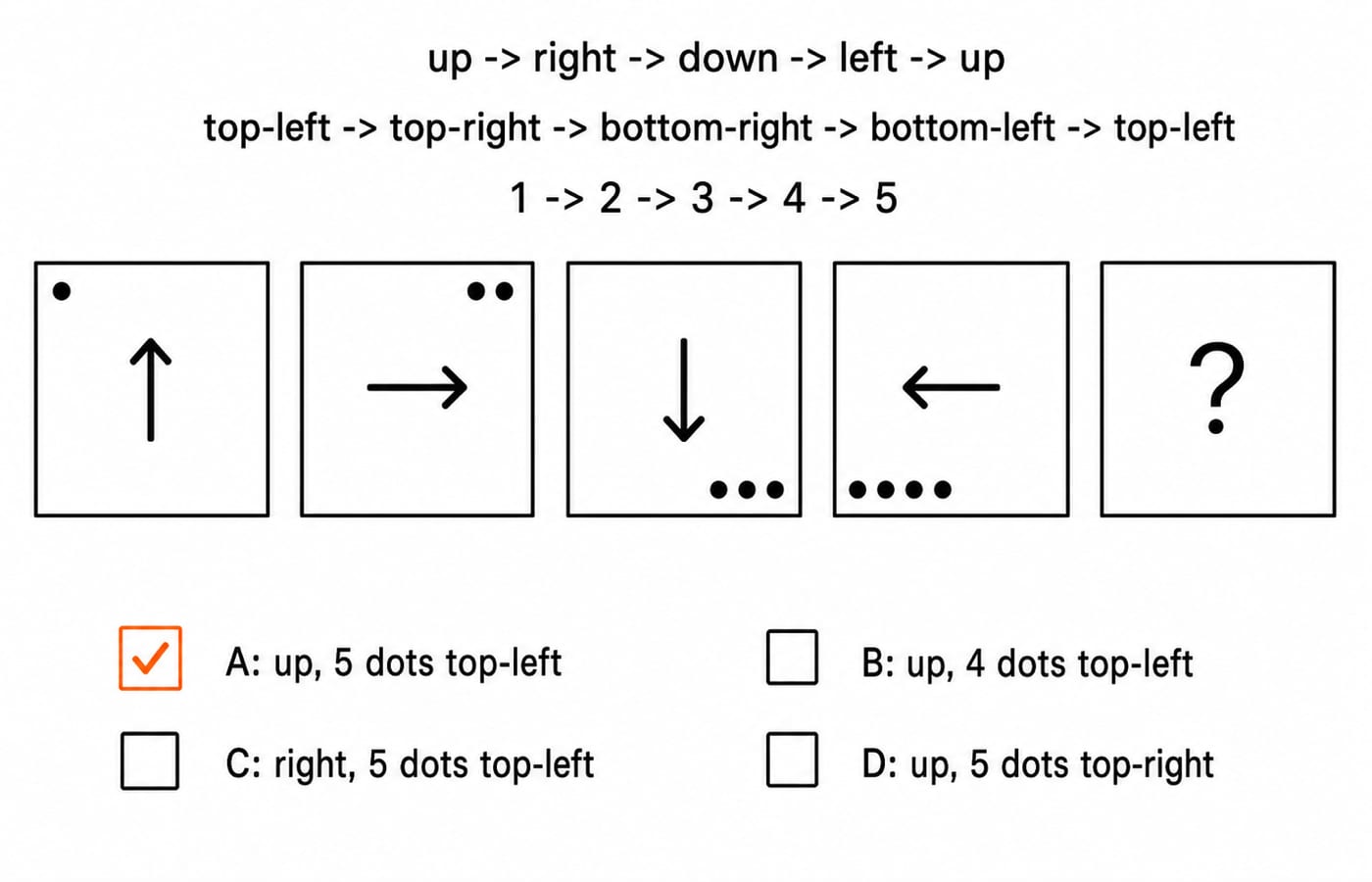
Every panel in this series uses the same unfilled square frame with a central black arrow.
Panel 1: arrow up, 1 black dot at the top-left.
Panel 2: arrow right, 2 black dots at the top-right.
Panel 3: arrow down, 3 black dots at the bottom-right.
Panel 4: arrow left, 4 black dots at the bottom-left.
Panel 5: missing.
Now separate the rules. The arrow turns 90 degrees clockwise at each step: up, right, down, left, then up. The dot block moves clockwise through the corners: top-left, top-right, bottom-right, bottom-left, then top-left. Its count increases as 1, 2, 3, 4, then 5.
The prediction is an up arrow with exactly 5 black dots at the top-left. Test the options:
(A) up arrow, 5 dots top-left
(B) up arrow, 4 dots top-left
(C) right arrow, 5 dots top-left
(D) up arrow, 5 dots top-right
The answer is (A). Option (B) misses count, (C) misses rotation, and (D) misses corner movement. Check features instead of choosing by overall resemblance.
Rotation, Mirror Images and Water Images: Use Coordinates, Not Intuition
Rotation changes orientation around a point. A vertical mirror swaps left and right; a horizontal water line swaps top and bottom. Text and asymmetric hooks reverse under reflection, but pure rotation does not create a mirror image.
On an 8 by 6 grid, a bent shape has vertices A(1,5), B(3,5) and C(3,2). Reflect it in x=4 using x' = 8-x, with y unchanged:
A(1,5)becomesA'(7,5).B(3,5)becomesB'(5,5).C(3,2)becomesC'(5,2).
To reflect the original shape in y=3, keep x and use y' = 6-y. The images are A''(1,1), B''(3,1) and C''(3,4).
Check one distinctive point. A was 3 units left of x=4, so A' must be 3 units right at x=7. Reject a choice that moves it above the axis or changes that distance.
Paper Folding and Cutting: Unfold in Reverse Order
Start with square paper ABCD of side 8 cm: A(0,0), B(8,0), C(8,8) and D(0,8). Fold the right half left along x=4, then the top half down along y=4. The packet occupies 0 <= x <= 4 and 0 <= y <= 4. Punch one circular hole at P(1,3), away from both fold lines.
Unfold in reverse order:
Undo the horizontal fold. Reflect
y=3acrossy=4, soy'=8-3=5. The holes are(1,3)and(1,5).Undo the vertical fold. Reflect
x=1acrossx=4, sox'=8-1=7. Both existing holes gain partners at(7,3)and(7,5).
The opened sheet has exactly four holes: (1,3), (1,5), (7,3) and (7,5). Each off-crease punch doubles per independent fold, so 1 x 2 x 2 = 4. A punch on a fold line would not double across it, but P is off both creases.
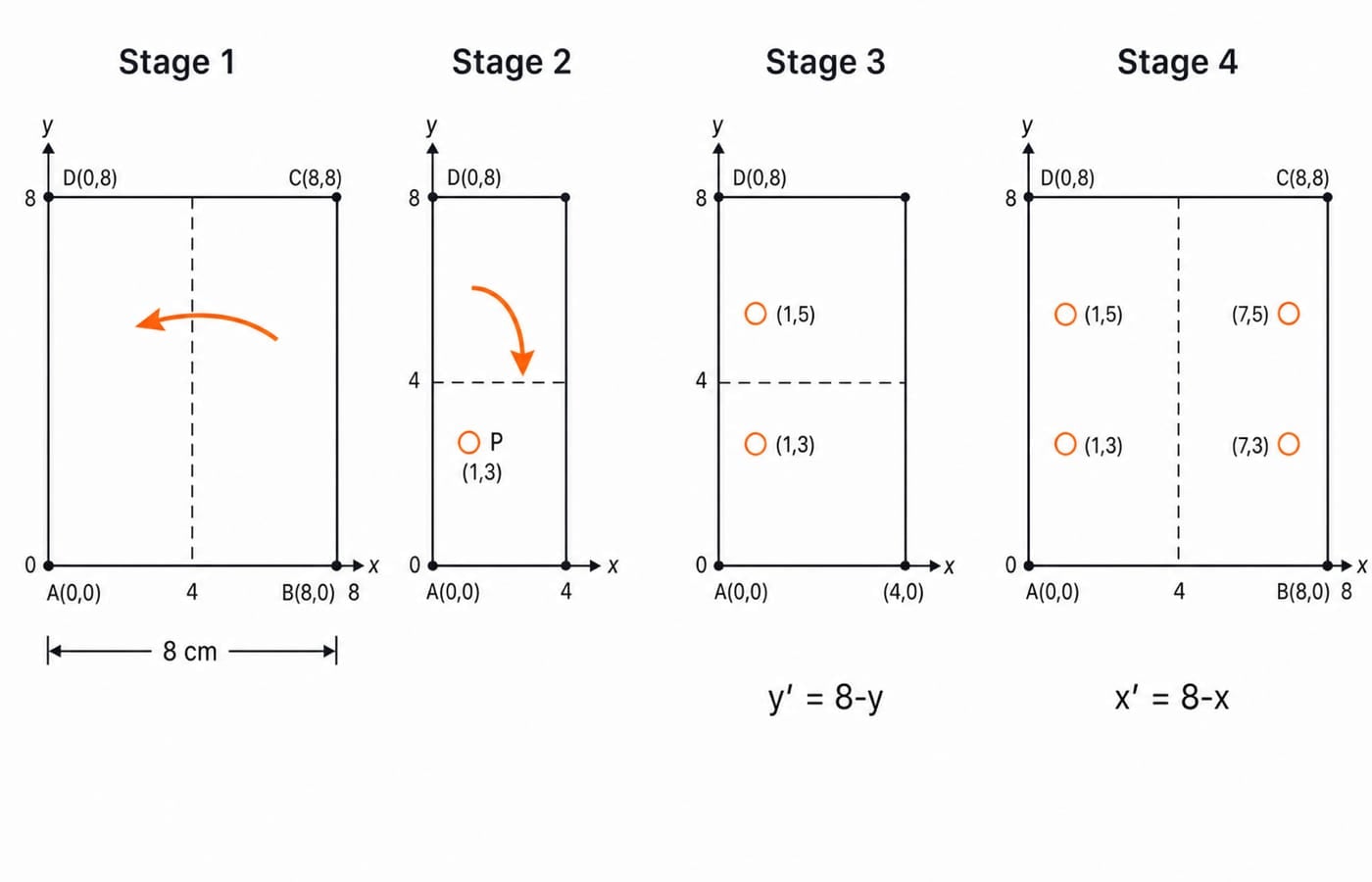
Figure Matrices, Odd-One-Out and Hidden Figures
In a 2 by 2 matrix, separate the row and column rules. The top-left is a circle with 1 rising diagonal /, the top-right the same circle with 2 parallel rising diagonals, and the bottom-left a square with 1 rising diagonal. The bottom-right must be a square with 2 parallel rising diagonals. Across a row the count rises by 1; down a column only the boundary changes from circle to square.
Classification needs a measurable rule. Let A be a triangle with 1 dot, B a square with 2, C a pentagon with 3, and D a hexagon with 5. The values follow dots = sides - 2: 3-2=1, 4-2=2, and 5-2=3. A hexagon should have 6-2=4 dots, so D is odd.
For embedded figures, anchor on a distinctive angle or intersection. Trace connected segments without independently rotating parts, ignoring enclosing lines outside the target. For shape construction, compare edge lengths and matching cut boundaries.
How Competitive Exams Test Visual Reasoning, and How to Build Speed
Common forms include completing a series, selecting a missing matrix cell, identifying an odd figure, choosing a mirror or water image, unfolding paper, finding an embedded figure, and assembling parts. Exact syllabuses, marks, question counts and timing vary by organiser and cycle. For a named exam, check the organiser's current official notification or instructions.
Use this drill:
Solve 12 questions untimed while writing the six-feature record.
Solve a fresh 12 with a 45-second practice target.
Attempt 20 mixed questions with a 30-second first-pass target, deferring any item whose rule remains unclear.
Advance only after scoring at least 10/12 twice. Use Aptitude for Placements: Section Topics and Weekly Plan for the wider placement map. For government and banking practice order, use Bank PO Reasoning: High-Yield Topics and Puzzle Method.
Common Traps, the Short Version and the Next Step
Turn four common mistakes into corrections:
Treating reflection as rotation: track one asymmetric anchor point.
Noticing only one changing feature: maintain all six feature columns.
Unfolding in the original fold order: reverse the folds.
Forcing a rule after reading the options: predict first, then verify.
Recall inventory -> compare -> separate rules -> predict -> verify. In the primary series, this gives an up arrow with 5 black dots at the top-left. In the folding example, it gives four holes at (1,3), (1,5), (7,3) and (7,5).
For the broader aptitude, reasoning and verbal-ability learning path, use Aptitude for Placement. Then practise one visual family at a time and keep an error log labelled rotation, reflection, count, position, fold or hidden edge.
Keep learning
GATE Verbal Aptitude and Logical Reasoning: Question Types with Solved Examples
Learn to identify recurring GATE aptitude question types, apply a fixed method to each, and check the answer through four worked examples.
Updated 30 Oct 20266 min read74 viewsAptitude & Reasoning
Aptitude for placements: quant, logical reasoning and verbal, section by section
Almost every placement drive opens with an aptitude round, and it is the stage that quietly eliminates the most people. Not because the maths is hard, but because it is timed, mixed, and unforgiving of any section you skipped. Clear it and your interview is yours to earn.
Updated 29 Oct 20265 min read161 viewsAptitude & Reasoning
Infosys Aptitude Questions: High-Yield Quant, Reasoning and Verbal Problems Solved
Build dependable placement aptitude skills through fully worked quant, data interpretation, reasoning and verbal problems. Then use a timed drill and error log to target weak steps.
Updated 30 Aug 20267 min read404 viewsCompany-Specific Prep
Classification of Intelligence Tests for CTET: Individual, Group, Verbal, Non-Verbal and Performance
Learn to separate individual and group administration from verbal, non-verbal and performance tasks, then apply the rule to CTET-style questions.
Updated 10 Nov 20266 min readCTET & UPTET