

Fallacy in Logical Reasoning: Types, Shortcuts and Solved Examples
Learn to test fallacy questions by separating the conclusion, evidence and hidden bridge. Includes conditional, survey, analogy, causation and language examples.
KnowledgeGate Team
Exam prep & CS education
Updated 18 Nov 20266 min read
A fallacy question can sound convincing because its conclusion may be true in real life even when the stated premises do not prove it. The reliable fix is to separate the premise, conclusion and hidden bridge, then try to break that bridge with a counterexample. An accepted-application conditional, a survey of 12 out of 300 learners, and a score claim moving from 58 to 72 show the method in action.
For structured practice around these ideas, explore All Courses.
Fallacy concepts: judge the reasoning, not whether the conclusion sounds true
An argument uses premises to support a conclusion. A fallacy is a defect in that support. A true conclusion can be unsupported, while a valid inference can produce a false conclusion if a premise is false. Validity tests structure; truth tests statements.
A formal fallacy has an invalid pattern, such as P -> Q; Q; therefore P. An informal fallacy depends on language, evidence or relevance, such as a biased sample, causal leap, equivocation, straw man or personal attack.
Check | Example | Result |
|---|---|---|
Validity | All multiples of 4 are even; 28 is a multiple of 4; therefore 28 is even | Valid structure, true premises |
Truth | Replace 28 with 27, making the second premise false | Modus ponens remains valid, but the argument is unsound |
Keep validity and truth in separate columns when solving.
The four-step shortcut: conclusion, evidence, bridge, counterexample
Use this scratch-pad routine in order:
Underline the conclusion.
List only the stated evidence.
Write the missing bridge as one sentence.
Construct one case where every premise is true but the conclusion is false.
Consider: "Three of the first four practice questions were easy. Therefore all 80 questions in the set are easy." The conclusion covers all 80 questions, but the evidence covers only 4. Its hidden bridge is: "The first 4 represent the other 76." A counterexample is enough to break it: questions 5 to 80 could all be difficult. This is hasty generalisation, not merely "insufficient information".
The counterexample test is safe because you can expose broken support before remembering its label. For a broader method of translating reasoning questions into repeatable steps, read Logical Reasoning for Placement Tests: 3 Solving Methods.
Formal fallacies: test the four conditional patterns
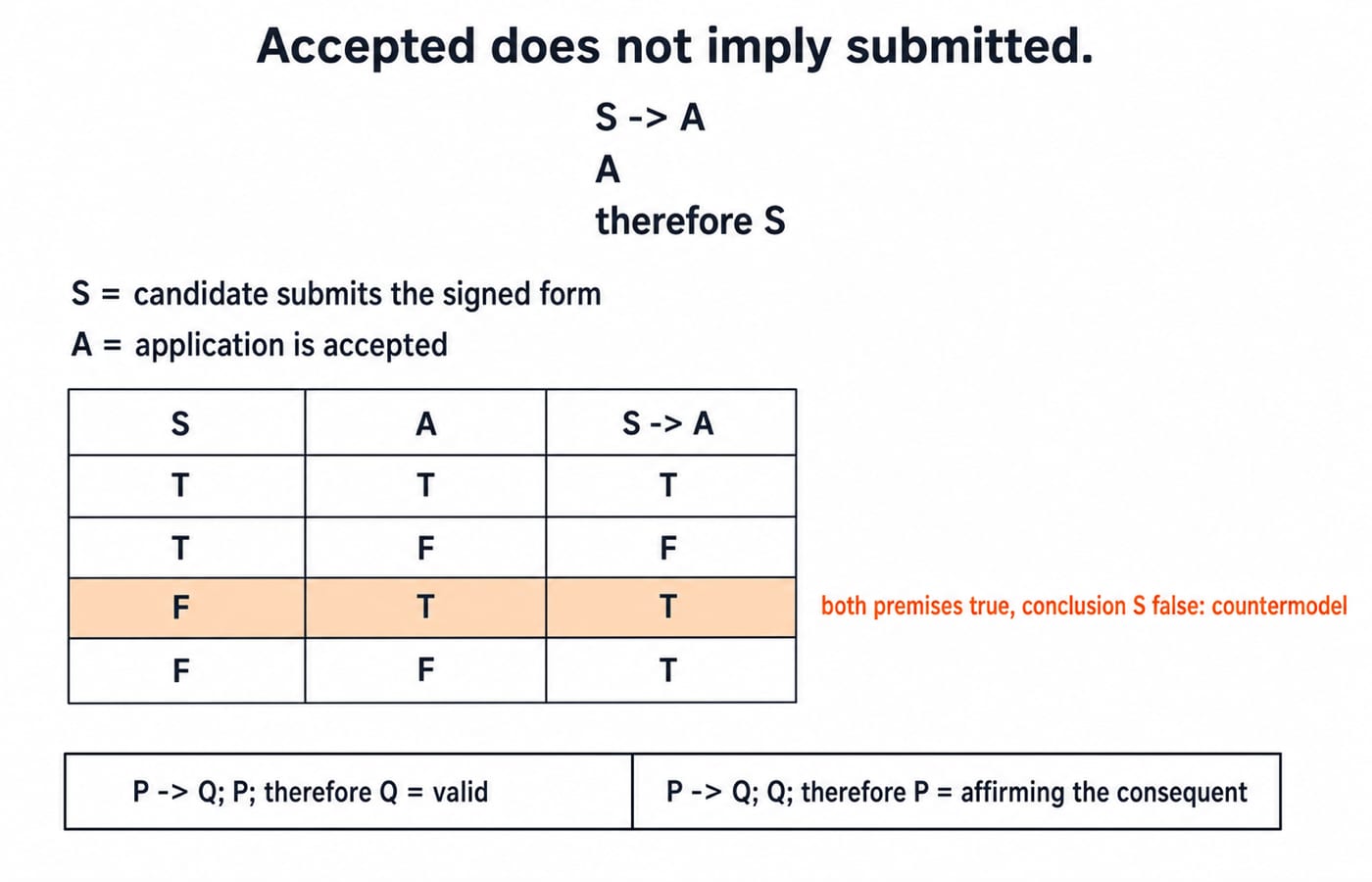
Suppose an item says: "If a candidate submits the signed form (S), the application is accepted (A). Ravi's application is accepted. Therefore Ravi submitted the signed form."
(a) valid modus ponens
(b) affirming the consequent
(c) denying the antecedent
(d) valid modus tollens
The structure is S -> A; A; therefore S, so the answer is (b) affirming the consequent. Set S = false and A = true. Then S -> A is true and the second premise A is true, while the conclusion S is false. Acceptance could have followed another permitted route. That possibility is a countermodel, not a claim about a real application system.
Pattern | Classification |
|---|---|
| Valid modus ponens |
| Valid modus tollens |
| Affirming the consequent |
| Denying the antecedent |
For the last pattern, take: "If the server is down (D), the portal is inaccessible (I); D = false; therefore I = false." The countermodel D = false, I = true represents an inaccessible portal for another reason, so the denial does not establish the conclusion.
Generalisation and analogy fallacies: inspect the evidence base
A coaching centre has 300 learners. It asks 12 volunteers leaving a topper session whether the session was useful, and 10 say yes. The reported percentage among respondents is:
10 / 12 x 100 = 83.3%
But the sample covers only:
12 / 300 x 100 = 4%
The claim that 83.3% of all 300 learners found the session useful has two defects. It generalises from a very small group, and the volunteers leaving that session may be self-selected. The premises allow a counter-scenario in which the remaining 288 learners include 200 who did not attend and would answer no. This does not prove the conclusion false. It shows that the evidence does not establish it.
For analogy questions, compare relevant dimensions. Two applicants both scored 82 in one mock. Applicant X later cleared an interview, but that does not prove Applicant Y will clear it too. A shared mock score does not establish equal communication, technical preparation or later selection conditions.
False cause and post hoc reasoning: compare changes before claiming a cause
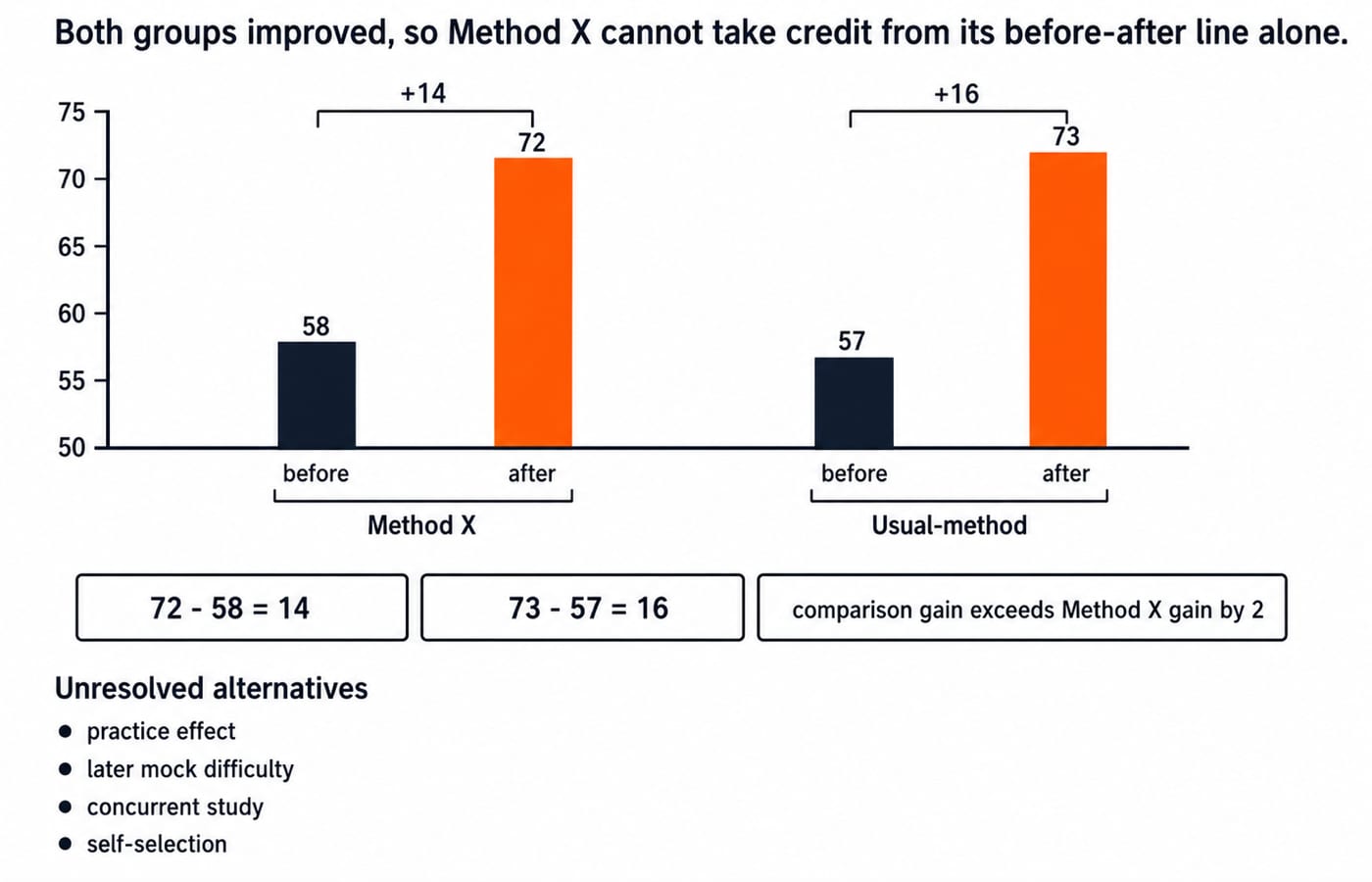
Consider: "Forty learners using Method X improved from an average mock score of 58 to 72 over six weeks. Therefore Method X caused the improvement." The observed gain is:
72 - 58 = 14
However, this before-after line does not rule out repeated practice, an easier later mock, concurrent study or self-selection into the method. Now add a comparison: another 40 learners using their usual method moved from 57 to 73.
73 - 57 = 16
The usual-method group gained 16 points, which is 2 points more than the Method X group's 14. Therefore the original result alone cannot establish that Method X produced a superior gain. These invented values illustrate reasoning only.
Post hoc reasoning treats "after" as "because of". Correlation mistakes co-movement for causation. A causal claim becomes stronger when alternatives are controlled and comparable groups are used.
Language and relevance fallacies: name the exact switch
Claim | Flaw | Repair |
|---|---|---|
Only sound arguments should be accepted; the speaker's voice is sound; therefore accept the argument | Equivocation changes "sound" | Fix one meaning |
Either solve all 50 questions tonight or make no progress | False dilemma ignores partial progress | Restore the third option |
The guide is reliable because it is trusted, and trusted because it is reliable | Circular reasoning repeats its conclusion | Add independent evidence |
A says "review 20 errors"; B says "A wants students to stop taking mocks" | Straw man distorts A's claim | Answer the original claim |
Reject Meera's plan because she scored 42/100 in her first mock | Ad hominem attacks Meera | Evaluate the plan |
Eight of 10 friends use shortcut Y, so it must be correct | Appeal to popularity counts supporters | Test the logic |
For elimination, ask whether the response switches a meaning, removes a third option, restates the conclusion, distorts a claim, attacks a person or counts supporters. Name the exact move.
How competitive exams test fallacies: formats, traps and a 60-second routine
Questions may ask you to identify a flaw, supply an assumption, weaken or strengthen an argument, test a conclusion, or match flawed patterns. Formats differ, so confirm each exam's current structure in its official materials.
For practice, use this 60-second routine:
0-10 seconds: mark the conclusion.10-25 seconds: list the premises.25-40 seconds: write the missing bridge.40-55 seconds: test one counterexample.55-60 seconds: match the exact label and option.
This is a practice routine, not an official limit. Test whether the conclusion follows, describe the broken bridge before choosing a label, use stated premises unless background is requested, call weak evidence "not established", and symbolise conditionals to separate converse from contrapositive. If the conclusion follows under every interpretation allowed by the premises, do not invent a fallacy.
Use SSC CGL Reasoning: High-Yield Topics and Solving Order as a broader practice context, while checking each exam's current structure in its official materials.
Fallacy short version: break the bridge, then choose the next practice route
Recall the chain: conclusion -> evidence -> bridge -> counterexample -> label. The three anchor results are S = false, A = true, which defeats affirming the consequent; 12 of 300 = 4%, which exposes the survey's evidence base; and gains of 14 versus 16, which block the Method X causal claim.
Practise with mixed sets and keep an error log with four columns: argument, assumed bridge, counterexample and fallacy name. Aim to explain each wrong option in one sentence. For the next route, use the Aptitude Course for Placement for placement and recruitment practice, or SSC CGL Tier 1 Complete Preparation for government-exam preparation.
Keep learning
Syllogisms: Solve Logical Reasoning Questions with Venn Diagrams
Translate syllogism statements into sets, test what must follow, and build witness or counterexample models for conclusions that are only possible or not definite.
Updated 14 Sep 20265 min read124 viewsAptitude & Reasoning
Logical Reasoning Principles: Core Rules and Worked Examples
Learn a five-step method for translating reasoning questions into constraints, then apply it to arrangements, syllogisms, series and data sufficiency.
Updated 23 Aug 20265 min readAptitude & Reasoning
GATE Verbal Aptitude and Logical Reasoning: Question Types with Solved Examples
Learn to identify recurring GATE aptitude question types, apply a fixed method to each, and check the answer through four worked examples.
Updated 30 Oct 20266 min read69 viewsAptitude & Reasoning
Logical Reasoning for Placement Tests: A Solving Method for Puzzles, Syllogisms and Series
Stop solving reasoning questions by instinct. Use one dependable procedure each for Venn syllogisms, number series and row-seating puzzles.
Updated 27 Jul 20265 min read53 viewsAptitude & Reasoning