Bank PO Reasoning: the high-yield topics and how to master them
The high-yield Bank PO reasoning topics for IBPS and SBI: puzzles and seating, syllogisms, inequalities and coding-decoding, with a worked puzzle method.
KnowledgeGate Team
Exam prep & CS education
Updated 26 Jul 20265 min read53 views
Reasoning is the most scoreable section in bank PO for the aspirant who prepares it methodically, and the most frustrating for the one who does not. The reason is simple: a large share of the section is puzzles and arrangements, which reward a systematic method far more than cleverness. Get the handful of topics that carry the marks under control, and puzzles stop being time-sinks and become the section you bank on.
The exact question count, sectional timing, and any negative marking are set in the official notification, so confirm those at ibps.in or the SBI recruitment portal. For drilling these exact patterns, the IBPS PO Prelims reasoning ability module pulls from a bank of more than 6,000 reasoning questions.
Related reading: IBPS PO syllabus and SBI PO preparation.
Puzzles and seating arrangement: the biggest block
Puzzles and seating arrangements dominate bank PO reasoning, especially in Mains, and mastering them is the highest-leverage decision you can make in this section.
Linear arrangement, people in a row facing one or both directions.
Circular and square arrangement, facing the centre or outward.
Floor and box puzzles, arranging items across levels.
Scheduling puzzles, days, months, or time slots.
These carry several questions per set, so fluency compounds. And they are learnable: the difference between a strong and a weak candidate here is method, not intelligence.
A worked puzzle method, step by step
Puzzles are solved by a disciplined procedure, not by holding everything in your head. The same procedure works on any arrangement set, so learn it once on a five-seat row and it transfers to floors, boxes and circles.
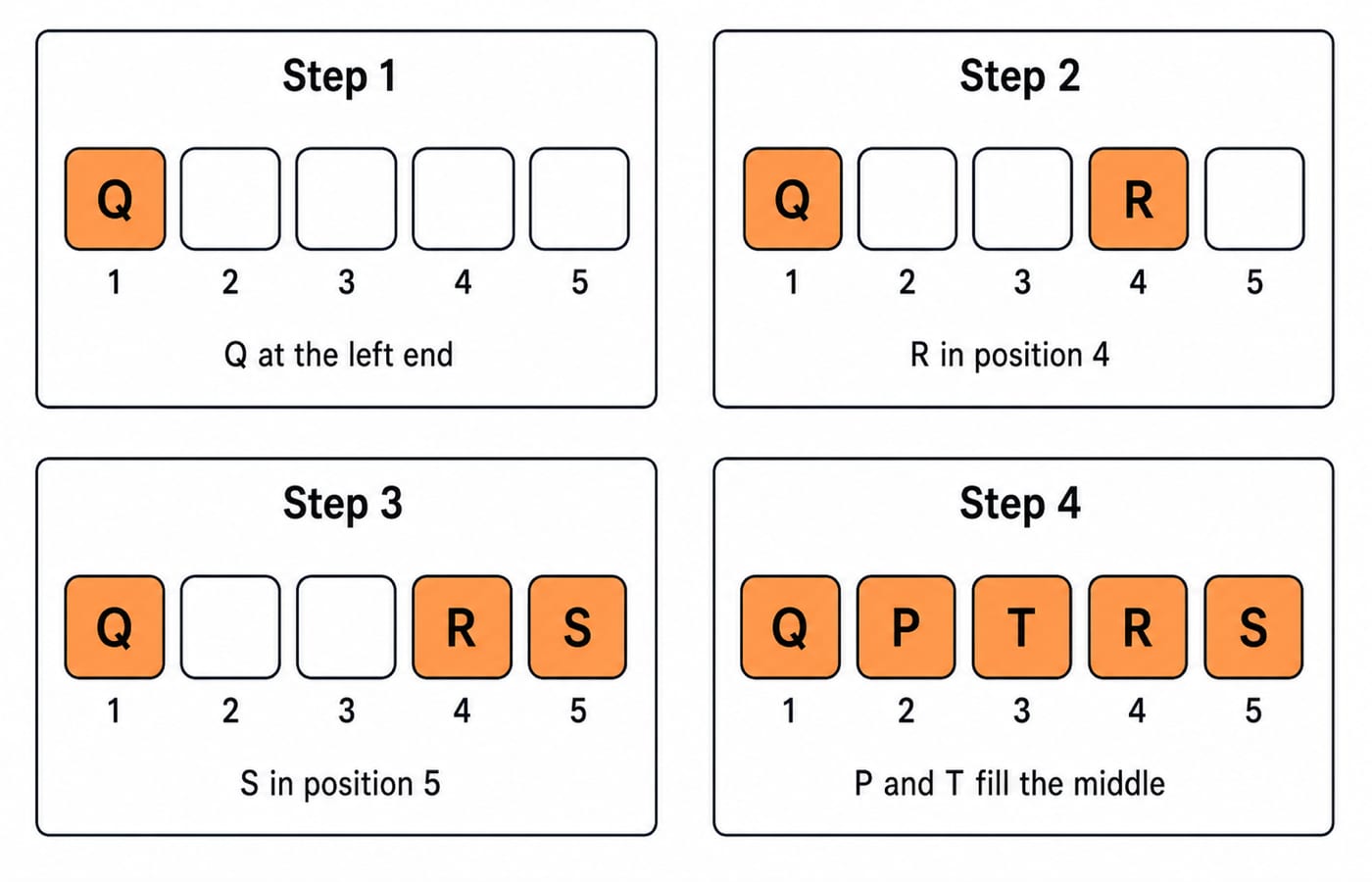
Suppose you are told: five people, P, Q, R, S and T, sit in a row facing north; Q is at an end; there are two people between Q and R; S sits immediately right of R.
Work it in order. First, draw the frame: five positions, left to right. Second, place the most definite clue: Q is at an end, so try Q at the far left. Third, layer the next constraint: two people between Q and R puts R in the fourth position. Fourth, apply the dependent clue: S immediately right of R puts S in the fifth position. Fifth, place the remainder: P and T take the two open middle seats, in either order until a further clue fixes which is which. If a placement ever contradicts a clue, discard that branch and try the other end for Q.
That is the whole technique: start from the most rigid clue, build outward one constraint at a time, and keep alternative branches when a clue is ambiguous. Never try to solve a puzzle in your head, and never start from a vague clue.
Syllogisms and inequalities: rule-based and fast
These topics are pure logic, which means once you know the rules they are quick and reliable marks.
Syllogisms. Draw the relationships as circles (Venn-style) and test each conclusion against every possible arrangement. A conclusion is true only if it holds in all valid arrangements, which is the single rule that resolves most questions. Test it on a pair: from "all pens are books" and "some books are red", the conclusion "some pens are red" does not follow, because an arrangement exists in which every red book sits outside the pen circle.
Inequalities. Translate the coded symbols into a clear chain of greater-than and less-than relations, then read off whether each conclusion follows. Watch for the "either-or" case, where neither conclusion alone is definite but together they are exhaustive: from P ≥ Q and Q ≥ R you get P ≥ R, so "P > R" is not definite and "P = R" is not definite, yet between them they cover every possibility, which is precisely when the either-or option is the right answer.
Because these are rule-based, they reward drilling the rules until application is automatic, at which point they become some of the fastest marks in the section.
Coding-decoding, blood relations and directions
A cluster of smaller topics rounds out the section and reliably appears.
Coding-decoding, both the older letter-shift style and newer logic-based coding. In the logic-based type you are handed two or three coded sentences and recover the mapping by intersection: a code appearing in two of them must stand for the word those two sentences share, and one confirmed pair usually unlocks the rest.
Blood relations, solved cleanly by drawing a family tree rather than reasoning verbally.
Direction sense, solved by sketching each turn on paper.
Order and ranking, and data sufficiency, where you judge whether the given information is enough rather than compute an answer.
The common thread across all of these is the same as puzzles: draw it, do not hold it in your head. A quick sketch converts a confusing verbal chain into a clear picture.
How reasoning is tested, and what to prioritise
Prelims reasoning rewards speed on simpler puzzles and the rule-based topics; Mains reasoning brings harder, multi-variable puzzles and often couples reasoning with data (the stage-by-stage topic split sits in IBPS PO Syllabus 2026). The prioritisation is the same: master puzzles and seating arrangement first because they carry the most weight, then lock in the fast rule-based topics of syllogisms and inequalities, then round out with coding, relations, and directions.
Your exam-day skill is selection as much as solving: recognise quickly which puzzle set is worth your time and which to leave, because a single hard set can swallow the minutes that three easier questions would have earned. A useful habit is to scan every puzzle in the section before committing to any, rank them by how tightly constrained the opening clues are, and start with the most rigid one. A puzzle that begins with a fixed position and a definite count is far more solvable than one built on floating, conditional clues, and spotting that difference in ten seconds is a trainable skill that saves you from sinking into the wrong set first.
Your next step
Make puzzles and seating arrangement your first priority, solve them with a disciplined draw-and-branch method, and lock in syllogisms and inequalities as fast rule-based marks. Practise under a clock so that choosing which set to attempt becomes instinctive.
Our structured reasoning coverage sits inside the IBPS PO bundle and the SBI PO bundle, each covering Prelims and Mains together. Confirm the current reasoning pattern at ibps.in before you plan your hours.
Keep learning
Mensuration and Geometry for Competitive Exams: Formulas, Shortcuts and Solved Examples
Learn how to choose the right mensuration formula, avoid common geometry traps, and solve 2D path and 3D recasting problems step by step.
Updated 6 Oct 20266 min readAptitude & Reasoning
Age Comparison and Multiple-Condition Problems: 12 Solved MCQs
Practise 12 age-problem MCQs with equations, timelines, back-checks, relation chains, changing ratios, birth years, and family conditions.
1 Oct 20268 min readAptitude & Reasoning
True, False and Cannot Say Questions: 10 Solved Passage MCQs
Learn how to separate contradictions from missing evidence, then apply the method to 10 previous-year passage MCQs with concise, evidence-led solutions.
26 Sep 20268 min readAptitude & Reasoning
TCS Aptitude Questions: High-Yield Quant and Reasoning Topics, Solved Step by Step
Learn the first move for common quant and reasoning question families through solved examples on ratios, work, trains, data, remainders, and seating.
Updated 25 Sep 20266 min read104 viewsAptitude & Reasoning