

Learning Disabilities for CTET: Types, Signs and Classroom Support
Identify the skill barrier in a classroom vignette, then choose support that preserves the learning goal. Compare learning disabilities with ADHD and work through subtraction with regrouping.
KnowledgeGate Team
Exam prep & CS education
Updated 25 Nov 20265 min read
A CTET classroom vignette can sound familiar yet leave you confused between reading, writing, number understanding and attention. The useful starting point is to identify the central barrier, then select support that fits the learning goal. These original teaching examples help you practise that distinction. Exam vignettes simplify real children: classroom observations guide support and referral rather than a diagnosis.
What learning disabilities mean in CTET questions
A specific learning disability involves persistent difficulty acquiring or using an academic skill. NICHD explains that learning disabilities affect areas such as reading, writing and mathematics, and do not indicate a person's intelligence. Its overview, About Learning Disabilities, provides further context.
Do not infer effort or general ability from one difficult task. Consider the pattern over time, opportunities for instruction and familiarity with the language of teaching. A single low score gives much less information than repeated observations across suitable tasks.
For example, a child explains the events of an orally narrated story but struggles to decode its printed words. Oral participation remains a strength; reading access needs attention. Place this distinction alongside the wider CTET child development and pedagogy concepts when revising learner differences and assessment.
Dyslexia, dysgraphia and dyscalculia: identify the main skill barrier
Use this comparison to locate the main difficulty. These descriptions are starting points, and difficulties can overlap.
Type | Skill affected | Signs a vignette may describe | Not the same as |
|---|---|---|---|
Dyslexia | Accurate, fluent word reading and decoding | Persistent difficulty blending letter sounds | Simply reversing letters |
Dysgraphia | Handwriting and getting ideas onto paper | Slow, effortful letter formation or written expression | Simply untidy work |
Dyscalculia | Number sense and arithmetic | Persistent difficulty connecting quantities, symbols and operations | One careless sum |
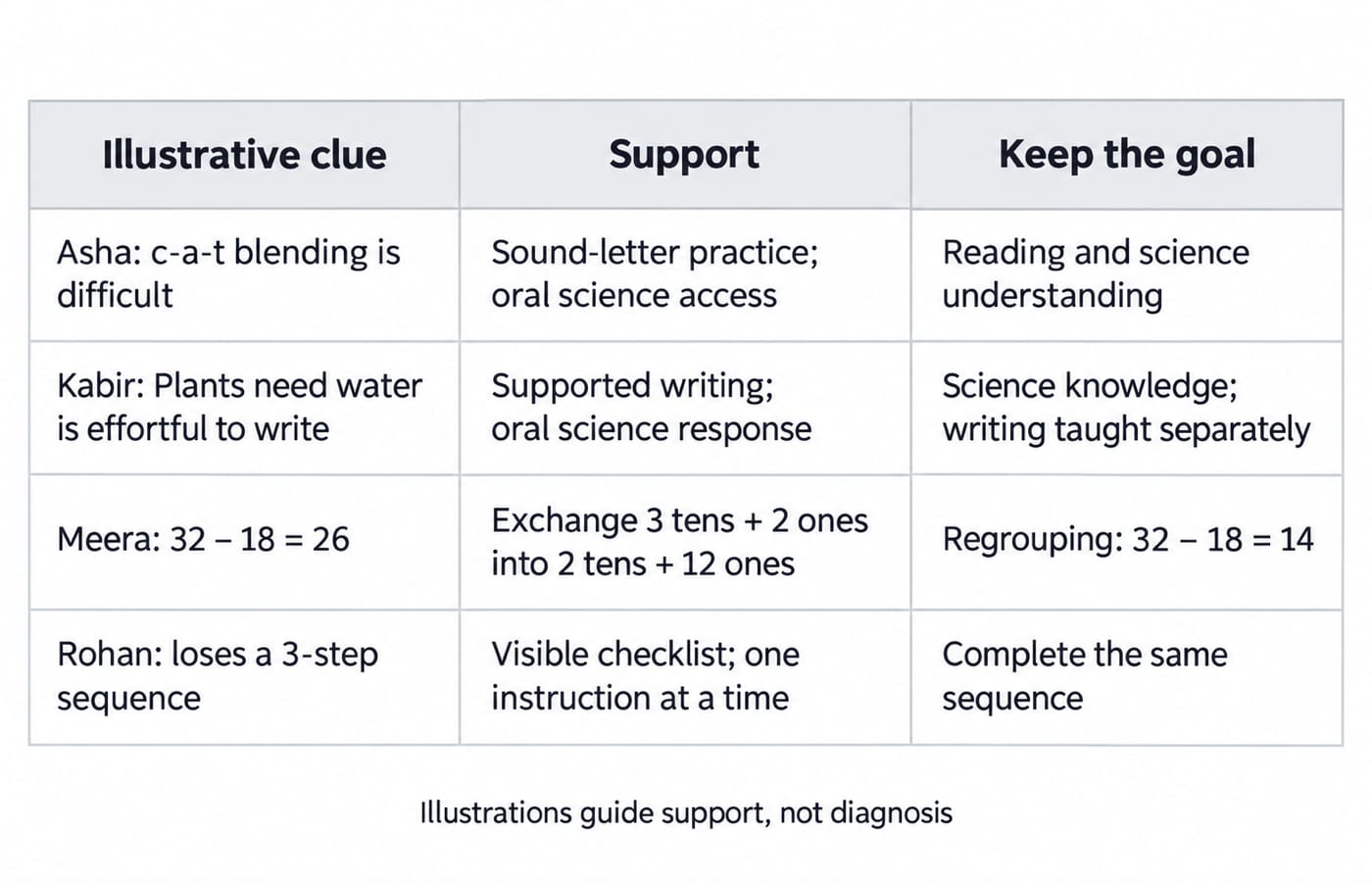
Asha explains a story orally but struggles to blend c-a-t. Begin with explicit sound-letter practice and guided blending.
Kabir orally supplies “Plants need water”, but writing those three words is effortful. Support writing and allow another response mode when handwriting is not the assessed skill.
Meera, even after instruction with bundles of ten, repeatedly struggles to identify whether 32 or 23 is larger and what the 3 in 32 represents. Link concrete quantities to numerals: 32 is larger than 23, and its 3 represents three tens, or 30. Keep the quantities visible while discussing place value.
The common principle is to teach the affected skill explicitly while allowing participation in other learning.
ADHD affects learning, but belongs in a separate comparison
ADHD is a neurodevelopmental condition involving attention regulation and/or hyperactivity-impulsivity. It is distinct from specific learning disabilities, although they can coexist. The CDC describes inattentive, hyperactive-impulsive and combined presentations in its guidance on ADHD symptoms. A quiet child can also have attention difficulties; visible restlessness is not essential.
Rohan receives the instruction, “Open your notebook, write the date, solve question 1”, but repeatedly loses track of the sequence. Make a visible checklist:
Open your notebook.
Write the date.
Solve question 1.
Give one instruction at a time and let him mark each completed step. The task remains the same, but its sequence is easier to follow. In a question stem, identify the barrier actually described before choosing support. Treating difficulty following instructions as deliberate disobedience misses the teaching opportunity.
Worked example: support understanding of 32 - 18
The goal is understanding subtraction with regrouping. Meera writes 32 - 18 = 26: she uses 8 - 2 = 6 and 3 - 1 = 2, subtracting the smaller digit from the larger in each column. Those calculations explain her answer but do not carry out the given subtraction. A regrouping error is common; her repeated number-sense difficulties deserve continued observation and support.
Model the exchange with base-ten blocks:
Represent
32 = 3 tens + 2 ones.Exchange one ten for ten ones:
2 tens + 12 ones = 32. The quantity stays unchanged.Remove
18, meaning1 ten + 8 ones.Subtract the ones:
12 - 8 = 4. Subtract the tens:2 - 1 = 1.The remainder is
1 ten + 4 ones = 14. Check:18 + 14 = 32.
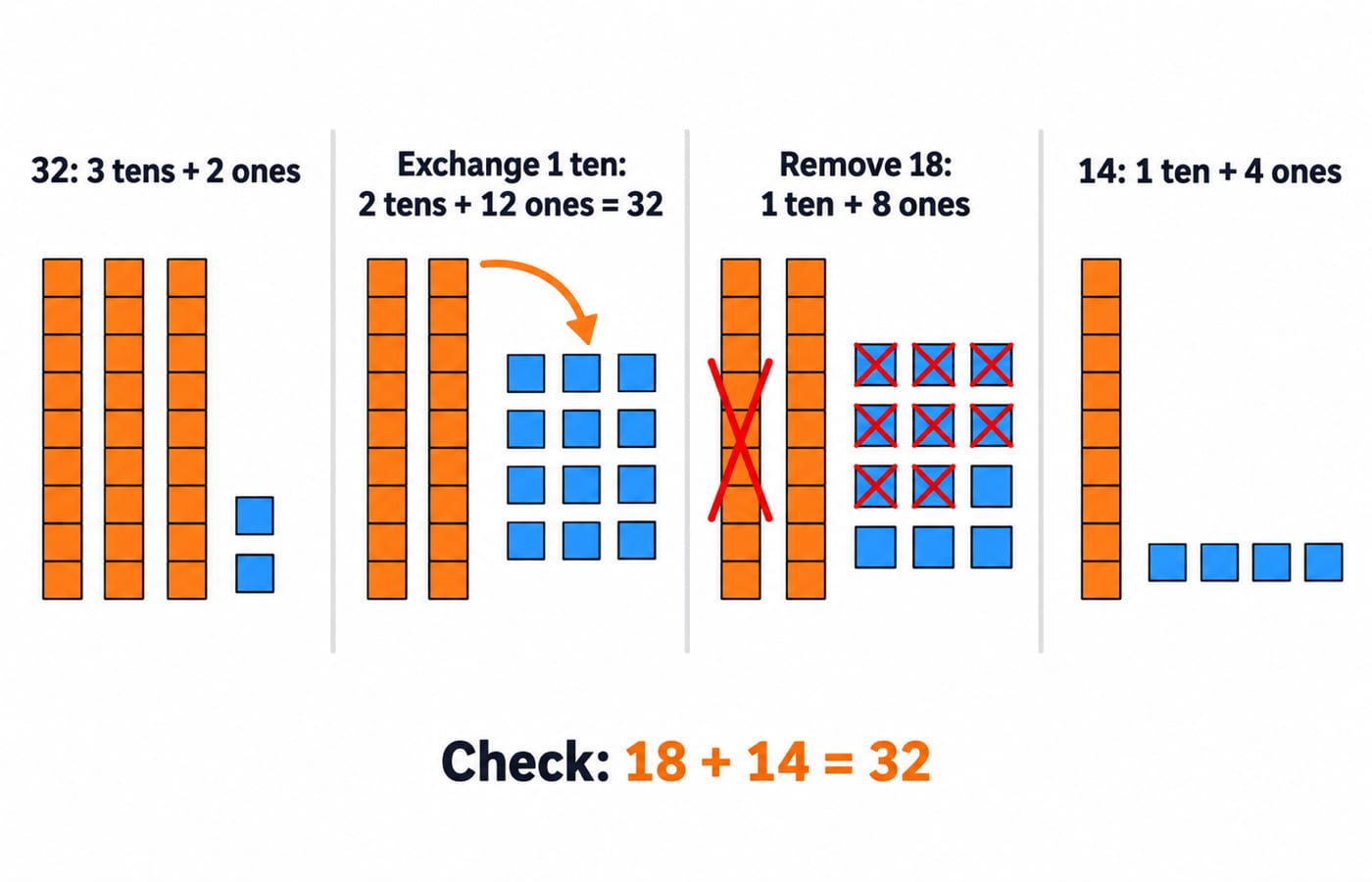
Ask Meera to demonstrate the exchange and explain the remainder. Then try 41 - 16: exchange 4 tens + 1 one for 3 tens + 11 ones. Remove 1 ten + 6 ones: 11 - 6 = 5 ones and 3 - 1 = 2 tens remain. Thus, 41 - 16 = 25; check 16 + 25 = 41. Observe her strategy as well as the answer.
Match classroom support to the barrier
Separate access to content from instruction in a skill. Asha can hear a science explanation while receiving explicit reading instruction. Kabir can answer science questions orally while practising writing separately. However, reading aloud to Asha cannot demonstrate her independent decoding when decoding itself is being assessed.
Meera's blocks and Rohan's checklist follow the same principle: preserve the goal while adapting the route. Use accessible materials and specific feedback, such as “You exchanged one ten and kept the total unchanged.” Track which steps the child completes independently. Avoid public comparisons, permanent segregation or copying as punishment. Explore further decisions through these inclusive education classroom cases.
When difficulties persist, share observations respectfully with the family and relevant school specialists for assessment and further support. Classroom observations alone do not establish a diagnosis.
How to answer CTET-style questions and avoid the traps
CBSE's February 2026 CTET Information Bulletin includes addressing children with learning difficulties under inclusive education in the CDP syllabus for both papers. This establishes relevance, without promising a topic-specific question frequency.
Original practice vignette: A learner explains the water cycle accurately but struggles to record the explanation in writing. When the goal is assessing science understanding, which response is most appropriate?
(a) Award zero for incomplete handwriting.
(b) Require repeated copying before allowing participation.
(c) Allow an oral explanation and provide separate writing support.
(d) Remove the learner from science activities.
Answer: (c). It preserves the assessed goal. Option (a) confuses response mode with knowledge; (b) delays access without assessing understanding; (d) excludes the learner.
Watch three traps: dyslexia means only letter reversal; every mathematics error means dyscalculia; fairness requires identical response formats. Replace these shortcuts with attention to the skill pattern, evidence over time and support matched to the goal. For broader study planning, compare the teaching eligibility preparation options.
Short version and your next revision step
For revision, connect reading with dyslexia, writing with dysgraphia, and number understanding with dyscalculia. Consider attention regulation and ADHD separately. Ask: what barrier, what learning goal, what support?
Rewrite Asha, Kabir, Meera and Rohan as a four-row barrier/support grid. Then explain why 32 - 18 = 14, including the exchange. Paper 1 aspirants can consider the CTET Paper 1 course as an option for organising further preparation.
Go deeper with the full courseCTET Paper 1 2026 — प्राथमिक शिक्षक (कक्षा 1–5)
Keep learning
NCF 2005 for CTET: Key Recommendations and Classroom Question Traps
Turn NCF 2005 recommendations into classroom decisions. Use an equal-strip fractions lesson to understand constructivism, diagnose mistakes and choose useful assessment responses.
Updated 19 Nov 20266 min readCTET & UPTET
Principles of English Language Teaching: CTET Notes with Classroom Examples
Turn language-teaching principles into classroom decisions. Follow a library timetable lesson, understand purposeful error correction, and practise matching an activity to its learning objective.
Updated 18 Nov 20265 min readCTET & UPTET
Learning Theories for Teaching Exams: Complete Notes with Classroom Examples
Build a usable map of major learning theories, then apply it to classroom cases involving fractions, reinforcement, observation, morality, identity and language.
Updated 7 Nov 20265 min readCTET & UPTET
Teaching-Learning Process for Teaching Exams: Phases, Principles and a Worked Classroom Example
Connect teaching decisions to learner evidence. Revise the three phases, four learning lenses and common distractors through one complete fractions lesson.
Updated 2 Nov 20266 min readCTET & UPTET