

NCF 2005 for CTET: Key Recommendations and Classroom Question Traps
Turn NCF 2005 recommendations into classroom decisions. Use an equal-strip fractions lesson to understand constructivism, diagnose mistakes and choose useful assessment responses.
KnowledgeGate Team
Exam prep & CS education
Updated 19 Nov 20266 min read
Memorising an NCF 2005 recommendation is easier than recognising it inside a classroom situation where several teacher responses sound reasonable. For CTET, treat the framework as five classroom decisions: connect knowledge with life, replace rote copying with reasoning, extend learning beyond textbooks, use assessment to support learning and build democratic participation. The worked lesson and practice checks make those connections explicit. CTET and UPTET preparation, use these examples to practise explaining why one action helps a child learn and another does not.
NCF 2005: five guiding principles as classroom decisions
NCERT's National Curriculum Framework 2005, §1.4, sets out five guiding principles. Each principle becomes testable when you can name the classroom action it supports.
Principle | An observable classroom action |
|---|---|
Connect school knowledge with everyday life | Children measure classroom objects to apply measurement ideas. |
Move learning beyond rote methods | Ask a child to explain a method, not merely recite it. |
Enrich learning beyond textbooks | Consult a local map alongside the textbook lesson. |
Make examinations flexible and integrate them with classroom learning | Use a short exit response to plan tomorrow's support. |
Develop a caring identity within a democratic society | Agree on fair turn-taking and listen to classmates. |
A curriculum framework guides educational aims and approaches; a syllabus checklist identifies content to cover. For revision, attach an action to each principle. The fifth principle needs particular care: remembering only “child-centred learning” loses its social and democratic purpose. Ask how a classroom decision supports participation, responsibility or concern for others, as well as individual understanding.
Learning without burden: keep the thinking, change the task
NCERT's foreword and executive summary address memorisation and curriculum burden, building on Learning Without Burden (1993). Reducing burden is more than reducing schoolbag weight.
Compare two tasks:
Task A: Copy “one half equals two quarters” 20 times.
Task B: Take two equal 12 cm strips. Fold one into two equal parts and the other into four. Shade half of the first and two quarters of the second, then explain the match.
Task B still demands effort. Children must partition accurately, compare lengths and justify a conclusion. It gives them a reason for the equality instead of another line to copy. “Remove all difficult work” therefore misses the point. Materials, prompts and time to reason can make difficulty productive; the teacher should examine what the effort achieves.
Constructivism worked through a fractions lesson
NCERT §2.4.1 connects existing ideas and activity with constructing knowledge. In this lesson, a child says, “A quarter is bigger than a half because 4 is bigger than 2.” Ask for a prediction before folding: which piece will be longer?
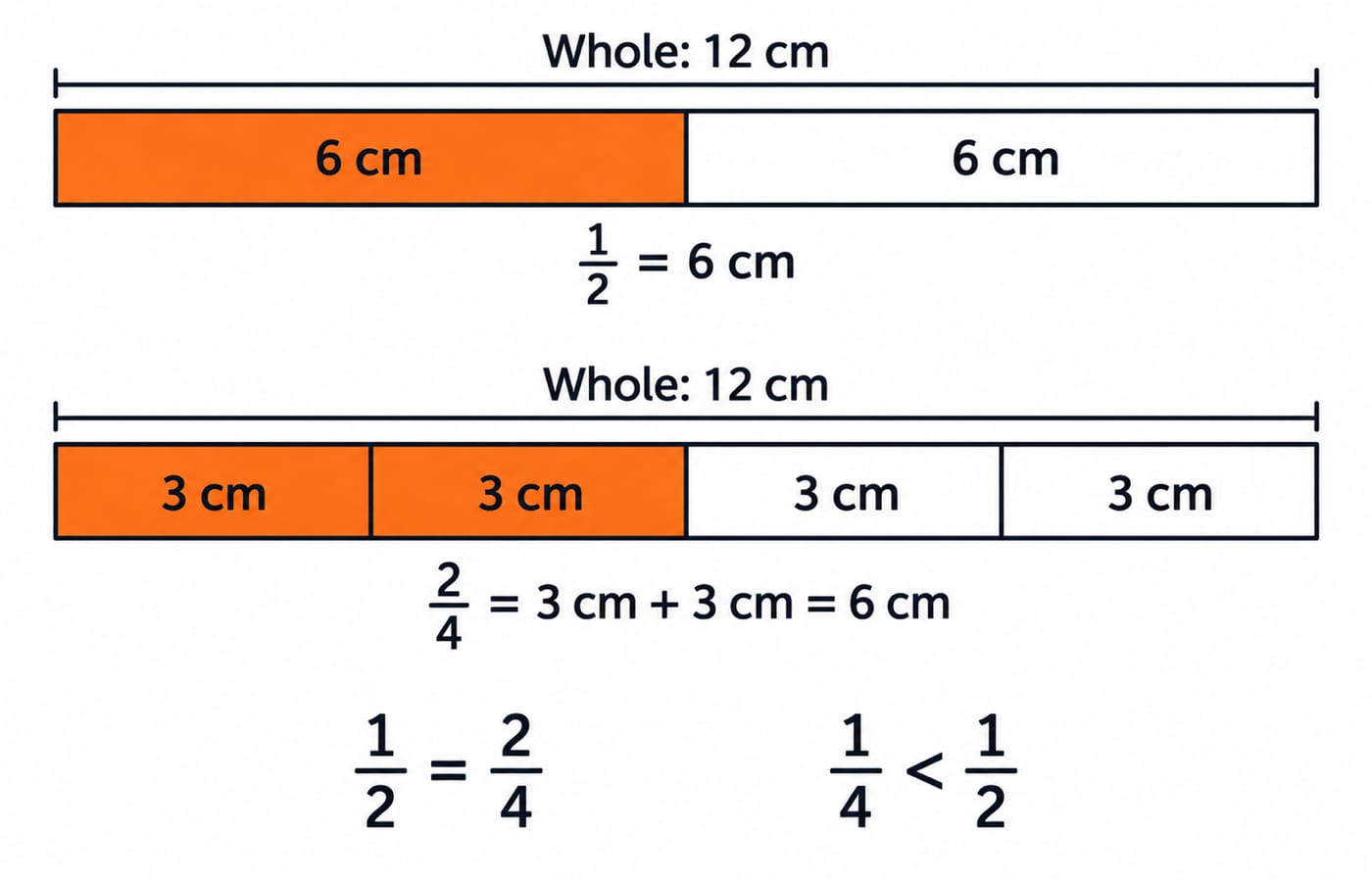
Both strips represent the same whole, 12 cm:
Divide the first into halves: 12 ÷ 2 = 6 cm per half.
Divide the second into quarters: 12 ÷ 4 = 3 cm per quarter.
One shaded half measures 6 cm.
Two shaded quarters measure 3 + 3 = 6 cm.
Therefore 1/2 = 2/4, while 1/4 < 1/2. More equal parts of the same whole means smaller individual pieces.
Ask the child to revise the claim and explain why the whole sizes must match. Unequal strips would confuse the comparison. The teacher selects materials, asks questions and checks understanding; peers compare explanations. Connect this sequence with the wider child development and pedagogy concepts. An experiential-pedagogy treatment uses fraction strips to trace reflection and transfer; this section uses the strips to diagnose the denominator misconception and select feedback. Read Experiential Pedagogy for Exams: Kolb Cycle and Examples for that different lens.
Now transfer the reasoning to a 16 cm strip: a half is 16 ÷ 2 = 8 cm; a quarter is 16 ÷ 4 = 4 cm; two quarters give 4 + 4 = 8 cm. Explaining this new case shows more than repeating the first equality.
Assessment reform: use the answer to decide what to teach next
NCERT §§3.11 and 5.3 discuss assessment and examination reform. Assessment remains necessary; evidence from learning should inform support.
Consider a class of 30 learners after the strip task:
Evidence | Next teaching decision |
|---|---|
18 explain the equal whole and equality correctly | Offer an extension requiring another representation. |
8 reach the correct answer but cannot explain it | Ask them to explain using equal strips. |
4 still think a larger denominator means a larger piece | Guide them through comparing individual pieces. |
The total checks: 18 + 8 + 4 = 30. These are temporary instructional responses, not permanent ability labels.
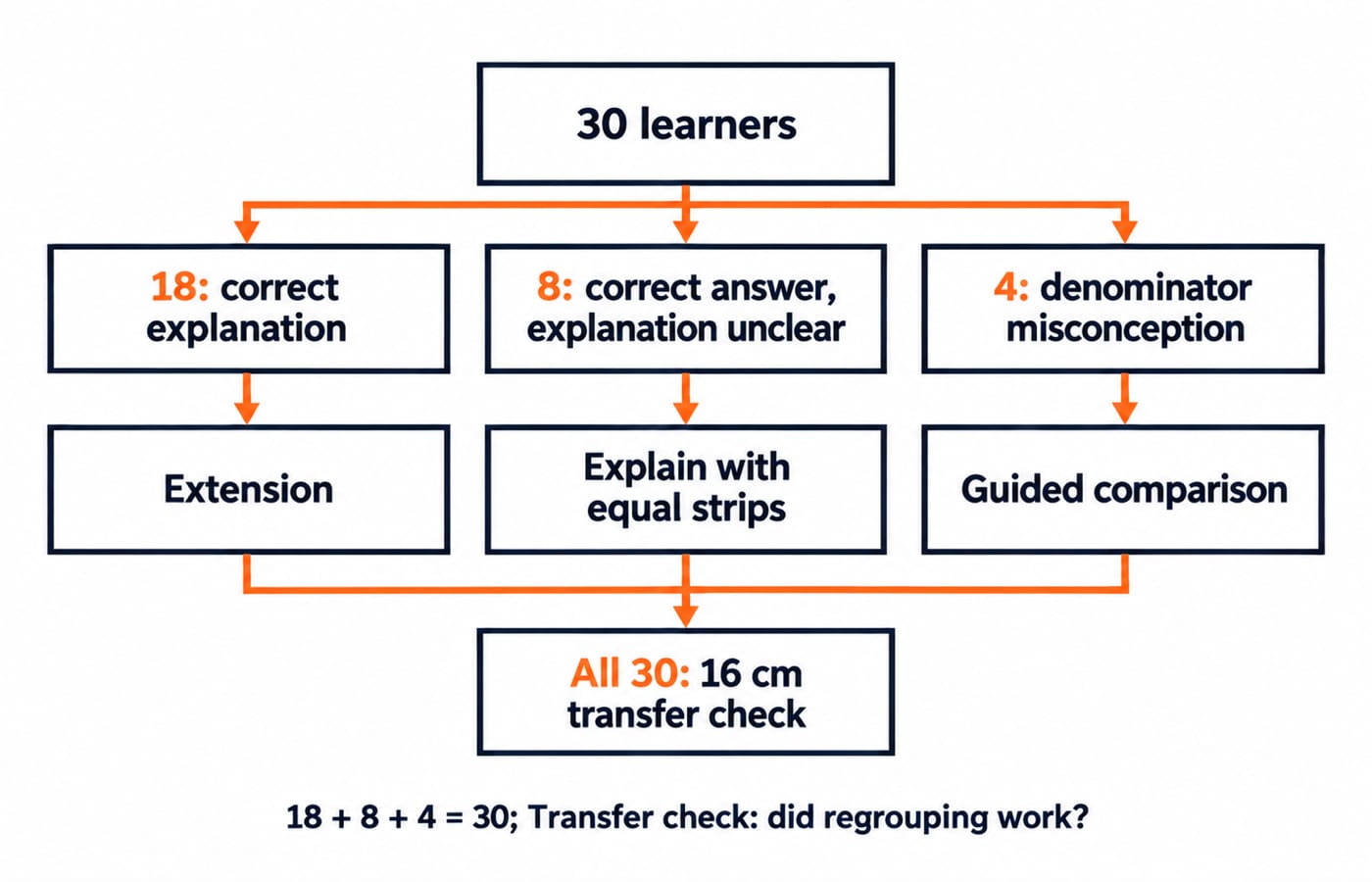
All 30 attempt the 16 cm transfer check. Their explanations show whether the regrouping worked. Recording only 18 + 8 = 26 correct answers hides the eight children whose reasoning remains uncertain. The useful record includes what each response reveals and what to check next.
Four traps that make plausible options wrong
Watch how an attractive phrase can conceal an unhelpful action:
“Active learning means no teacher guidance.” The strips lesson needs planned prompts, suitable materials and a check of the child's explanation. Activity alone does not establish understanding.
“Beyond textbooks means discard textbooks.” Add local resources and practical comparisons. The strips can support a textbook fraction diagram rather than replace the book.
“Continuous assessment means constant graded tests.” Listening to a comparison and examining a drawing can provide useful evidence during learning. Another score is not automatically useful feedback.
“Child-centred means every answer is equally valid.” Respect the child's reasoning while helping them revise the incorrect claim about quarters.
To eliminate an option, identify the proposed teacher action, the evidence it uses and the learning it supports. Inspect words such as “always”, but do not treat them as an automatic rejection rule. Judge the complete statement against the situation.
How to practise CTET question framings without guessing keywords
Check 1: A child says 1/4 is greater than 1/2 because 4 is greater than 2. Which response best supports knowledge construction?
(a) Dictate the correct rule.
(b) Ask the child to compare equal paper strips and explain.
(c) Ignore the mistake.
(d) Give 20 identical copying exercises.
Answer: (b). Guided comparison uses the misconception as evidence and helps the child test it. Option (a) supplies a rule; (c) leaves the misconception unresolved; (d) repeats without diagnosing the difficulty.
Check 2: Eight children give the correct fraction answer but cannot explain it. What should the teacher do next?
(a) Declare mastery.
(b) Rank them publicly.
(c) Ask for a representation and explanation.
(d) Stop assessing them.
Answer: (c). A correct answer alone does not settle understanding. A representation lets the teacher inspect how the child connects the parts with the whole.
Use CBSE's CTET January 2024 question-paper archive on ctet.nic.in for authentic papers and the CTET pedagogy paper analysis for broader study context. Classify actual items as recommendation recognition, classroom response or assessment decision, then explain your choice before consulting the answer.
The short version and your next revision step
Use a retrieval routine: name the principle, give a classroom action and explain why a competing action fails. Try this suggested 10-minute revision block:
3 minutes: Recall the five principles.
4 minutes: Explain the fractions lesson and transfer check.
3 minutes: Answer the two practice questions with reasons.
That is 3 + 4 + 3 = 10 minutes. If you are preparing for Paper 1 and want a structured course next step, explore the CTET Paper 1 course.
Go deeper with the full courseCTET Paper 1 2026 — प्राथमिक शिक्षक (कक्षा 1–5)
Keep learning
Curriculum Framework and Reforms for Teaching Exams: NCF 2005, NEP 2020 and NCF-SE 2023 Notes
Learn how policy, curriculum frameworks, syllabi, pedagogy and assessment fit together. Use one worked Class VI lesson to revise reform concepts for teaching exams.
Updated 18 Sep 20265 min read71 viewsCTET & UPTET
Principles of English Language Teaching: CTET Notes with Classroom Examples
Turn language-teaching principles into classroom decisions. Follow a library timetable lesson, understand purposeful error correction, and practise matching an activity to its learning objective.
Updated 18 Nov 20265 min readCTET & UPTET
Pre-Independence Education Commissions for Teaching Exams: Timeline and Key Recommendations
Separate minutes, despatches, commissions, Acts and plans before memorising the dates. This guide builds the full timeline and solves a seven-item match.
Updated 31 Aug 20265 min read117 viewsCTET & UPTET

Teaching-exam mock strategy: using mocks across DSSSB, KVS and state CS papers
A mock-test strategy for teaching CS exams: cadence, disciplined review, and how one shared core lets a single mock habit serve DSSSB, KVS and state papers.
Updated 29 Oct 20265 min readCTET & UPTET