

Early Childhood Care and Education (ECCE): CTET Notes, Age Groups and Examples
Separate preschool from the foundational stage, then see how eight blocks connect care, play and assessment. Includes an age-stage calculation and two original CTET-style practice checks.
KnowledgeGate Team
Exam prep & CS education
Updated 26 Nov 20265 min read
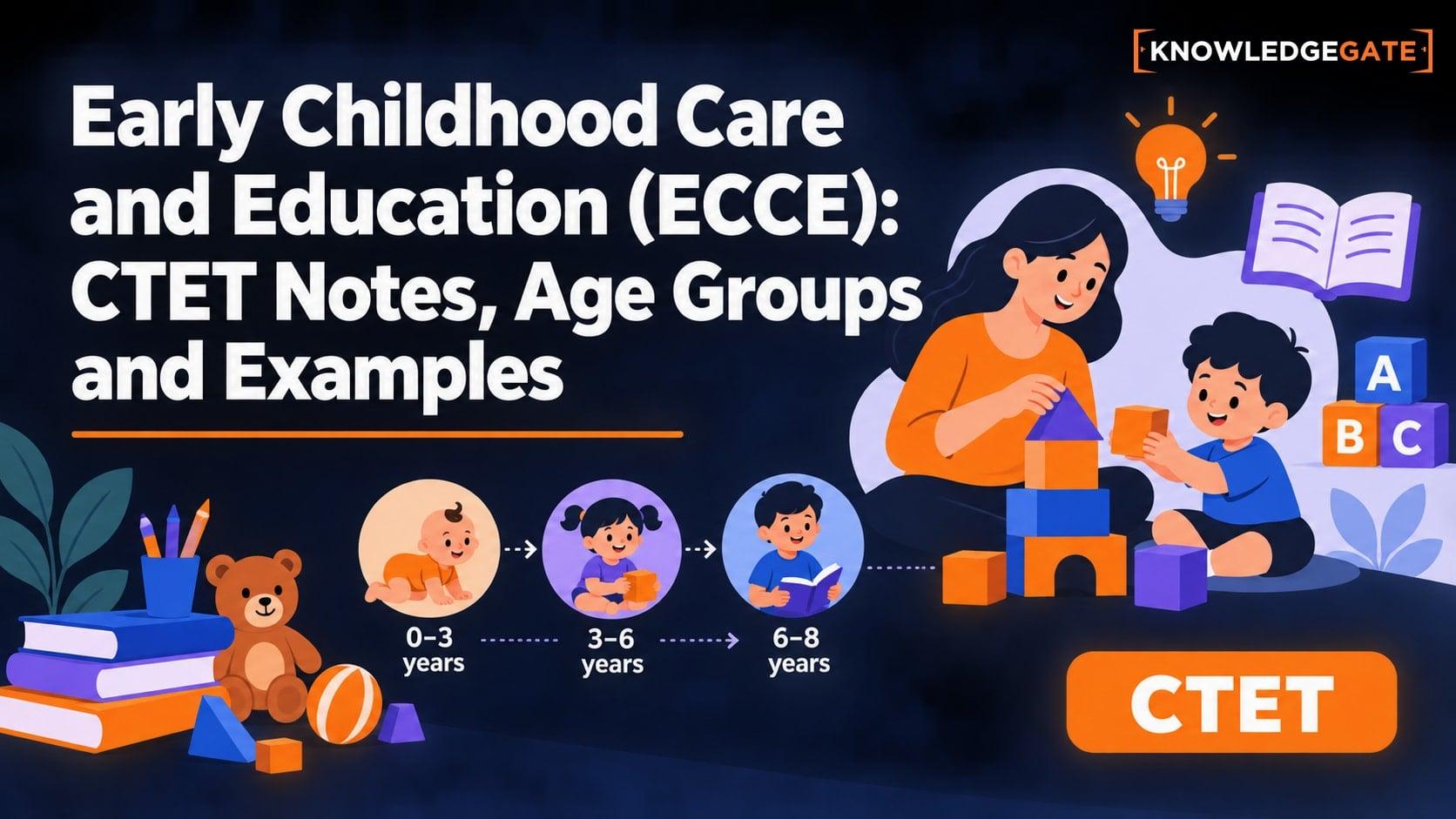
Remembering “play-way” is easy; explaining which ages ECCE covers and how play supports learning takes more thought. You may also confuse preschool with the foundational stage or treat care as separate from education. ECCE links its definitions to a five-year age-stage calculation, a classroom activity and two practice checks, so the reasoning behind an answer stays visible.
What ECCE means and what it develops
ECCE means Early Childhood Care and Education. Nutrition, safety, emotional security, responsive interaction and learning opportunities support one another. A hungry or frightened child needs care to participate comfortably; alphabet drilling alone cannot meet these needs.
NCERT's NCF-FS 2022 describes home as almost the sole provider of care and early stimulation up to age 3. From 3–8, home support continues alongside institutional provision: preschool settings at 3–6 and Grades 1–2 at 6–8. ECCE therefore extends beyond preschool alone.
Look for development in observable actions. Grasping a large block uses motor coordination; grouping objects involves cognition; describing a picture uses language; waiting for a turn involves social and emotional learning. These areas overlap within one activity.
Readiness includes confidence, communication and participation alongside emerging literacy and numeracy. Connect these observations to the broader principles in Child Development for CTET and TET. Ask what support helps a child participate, rather than judging readiness only through written work.
NEP 2020: why the foundational stage is five years
NEP 2020's structure, explained in NCERT's National Curriculum Framework for Foundational Stage 2022, is:
Stage | Years | Age band | Composition |
|---|---|---|---|
Foundational | 5 | 3–8 | Three preschool years + Grades 1–2 |
Preparatory | 3 | 8–11 | Grades 3–5 |
Middle | 3 | 11–14 | Grades 6–8 |
Secondary | 4 | 14–18 | Grades 9–12 |
These are policy bands, not current individual admission cut-offs.
Suppose Meera starts preschool at 3. Count the intervals:
Preschool: 3–4, 4–5 and 5–6, giving three years.
Grade 1: 6–7, giving one year.
Grade 2: 7–8, giving one year.
Thus, 3 + 2 = 5 years. Check by subtraction: 8 - 3 = 5. Meera at 7 in Grade 2 is still in the foundational stage. Six endpoint labels, 3 through 8, mark five intervals; they do not mean six years.
For the wider policy structure, continue with Types of Education & NEP 2020.
Anganwadi, preschool and Balvatika: distinguish their roles
NCERT's framework describes Anganwadis under ICDS as settings connecting care, nutrition, health support and early learning. An Anganwadi is a setting; ECCE is the broader approach.
Preschool covers ages 3–6, before Grades 1–2. The NCF-FS glossary defines Balvatika as a one-year preparatory class for ages 5–6 before Grade 1, possible in different settings. It differs from the NEP Preparatory Stage, Grades 3–5.
Imagine a 5-year-old listening to a story and sorting objects at an Anganwadi. The child predicts what happens next, handles materials and explains a grouping. Learning is taking place without a formal subject timetable.
When revising these terms, ask whether the word identifies an institution, a class or an educational approach. That small distinction prevents you from treating different kinds of terms as interchangeable.
Worked example: turn eight blocks into holistic learning
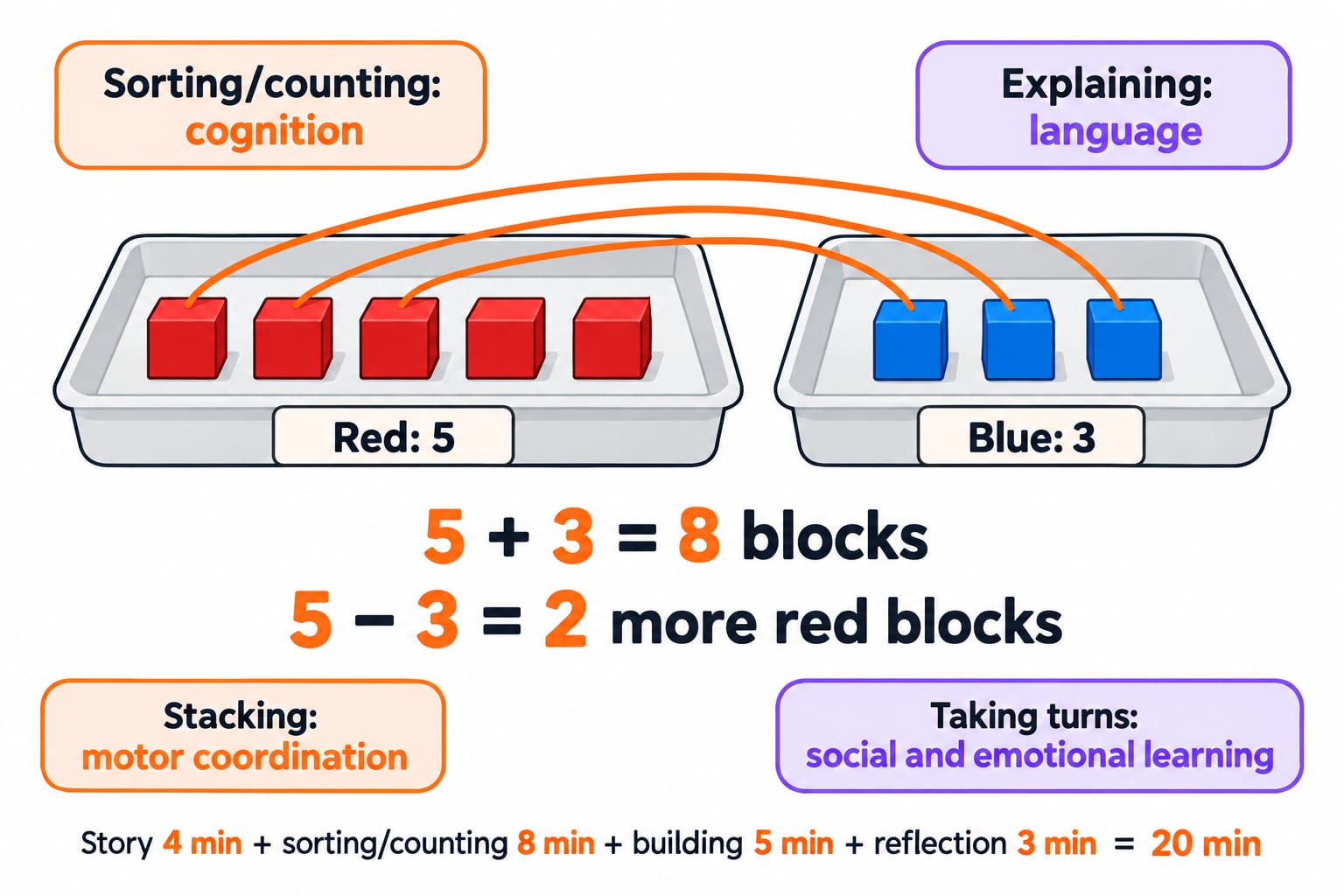
Use this classroom activity with two children aged 5: eight large, child-safe blocks, five red and three blue, plus two trays. Plan 4 minutes for story/conversation, 8 for sorting/counting, 5 for turn-taking building and 3 for reflection. The total is 4 + 8 = 12, 12 + 5 = 17, and 17 + 3 = 20 minutes.
Ask, “How can we group these?” The children choose colour. They place five red blocks in one tray and three blue blocks in the other: 5 + 3 = 8. Pair three red blocks with three blue blocks. Two red blocks remain unpaired, so red has 5 - 3 = 2 more. Show this comparison before introducing symbols.
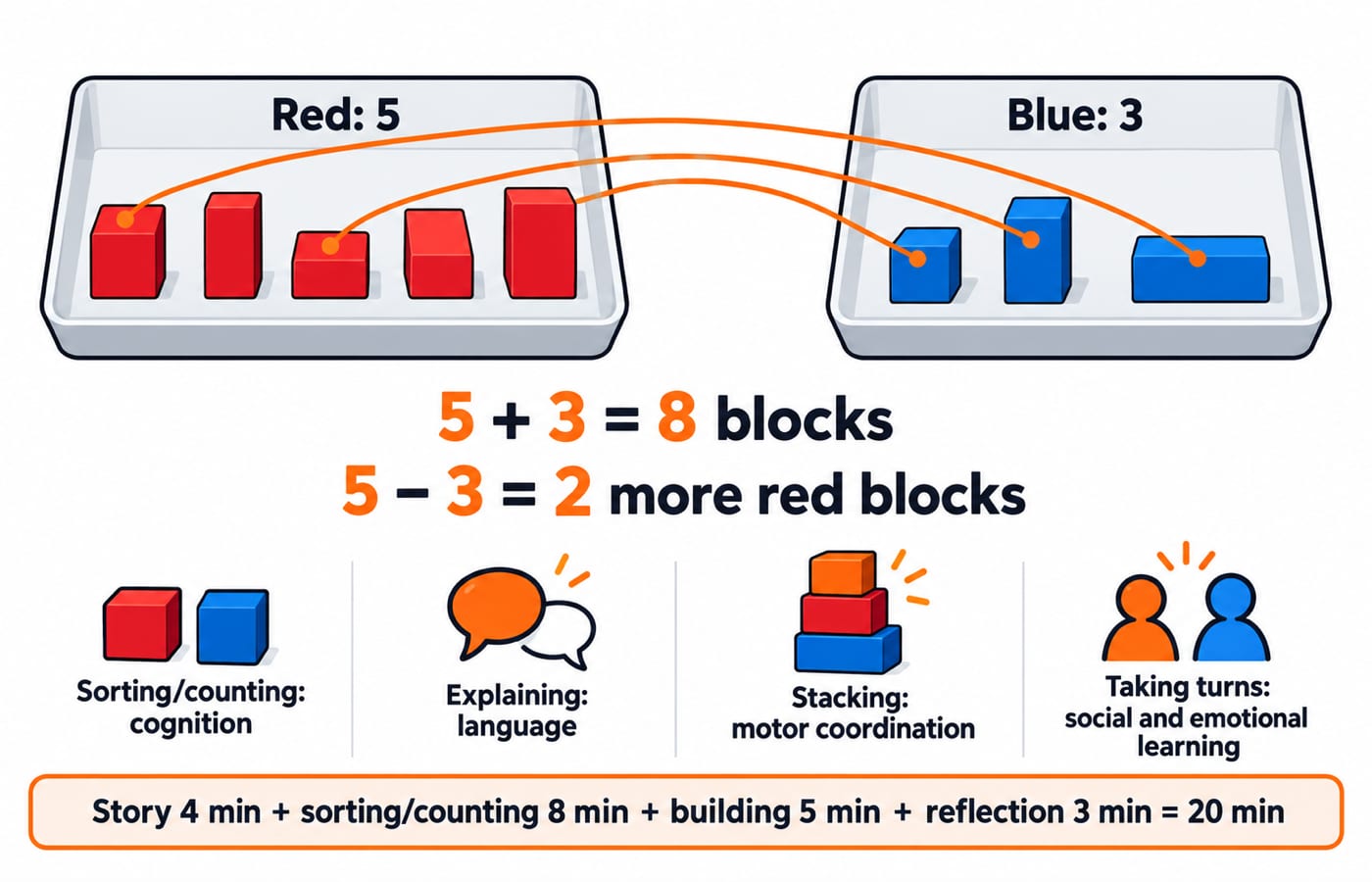
Sorting/counting supports cognition, explaining choices supports language, stacking practises motor coordination, and alternating turns supports social and emotional learning. Accept home-language answers, pointing or handling blocks; limited classroom-language fluency should not attract a penalty.
Asha touches and counts each red block once. Kabir counts one blue block twice and says “four”. Record the action, model moving each counted block into the tray, then invite a recount of the three blue blocks. This links assessment to teaching without ranking the children or labelling Kabir “weak”.
ECCE misconceptions that lead to wrong answers
The cited framework separates these common traps:
Trap | Correction |
|---|---|
Foundational means preschool only | It includes three preschool years plus Grades 1–2. |
Balvatika is the Preparatory Stage | The pre-Grade-1 class differs from Grades 3–5. |
School readiness means early textbook completion | Readiness includes communication, participation and self-regulation. |
“Play means no teaching” is another misleading shortcut. The block activity has a purpose, teacher prompts and observation. The children still make choices and handle materials. Equally, adding colourful decoration to a copying worksheet does not automatically make the task meaningful play-based learning.
An observation is evidence for support, not a diagnosis or fixed ability label. Kabir's double-counting tells the teacher what happened during this attempt. His recount can show whether moving blocks helps him track counted objects.
How to reason through CTET-style ECCE questions
CBSE's CTET December 2024 Information Bulletin includes child-centred education, socialisation and principles of development in its CDP syllabus. These provide a study connection for ECCE. Use CTET Exam Preparation to navigate broader preparation.
Original practice check A: In the NEP 2020 structure, which combination forms the five-year foundational stage?
(a) Grades 1–5
(b) Three preschool years plus Grades 1–2
(c) Two preschool years plus Grades 1–3
(d) Preschool only
Answer: (b). The composition is 3 + 2 = 5, spanning ages 3–8. Option (a) excludes preschool; (c) changes the preschool and grade split; (d) leaves out Grades 1–2. A total of five years alone is insufficient: its components must also match.
Original practice check B: Kabir counts one of three blue blocks twice. What should the teacher do next?
(a) Give him a lower ability label.
(b) Make him copy the numeral 3 repeatedly.
(c) Model moving each counted block and invite a recount.
(d) Stop the activity for everyone.
Answer: (c). It addresses the observed counting process. Copying a numeral does not address tracking objects; a label supplies no guidance; stopping everyone removes a useful learning opportunity. Choose feedback tied to the action.
The short version and your next revision step
ECCE connects care with education. Remember the foundational split of three preschool years plus Grades 1–2, and use the block activity to explain purposeful play with supportive observation.
Reconstruct Meera's five age intervals and explain why moving blocks could help Kabir recount. Explaining both connects the policy structure to a teaching decision. For structured Paper 1 preparation, explore CTET Paper 1 2026.
Go deeper with the full courseCTET Paper 1 2026 — प्राथमिक शिक्षक (कक्षा 1–5)
Keep learning
IISc Administrative Assistant Eligibility: Education, Age and a Document-Ready Check
Check the four eligibility gates for IISc Administrative Assistant recruitment, then compare one clear candidate file with one that should remain on hold.
Updated 30 Oct 20266 min readIISC Administrative Assistant
SSC CGL Eligibility 2026: Age Limit, Attempts, Education and Post-wise Requirements
SSC CGL eligibility is post-wise, not one rule: the age band depends on the post, the degree requirement carries statistics-post exceptions, and there is no attempt limit. Category-wise relaxation extends the upper limit, final-year applicants are decided by the qualification cutoff date, and every exact figure sits in the official 2026 notification.
Updated 29 Oct 20265 min readSSC CGL
EVS for CTET: Environmental Studies vs Environmental Education with Worked Examples
Learn how primary-stage EVS differs from Environmental Education, how six themes integrate around a child's life, and how to solve evidence-led CTET choices.
Updated 11 Nov 20265 min readCTET & UPTET
BTSC Lab Assistant Job Profile: Records, Equipment Care and Daily Lab Workflow
Build a realistic CS/IT Laboratory Assistant role model around readiness checks, auditable registers, safe fault handling and evidence-based handover.
Updated 30 Oct 20265 min readBTSC Lab Assistant