

Bandura’s Social Learning Theory: Bobo Doll, Four Processes and CTET Questions
Can a child learn a behaviour without displaying it? Use Bandura’s four processes, a classroom example and two explained questions to separate learning from performance.
KnowledgeGate Team
Exam prep & CS education
Updated 25 Nov 20265 min read
Bandura’s observational learning becomes easier to apply when a classroom question separates attention, retention, reproduction and motivation. The Bobo doll evidence shows how observed behaviour can be acquired before it is performed. CTET and NET questions often turn on that gap between learning and performance.
What Bandura means by learning through observation
In observational learning, a model demonstrates behaviour and an observer learns from watching it. The model may be a teacher or peer; the modelled behaviour might be arranging materials or taking turns in a discussion.
A pupil can acquire a response before receiving any reward for performing it. This differs from learning through the consequences of one's own actions, such as repeating a response because it previously earned praise.
The observer is not a passive copier. Attention selects what is noticed, and a mental representation preserves the action for later use. Remembering a demonstration, being able to reproduce it and choosing to do so are separate matters. Reinforcement still matters, particularly for whether learned behaviour is displayed; observation does not explain every kind of learning.
The broader Primary-teaching preparation hub (live) places Bandura beside the other major theorists; this post isolates the four-process diagnostic, vicarious reinforcement and CTET question solving.
What the Bobo doll experiment established
Albert Bandura, Dorothea Ross and Sheila Ross reported their 1961 study in the Journal of Abnormal and Social Psychology. Nursery-school children encountered an aggressive adult model, a non-aggressive model or no model. The aggressive adult struck an inflated Bobo doll with a mallet and used distinctive phrases.
After mild frustration through removal from attractive toys, children were observed for 20 minutes in another room without the model. Those exposed to aggression reproduced its distinctive actions and speech much more than the other groups.
Behaviour observed once, without rewarding the observer, was reproduced later in a new setting. A laboratory doll task does not establish that every observer becomes violent. Consequences delivered to the model belong to separate work, discussed below.
Attention, retention, reproduction and motivation: one worked example
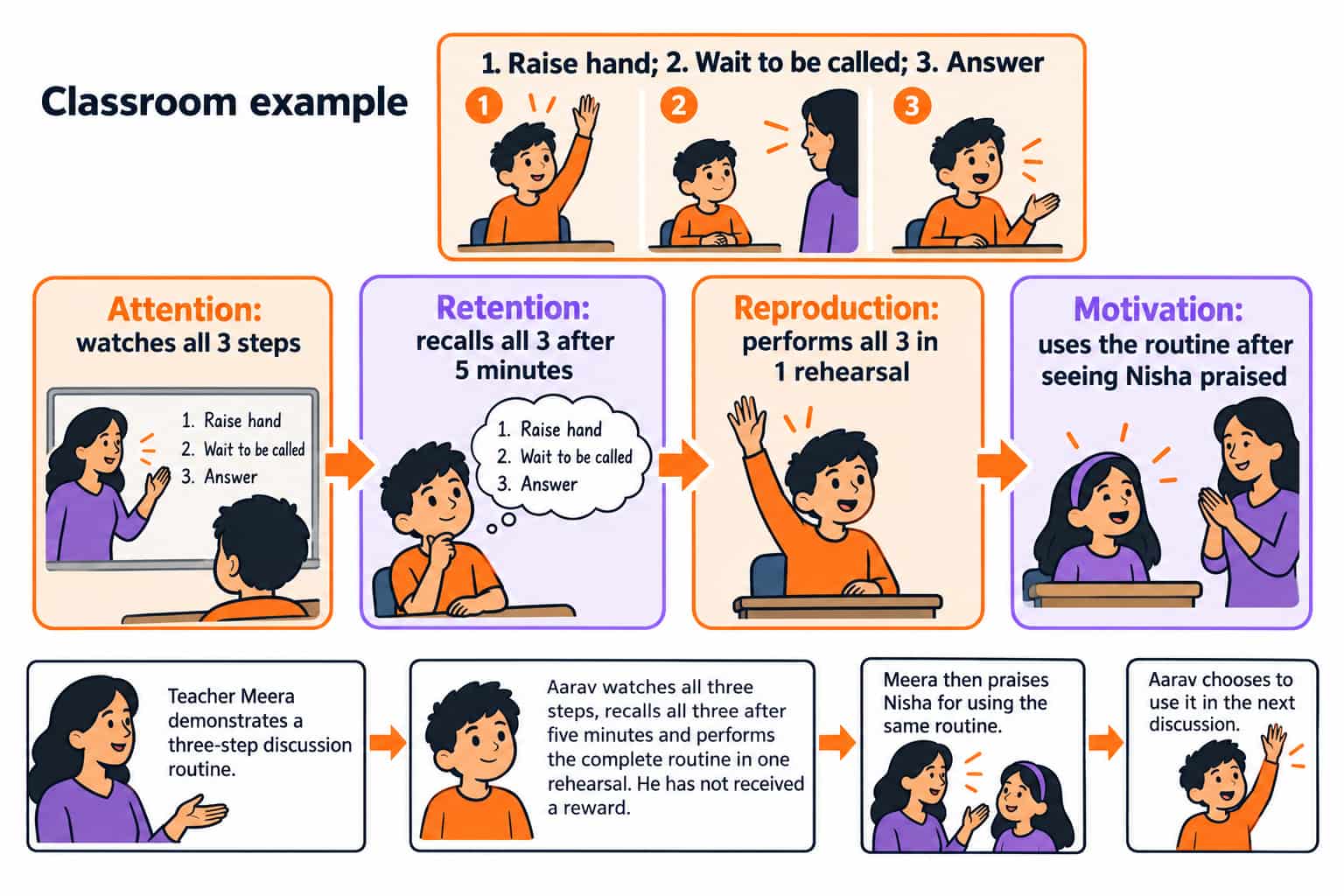
Consider a classroom example. Teacher Meera demonstrates a three-step discussion routine: raise a hand, wait to be called, then answer. Aarav watches all three steps, recalls all three after five minutes and performs the complete routine in one rehearsal. He has not received a reward.
Meera then praises Nisha for using the same routine. Aarav chooses to use it in the next discussion.
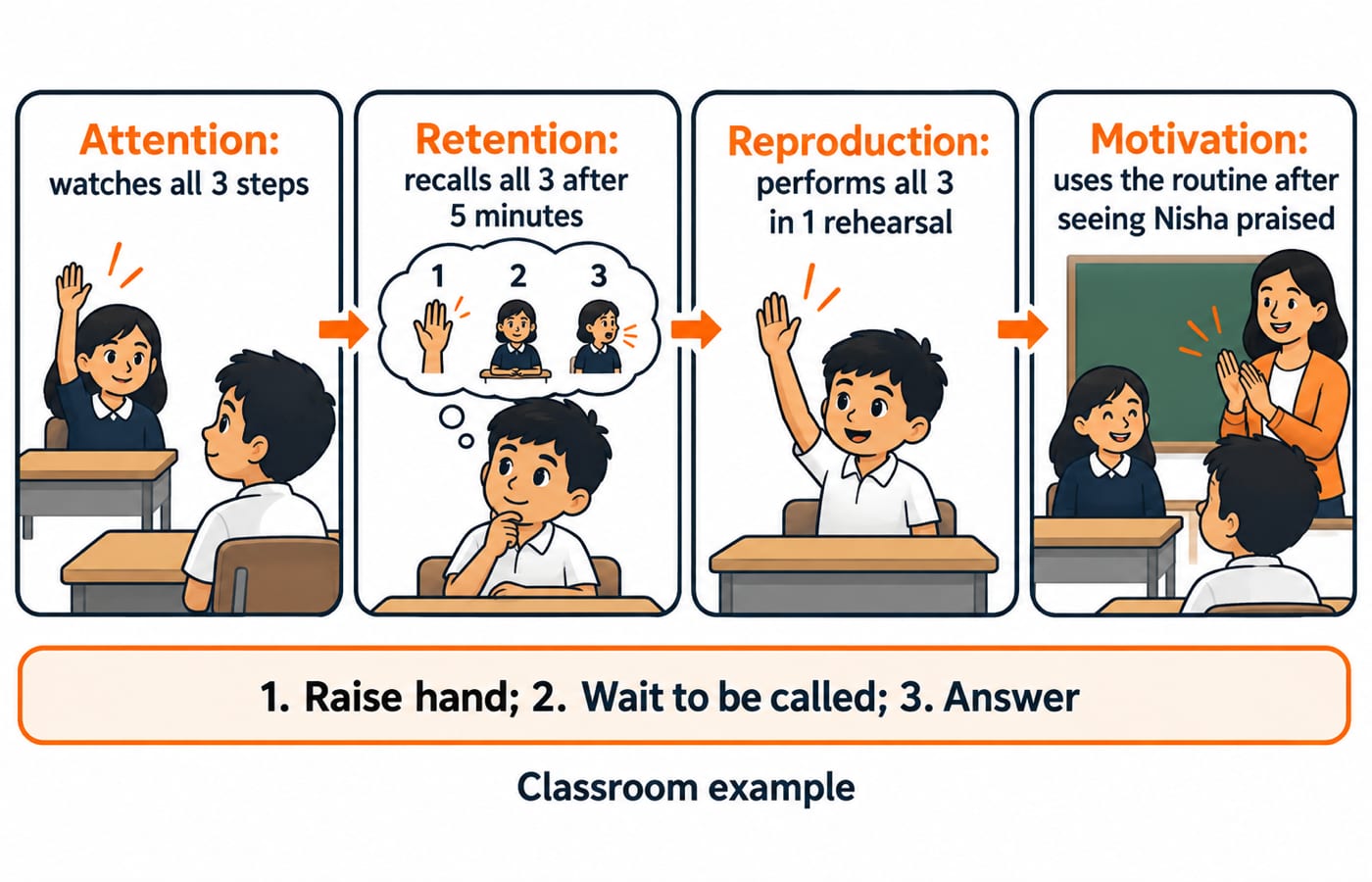
Each observation answers a different question:
Process | Evidence from Aarav | What it establishes |
|---|---|---|
Attention | Watches all three steps | Notices the relevant actions |
Retention | Recalls them after five minutes | Keeps a mental representation |
Reproduction | Performs the routine in rehearsal | Can translate memory into action |
Motivation | Uses it after seeing Nisha praised | Has a reason to enact it |
Five minutes is the delay in this example, not a threshold defining retention. Recall alone does not prove execution skill, and successful rehearsal does not guarantee spontaneous use.
Treat the four processes as an explanatory framework, not a stopwatch sequence. Motivation can also influence what a learner attends to and practises; it does not suddenly begin only at the final box.
Vicarious reinforcement is different from direct reinforcement
Nisha receives praise; Aarav observes it. When that observed consequence increases Aarav's use of the routine, it illustrates vicarious reinforcement. If Meera later praises Aarav for his own response and his future use increases, that is direct reinforcement. A consequence functions as reinforcement when it increases future behaviour, not simply because someone calls it a reward.
Track the difference between ability and performance. Aarav recalls 3 of 3 steps and performs 3 of 3 in rehearsal, but uses the routine in 0 of 2 voluntary opportunities. After seeing Nisha praised, he uses it at the third opportunity: 0 + 1 = 1 use across 2 + 1 = 3 opportunities. His earlier non-performance did not establish absence of learning.
In Bandura’s 1965 study in the Journal of Personality and Social Psychology, children saw a filmed model rewarded, punished or given no consequence. Observing punishment reduced spontaneous imitation, but group differences largely disappeared when children received incentives to reproduce the actions, distinguishing acquisition from performance.
Vicarious punishment discourages enactment through consequences observed for someone else. It differs from negative reinforcement, which increases behaviour through removal or avoidance of something unpleasant.
Two practice questions and the distractors they expose
Practice question 1
A learner watches closely as her teacher demonstrates a three-step routine, and correctly names all three steps immediately afterwards. Five minutes later she is keen to try it but cannot recall the steps. Which process of observational learning has broken down?
(a) Attention
(b) Retention
(c) Reproduction
(d) Motivation
Answer: (b) Retention. Naming the steps immediately rules out (a) as the problem described. She never reaches an attempt, so (c), her ability to execute the routine, remains untested. Being keen to try rules out (d). The missing evidence is an accessible mental representation after a delay.
Practice question 2
Ravi knows how to arrange classroom materials but rarely does so. After seeing a classmate praised for arranging them, he starts doing it too, before receiving any praise himself. What best explains the change?
(a) Direct reinforcement of Ravi
(b) Vicarious reinforcement
(c) Classical conditioning through a neutral stimulus
(d) Maturation alone
Answer: (b) Vicarious reinforcement. The classmate receives praise; Ravi's behaviour changes. Option (a) fails because Ravi has received no consequence himself. Option (c) lacks a described pairing of stimuli. Option (d) cannot explain the specific change following social observation, especially when Ravi already knew the task.
For elimination, locate the model, remembered action, ability to perform and recipient of the consequence. Continue with CTET CDP previous-year analysis. For NET-style statements, inspect “always” and “only”: “learning occurs only when the learner is reinforced” is false under Bandura.
How to connect this topic to CTET preparation
The CBSE CTET February 2026 Information Bulletin includes “learning as a social activity” and “Motivation and learning” within Learning and Pedagogy. Syllabus note: these entries name topics, not theorists. Bandura helps explain them, but is not explicitly named in these entries.
Two classroom applications follow. First, demonstrate the behaviour you request: show turn-taking rather than only instructing pupils to cooperate. Second, allow recall and guided rehearsal before treating non-performance as disobedience. A pupil may have missed a step, forgotten it or need help executing it.
When comparing study routes, review the CTET and UPTET preparation options. Keep your own revision focused on explaining classroom evidence, not merely matching a theorist to a keyword.
The short version and a ten-minute revision task
Observational learning involves attention, retention, reproduction and motivation. Learning an action differs from displaying it; observing someone else's consequence differs from receiving one yourself.
Readers preparing specifically for Paper 1 can review the CTET Paper 1 course.
Now complete a ten-minute revision task:
Spend 2 minutes writing the four processes from memory.
Spend 4 minutes mapping Aarav's example to each process, including his voluntary opportunities.
Spend 4 minutes answering both questions and explaining why each distractor fails.
Total: 2 + 4 + 4 = 10 minutes. Explain who learned, who performed and who received praise in each case.
Go deeper with the full courseCTET Paper 1 2026 — प्राथमिक शिक्षक (कक्षा 1–5)
Keep learning

EVS in CTET: Scope and Relation to Science and Social Studies, with a Worked Example
Understand integrated EVS through its six themes, three contributing lenses and a four-household water inquiry that separates evidence from assumption.
Updated 14 Nov 20266 min readCTET & UPTET

Learning Disabilities for CTET: Types, Signs and Classroom Support
Identify the skill barrier in a classroom vignette, then choose support that preserves the learning goal. Compare learning disabilities with ADHD and work through subtraction with regrouping.
Updated 25 Nov 20265 min readCTET & UPTET

REET Social Science Preparation: Priority Topics and an 8-Week Plan
Decide what to revise first using syllabus coverage and your diagnostic results. Use a nine-hour weekly plan, a diagnostic tally and worked practice examples to organise Social Studies preparation.
Updated 23 Nov 20264 min readCTET & UPTET

Linux OS (Operating System): Kernel, Processes, Memory and File Systems with Worked Examples
Connect Linux commands to the OS mechanisms beneath them through exact traces of system calls, a two-process pipe, virtual address translation and file permissions.
Updated 30 Oct 20266 min read57 viewsOperating Systems