Vedic Education Notes for Teaching Exams: Concepts, Features and Solved Examples
Separate the setting, relationship, initiation, methods and aims of Vedic education. These notes include a solved match-the-following question and a six-point revision card.
KnowledgeGate Team
Exam prep & CS education
Updated 11 Sep 20265 min read56 views
Revision notes often mix the Vedic gurukul, later ancient universities, broad Indian philosophy and modern teaching aptitude into one list, obscuring the differences between institutions, relationships, ceremonies and methods. Vedic education is clearest when gurukul, guru-shishya parampara, upanayana, oral instruction and reflection are classified separately. The UGC Paper I syllabus includes ancient Indian higher learning under Unit X, while CTET, state TET and recruitment syllabi vary. Start by understanding the Paper I scope, then confirm your own examination's current notification.
1. Vedic education at a glance: four anchors before the details
Here, Vedic education means the early ancient Indian teaching tradition described through the gurukul and the guru-shishya relationship. It is not a label for every institution, subject or educational development in ancient India.
Use four anchors to organise the topic:
Place: gurukul
Relationship: guru-shishya parampara
Initiation: upanayana
Primary mode: oral instruction and memorisation
Each anchor answers a different question. Where did learning happen? Who guided the learner? How was entry into learning generally marked? How was material transmitted? Keeping these four slots separate gives you a retrieval frame for definitions, statement questions and match-the-following sets. The terms are related, but they are not interchangeable.
2. Aims of Vedic education: inner growth, thinking and self-discipline
NIOS, in Indian Culture and Heritage, Lesson 18, describes the aim of ancient Indian education as development of the learner's overall personality, inner growth and self-fulfilment. Training the mind mattered because the mind was treated as the instrument for acquiring knowledge. The thinking capacity, manana shakti, was therefore central.
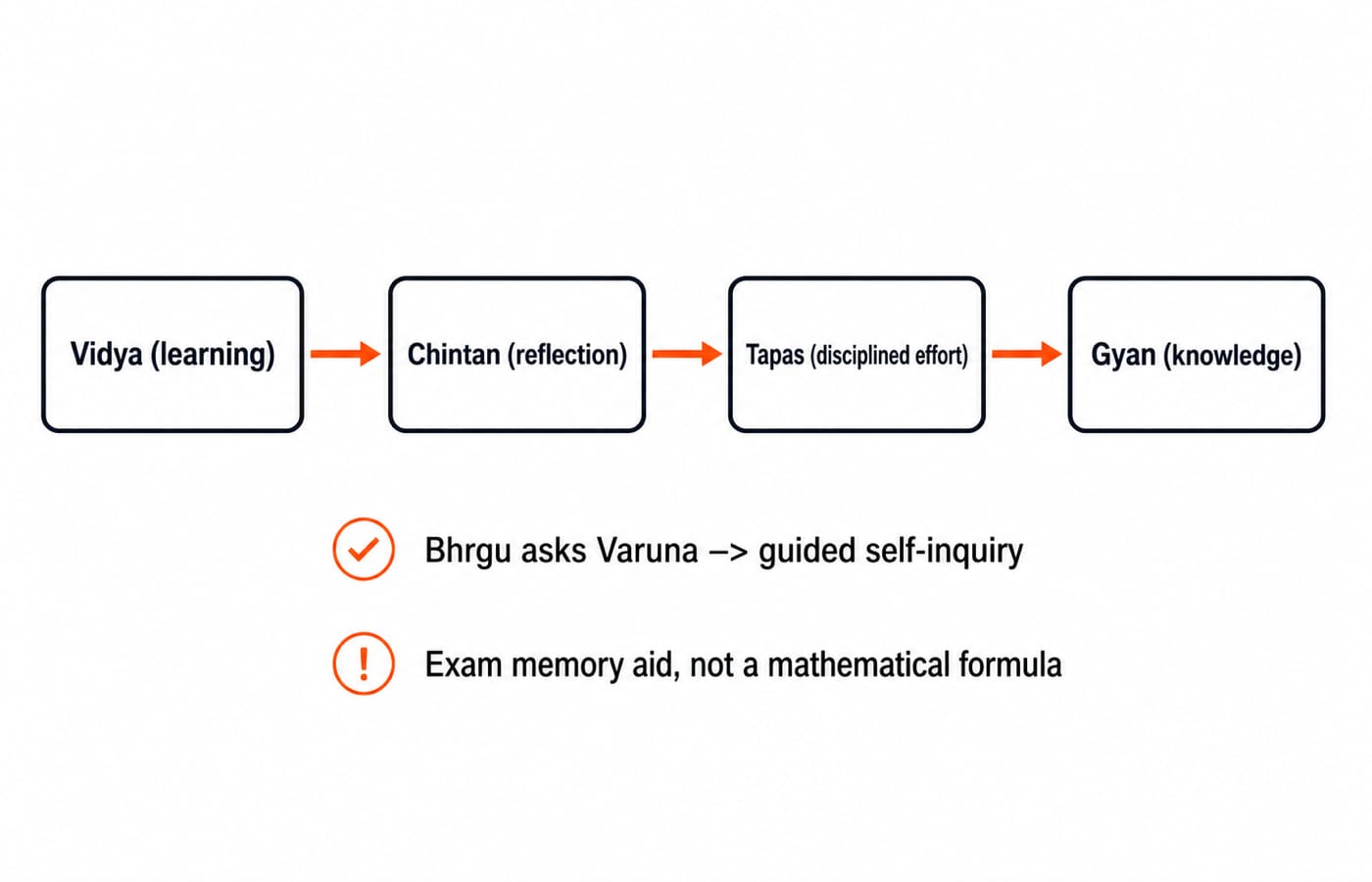
An exam-friendly memory sequence is:
Vidya (learning) -> Chintan (reflection) -> Tapas (disciplined effort or austerity) -> Gyan (knowledge).
This is a memory sequence, not a modern learning-science equation. NIOS also gives the example of Bhrgu approaching Varuna for knowledge of Brahman. Instead of simply supplying a final answer, Varuna directs him towards inquiry and meditation. Oral memorisation was important, but the presence of reflection and guided self-inquiry makes the claim that Vedic education was only rote learning incomplete.
3. Gurukul, guru-shishya parampara and upanayana are not synonyms
NIOS describes the gurukul as a domestic school or residential learning setting in the guru's household or ashrama. Pupils lived as members of the household, and the guru provided personal instruction and attention. This describes the setting, not the complete educational relationship.
The guru-shishya parampara names the close teacher-pupil relationship. Upanayana names the initiatory ceremony that generally marked the beginning of learning in the account. The clean contrast is: gurukul tells you where; guru-shishya tells you the relationship; upanayana tells you the initiation.
There is also an important historical limit. NIOS notes that education was primarily a privilege of upper castes, while Sanskrit held a privileged place in Brahmanical education. Access was not universal. Personal guidance may invite comparison with modern learner support, but historical gurukul education and contemporary pedagogy belong to different social and institutional settings.
4. Curriculum, medium and method: keep the three columns separate
What was studied | How it was taught | Setting or relationship |
|---|---|---|
Vedas and Dharmashastras | Oral instruction and memorisation | Gurukul with personal guidance |
Grammar, Logic and Metaphysics, identified by NIOS as later additions | Oral study plus reflection | Teacher-pupil guidance |
Curriculum, medium and method are different answer categories. The Vedas and Dharmashastras were content. Oral transmission and memorisation were methods. Sanskrit was a privileged medium in Brahmanical education. Mixing these categories creates avoidable matching errors.
The Indira Gandhi National Centre for the Arts documents exacting recitative methods used in Vedic oral traditions to preserve transmission without distortion. That supports a narrow point about rigorous recitation. It does not prove that every learner, subject or period used one identical method. It also does not remove reflection from the learning process.
5. Worked example: solve a four-pair match-the-following question
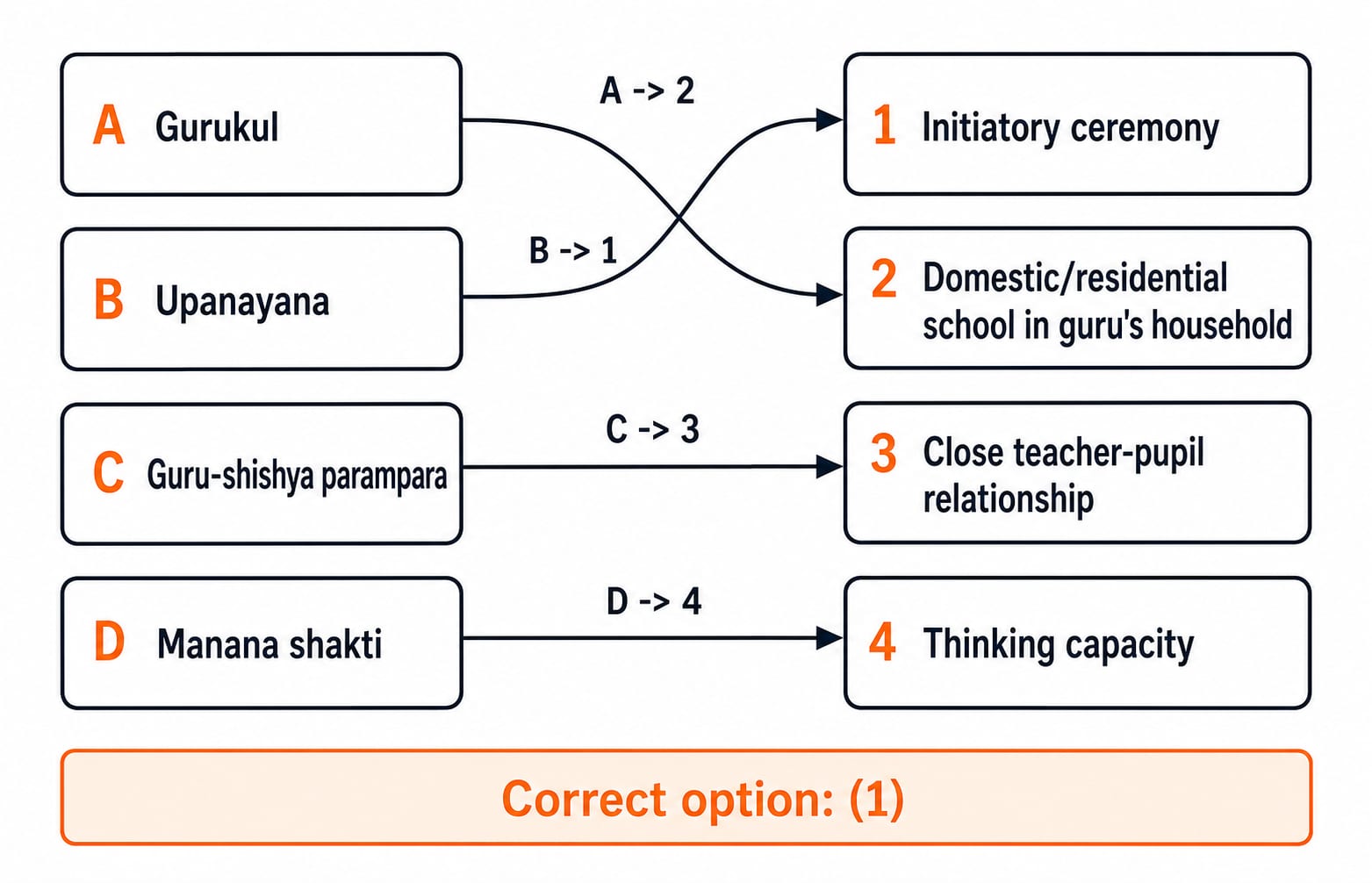
Match Column I with Column II.
Column I | Column II |
|---|---|
A. Gurukul | 1. Initiatory ceremony |
B. Upanayana | 2. Domestic or residential school in the guru's household |
C. Guru-shishya parampara | 3. Close teacher-pupil relationship |
D. Manana shakti | 4. Thinking capacity placed above the mere subject of thought |
Options
A-2, B-1, C-3, D-4
A-1, B-2, C-4, D-3
A-2, B-3, C-1, D-4
A-4, B-1, C-2, D-3
Solve it by classifying each term before looking for an option.
A must match 2. Gurukul is the domestic or residential learning setting.
B must match 1. Upanayana is the initiatory ceremony.
C must match 3. Guru-shishya parampara names the close teacher-pupil relationship.
D must match 4. Manana shakti is the thinking capacity or faculty.
Therefore, the correct answer is option (1): A-2, B-1, C-3, D-4. The reusable rule is to classify the terms as place, ceremony, relationship or faculty, then match. This turns four separate facts into an elimination method.
6. Five traps that make otherwise easy questions go wrong
Treating three terms as synonyms. Gurukul is the place, guru-shishya parampara is the relationship, and upanayana is the initiation.
Equating oral learning with the absence of thought. Memorisation mattered, but the vidya, chintan, tapas and gyan sequence also gives reflection and disciplined effort a place.
Moving later institutions into the Vedic period. Nalanda and later Buddhist monastic learning should not be labelled as features of the Vedic gurukul. Preserve period labels.
Moving every later subject into the earliest curriculum. NIOS identifies Grammar, Logic and Metaphysics as later additions, so they should not be moved into the earliest curriculum.
Assuming universal access or universal exam coverage. The historical account contains access limitations. UGC Paper I supplies a confirmed Unit X alignment, but candidates for other examinations must consult their own current syllabus. Presence in a syllabus or practice set does not establish how frequently a topic appears.
7. How teaching exams can test Vedic education
The UGC's official updated-syllabus page, applicable from June 2019 onwards, links the General Paper on Teaching and Research Aptitude syllabus. In that Paper I syllabus, Unit X, Higher Education System, includes institutions of higher learning and education in ancient India. This establishes the scope, not a fixed question count, weightage or appearance frequency.
The same content can be tested in three sound forms:
a four-pair match such as the solved example above;
a five-statement correct or incorrect set, where each statement should be checked independently before reading the combination options;
a category distinction, such as institution versus ceremony versus method.
After revising, use the UGC NET Paper 1 Test Series for timed practice. Review the reason for every error using a clear teaching exam mock-test strategy. The linked test series has 20+ Vedic Education questions available for targeted practice.
8. The short version and the next study step
Aim: overall personality and inner growth
Setting: gurukul
Relationship: guru-shishya parampara
Initiation: upanayana
Method: oral instruction, memorisation and reflection
Content: Vedas and Dharmashastras, with Grammar, Logic and Metaphysics identified as later additions
Study the broader sequence through NTA UGC NET Paper 1, then test whether each term is a place, relationship, ceremony, method, medium or subject. Use the NET preparation hub for the wider path. If you are preparing for CTET, a state TET or another recruitment examination, confirm that Vedic Education appears in your own current official notification before treating it as prescribed content.
Keep learning
सामान्य अशुद्धियाँ (Samanya Ashuddhiyaan): Complete Hindi Grammar Notes for CTET and TET Exams
Learn to identify and correct Hindi word-form, agreement, pronoun and redundancy errors through exact examples, a worked MCQ and a scored diagnostic.
Updated 6 Oct 20266 min readCTET & UPTET
Universities and Learning Programmes for Teaching Exams: Types, Modes and Solved Examples
Separate university status, delivery mode and programme purpose with a repeatable method, then test it on five UGC NET-style classification cases.
Updated 2 Oct 20265 min readCTET & UPTET

National Education Policy (NEP) 2020 Notes for Teaching Exams: 5+3+3+4, Reforms and MCQ Traps
Build an exam-ready map of NEP 2020, from the age-stage structure to pedagogy, language, PARAKH, B.Ed. routes and reliable distractor elimination.
Updated 26 Sep 20265 min readCTET & UPTET
Miscellaneous Pedagogy Topics for Teaching Exams: Complete Notes and Worked Examples
Turn a loose syllabus label into a five-part concept map, then use classroom evidence to distinguish sound pedagogy from attractive but incomplete options.
Updated 25 Sep 20266 min readCTET & UPTET