HR Interview: Tell Me About Yourself for Freshers in 60 Seconds
Build a fresher self-introduction from four blocks, then test it for truth, timing and follow-up readiness. Includes a fictional 119-word backend example.
KnowledgeGate Team
Exam prep & CS education
Updated 31 Jul 20265 min read
“Tell me about yourself” sounds broad, so freshers recite the resume or add family details and empty adjectives. A 60-second answer that connects your education, one project, the proof it produced and the target role wins that minute instead, and it leaves two follow-up routes you have already chosen. Treat it as the first drill of your placement preparation.
What the interviewer is listening for in your first minute
This is not your life story. Answer: Who are you now? What relevant work did you do? What did it prove? Why this role next?
Four things should be unmistakable by the time you stop talking: the answer ran 50 to 65 seconds, one proof point can survive questioning, the target role was named out loud, and two threads were left open for the interviewer to pull. Some interviewers listen hardest for evidence and others for role fit, so make both explicit instead of guessing which one is across the table.
“Hardworking, passionate and a quick learner” proves nothing. Keep adjectives only when an action, result or learning habit supports them.
Use four blocks to build the 60-second answer
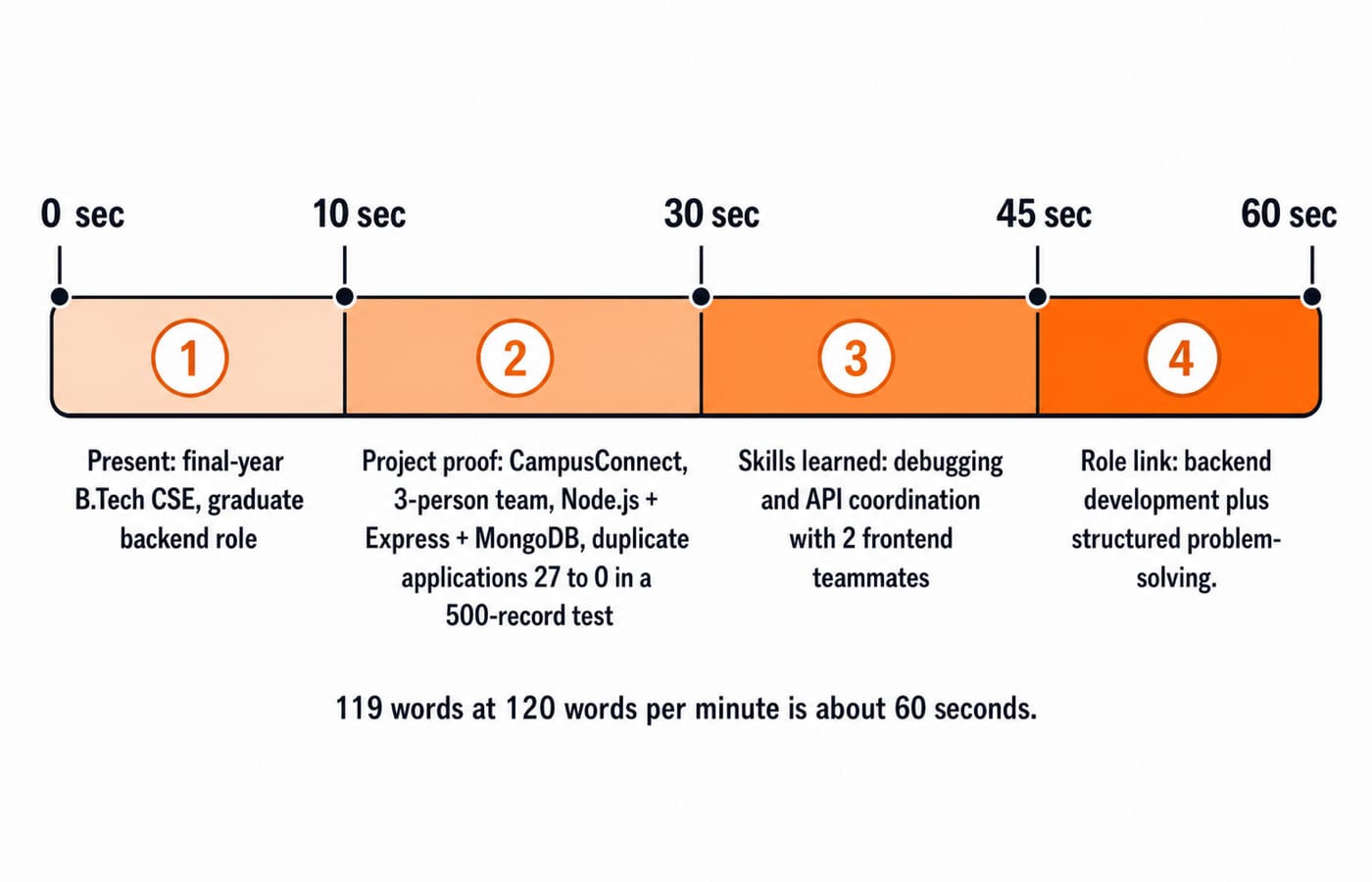
Split the minute at three points and give each block one job:
0 to 10 seconds: Present identity and target role.
10 to 30 seconds: One relevant project, internship or experience.
30 to 45 seconds: The skill or lesson that the work proved.
45 to 60 seconds: The connection to the open role and a conversational close.
Draft 110 to 125 words: one education line, one project, up to three tools, one result and one role-fit sentence. The true, explainable result may be a tested count, time saved, accuracy change, user count or completed scope.
Lead with evidence, not chronology. Save other projects for follow-ups.
Worked example for a graduate backend role
This model is fictional. Do not borrow its achievements; replace every detail.
Good morning. I’m Asha Sharma, a final-year B.Tech Computer Science student at ABC Institute, and I’m applying for graduate backend roles. In a three-member project team, I built the API layer for CampusConnect, a placement application tracker, using Node.js, Express and MongoDB. I added server-side validation to prevent duplicate applications; in our 500-record test, duplicates fell from 27 to 0. That work strengthened my debugging and collaboration because I coordinated the API contract with two frontend teammates. I’m now improving my DSA in Java by solving five timed problems each week. This role appeals to me because it combines backend development with structured problem-solving, and I’d be glad to discuss the API design or validation issue in more detail.
The sample has 119 words. At 120 words per minute, 119 ÷ 120 × 60 = 59.5 seconds, which is about one minute.
It has identity, one project, a result, a learning habit and two hooks: API design and validation. Explain each tool and number.
Replace the sample with evidence from your resume
Fill the third column from your own record before you rewrite a single line:
Block | Asha’s fictional example | Your evidence |
|---|---|---|
Now | Final-year B.Tech Computer Science student; graduate backend role | [Degree, year and target role] |
Evidence | CampusConnect; owned the API layer; Node.js, Express, MongoDB | [Project or internship, your action, up to three tools] |
Proof | Duplicate applications fell from 27 to 0 in a 500-record test | [One true value and what it measures] |
Next | Backend development plus structured problem-solving | [Why the role uses the skill you demonstrated] |
With an internship, choose one owned contribution. Without one, use a lab, capstone, hackathon or personal build. With neither, use substantial coursework or responsibility and state its limited scope. Never invent users, improvements, clients or leadership.
Make the spoken answer match the written resume, because a mismatch invites the wrong follow-up. Fix the written side with our resume for freshers guide. Explain an absent project and verify every number against your notes.
Cut the lines that make fresher answers sound generic
Weak: “I am hardworking, passionate and a quick learner.”
Stronger: “I found 27 duplicate application records in our 500-record test and added server-side validation that reduced them to 0.”
The stronger line shows action, scale and outcome, and invites a follow-up. Cut:
Family background unless asked, because it does not establish role fit.
School-to-college chronology, because it repeats the resume.
Every technology, because it buries the main evidence.
Unrelated hobbies, because they add no proof.
Remove unsupported claims such as “excellent communicator” or “expert in Java”. Do not pre-answer strengths, weaknesses, salary, relocation or long-term goals. Prepare those separately with our HR interview questions for freshers guide.
Build your first usable version in 45 minutes
Work through five stretches in order:
Minutes 0 to 10: Collect three possible evidence items.
Minutes 10 to 20: Choose the one most relevant to the job description.
Minutes 20 to 30: Draft the four blocks.
Minutes 30 to 38: Cut the answer to 110 to 125 words.
Minutes 38 to 45: Record two takes and revise the first stumble or overrun.
Score each item from 0 to 4: one point for relevance, ownership, a verifiable result and follow-up readiness. Prefer a truthful 3 out of 4 to an inflated 4 out of 4.
Underline two job phrases, such as “REST APIs” and “problem-solving”. Use them only where your evidence proves them.
Rehearse for seven days without sounding memorised
Spend 15 minutes a day:
Day 1: Read and time three takes.
Day 2: Speak from the four block labels instead of the script.
Day 3: Cut every repeated idea.
Day 4: Answer six likely follow-ups about the project and role.
Day 5: Practise a 30-second version of 55 to 70 words.
Day 6: Do two interrupted mock rounds with a friend.
Day 7: Record one cold take and change only factual or clarity problems.
If you miss a day, do not double up. Resume with the next useful drill and retain the final cold take.
Use 30 seconds when asked to be brief and 60 seconds by default. Expand towards 90 seconds only when invited. If interrupted, answer the new question instead of finishing the script.
Run the final truth, timing and follow-up check
Confirm all eight points:
50 to 65 seconds.
110 to 125 words.
Education in one line.
Exactly one main example.
No more than three tools.
At least one verifiable result.
The target role is named.
At least two follow-up questions you can answer.
Timing is a rehearsal aid, not a reason to rush. Asha’s prompts are: “How did your validation prevent duplicate applications?” and “How did you coordinate the API contract with the two frontend teammates?” Prepare answers for yours.
The short version
State your present identity, one proved contribution and one clear connection to the role. Draft, record and revise one answer today.
For structured resume, technical and HR interview training, plus resume review and mock-interview practice, use the Interview & Resume Preparation Course as your next step.
Keep learning
Placement Mock Analysis: One Error Ledger Across Every Test Round
Use one error ledger without flattening unlike round results. This worked example shows how to find the first wrong step, prioritise repairs and close errors only after fresh retests.
Updated 4 Oct 20265 min readInterview Corner
Internship to PPO: Build a Weekly Evidence Trail Before the Final Review
Use a weekly outcome ledger to make your internship work visible before the final review. This practice model shows how to record delivery, feedback, effect and handoff honestly.
Updated 28 Sep 20265 min readInterview Corner
DSA Mock Interview Rubric: A 100-Point Scorecard for Reasoning, Code and Communication
A practical six-part scorecard for running comparable DSA mocks, grading visible evidence and turning weak areas into the next week's practice.
Updated 25 Sep 20265 min readInterview Corner
Campus Recruitment Timeline: Stage by Stage from Pre-Placement Talk to Written Offer
Follow a campus drive without guessing. Build an evidence sheet, verify eligibility, plan each preparation window and check the written offer before responding.
Updated 24 Sep 20265 min readInterview Corner