Backend Language Roadmap: Choose Go, Rust, Kotlin, C# or PHP in Six Weeks
Stop comparing backend ecosystems in the abstract. Use one scorecard and a 42-hour API project to decide whether to continue, switch, or strengthen your foundations.
KnowledgeGate Team
Exam prep & CS education
Updated 24 Aug 20265 min read
Go, Rust, Kotlin, C# and PHP can all build backends. The difficulty is choosing one you can use. Comparing syntax, popularity and opinions will not show which language you can finish a project with. Make the choice reversible: pick one candidate, invest 6 weeks x 7 hours = 42 hours, and ship the same bounded API. Continue or switch using recorded evidence.
Backend language roadmap: start with the project, not the winner
Language | Best first trial when | Prerequisite | What the project should test |
|---|---|---|---|
Go | A small HTTP service or worker needs simple deployment and concurrency | Functions, structs, errors | Handlers, concurrent work, deployment |
Rust | A systems-facing service makes memory control the goal | Enums, | Safe state changes and explicit errors |
Kotlin | A JVM service can use Java libraries and OO design | Classes, null handling, JVM tools | Typed domains and library use |
C# | A .NET business API needs typed models | Classes, interfaces, async calls | Validation, async I/O and models |
PHP | A content, commerce or CRUD app is the target | Functions, associative arrays, HTTP basics | Request handling and CRUD delivery |
Select one goal: an inventory API for 500 products, a background CSV processor for 20 files, or a content dashboard with 4 CRUD screens. That narrows the shortlist before syntax preference. If these feel premature, use Coding & Skill Development Courses for foundations.
Go, Rust, Kotlin, C# and PHP prerequisites: run a 60-minute self-check
Set a 60-minute timer and work one language-neutral exercise. Read ['go', 'php', 'go', 'rust', 'php', 'go'], return {go: 3, php: 2, rust: 1}, reject an empty string, and test the six-item input and [].
Each language then adds its own starting cost on top of that exercise. Go needs functions, structs and explicit errors. Rust needs enums, match and willingness to learn ownership. Kotlin needs classes, null handling and JVM tools. C# needs classes, interfaces and async calls. PHP needs functions, associative arrays and HTTP request basics.
If you cannot finish inside the hour, spend one preparatory week on fundamentals, then restart the clock. For Kotlin, the Complete Java Course provides a Java and JVM foundation, not a Kotlin course. For a smaller pass, practise Classic Programs in C, Java and Python.
Backend language decision matrix: work one score from start to finish
Consider a learner who knows basic JavaScript, has 7 hours weekly, wants a deployable reading-list API, has no JVM or .NET requirement, and values finishing above maximum runtime performance.
Rate each language from 1 to 5. Weight project fit 35, learning effort 25, documentation comfort 15, deployment comfort 15 and enjoyment 10. For each criterion:
weighted points = rating / 5 x weight
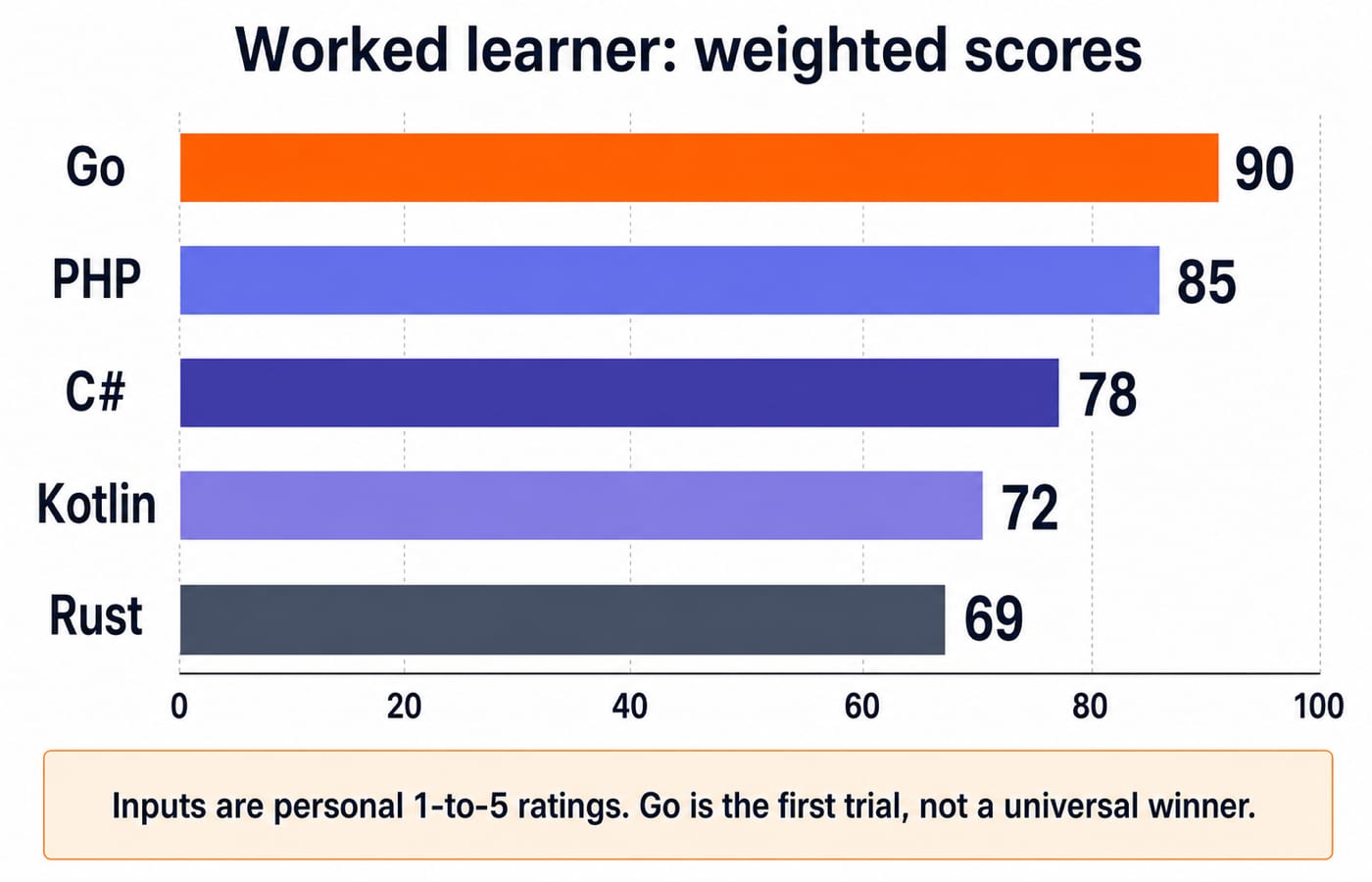
This learner's ratings out of 100 give:
Language | Ratings in weight order | Worked total |
|---|---|---|
Go | 5, 4, 4, 5, 4 |
|
Rust | 4, 2, 4, 3, 5 |
|
Kotlin | 4, 3, 4, 3, 4 |
|
C# | 4, 3, 5, 4, 4 |
|
PHP | 5, 4, 4, 4, 3 |
|
Go is the first trial at 90; PHP is the runner-up at 85. Change the weights and the order changes: with project fit at 10 and enjoyment at 35, the same ratings give Go 85, C# 78, PHP 75, Rust 74, Kotlin 72, so the runner-up is no longer PHP. Rate against your own constraints rather than reusing this learner's.
Six-week backend trial project: build one reading-list API
Fix the contract before picking a framework. Build GET /books, POST /books, PATCH /books/:id and DELETE /books/:id with one books table. Use this record:
{"id":17,"title":"Designing Data-Intensive Applications","status":"reading","rating":4}
Allow planned, reading or finished for status, and an integer from 1 to 5 or null for rating. An empty collection returns 200 with []; creating the sample returns 201; rating 6 returns 400; missing id 9999 returns 404; deleting id 17 returns 204.
Seed 50 books, write 12 automated tests and one migration, log request method, path and status in structured form, then deploy a container. The Node.js, Express.js & MongoDB Course is an optional reference for routes, REST APIs, persistence and validation. Implement the trial in your chosen stack.
Six-week backend schedule: protect 42 honest hours
Use 90 minutes on Tuesday, 90 on Thursday and 4 hours on Saturday: 1.5 + 1.5 + 4 = 7 hours. Keep Sunday for recovery.
Week 1:
5hours on syntax and tooling,2onGET /healthand setup.Week 2:
7hours on in-memory CRUD and specified responses.Week 3:
7hours on the table, migration and50seed rows.Week 4:
7hours on validation, errors and request logs.Week 5:
7hours on12tests and fixing failures.Week 6:
5hours on deployment,2on the evidence scorecard.
The total is (5 + 2) + 7 + 7 + 7 + 7 + (5 + 2) = 42, also 6 x 7. Move one missed weekday block to Sunday. If both are missed, cut an optional refactor instead of forcing a seven-hour Saturday.
Backend language proof: record friction instead of repeating opinions
Each week, record build, debugging and documentation minutes, plus sessions blocked beyond 30 minutes. A sample Week 2 log is 260 + 100 + 60 = 420 minutes. Debugging is 100 / 420 x 100 = 23.8%, rounded to 24%, with 1 blocked session. Expect the share to fall as tooling familiarity grows; if Week 5 is still near 24%, the friction is structural rather than first-week noise.
At the end, run all 12 tests from a clean checkout, create the 50 rows, and reproduce 200, 201, 400, 404 and 204. Note any undocumented deployment step. The trial answers “Can I work effectively in this stack?”, not “Which language is fastest?”; one laptop cannot settle the second. Placement-focused learners can turn this into timed practice with Coding Round Strategy for Placements.
Choose, switch or defer: make the decision reversible
Continue for 12 weeks if all four endpoints deploy, at least 10 of 12 tests pass before cleanup, average self-rated friction is at most 2.5/5, and you want a second service. Extend exactly 1 week if only deployment is incomplete. Add no features or restart tutorials.
Switch to the runner-up if two or more gates fail, or one language-specific concept blocks 3 sessions. Here, move from Go to PHP with the same API contract. Defer when failures are language-neutral, such as confusion about HTTP status codes, SQL tables or test assertions.
The short version
Save the scorecard, book the first three study blocks and stop comparing ecosystems until Week 6. A shipped small API is stronger evidence than another month of opinion-based research.
Keep learning
Types of Programming Languages MCQs: 12 Solved Classification Questions
Work through 12 solved programming-language classification questions. Each solution identifies the deciding axis, checks the options and explains the main trap.
Updated 24 Oct 20267 min readProgramming Languages Survey
Classes and Objects MCQs: 12 Solved OOP Questions with Explanations
Solve 12 classes and objects MCQs, check each explanation, and use a worked Java trace to separate instance state, constructors, overloading and nested classes.
20 Oct 20267 min readProgramming Languages Survey
Programming Language Syntax MCQs: 12 Solved Questions on Grammar, Tokens and Semantics
Solve 12 MCQs on syntax, tokens, pseudocode, C grammar and runtime behaviour. Each explanation identifies the rule and applies it.
Updated 16 Oct 20268 min readProgramming Languages Survey
Imperative Programming Structure and Flow Control MCQs: 12 Solved Questions
Test whether you can trace changing state, choose the right loop, read a flowchart, and follow event-driven or exceptional control paths through 12 solved MCQs.
12 Oct 20267 min readProgramming Languages Survey