Discrete Mathematics for GATE: A 6-Week Topic-by-Topic Study Plan
Build Discrete Mathematics in prerequisite order over six weeks. Each week combines concepts, worked problems, timed sets, and scheduled error repair.
KnowledgeGate Team
Exam prep & CS education
Updated 20 Sep 20265 min read

Many learners read Discrete Mathematics definitions in isolation, then freeze when one question combines a property check, a count, and a short calculation. With about 1,300 Discrete Mathematics questions available in our practice bank, the challenge is choosing practice well. Use Discrete Mathematics for GATE: Syllabus, Weightage Context and Preparation Order for official syllabus boundaries, weightage context, and the broad preparation order. Execute that map as six 8-hour weeks with theory, worked problems, timed practice, error repair, two scheduled retries, and a missed-day rule. That repeated rhythm turns a definition into a usable method, so you always know what to study and why.
1. Diagnose the gap before Week 1
Start with a 60-minute baseline of 12 genuine past-paper questions: 3 from logic, 3 from sets and relations, 2 from functions and counting, 2 from recurrences or algebraic structures, and 2 from graph theory. Record the paper and question number for each; this split balances the diagnostic and does not predict the next paper.
Suppose you score 5/12: logic 2/3, sets and relations 1/3, functions and counting 1/2, recurrence or algebra 0/2, and graphs 1/2. Classify the seven misses as 3 concept errors, 2 setup errors, 1 calculation error, and 1 time-pressure skip. Repair the concept errors first.
Use one error-log line per miss: question | topic | my wrong step | corrected rule | retry date. Retry after 2 days and again after 7 days.
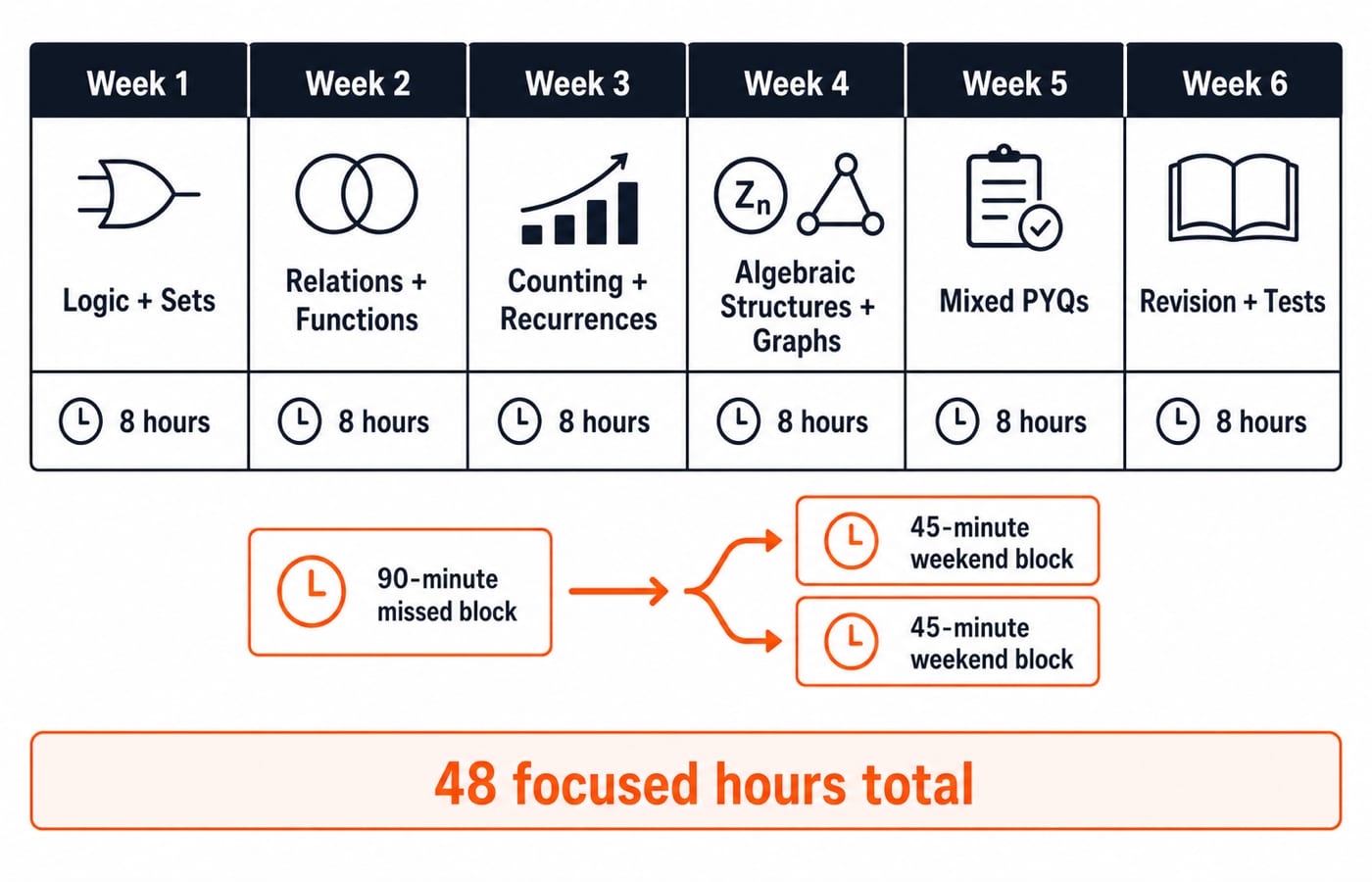
2. Week 1: logic and set operations, 8 hours
Spend 2 hours on propositions, connectives, implication, equivalence, and quantifiers; 2 on truth-table drills; 2 on sets, Cartesian products, and inclusion-exclusion; 1.5 on a timed mixed set; and 30 minutes on the error log. Then use Propositional and Predicate Logic Explained for drills.
Let p = true and q = false. Then p -> q = false and not q = true, so (p -> q) and (not q) = false. Change only q to true: p -> q = true, not q = false, and the compound is still false. Follow both connectives rather than memorising a row.
For A = {1,2,3,4} and B = {3,4,5}, A union B = {1,2,3,4,5} and A intersection B = {3,4}. Thus |A union B| = 4 + 3 - 2 = 5.
3. Week 2: relations and functions, 8 hours
Allocate 2 hours to relation properties and closures, 2 to equivalence relations and partial orders, 2 to function types and composition, 1.5 to mixed problems, and 30 minutes to error repair. Turn the relation-property definitions into a checklist before practising.
Let A = {1,2,3} and R = {(1,1),(2,2),(3,3),(1,2),(2,1)}. All diagonal pairs are present, so R is reflexive. Each non-diagonal pair has its reverse, so it is symmetric. The {1,2} block contains every required composition and 3 relates only to itself, so R is transitive. It is an equivalence relation with classes {1,2} and {3}.
From a four-element domain to a two-element codomain, each input has 2 image choices, giving 2^4 = 16 functions. Exclude the 2 constant functions, one per codomain element, to get 16 - 2 = 14 onto functions.
4. Week 3: counting and recurrences, 8 hours
Use 2 hours for permutations, combinations, the pigeonhole principle, and inclusion-exclusion; 2 for recurrence setup; 2 for solution methods; 1.5 for timed questions; and 30 minutes for corrections. For a structured next resource, use the Engineering Mathematics course.
Filling 3 distinct positions from 5 candidates gives 5P3 = 5 x 4 x 3 = 60. Selecting an unordered committee gives 5C3 = (5 x 4 x 3)/(3 x 2 x 1) = 10.
Next, trace T(n) = 2T(n/2) + n, where T(1) = 1:
T(2) = 2T(1) + 2 = 2 + 2 = 4T(4) = 2T(2) + 4 = 8 + 4 = 12T(8) = 2T(4) + 8 = 24 + 8 = 32
Write both the expansion and the final growth form, Theta(n log n).
5. Week 4: algebraic structures and graphs, 8 hours
Give 2 hours to semigroups, monoids, and groups; 1 to modular-operation tables; 2 to graph degree, paths, connectivity, trees, and planar basics; 2.5 to graph problems; and 30 minutes to the error log. Before the graph block, revise Euler trails, Hamiltonian paths, and colouring.
In Z5 = {0,1,2,3,4} under addition modulo 5, 0 is the identity. The inverse of 2 is 3 because (2 + 3) mod 5 = 0. Closure holds because results stay in Z5; for example, (4 + 3) mod 5 = 2.
For the connected graph V = {A,B,C,D} and E = {AB,BC,CD,DA,AC}, deg(A)=3, deg(B)=2, deg(C)=3, and deg(D)=2. Exactly A and C are odd, so there is an Euler trail but no Euler circuit. The trail A-B-C-D-A-C uses all five edges once.
6. Week 5: turn topic knowledge into timed PYQ patterns
Group genuine past-paper questions by operation: construct a truth table, test relation properties, count functions, apply inclusion-exclusion, solve a recurrence, or use degree and path conditions. Do not infer a fixed frequency. Name the sampled papers before calling any pattern recurring.
The budget is exact: three 50-minute mixed sets take 2.5 hours, three 40-minute reviews take 2 hours, two 90-minute repair blocks take 3 hours, and a formula-sheet update takes 30 minutes.
In a 10-question, 50-minute set, suppose 6 are correct, 2 wrong, and 2 skipped. Label one wrong answer a concept error and one a calculation error. Restate the rule for the first and find the first incorrect line for the second. After 48 hours, retry all four missed items without the solution.
7. Week 6: revise, test, and recover missed days
Take two 90-minute subject tests (3 hours), review them line by line for 2 hours, spend 2 hours on the two weakest error-log topics, and use 1 hour for a final formula and definition sheet. Finish with the GATE Test Series, then follow the wider GATE CS preparation pathway.
Recover a lost 90-minute weekday block as two 45-minute weekend blocks. Preserve error review and cut one fresh drill first. If a full 8-hour week is lost, extend the plan by one week instead of compressing 16 hours into seven days.
8. The short version
Study 8 hours a week, keep one error log, retry every miss twice, and follow prerequisite order. Take the baseline today and schedule Week 1.
Keep learning

Classification of Finite and Infinite Groups: Orders, Cyclicity and Worked Examples
Learn how group axioms, group order, element order and generators classify finite and infinite groups through complete, checkable examples.
Updated 4 Oct 20266 min readEngineering Mathematics
Bipartite, Cycle, Regular and Complement Graphs: Tests, Formulas and a C6 Worked Example
Learn a dependable order for classifying simple graphs, then apply it to C6 and list, count and test every edge in its complement.
Updated 29 Sep 20266 min readEngineering Mathematics

Basic Terminologies in Linear Programming: Feasible Solutions, BFS and an Optimal Solution Worked Step by Step
Separate feasible, basic feasible and optimal solutions through geometry, slack variables, vertex enumeration and concise counterexamples.
Updated 25 Sep 20265 min readEngineering Mathematics
Assignment Problem and Hungarian Method: Formulation with a Complete Worked Example
Learn why greedy assignment fails, how matrix reductions preserve the optimum, and how the uncovered-value adjustment leads to a minimum cost of 140.
Updated 24 Sep 20266 min readEngineering Mathematics