Engineering Mathematics
50 articles in this topic
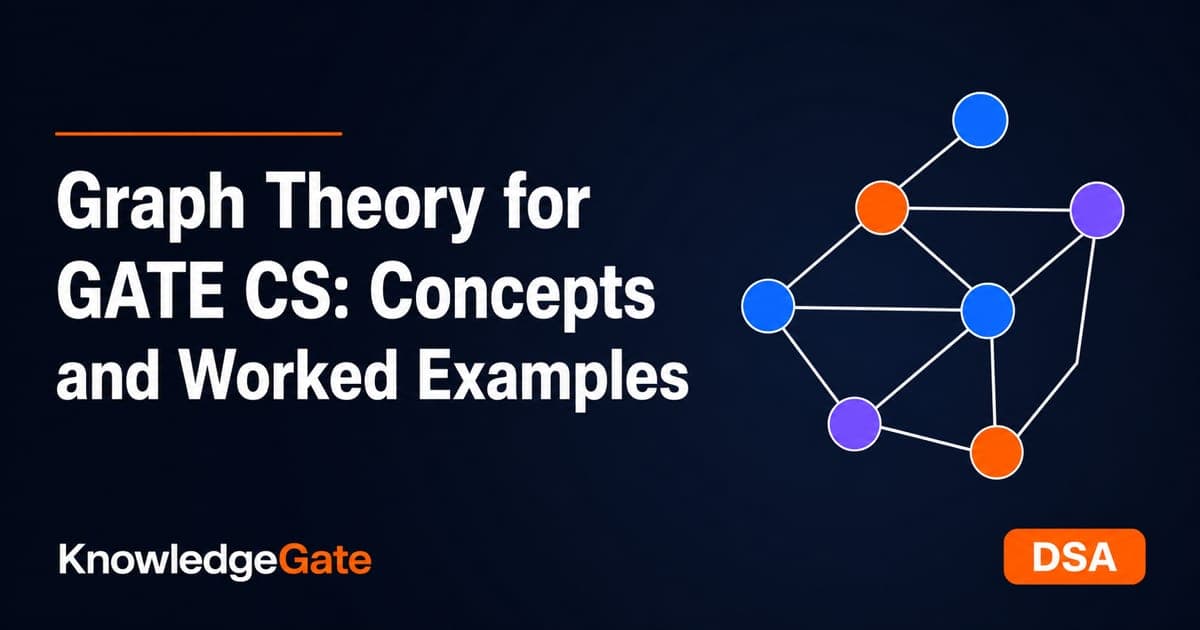
Graph Theory for GATE CS: Concepts and Worked Examples
Build graph theory from two fully specified examples. Work through degree counts, connectivity, spanning trees, bipartiteness, planarity, and Euler and Hamilton checks.
Updated 8 Aug 20266 min readEngineering Mathematics
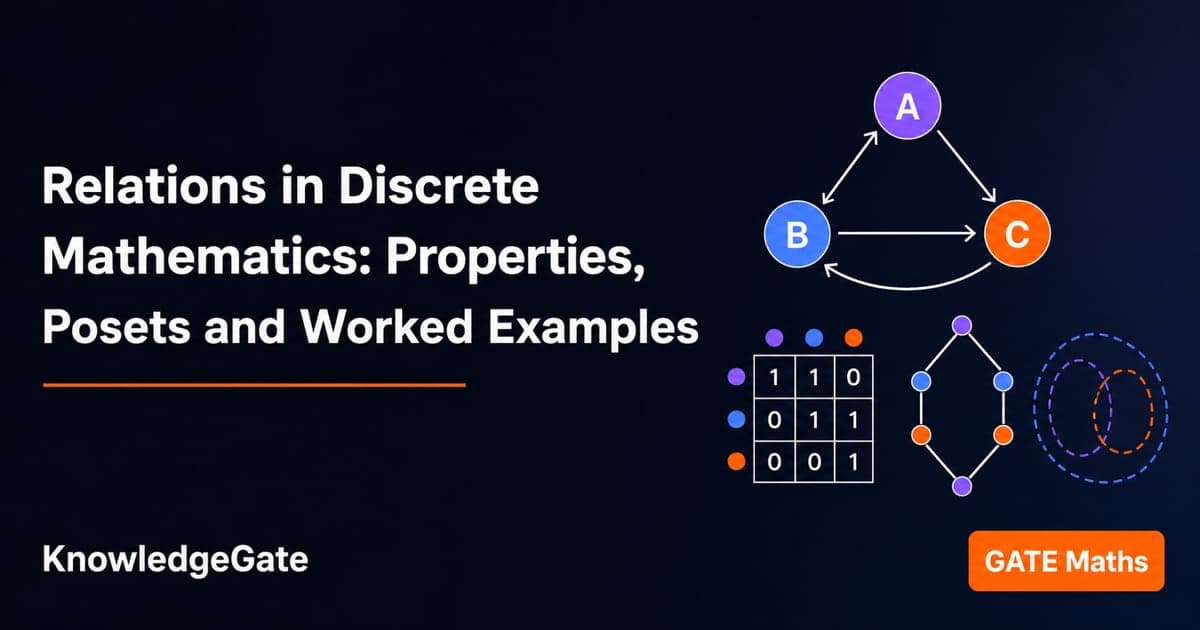
Relations in Discrete Mathematics: Properties, Posets and Worked Examples
Build relations from Cartesian products, test their properties mechanically, and solve equivalence, partial-order, closure, and counting questions with exact examples.
Updated 6 Aug 20266 min read332 viewsEngineering Mathematics

Propositional and Predicate Logic in Discrete Mathematics: From Truth Tables to Quantifiers
Build logic from atomic propositions to nested quantifiers, with complete truth tables, canonical forms, countervaluations, and finite-domain checks.
Updated 3 Aug 20266 min read55 viewsEngineering Mathematics
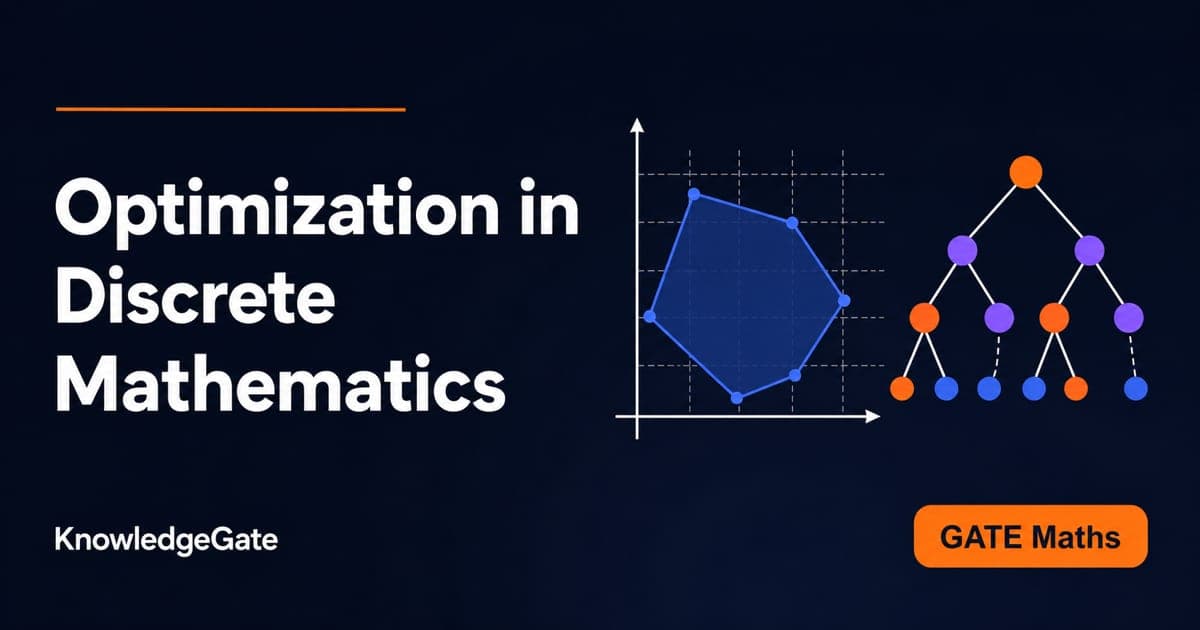
Optimization in Discrete Mathematics: Linear Programming, Integer Methods and Worked Examples
Learn how to model and solve continuous and discrete optimization problems through a workshop LP, an integer branch-and-bound tree, an assignment matrix, and a dual.
Updated 1 Aug 20267 min readEngineering Mathematics
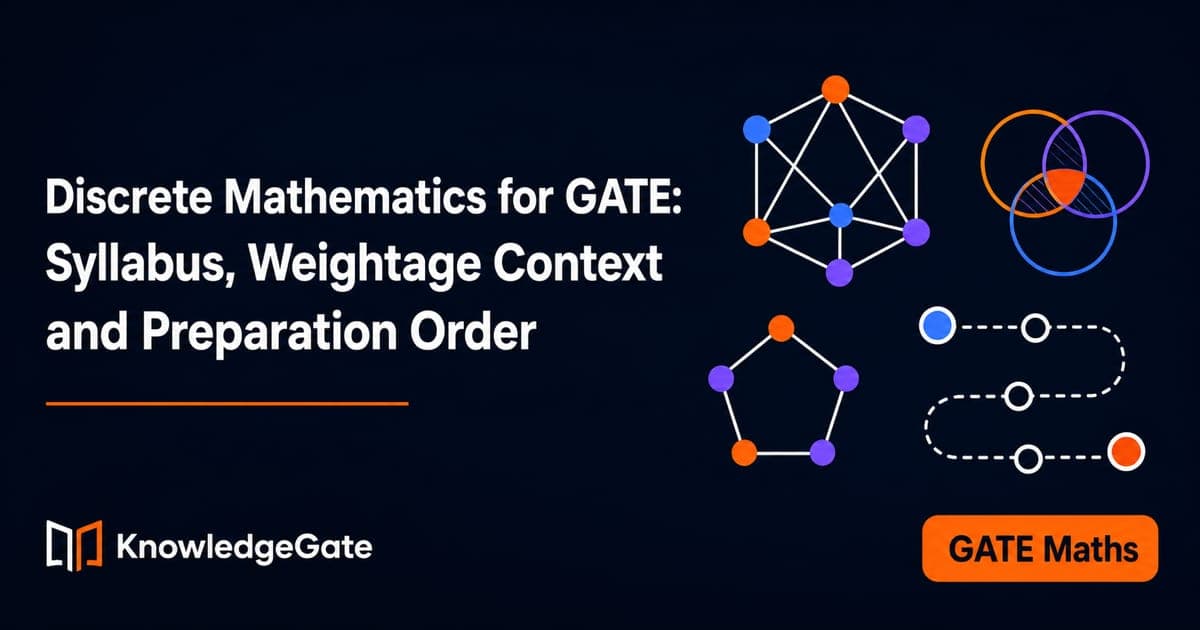
Discrete Mathematics for GATE: Syllabus, Weightage Context and Preparation Order
Learn where Discrete Mathematics sits in GATE CS, how its syllabus areas connect, and how to cover them through a practical 45-hour study plan.
Updated 29 Jul 20265 min read202 viewsEngineering Mathematics

Lattices and Hasse Diagrams for GATE: Posets, LUB, GLB and the Lattice Test, Solved
Learn to read covering relations, compute joins and meets, and prove whether a poset is a lattice through two complete worked examples.
Updated 27 Jul 20266 min read171 viewsEngineering Mathematics
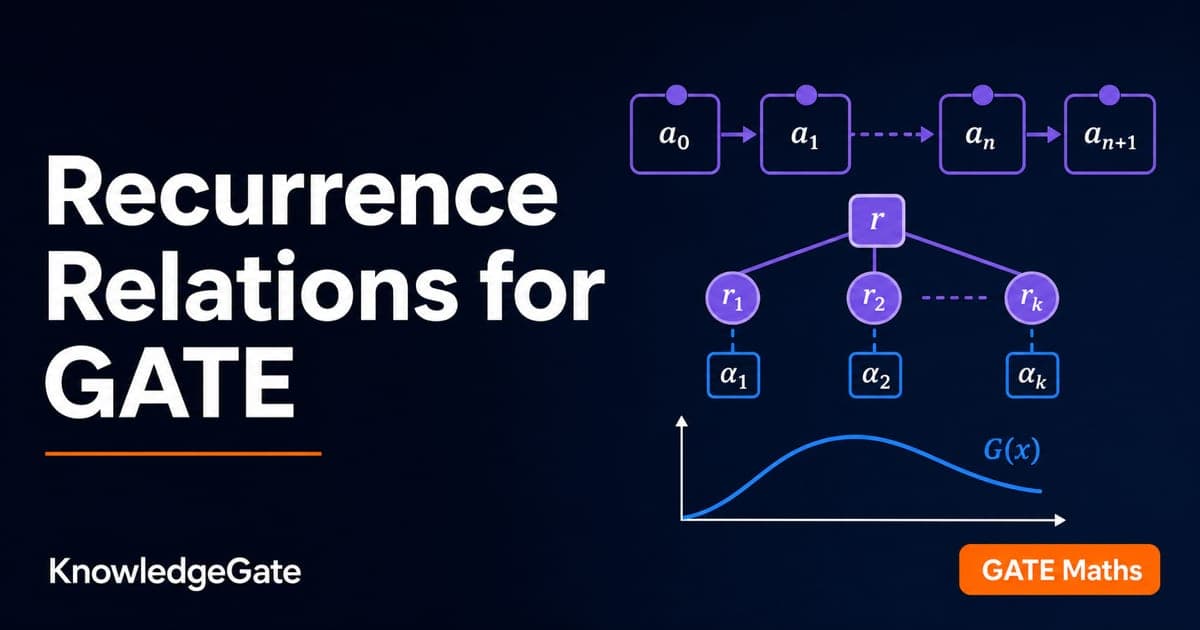
Recurrence Relations for GATE: Solving Linear Recurrences by Characteristic Roots and Generating Functions
Solve one linear recurrence twice, see why both methods agree, and keep discrete-maths recurrences separate from the Master Theorem.
Updated 24 Jul 20265 min read63 viewsEngineering Mathematics
Probability for GATE CS
Translate the wording into events before calculating. Exact dice, Bayes and expectation examples show how to build the denominator and avoid the standard independence trap.
Updated 21 Jul 20265 min readEngineering Mathematics
Linear Algebra for GATE CS: Rank, Consistency and Eigenvalues
Reduce matrices cleanly, classify Ax=b by ranks, and turn eigenvalue properties into fast calculations. Each result is checked against an independent property.
Updated 29 Jul 20265 min readEngineering Mathematics
Permutations and Combinations for GATE CS: Counting Questions Solved with a Repeatable Method
One repeatable method (choose, arrange, subtract) applied to 20 GATE-style counting problems, with the four-question decision procedure that replaces formula memorisation for permutations and combinations in GATE CS.
Updated 26 Jul 20266 min read201 viewsEngineering Mathematics
Group Theory and Algebraic Structures: Groups, Rings and Fields Explained
Group theory for GATE CS: binary operations, group axioms, abelian and cyclic groups, subgroups, Lagrange's theorem, rings, fields and a worked Zn example.
Updated 15 Jul 20266 min readEngineering Mathematics
Set theory and relations: closures, equivalence and partial orders explained
Antisymmetric is not the negation of symmetric, a transitive closure is not finished after one pass, and a Hasse diagram is what is left once you delete every edge transitivity already implies. Set operations, relation properties, closures, equivalence classes and posets, worked for GATE.
Updated 29 Jul 20266 min readEngineering Mathematics