Group Theory and Algebraic Structures: Groups, Rings and Fields Explained
Group theory for GATE CS: binary operations, group axioms, abelian and cyclic groups, subgroups, Lagrange's theorem, rings, fields and a worked Zn example.
KnowledgeGate Team
Exam prep & CS education
Updated 15 Jul 20266 min read
Algebraic structures look abstract until you see that they are just a set plus an operation, with a checklist of properties. Group theory is the checklist done carefully, and once you can verify the axioms and apply Lagrange's theorem, this becomes one of the most predictable topics in Discrete Mathematics.
Exam questions on this topic reward exactness: one missed axiom or one miscounted order loses the mark. The hierarchy runs from a bare operation up to fields, and the integers modulo 6 make every step of it concrete.
Related reading: subgroup tests and element orders in groups.
Binary operations and closure
A binary operation on a set S is a rule that takes two elements of S and returns another element of S. The return-to-S part is closure, and it is a property in its own right. Addition is closed on the integers; ordinary division is not, because dividing two integers can leave the set. Every algebraic structure is built the same way: fix a set and an operation, then ask which properties that pair satisfies.
Building up, a set with a closed associative operation is a semigroup; add an identity element and it is a monoid; add inverses and it becomes a group. Knowing the ladder helps you name exactly what a question is describing.
The group axioms
A set G with an operation, often written as multiplication, is a group when all four axioms hold:
Closure: for all a and b in G, the result of the operation is in G.
Associativity: for all a, b and c in G, (ab)c equals a(bc), so the grouping of the operations does not change the result.
Identity: there is an element e such that operating e with any a returns a.
Inverse: every a has an element that operates with it to give e.
That is the whole definition. A finite group has finitely many elements; the number of elements is the group's order, written |G|.
Abelian and cyclic groups
A group is abelian, or commutative, when the order of the two elements does not matter, that is, ab equals ba for every a and b in G. The integers under addition are abelian; matrix multiplication in general is not.
A group is cyclic when a single element generates the whole group by repeated operation. That element is a generator. The integers modulo n under addition are cyclic, generated by 1, since adding 1 repeatedly reaches every element. Every cyclic group is abelian, though the converse fails. The order of an element a is the smallest positive k for which operating a with itself k times gives the identity.
Subgroups and Lagrange's theorem
A subgroup is a subset of G that is itself a group under the same operation. Every group has two trivial subgroups, the identity alone and the whole group.
The central counting theorem is Lagrange's theorem: in a finite group, the order of any subgroup divides the order of the group. A direct corollary is that the order of every element divides the order of the group. This is a fast filter in the exam. If a group has 6 elements, no subgroup or element can have order 4 or 5, because neither divides 6. Whenever a question offers a candidate subgroup, check the size first.
Rings and fields
Groups have one operation. Rings and fields add a second, so they model systems like the integers with both addition and multiplication.
A ring is a set with two operations, usually called addition and multiplication, where the set is an abelian group under addition, multiplication is associative, and multiplication distributes over addition. The integers form a ring.
A field is a richer structure: a commutative ring with a multiplicative identity in which every non-zero element has a multiplicative inverse. The rational numbers and the real numbers are fields; the integers are not, because most integers have no integer multiplicative inverse. A clean finite example: the integers modulo a prime p form a field, which is why prime moduli appear everywhere in coding theory and cryptography.
The gap between the two is easiest to see on modular arithmetic. The integers modulo 6 form a ring under addition and multiplication, but not a field: multiplying 2 by 0, 1, 2, 3, 4 and 5 gives 0, 2, 4, 0, 2 and 4, so 2 never reaches 1 and has no multiplicative inverse. Move to modulus 5, a prime, and every non-zero element inverts: 1 times 1 is 1, 2 times 3 is 6 which is 1 modulo 5, and 4 times 4 is 16 which is also 1 modulo 5. That single property, an inverse for every non-zero element, is the whole difference between a ring and a field.
A worked example on the integers modulo 6
Take the set of integers modulo 6 under addition, that is the elements 0 through 5. It has order 6 and is cyclic. Compute the order of each element, remembering the identity is 0:
Element | Order |
|---|---|
0 | 1 |
1 | 6 |
2 | 3 |
3 | 2 |
4 | 3 |
5 | 6 |
Read element 2 as a check: 2, then 2 plus 2 is 4, then 4 plus 2 is 0, so it returns to the identity in 3 steps and has order 3. Every order in the table, namely 1, 2, 3 and 6, divides 6, exactly as Lagrange's theorem predicts. The generators are the elements of order 6, which are 1 and 5, the elements coprime to 6.
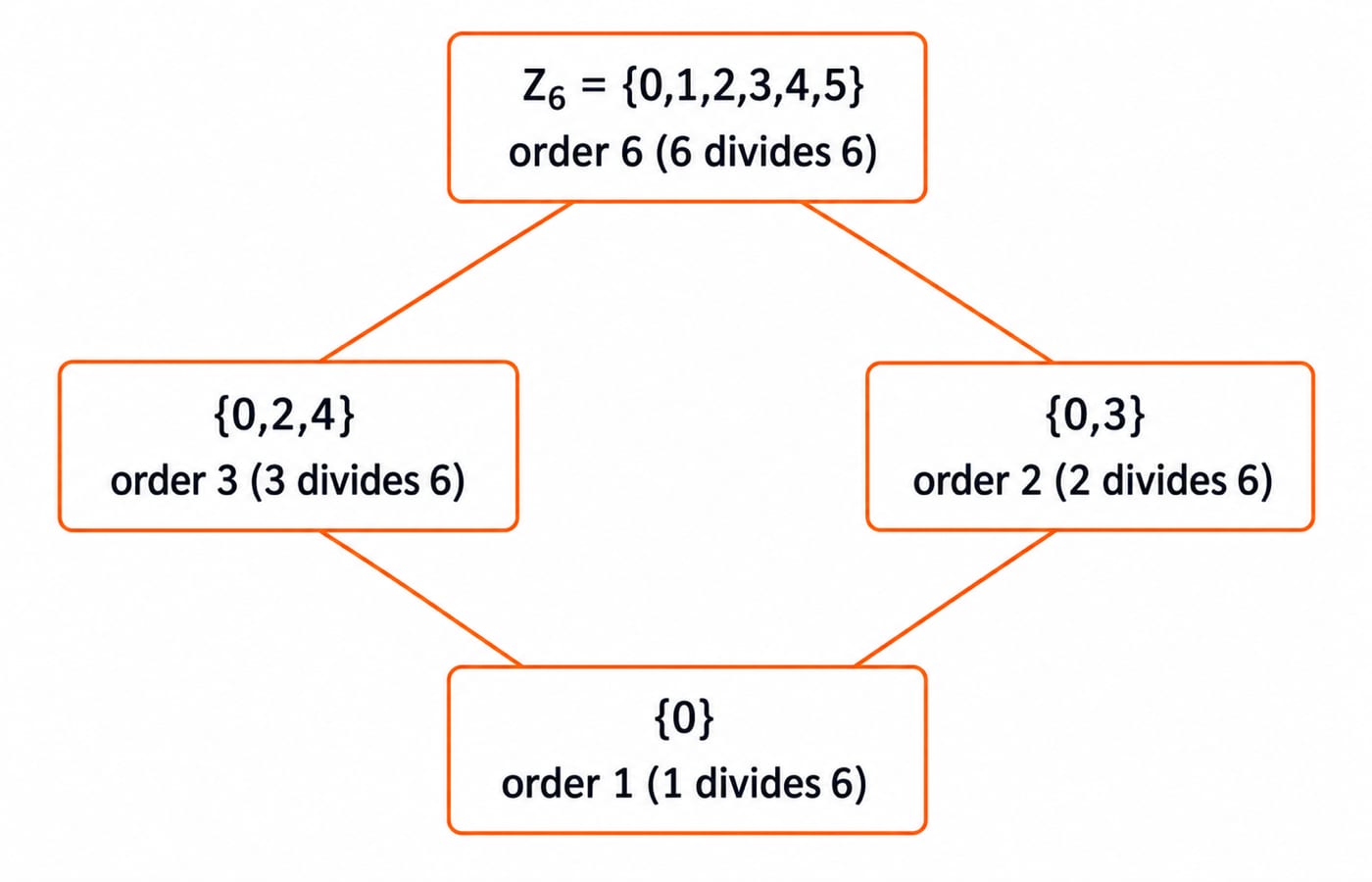
The subgroups follow the same rule: the identity alone (order 1), the set {0, 3} (order 2), the set {0, 2, 4} (order 3), and the whole group (order 6). Their orders are exactly the divisors of 6. Work this table by hand once and the abstract axioms turn concrete.
How group theory is tested in GATE
GATE CS tests this topic two ways, conceptual identification and small numerical computations. Expect a question that hands you a set and an operation and asks which structure it is, a group, monoid, or merely a semigroup. Expect an order-of-element or generator computation on a modular group, exactly like the order table for the integers modulo 6. And expect a Lagrange-based question ruling a subgroup in or out by its size. The ring and field definitions appear as short identification questions, often testing whether a given system is a field.
The topic sits beside the rest of Discrete Mathematics. The same relation-and-operation reasoning underlies our set theory and relations deep-dive, and the Discrete Mathematics learn module sequences algebraic structures alongside it. To drill this area, work the subgroup verification set and the order of elements set from previous years.
Practise it, do not just read it
Group theory is learned on questions, not on rereading. Learn the four axioms, the abelian-versus-cyclic distinction, and Lagrange's theorem, then compute one full order table by hand until it is routine.
For Discrete Mathematics across the whole GATE CS syllabus, GATE Guidance by Sanchit Sir sequences algebraic structures with logic, set theory and graph theory.
Browse the neighbouring topics in the CS Fundamentals category.
Verify the axioms carefully, use Lagrange's theorem as your first filter, and hand-compute one modular group. Do that, and algebraic structures become marks you can rely on.
Keep learning
Graphical Method in Linear Programming: Feasible Region, Corner Points and Optimality with a Worked Example
Learn the two-variable graphical method in the right order, then solve and audit a complete maximisation model without trusting the sketch alone.
Updated 21 Oct 20265 min readEngineering Mathematics
Duality in LP: Construct the Dual, Solve a Worked Example, and Apply Key Properties
Learn a reliable matrix-first method to form an LP dual, solve both programs to value 21, and use duality properties to check optimality and avoid sign errors.
Updated 17 Oct 20266 min readEngineering Mathematics
Commutative Property and Abelian Groups: Tests, Worked Examples and Exam Traps
Learn how to separate commutativity from the other group axioms, test custom operations step by step, and avoid the usual classification traps.
Updated 13 Oct 20266 min readEngineering Mathematics
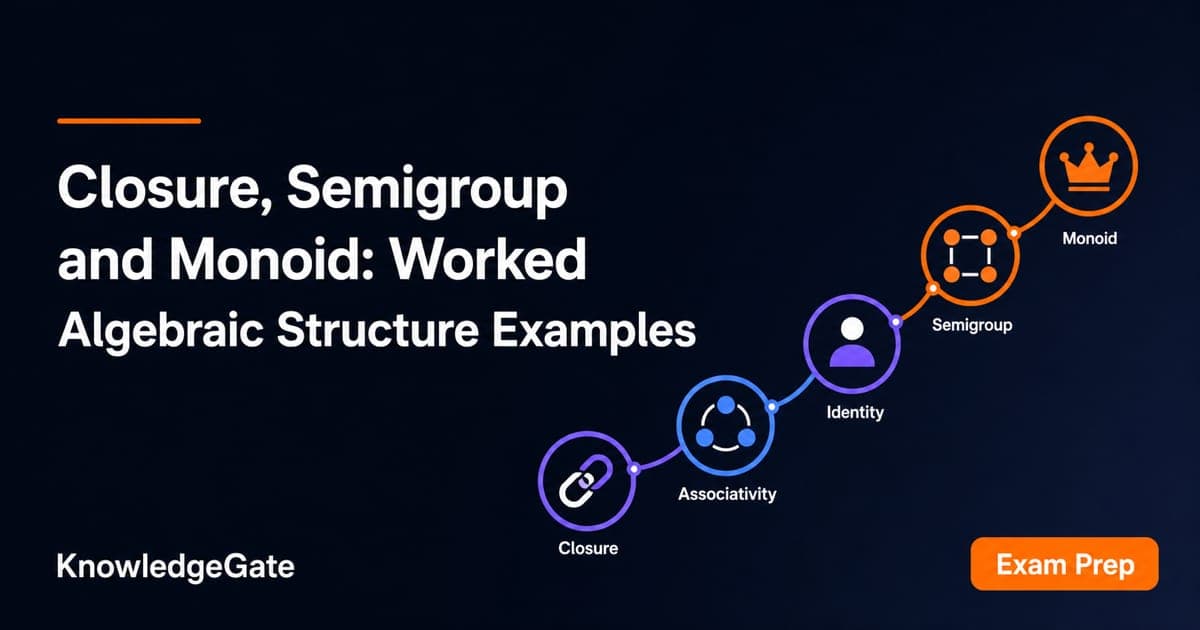
Closure, Semigroup and Monoid: Worked Algebraic Structure Examples
Learn a reliable order for testing closure, associativity and identity. Worked tables and counterexamples show exactly when a structure becomes a semigroup or monoid.
Updated 9 Oct 20266 min readEngineering Mathematics