DSSSB Computer Science Syllabus: What to Study in Every Block
Turn the DSSSB Computer Science syllabus into bounded scope: all 32 historical subject lines, the pedagogy block and Section A, mapped with worked diagnostics and no invented weightage.
KnowledgeGate Team
Exam prep & CS education
Updated 29 Jul 20266 min read680 views
The DSSSB Computer Science syllabus is long enough that most aspirants stop reading it and start collecting playlists instead. The official subject labels, the teaching-methodology requirement and Section A almost never sit on one checklist, so scope stays vague and revision stays unbounded. The historical example here is DSSSB's 2024 Post Code 56/24 TGT (Computer Science) advertisement and its syllabus PDF. Your own post code and its corrigenda are what actually bind, so reconcile the live DSSSB preparation tracks against them before you commit a week of study.
1. Read the syllabus as three source layers, not one list
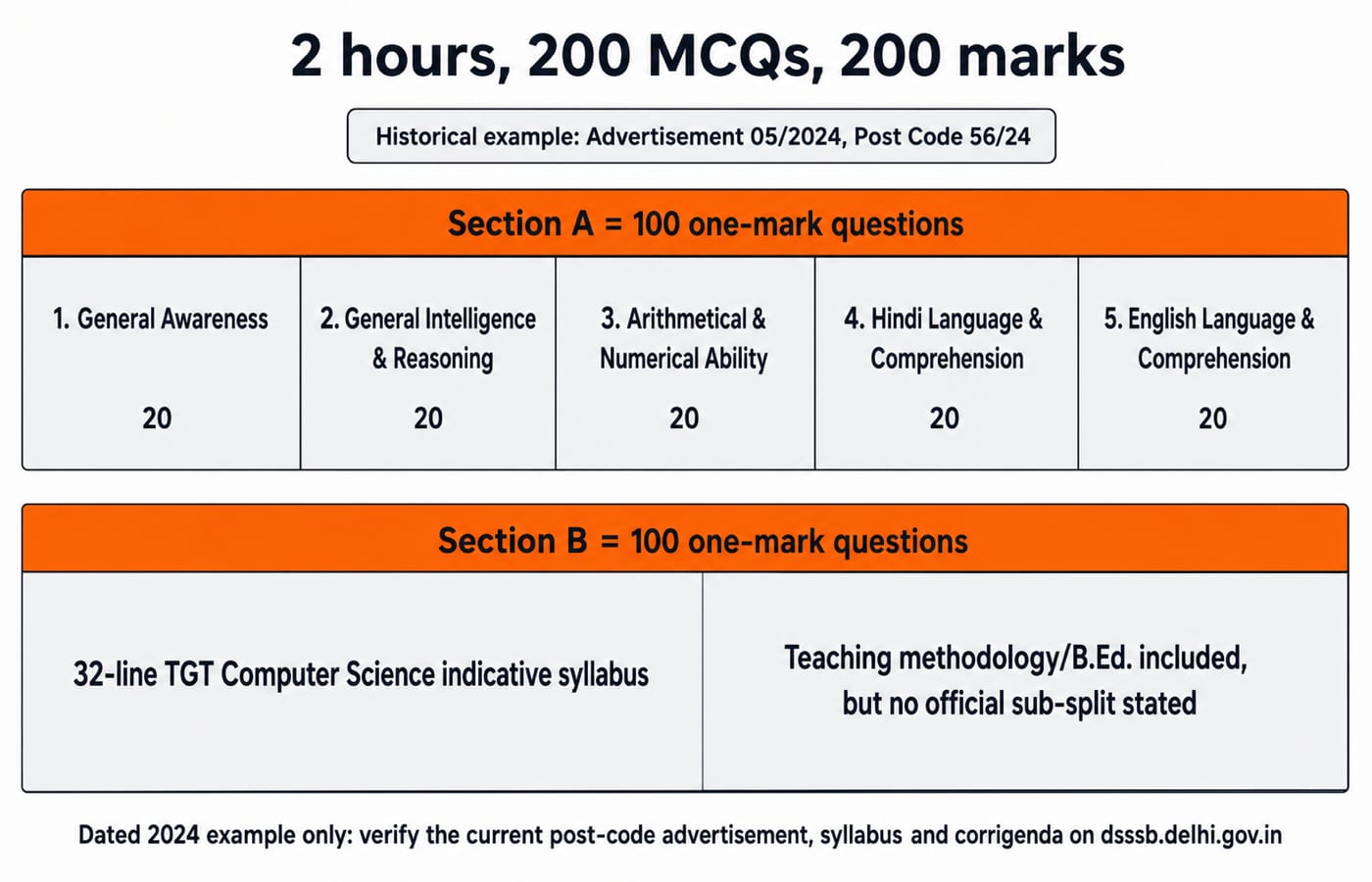
Use three layers: the post-code advertisement for the scheme, DSSSB's Section A scheme, and the post-specific Section B syllabus. Advertisement 05/2024 assigned Post Code 56/24 to I-T-T Scheme D; a separate Post Code 56/24 PDF listed 32 Computer Science items. That advertisement specified a 2-hour, 200-question paper: 100 one-mark MCQs across five Section A areas and 100 in Section B, including teaching methodology and B.Ed. None of those 2024 numbers carry forward on their own; only the advertisement for your post code restates them.
Record the advertisement number, post code, scheme name and syllabus-PDF title on the front of your file. If any one of them differs from the 2024 example, rebuild the map before you study from it. One convention holds from here on: the numbered lines are DSSSB's exact wording, while the folder names, study orders and sub-topic expansions around them are reading aids, never official units and never a weightage claim.
2. Computer Science block 1: mathematics, digital logic and machine foundations
Preserve the official wording and numbers:
Folder | Official items |
|---|---|
Quantitative foundations |
|
Digital and machine foundations |
|
Expand the second folder with number systems, Boolean logic, CPU organisation, memory hierarchy and I/O, which is where TGT-level questions on those four lines actually sit.
For line 30, attempt two closed-note questions per named area. A score of 2/2 + 1/2 + 1/2 + 0/2 = 4/8 makes descriptive statistics green, probability concepts and distributions amber, and inference red. Inference is the one that quietly costs marks, because it only becomes reliable after the two probability lines above it are solid.
3. Computer Science block 2: programming, algorithms and operating environments
Do not silently drop older technologies. Track 4. Programming with C, Data Structures using C, C++ Programming; 12. Object/Computer Oriented Programming/Numerical Techniques; 14. Java Programming and website design; 15. Operating Systems; 18. .net programming; 19. Linux Environment; 21. Design and analysis of algorithms; and 29. Problem Solving & Programming.
Study problem solving and C first, then data structures and algorithms, object-oriented programming, Java and C++, operating systems, Linux and .NET, because each stage assumes the one before it. Once the post-code PDF has fixed your scope, the DSSSB TGT Computer Science Paper 2 course runs that sequence in the same order.
Join lines 4, 21 and 29 with insertion sort. For A = [7, 2, 5, 1], the states are [2, 7, 5, 1], [2, 5, 7, 1], [1, 2, 5, 7]. Counting each evaluated A[j] > key and each shift gives 1 + 2 + 3 = 6 comparisons and 1 + 1 + 3 = 5 shifts. Check code, trace and complexity separately.
4. Computer Science block 3: data, networks, web and applied subjects
Keep the remaining labels, including their odd wording:
Folder | Official items |
|---|---|
Data and software |
|
Networks, mobile and security |
|
Web, graphics and commerce |
|
Business and communication context |
|
For line 17, 192.168.10.0/27 leaves 5 host bits: 2^5 = 32 addresses and 32 - 2 = 30 usable hosts. Hosts run from 192.168.10.1 to 192.168.10.30, and the broadcast address is 192.168.10.31. Line 17 names only the subject, so build the rest of that block from the Computer Networks guide.
5. Teaching methodology and B.Ed.: keep a separate block
DSSSB's 2024 Scheme D placed teaching methodology and B.Ed. inside Section B, but the 56/24 list gave no pedagogy question count and no detailed pedagogy syllabus, so there is no marks split to plan around. Work from six provisional baskets instead: learner and learning; objectives and lesson planning; teaching methods; classroom communication and management; assessment; and inclusive or ICT-supported teaching. Keep one basket live in every study cycle, or pedagogy becomes the block you touch last.
Try a 35-minute lesson for 40 students: 5-minute diagnostic; 10-minute demonstration converting 45 to binary 101101; 10-minute paired conversion of 26 to 11010; 5-minute exit conversion of 19 to 10011; 5-minute feedback. Identify the objective, checks, grouping and remediation.
6. Section A: five general areas need their own checklist
DSSSB's I-T-T One Tier (Technical/Teaching) 200 Marks sheet names General Awareness; General Intelligence and Reasoning Ability; Arithmetical and Numerical Ability; English Language and Comprehension; and Hindi Language and Comprehension. Advertisement 05/2024 Scheme D gave each of the five 20 marks, totalling 100 questions and 100 marks. Recheck those values against the advertisement for your own post code.
General Awareness draws on current events, history, polity, the Constitution, geography, economics, everyday science and major organisations. General Intelligence and Reasoning draws on analogy, classification, series, coding-decoding, relationships, direction, syllogism and analysis. Arithmetical and Numerical Ability draws on number systems, fractions, ratio, percentage, average, profit and loss, interest, mensuration, time and work, time and distance, and data interpretation. Each language area draws on vocabulary, grammar, sentence structure, synonyms, antonyms and comprehension. The DSSSB Section A subject strategy takes those five areas one at a time.
In a five-per-area diagnostic, Awareness 2/5, Reasoning 4/5, Arithmetic 3/5, Hindi 3/5 and English 4/5 give 2 + 4 + 3 + 3 + 4 = 16, then 16/25 = 64%. Repair Awareness first, because it is the widest area and the slowest to move, then Arithmetic and Hindi. The DSSSB Section A course is built for that repair work.
7. Worked syllabus audit: turn 32 lines into bounded scope
Use 32 rows: official item number; exact label; PDF URL and page; chapter mapping; practice source; closed-note score; status; next action.
For row 17, retain Computer Networks and the 56/24 PDF source. Mark OSI/TCP-IP, subnetting, routing, TCP/UDP, application protocols and security as study expansions. If 7 are correct, 3 wrong and 2 unattempted, 7 + 3 + 2 = 12; mark amber and re-solve five items.
If 18 green + 9 amber + 5 red = 32, green coverage is 18/32 = 56.25%, which stays the honest number even when all 32 rows carry notes. Revisit the five reds first, then the nine ambers, keeping one Section A area and one pedagogy basket live in every cycle.
The short version
Freeze your scope from the post code, map every official line to a chapter, keep pedagogy and Section A visible on the same sheet, and let closed-note scores decide the revision order. Confirm the current advertisement, syllabus and corrigenda on the official DSSSB site before any of it hardens into a study plan.
Keep learning
DSSSB TGT Computer Science Exam Pattern and Marking Scheme: Sections, Scores and Timing
Understand how Section A and Section B contribute to the historical 39/22 scheme. Work through the negative-marking calculation, distinguish qualification from merit, and plan a timed mock.
30 Sep 20264 min read137 viewsDSSSB Computer Science
DSSSB Computer Science 16-Week Preparation Plan: 12 Hours a Week
Follow a practical 16-week timetable that balances Computer Science, Section A, questions, error repair and mock analysis, with a clear route back after missed sessions.
Updated 6 Aug 20265 min read194 viewsDSSSB Computer Science
DSSSB vs State PSC Teaching: A Route Guide for CS Graduates
Choose a primary government teaching route by checking your documents, transferable CS preparation, posting preference, and notification readiness.
Updated 3 Aug 20266 min readDSSSB Computer Science
DSSSB Computer Science DBMS, OS and Networks Question Playbook
Learn a repeatable way to solve DBMS dependencies, OS scheduling timelines and network address ranges, with three worked examples and an error-led practice routine.
Updated 31 Jul 20266 min read751 viewsDSSSB Computer Science