DSSSB Computer Science 16-Week Preparation Plan: 12 Hours a Week
Follow a practical 16-week timetable that balances Computer Science, Section A, questions, error repair and mock analysis, with a clear route back after missed sessions.
KnowledgeGate Team
Exam prep & CS education
Updated 6 Aug 20265 min read194 views
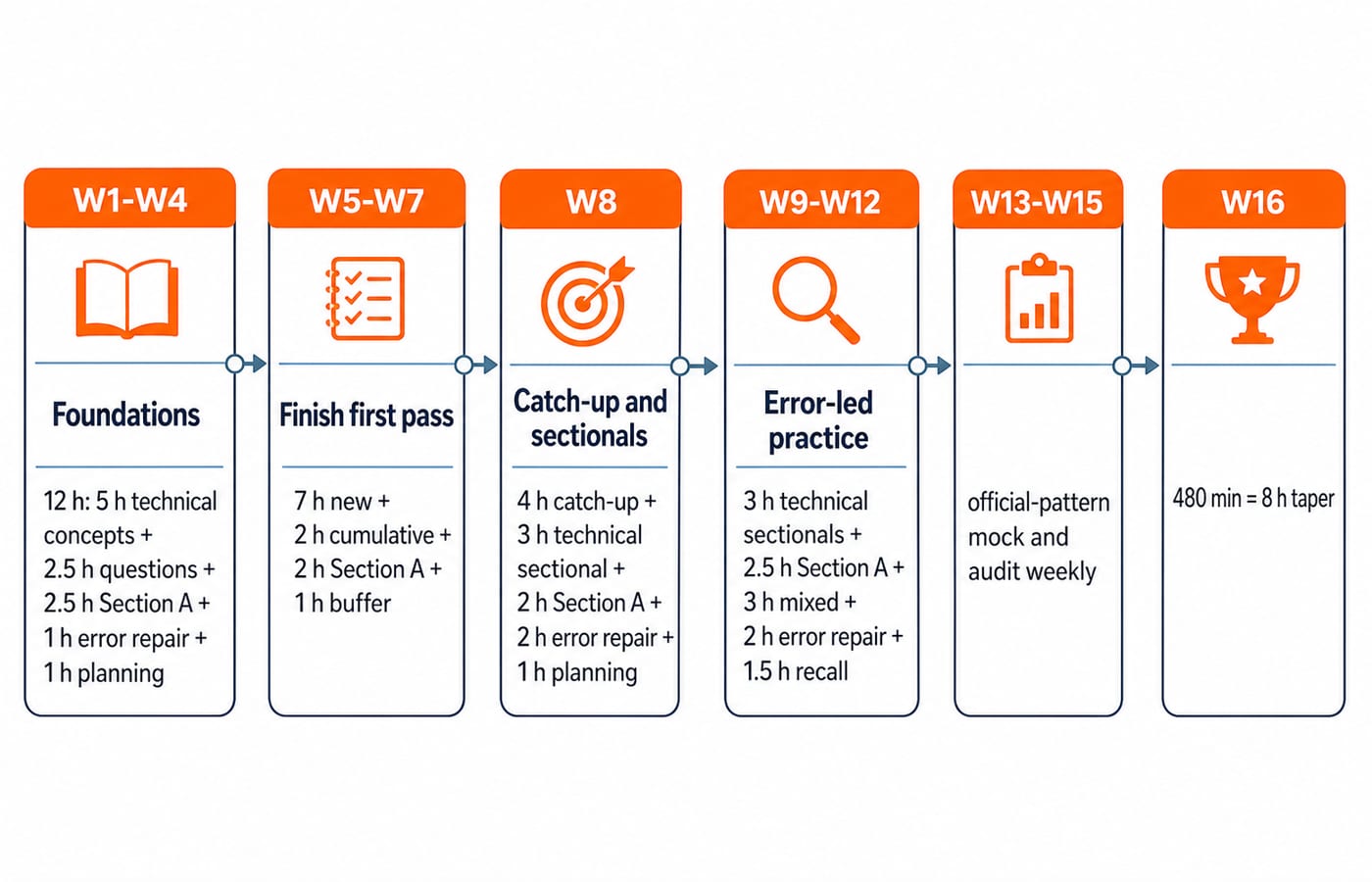
Sixteen weeks looks comfortable until work, commuting and family duties erase study days. Twelve hours a week that you actually protect beat thirty you merely intend, and they only work in phases: four weeks to build foundations, four to close first-pass coverage, four of error-led practice, three of full mocks, then one taper week at eight hours. Start tonight with the current official syllabus and notice for your DSSSB post code, because that document fixes the order of everything below.
Fix a 12-hour week and map the official scope
Through Week 15, use 90-minute CS concept sessions on Monday and Tuesday; Wednesday as buffer or rest; 90 minutes of Section A on Thursday; 90 minutes of CS questions on Friday; 120 minutes of CS learning plus 60 of error review on Saturday; and 60 each of Section A, mixed questions and planning on Sunday.
That is 4 x 90 minutes + 180 minutes + 180 minutes = 720 minutes = 12 hours: 5 hours technical concepts, 2.5 questions, 2.5 Section A, 1 error repair and 1 planning. Keep those five buckets visible on the timetable, because the first thing a bad week eats is error repair and planning. The DSSSB course category lists the courses built against these papers.
First evening, find your post code's notice and syllabus on the official DSSSB website. Copy each syllabus line into a tracker, marked strong, partial or unseen. Order the work from there: large unseen lines first, partial lines next, and strong lines only inside the recall blocks.
Weeks 1-4: build core CS foundations and start Section A
Example sequence: Week 1, programming concepts and a diagnostic; Week 2, data structures and algorithms; Week 3, operating systems and DBMS; Week 4, networks and computer organisation, then a backlog block. The DSSSB TGT Computer Science Section B course offers structure, but your tracker controls the order.
Each concept session is 55 minutes learn + 20 minutes closed-book recall + 15 minutes questions. Across Weeks 1-4, rotate reasoning; arithmetic and numerical ability; English plus Hindi; then general awareness, teaching aptitude and pedagogy.
End Week 4 with a private 40-question diagnostic drawn only from material you have already studied. Record correct, wrong and unattempted totals, then write one line explaining each miss. Count every unattempted question as a miss too.
Weeks 5-8: finish first-pass coverage without forgetting
Use Week 5 for software engineering and web technologies; Week 6 for object-oriented programming and programming repair; Week 7 for the two weakest official units; Week 8 for catch-up, technical and Section A sectionals. Adjust this to the current syllabus.
Weeks 5-7 use 7 hours new + 2 hours cumulative + 2 hours Section A + 1 hour buffer = 12 hours. Week 8 uses 4 hours catch-up + 3 hours technical sectionals + 2 hours Section A + 2 hours error repair + 1 hour planning = 12 hours.
Old-topic recall of 14 from 20 is 14/20 x 100 = 70%; current-topic recall of 9 from 10 is 9/10 x 100 = 90%. Week 7's first 60-minute repair block goes to the weakest old topic.
Weeks 9-12: turn practice into an error-led revision plan
Draw questions from lessons you have finished, the course sequence, or KnowledgeGate's platform-wide practice bank of about 50,000 questions, filtered down to the topics your tracker actually lists. Split 3 hours into technical sectionals, 2.5 into Section A, 3 into mixed practice, 2 into error repair and 1.5 into closed-book recall, totalling 12 hours.
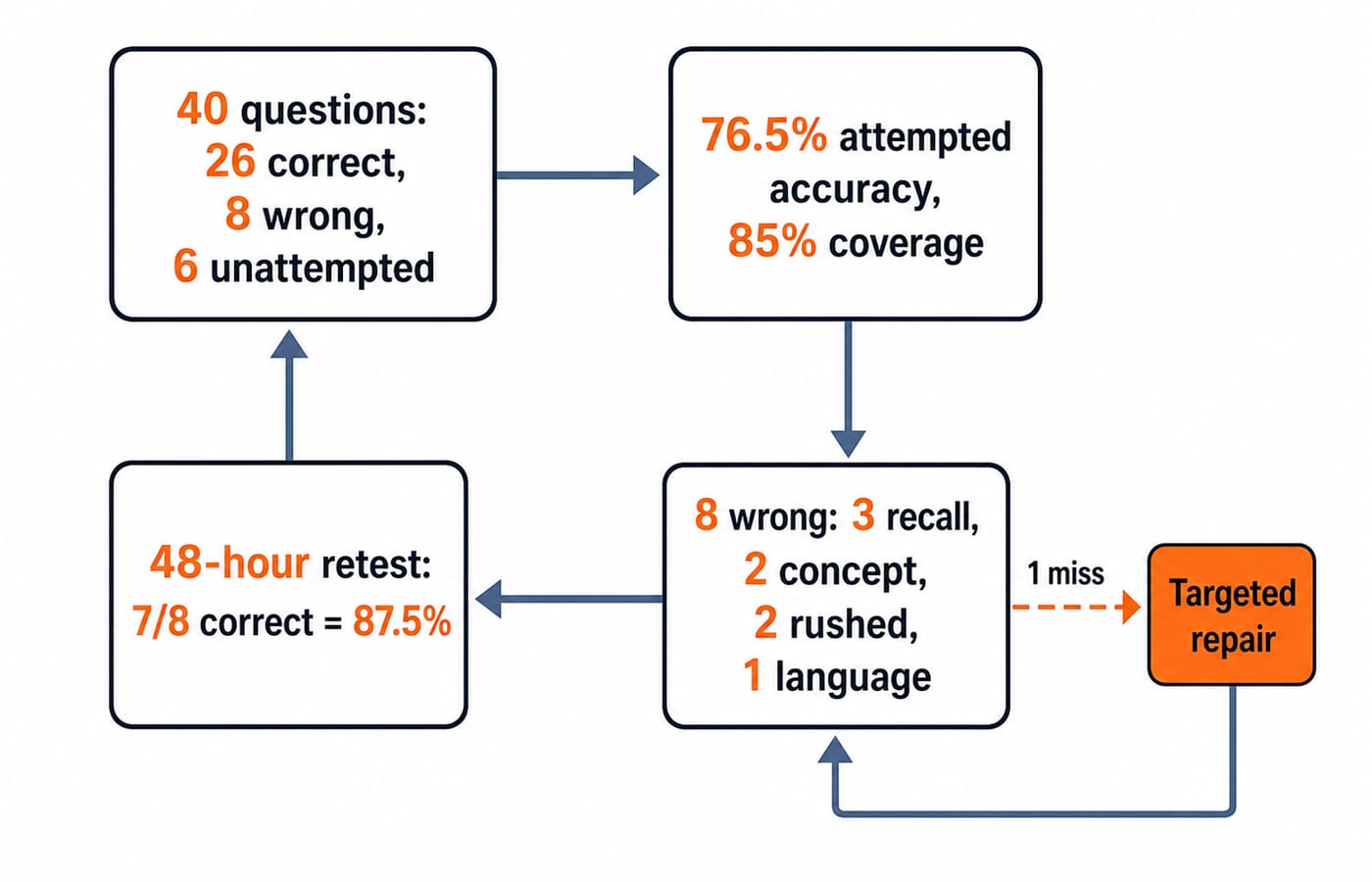
In a 40-question diagnostic, 26 correct, 8 wrong and 6 unattempted means 34 attempts. Accuracy is 26/34 x 100 = 76.5%; coverage is 34/40 x 100 = 85%. Classify errors as 3 recall, 2 concept, 2 rushed and 1 language. After 48 hours, 7 correct retests give 7/8 x 100 = 87.5%; one miss stays logged.
Week 9 uses two weak-subject sectionals. Week 10 repeats the largest error buckets. Weeks 11 and 12 each run a 40-question mixed diagnostic, with Week 12 closing overdue retests. Keep the topic mix and the timing identical across those two diagnostics, or the scores will not compare.
Weeks 13-15: rehearse the current pattern and analyse every mock
Recheck the current notice and match each mock to its stated pattern and duration. Week 13 runs one mock and a two-hour audit; Week 14 runs one mock plus two 45-minute weak-area drills. Run Week 15's final mock early in the week and audit it the same way, so days remain to repair what it exposes.
Use the teaching-exam mock strategy: sit, classify, repair, retest. For 12 misses containing 5 concept gaps, 4 recall failures and 3 haste errors, schedule four 45-minute blocks: two concept, one recall and one attempt-control. That is 4 x 45 = 180 minutes.
The DSSSB Section A subjects and strategy guide helps keep reasoning, arithmetic, languages, general awareness and pedagogy in rotation.
Week 16: taper to eight hours and revise mapped material
Taper to eight hours: Monday, 90 minutes of Section B blank-page recall; Tuesday, 90 minutes of Section A formulas, rules and languages; Thursday, 90 minutes of mixed retrieval; Friday, 60 minutes of error-log retests; Saturday, 120 minutes of weak-topic repair; Sunday, 30 minutes for the official-notice and exam-day checklist. Total: 90 + 90 + 90 + 60 + 120 + 30 = 480 minutes = 8 hours.
Ban new books, untouched playlists and prediction lists. Use only the official tracker, 20 repeatedly missed rules, latest mock audit and existing memory sheets. Remove topics only after closed-book recall or retest. Recheck DSSSB for schedule, admit-card or instruction updates.
Recover missed days without losing the plan
Move a missed 90-minute weekday session to Wednesday as 60 minutes and Sunday as 30. Never double the next night. If Saturday's 180 minutes disappear, add 60 on Wednesday, complete a 10-hour priority week and move 120 minutes of new content to Week 4 or Week 8.
Losing Saturday in Week 6 reduces 12 planned hours to 9. Restore the 60-minute error review on Wednesday to finish 10 hours, protect every Section A block and defer exactly 120 minutes of lower-priority coverage. One content block moves, not the week.
At 5 hours or fewer, repeat the highest-priority syllabus block before advancing. Preserve one recall and one Section A block. Never use an unsafe all-night session.
The short version and the next structured step
Map the syllabus, protect 12 hours, build foundations in Weeks 1-4, finish coverage in Weeks 5-8, diagnose errors in Weeks 9-12, run mocks in Weeks 13-15 and taper in Week 16. Recovery belongs in the plan.
Use the Section B course above for technical coverage and the DSSSB Section A course for non-technical work. Tonight, create the tracker, mark every line strong, partial or unseen, and schedule four 90-minute blocks before opening another resource.
Keep learning
DSSSB TGT Computer Science Exam Pattern and Marking Scheme: Sections, Scores and Timing
Understand how Section A and Section B contribute to the historical 39/22 scheme. Work through the negative-marking calculation, distinguish qualification from merit, and plan a timed mock.
30 Sep 20264 min read137 viewsDSSSB Computer Science
DSSSB vs State PSC Teaching: A Route Guide for CS Graduates
Choose a primary government teaching route by checking your documents, transferable CS preparation, posting preference, and notification readiness.
Updated 3 Aug 20266 min readDSSSB Computer Science
DSSSB Computer Science DBMS, OS and Networks Question Playbook
Learn a repeatable way to solve DBMS dependencies, OS scheduling timelines and network address ranges, with three worked examples and an error-led practice routine.
Updated 31 Jul 20266 min read751 viewsDSSSB Computer Science
DSSSB Computer Science Syllabus: What to Study in Every Block
Turn the DSSSB Computer Science syllabus into bounded scope: all 32 historical subject lines, the pedagogy block and Section A, mapped with worked diagnostics and no invented weightage.
Updated 29 Jul 20266 min read685 viewsDSSSB Computer Science