DSSSB vs State PSC Teaching: A Route Guide for CS Graduates
Choose a primary government teaching route by checking your documents, transferable CS preparation, posting preference, and notification readiness.
KnowledgeGate Team
Exam prep & CS education
Updated 3 Aug 20266 min read
A CS graduate can revise the same core subjects for several teaching recruitments, but that overlap does not make DSSSB and every State PSC post interchangeable. DSSSB hires for Delhi and pairs a Computer Science Section B with a general Section A; “State PSC teaching” is a different post at a different institution level in every state. Choose one primary route, and if useful one secondary route, by checking documentary eligibility, syllabus portability, posting preference and notification readiness, in that order. Only the current advertisement or commission notice settles who is eligible.
1. DSSSB vs State PSC teaching is not one exam versus one exam
DSSSB is Delhi’s recruitment board, so its posts place you inside Delhi government schools and institutions. “State PSC teaching” is not one exam at all. HPSC recruits PGTs for Haryana schools, UPPSC recruits lecturers for Uttar Pradesh polytechnics, MPPSC recruits assistant professors for Madhya Pradesh colleges: school, diploma and degree level respectively. That ladder is the real fork: the higher the institution level, the more of your own engineering syllabus you teach. Compare one current DSSSB post code against one named State PSC post, never against the category.
The Government Teaching Jobs category lists the DSSSB, HPSC, UPPSC, MPPSC and RSSB programmes KnowledgeGate currently runs, showing which routes already have preparation behind them. If the field is still wide open, Which Teaching Computer Science Exam Should You Target? is the broader first-pass chooser; once it narrows, force the choice between DSSSB and one specific PSC notification.
2. Gate one: build an eligibility evidence sheet before comparing syllabi
Create a four-column audit: requirement quoted from official notice, document owned, exact wording on document, and verified or unresolved. Add rows for degree and branch wording, marks or class when specified, teacher-training or eligibility-test evidence when applicable, age and category evidence, and any stated domicile or language conditions.
Suppose Riya has a B.Tech in Computer Science and Engineering, all eight semester mark sheets, and a final degree certificate. She has no B.Ed certificate and no domicile certificate for the state being considered. Her audit records degree evidence as present, B.Ed as absent, domicile as absent, and the final route status as unresolved until each phrase is matched to the current notice.
Riya’s sheet is only as good as the notice she read it against, so match every phrase to the current advertisement for the post code on the DSSSB official portal or the named commission’s website before filling the final column. Clauses like “or equivalent” and “with Computer Science as a subject” decide more applications than any syllabus comparison does.
3. Gate two: measure what actually transfers between the two routes
Split preparation into portable CS core, route-specific non-technical material and post-specific teaching material. OS, DBMS, computer networks, programming, data structures and software engineering are the portable block, carrying furthest into diploma and degree-level posts, where you teach close to your own syllabus. The non-technical paper never travels: DSSSB pairs a Section A with the Computer Science Section B, and MPPSC’s assistant professor route pairs a general-knowledge Paper 1 with its CS Paper 2, so your degree answers one paper of two. The state layer stays separate too: Delhi-specific material, state GK or language, and school-versus-polytechnic pedagogy.
After comparing both syllabi line by line, suppose Riya maps 8 of 12 weekly hours to common CS. She keeps 2 hours for DSSSB-specific study and 2 for PSC-specific study.
Directly portable share:
8 / 12 × 100 = 66.7%Route-specific share:
(2 + 2) / 12 × 100 = 4 / 12 × 100 = 33.3%Weekly check:
8 + 2 + 2 = 12 hours
Those shares are Riya’s hours, not official subject weightage. Teaching CS Exams Compared maps the wider landscape, but her split comes from her two syllabi.
4. When DSSSB should be the primary route
DSSSB is the stronger primary route when three conditions hold. A current post code matches the wording and documents in the evidence sheet, the candidate genuinely accepts a Delhi posting, and the technical plus non-technical preparation named in that notice is sustainable.
Budget for both halves from the start. KnowledgeGate runs DSSSB Section A as a course separate from the Computer Science Section B, which maps how the work divides: reasoning, general awareness, arithmetic and language on one side, your degree subjects on the other. Marks, question count, duration, negative marking, dates, fee, vacancies and selection stages come off the current advertisement on the DSSSB portal.
Once that fit is established, the DSSSB TGT Computer Science Section B course covers the technical half and a separate Section A course covers the non-technical one. Sequence them: Section B while your degree material is still fresh, Section A in the weeks around the application window.
5. When a named State PSC route should be primary
Name the alternative before you score it. “UPPSC Polytechnic Lecturer (Computer Science)” is a usable comparison target; “PSC teaching” is not. DSSSB puts you in a Delhi school teaching school-level Computer Science as a Trained Graduate Teacher; UPPSC Polytechnic Lecturer puts you in an Uttar Pradesh government polytechnic, teaching diploma students material close to your own B.Tech papers. If your degree is your strongest asset and the school classroom your weakest, weight that trade heavily.
Make the named route primary when its current official notice matches the candidate’s documentary profile more cleanly, the candidate prefers that state’s posting context, and the extra state-specific or post-specific syllabus stays manageable. Never carry one commission’s rules to another: HPSC’s PGT conditions say nothing about UPPSC’s lecturer conditions.
The UPPSC Polytechnic Lecturer 2025 (CS) course is the concrete preparation option on that side, built around the subject depth a lecturer post expects rather than a school syllabus. Eligibility, vacancies, dates and selection stages come from the commission’s own current notice.
6. Worked route decision: an 82-to-66 matrix with a hard eligibility gate
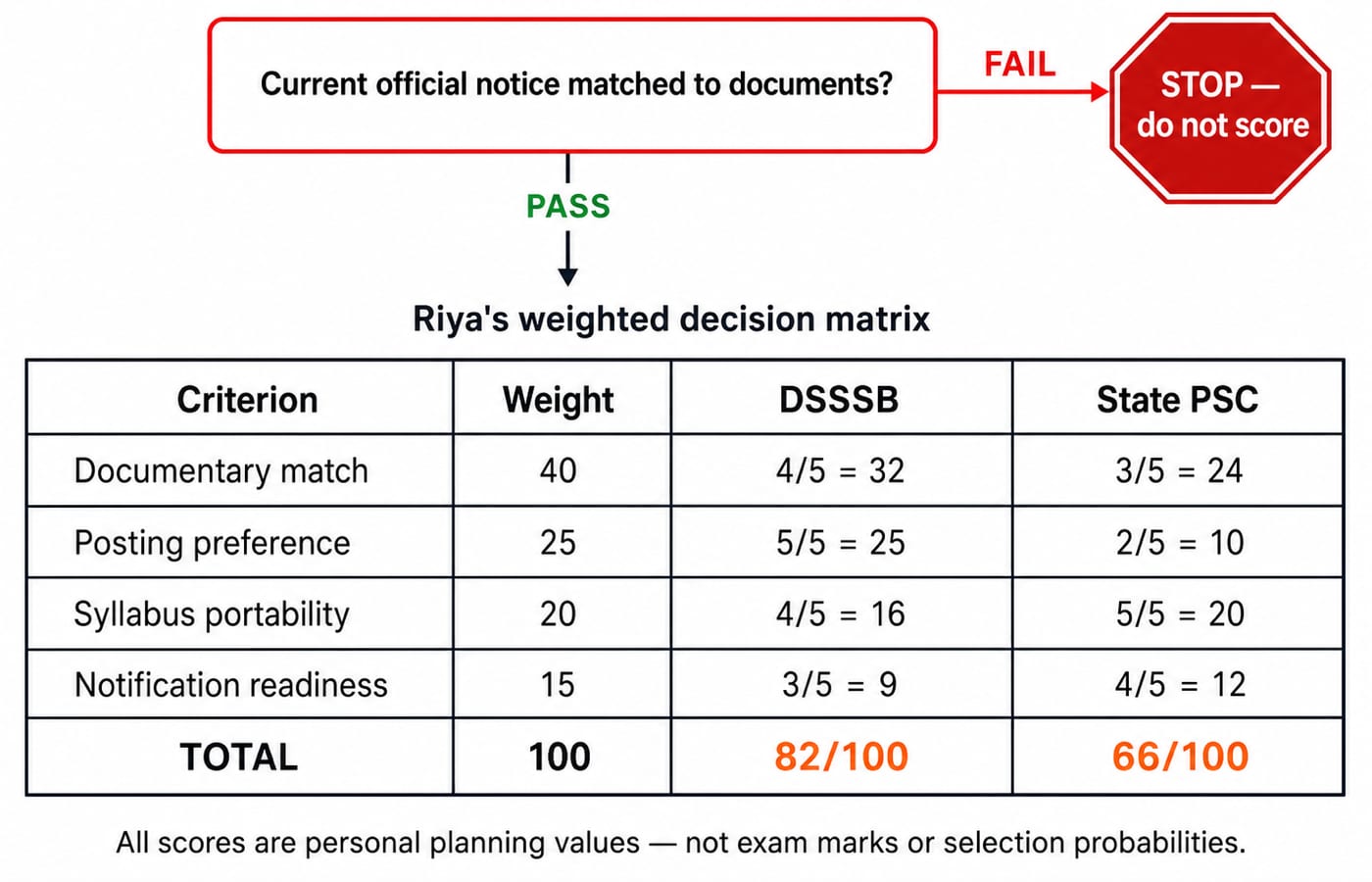
Eligibility is pass/fail. A route still marked unresolved must be matched to the current notice before it is scored, and preference cannot override a mandatory qualification. Past that gate, all four opening factors carry a weight.
Once both pass, score each factor 1 to 5: (score / 5) × weight.
Factor | Weight | DSSSB | State PSC |
|---|---|---|---|
Documentary match | 40 |
|
|
Posting preference | 25 |
|
|
Syllabus portability | 20 |
|
|
Notification readiness | 15 |
|
|
Total | 100 | 32 + 25 + 16 + 9 = 82/100 | 24 + 10 + 20 + 12 = 66/100 |
Riya picks DSSSB primary and the named PSC secondary. Read the 16-point gap: UPPSC wins portability (20 against 16) and readiness (12 against 9) by 7 combined, while documentary match (32 against 24) and posting preference (25 against 10) give DSSSB 23. Refusing to move to Uttar Pradesh is most of the decision. These are planning scores, not marks or selection probabilities.
7. Choose one primary route and run a four-week proof cycle
Test four weeks: 8 hours/week on shared CS, 3 hours/week on the primary route, and 1 hour/week on secondary monitoring and evidence-sheet updates.
The totals are 8 × 4 = 32 common-core hours, 3 × 4 = 12 primary-specific hours, and 1 × 4 = 4 secondary-monitoring hours. Check: 32 + 12 + 4 = 48 hours.
Continue only with confirmed eligibility, an acceptable posting and a route-specific backlog you can clear. Otherwise score one named alternative.
The short version: notice first, documents second, posting third, syllabus overlap fourth. If DSSSB wins, run Section B alongside Section A and plan for the half your degree does not answer. If UPPSC wins, the UPPSC CS course is the CS-depth option.
Keep learning
DSSSB TGT Computer Science Exam Pattern and Marking Scheme: Sections, Scores and Timing
Understand how Section A and Section B contribute to the historical 39/22 scheme. Work through the negative-marking calculation, distinguish qualification from merit, and plan a timed mock.
30 Sep 20264 min read137 viewsDSSSB Computer Science
DSSSB Computer Science 16-Week Preparation Plan: 12 Hours a Week
Follow a practical 16-week timetable that balances Computer Science, Section A, questions, error repair and mock analysis, with a clear route back after missed sessions.
Updated 6 Aug 20265 min read194 viewsDSSSB Computer Science
DSSSB Computer Science DBMS, OS and Networks Question Playbook
Learn a repeatable way to solve DBMS dependencies, OS scheduling timelines and network address ranges, with three worked examples and an error-led practice routine.
Updated 31 Jul 20266 min read751 viewsDSSSB Computer Science
DSSSB Computer Science Syllabus: What to Study in Every Block
Turn the DSSSB Computer Science syllabus into bounded scope: all 32 historical subject lines, the pedagogy block and Section A, mapped with worked diagnostics and no invented weightage.
Updated 29 Jul 20266 min read681 viewsDSSSB Computer Science