DSSSB Computer Science Subject Weightage: Build a Syllabus-and-PYQ Study Order
Turn the correct DSSSB Computer Science syllabus, an authenticated PYQ ledger and your diagnostic scores into a study order that changes with evidence.
KnowledgeGate Team
Exam prep & CS education
Updated 26 Jul 20266 min read145 views
Search results promise a fixed DSSSB Computer Science subject-weightage table. The official post-code syllabus lists its topics without assigning any of them a percentage, so there is no such table to copy. What you can build instead is a study order, made from the correct official syllabus, an authenticated ledger of previous-year questions and one honest diagnostic test, and revised whenever that evidence moves. The figures used throughout are a worked example; the method runs on yours.
DSSSB Computer Science subject weightage starts with the right post-code syllabus
The DSSSB indicative syllabus for post code 56-24 contains 32 numbered entries. They run from Mathematics I-IV and programming to DBMS, operating systems, networks, web technologies, business subjects and statistics. Do not assume that this list applies unchanged to another Computer Science recruitment.
First match the post code on your application to its syllabus and notification, then freeze that syllabus as your coverage boundary. Use the matching notification for every official scheme detail, including marks, question counts, timing, negative marking, dates and vacancies.
A syllabus line proves scope, not frequency. Because the sheet assigns no percentage to any of its 32 lines, the only defensible ranking is a personal one: what you can actually authenticate from past papers, and what you actually score in a diagnostic.
Group the 32 official syllabus lines into six revision clusters
These are editorial study clusters, not DSSSB categories. Each source line appears once, so the breadth count remains 8 + 10 + 4 + 4 + 2 + 4 = 32.
Editorial study cluster | Syllabus items | Representative terms |
|---|---|---|
Programming and problem solving | 8: 4, 12, 13, 14, 18, 21, 26, 29 | C, data structures, C++, Java, .NET, algorithms, software engineering, internet programming |
Systems, hardware and infrastructure | 10: 3, 5, 7, 9, 15, 17, 19, 22, 24, 31 | Computer basics, digital electronics, architecture, OS, networks, Linux, security, mobile computing, TCP and protocols |
Data and information systems | 4: 8, 20, 23, 27 | DBMS, e-commerce, MIS, knowledge management |
Mathematics, statistics and science | 4: 1, 6, 30, 32 | Mathematics, numerical techniques, physics, statistics |
Front end and graphics | 2: 10, 25 | Front end design tools, computer graphics, multimedia applications |
Business, communication and general foundations | 4: 2, 11, 16, 28 | Business communication, management, financial accounting, business economics, English |
Clustering prevents overlap in a weekly plan, but the original wording remains the source of truth. You may move a crossover topic, such as website design, provided all 32 lines remain visible somewhere.
Build an authenticated DSSSB PYQ ledger before ranking subjects
Count only questions traceable to an official DSSSB question-paper or answer-key page, or a scan whose post code, exam date and shift can be checked. Record the source URL or file, post code, date and shift, question number, cluster, subtopic, result and error type. Exclude untraceable coaching-memory lists. The result and error-type columns serve a different job, repairing what went wrong, and DSSSB Computer Science PYQs: Find and Fix Three Practice Gaps works the ledger from that side. Here the ledger is used only to count.
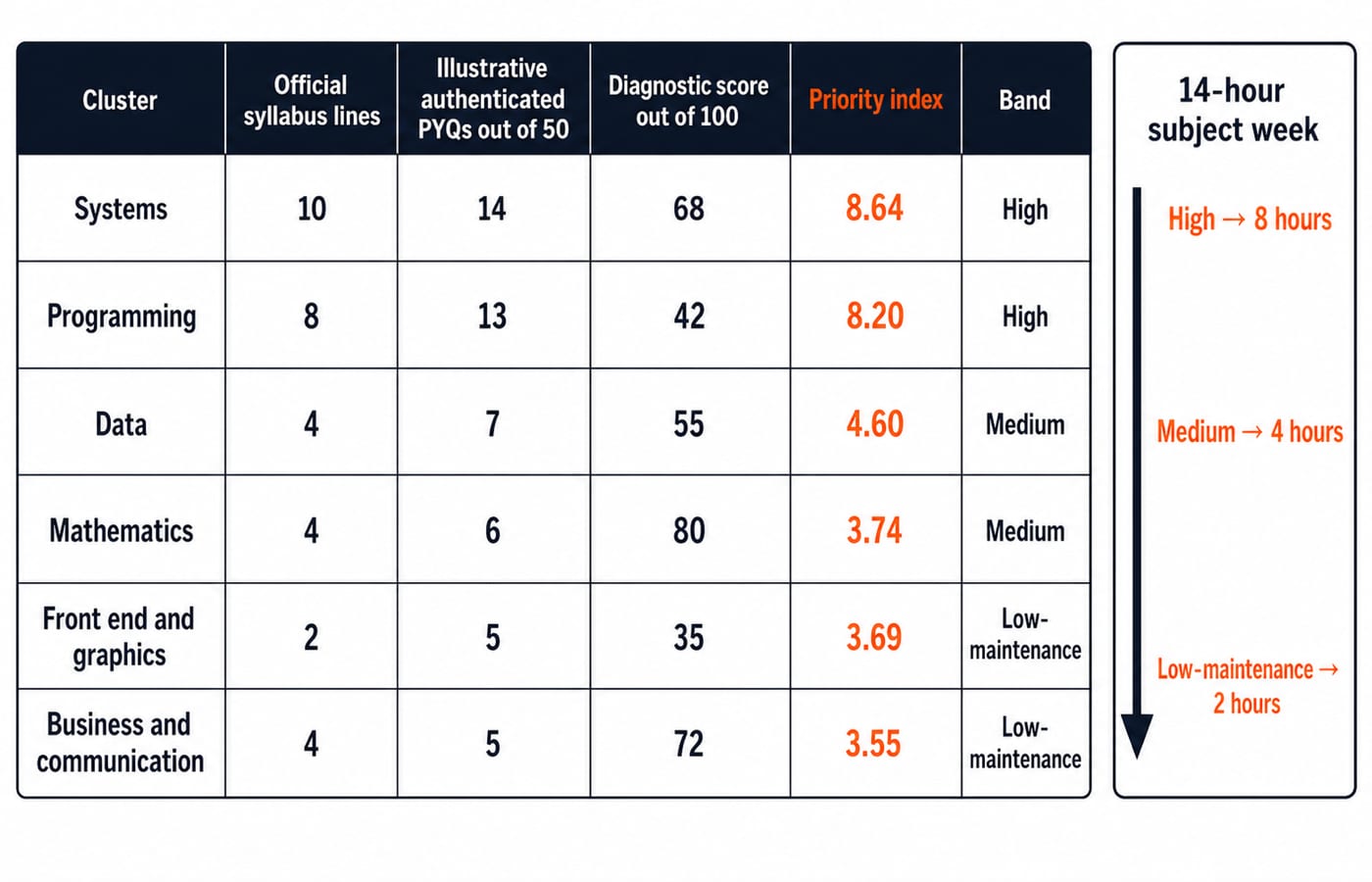
Suppose an illustrative 50-question audit contains Systems 14, Programming 13, Data 7, Mathematics 6, Front end and graphics 5, and Business and communication 5. The check is 14 + 13 + 7 + 6 + 5 + 5 = 50.
Do not turn 14/50 into a promised 28% exam weightage. Recurrence is one signal, rare syllabus lines stay in maintenance revision, and the ledger should grow whenever you authenticate more papers.
Calculate a personal priority index from your own numbers
Use diagnostic scores out of 100: Systems 68, Programming 42, Data 55, Mathematics 80, Front end and graphics 35, and Business and communication 72. For this planning dataset:
Priority = 5(PYQ count/14) + 3(syllabus lines/10) + 2((100 - diagnostic score)/100)
The weights say that recurrence in authenticated papers matters most, syllabus breadth next and personal weakness last. Nothing about them is official, so change them if your own evidence argues otherwise, and round only the final result.
Cluster | Visible calculation | Priority | Band |
|---|---|---|---|
Systems |
| 8.64 | High |
Programming |
| 8.20 | High |
Data |
| 4.60 | Medium |
Mathematics |
| 3.74 | Medium |
Front end and graphics |
| 3.69 | Low-maintenance |
Business and communication |
| 3.55 | Low-maintenance |
This ranks your own evidence instead of imposing a universal cutoff. Low-maintenance means a slower revision cycle, not a dropped topic: a subject you never revisit still costs full marks on the day it appears.
Turn the DSSSB subject order into a 14-hour week
A priority order that never reaches a calendar changes nothing. In a 14-hour subject week, High takes 8 hours, Medium 4 and Low-maintenance 2.
Cluster | Weekly time |
|---|---|
Systems | 4 hours 15 minutes |
Programming | 3 hours 45 minutes |
Data | 2 hours 15 minutes |
Mathematics | 1 hour 45 minutes |
Front end and graphics | 1 hour 15 minutes |
Business and communication | 45 minutes |
High gets 4:15 + 3:45 = 8:00, Medium gets 2:15 + 1:45 = 4:00, and Low-maintenance gets 1:15 + 0:45 = 2:00. The total is 8:00 + 4:00 + 2:00 = 14:00.
Use Systems for 2 hours 30 minutes of concept repair, 1 hour of authenticated PYQs and 45 minutes of recall. Use Programming for 2 hours 15 minutes of code tracing and concepts, 1 hour of PYQs and 30 minutes of error-log repair. Each other cluster needs a concept block, a question block and a 15-minute retrieval check within its allocation.
If only 10 hours happen, keep High at 5 hours 30 minutes, Medium at 3 hours and Low-maintenance at 1 hour 30 minutes. Carry unfinished questions into the next review block instead of forcing 14 planned hours into one weekend.
Keep DSSSB Section A and Computer Science in separate queues
Preparation queue | Resource path |
|---|---|
Technical syllabus, PYQs and mock-oriented preparation | |
Non-technical preparation |
Section A and the Computer Science section need different material and a different rhythm, and one merged timetable almost always ends with the technical section eating the general one. Keep two queues, two ledgers and two weekly budgets; how the two are weighted on the day is in the notification. The 14-hour example is a subject-preparation budget, not your whole-exam timetable. Use the DSSSB Section A Strategy for Computer Science Aspirants to plan that queue separately. If you need to compare available paths first, use the DSSSB Exam Preparation Courses page.
Re-test the order instead of preserving it for months
Recalculate after two timed diagnostics or after adding 15 authenticated PYQs, whichever comes first. Recalculating more often than that just chases noise in a small sample, and the order stops meaning anything.
Suppose Systems improves from 68 to 82. Its weakness term falls from 2(32/100) = 0.64 to 2(18/100) = 0.36, so priority becomes 5 + 3 + 0.36 = 8.36. If Data falls from 55 to 40, its term rises from 0.90 to 1.20, giving 2.50 + 1.20 + 1.20 = 4.90.
Move 45 minutes from Systems to Data. The new times are Systems 3:30, Programming 3:45, Data 3:00, Mathematics 1:45, Front end and graphics 1:15, and Business and communication 0:45. They still total exactly 14 hours.
The short version: breadth, recurrence, weakness, then revise
Freeze the correct post-code syllabus, cluster every line, count only authenticated PYQs, then combine recurrence with diagnostic weakness. No spreadsheet can turn your personal sample into an official DSSSB subject-weightage percentage.
For a structured technical syllabus, PYQ and mock path, use the DSSSB TGT Computer Science 2026 Section B Complete Course. If you already have resources, apply the same 14-hour matrix to your own verified ledger.
Keep learning
DSSSB TGT Computer Science Exam Pattern and Marking Scheme: Sections, Scores and Timing
Understand how Section A and Section B contribute to the historical 39/22 scheme. Work through the negative-marking calculation, distinguish qualification from merit, and plan a timed mock.
30 Sep 20264 min read137 viewsDSSSB Computer Science
DSSSB Computer Science 16-Week Preparation Plan: 12 Hours a Week
Follow a practical 16-week timetable that balances Computer Science, Section A, questions, error repair and mock analysis, with a clear route back after missed sessions.
Updated 6 Aug 20265 min read194 viewsDSSSB Computer Science
DSSSB vs State PSC Teaching: A Route Guide for CS Graduates
Choose a primary government teaching route by checking your documents, transferable CS preparation, posting preference, and notification readiness.
Updated 3 Aug 20266 min readDSSSB Computer Science
DSSSB Computer Science DBMS, OS and Networks Question Playbook
Learn a repeatable way to solve DBMS dependencies, OS scheduling timelines and network address ranges, with three worked examples and an error-led practice routine.
Updated 31 Jul 20266 min read751 viewsDSSSB Computer Science