DSSSB Computer Science DBMS, OS and Networks Question Playbook
Learn a repeatable way to solve DBMS dependencies, OS scheduling timelines and network address ranges, with three worked examples and an error-led practice routine.
KnowledgeGate Team
Exam prep & CS education
Updated 31 Jul 20266 min read751 views
In Section B of the DSSSB TGT Computer Science paper you can know every definition and still lose the question, because the same idea arrives as a dependency, a timeline or an address range. Treat DBMS, Operating Systems and Computer Networks as three reasoning systems: dependencies, state over time, and ranges with direction. The repeatable method is to identify the governing rule, compute only the decisive value, and eliminate options before doing unnecessary work.
Turn Three Large Subjects into a Question Map
Each subject announces itself through the representation its questions demand.
Subject | Question families | Recognition cue |
|---|---|---|
DBMS | Keys and functional dependencies, normal forms, SQL, transactions, indexing | A relation or schedule means track dependencies or conflicts. |
Operating Systems | Process states, CPU scheduling, synchronisation, deadlocks, paging, file systems | Arrivals, bursts or page references mean draw a timeline or frame table. |
Computer Networks | Layers and protocols, IPv4 subnetting, routing, error control, TCP and UDP behaviour | An IP prefix or protocol exchange means mark the address range or packet direction. |
Section B of the DSSSB TGT paper tests the Computer Science knowledge required for the post you apply to, and these three subjects sit inside it alongside programming, data structures, digital logic and computer organisation. The question count, marks and topic list for your post code are in the current advertisement at dsssb.delhi.gov.in. Other teaching recruitments that test the same subjects are grouped under government teaching exam preparation.
DBMS: Reduce Every Question to Keys, Dependencies and Normal Forms
Consider ENROLMENT(StudentID, CourseID, InstructorID, InstructorExt, Grade) with these functional dependencies:
(StudentID, CourseID) -> GradeCourseID -> InstructorIDInstructorID -> InstructorExt
A single row like (S17, C204, I9, 4109, A) can never prove a dependency; only the stated functional dependencies can. The candidate key is {StudentID, CourseID}. Together, those attributes determine Grade; CourseID determines InstructorID, which determines InstructorExt. Neither key attribute alone determines the whole row.
Now normalise in order. CourseID -> InstructorID makes InstructorID depend on only part of the composite key, so the original relation is not in 2NF. InstructorID -> InstructorExt creates the next transitive dependency. Decompose it into:
ENROLMENT(StudentID, CourseID, Grade)COURSE_INSTRUCTOR(CourseID, InstructorID)INSTRUCTOR(InstructorID, InstructorExt)
The first relation removes instructor facts from each enrolment. The second records an instructor assignment per course, while the third stores an instructor's extension once. Joining on CourseID and then InstructorID reconstructs the original facts without repetition.
The decision rule is simple: find a candidate key, classify every non-key dependency, then test the strongest normal form named in the options. To drill that sequence over more relations, work through DBMS normalisation MCQs from 1NF to BCNF.
Operating Systems: Draw Time Before Calculating Averages
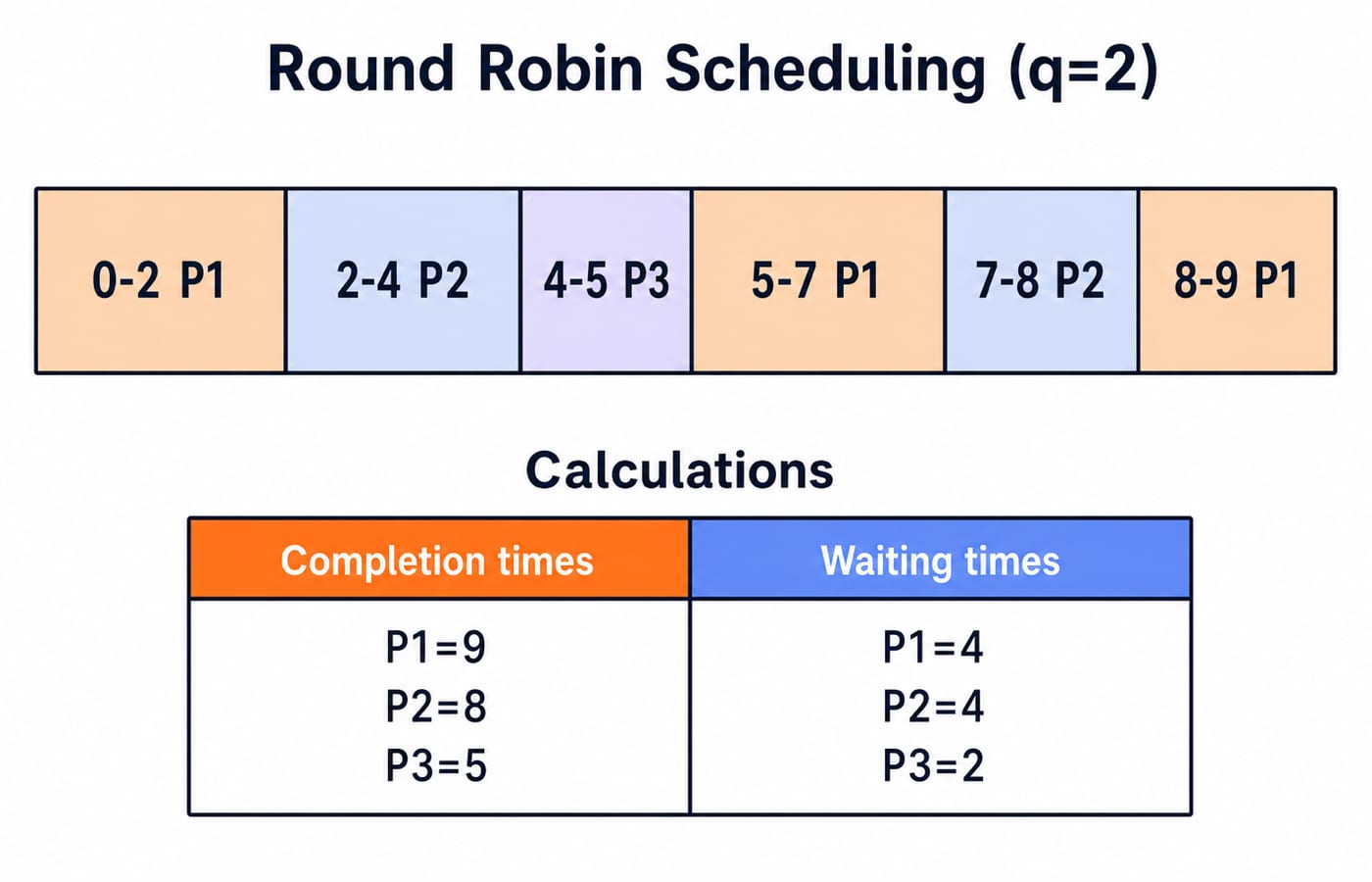
Take Round Robin with P1(arrival 0, burst 5), P2(arrival 1, burst 3), P3(arrival 2, burst 1) and time quantum 2. Use this queue convention: processes that have arrived by time 2 enter the ready queue before the pre-empted P1 is requeued.
The Gantt chart is:
0-2 P1 | 2-4 P2 | 4-5 P3 | 5-7 P1 | 7-8 P2 | 8-9 P1
Completion times are P1=9, P2=8, P3=5. Therefore:
Turnaround times, using
completion - arrival, are9,7,3.Waiting times, using
completion - arrival - burst, are4,4,2.Average waiting time is
(4+4+2)/3 = 10/3 = 3.33time units.
Suppose the options are exactly:
A
4,4,2; average 3.33B
3,4,2; average 3.00C
4,3,2; average 3.00D
5,4,2; average 3.67
P2 completes at 8, so its waiting time is 8-1-3=4; eliminate C. P1's waiting time is 9-0-5=4; eliminate B and D. A remains, and two subtractions did the whole job. The same timeline habit transfers to deadlocks and memory management, worked at greater depth in Operating Systems for GATE.
Computer Networks: Convert Prefix Length into a Visible Range
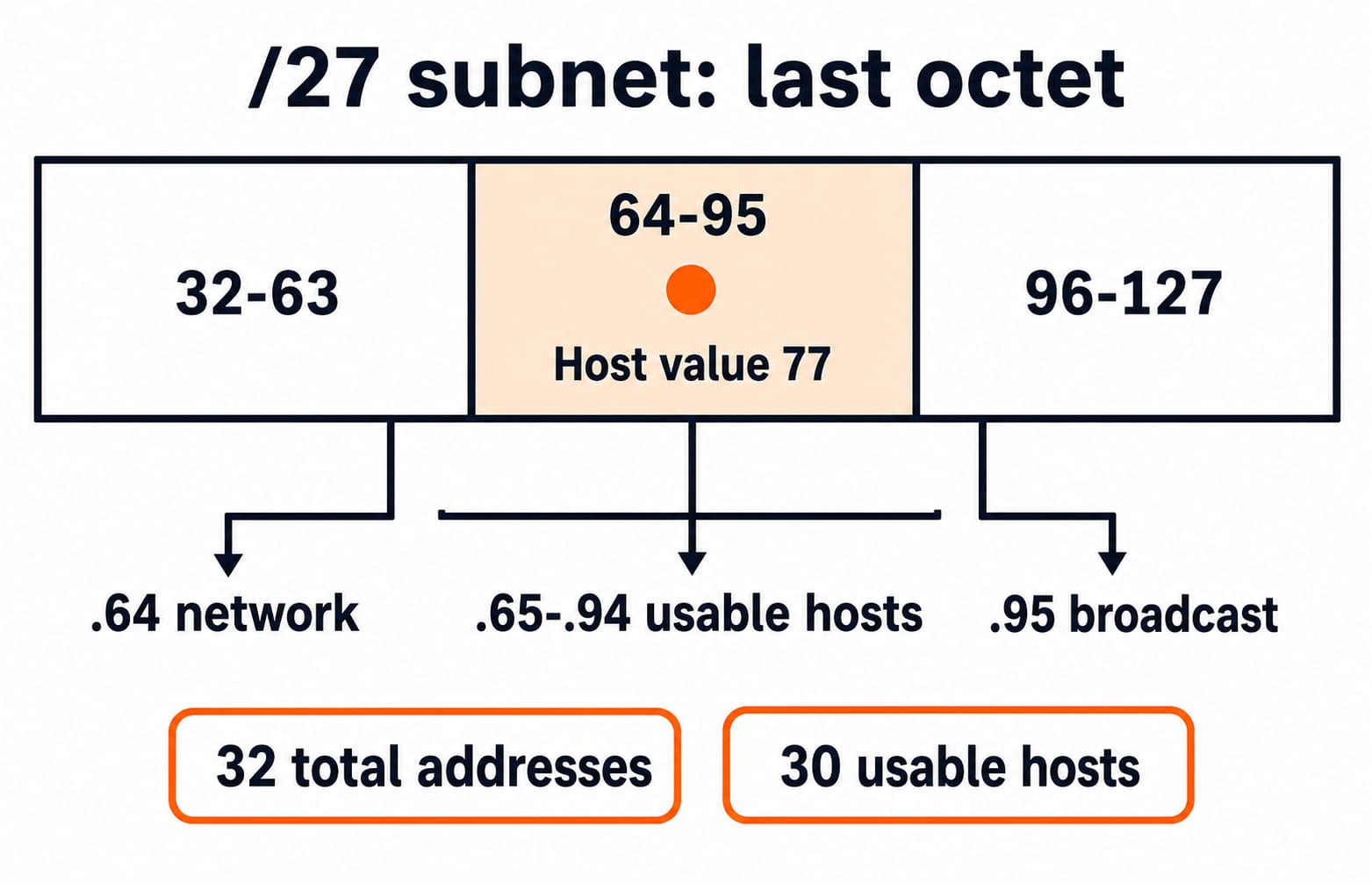
For 192.168.10.77/27, the prefix leaves 32-27=5 host bits. The block size is 2^5=32 addresses. Last-octet blocks are 0-31, 32-63, 64-95, 96-127, and so on. Since 77 lies in 64-95, the network address is 192.168.10.64 and the broadcast address is 192.168.10.95.
The usable range is 192.168.10.65 to 192.168.10.94, giving 32-2=30 usable host addresses. Reject .77 as a network address because it is inside the block. Reject .96 because it begins the next block. Then distinguish 32 total addresses from 30 usable hosts.
At protocol level, an IP address identifies an interface at the network layer, a port identifies a process endpoint at the transport layer, and a MAC address handles local-link delivery. Keep both range and direction visible while solving subnetting and IP addressing MCQs.
Traps That Make Correct Definitions Produce Wrong Answers
Attach a check or formula to every term:
Subject | Common contrast | Decisive check |
|---|---|---|
DBMS | Superkey vs candidate key | Test minimality. A candidate key has no removable attribute. |
DBMS |
| The first counts rows; the second excludes |
DBMS | Conflict serialisability vs no obvious dirty read | Draw the precedence graph and inspect edge direction for a cycle. |
OS | Response, waiting and turnaround time | Response is first run minus arrival; turnaround is completion minus arrival; waiting is turnaround minus burst. |
OS | Safe state vs current deadlock | Search for a safe completion sequence. Unsafe does not automatically mean already deadlocked. |
OS | Page number bits vs offset bits | Page size fixes the offset. |
Networks | Network vs broadcast address | Mark the first and last value of the subnet block. |
Networks | Bits vs bytes, sequence vs acknowledgement | Write units and direction beside the value before selecting an option. |
How Objective Questions Raise the Difficulty
A topic usually moves through three reasoning levels: definition recall, one-rule application, then a multi-step numerical or schedule. A prompt asking for the highest normal form needs the dependency test. Average waiting time needs a timeline. A valid host needs network and broadcast boundaries.
Use option-first triage. If options differ in only one field, compute that field first. In the Round Robin example, P2's waiting time removes C. In the subnet example, the block boundary removes impossible addresses before the host count is needed.
A 50-Minute Practice Loop for These Three Subjects
Attempt 12 questions: 4 DBMS, 4 OS and 4 Networks. Spend 18 minutes on direct and one-rule questions, 22 minutes on schedules, normalisation and subnetting, then 10 minutes recomputing only answers where units, queue order or dependency direction were uncertain.
KnowledgeGate's question bank carries more than 6,400 solved questions across DBMS, Operating Systems and Computer Networks. Rotate one weak question family per session instead of trying to exhaust it.
Keep an error log with four columns: question cue, rule missed, working that should have been drawn, and next check date. A filled row could be: valid host in /27 | forgot broadcast boundary | draw 64-95 block | review after 2 days.
Short Version and the Next Step
DBMS questions need dependencies. OS questions need timelines. Network questions need ranges and direction.
Identify the rule, draw the smallest useful representation, calculate the value that separates the options, eliminate, and only then verify the full answer. Redo the candidate key, average waiting time and /27 range without looking. Then attempt a mixed 12-question set and classify every error by subject family. For structured coverage, continue with the DSSSB TGT Computer Science Section B course.
Keep learning
DSSSB TGT Computer Science Exam Pattern and Marking Scheme: Sections, Scores and Timing
Understand how Section A and Section B contribute to the historical 39/22 scheme. Work through the negative-marking calculation, distinguish qualification from merit, and plan a timed mock.
30 Sep 20264 min read137 viewsDSSSB Computer Science
DSSSB Computer Science 16-Week Preparation Plan: 12 Hours a Week
Follow a practical 16-week timetable that balances Computer Science, Section A, questions, error repair and mock analysis, with a clear route back after missed sessions.
Updated 6 Aug 20265 min read194 viewsDSSSB Computer Science
DSSSB vs State PSC Teaching: A Route Guide for CS Graduates
Choose a primary government teaching route by checking your documents, transferable CS preparation, posting preference, and notification readiness.
Updated 3 Aug 20266 min readDSSSB Computer Science
DSSSB Computer Science Syllabus: What to Study in Every Block
Turn the DSSSB Computer Science syllabus into bounded scope: all 32 historical subject lines, the pedagogy block and Section A, mapped with worked diagnostics and no invented weightage.
Updated 29 Jul 20266 min read685 viewsDSSSB Computer Science