DSSSB Computer Science Eligibility and Exam Structure: A Post-Code Checklist
Use this post-code checklist to test qualification and age wording, understand the dated 56/24 paper, and verify a current DSSSB notice before preparing.
KnowledgeGate Team
Exam prep & CS education
Updated 26 Jul 20265 min read
DSSSB Computer Science is not one permanent eligibility rule or one permanent paper pattern. The post code and its advertisement control both, so begin from the DSSSB preparation page, then verify everything against the official DSSSB advertisement. Use a two-pass check: first match your qualification and age to the current post-code notice, then map its paper and selection stages before preparing.
Start with the post code, not a generic DSSSB rule
DSSSB recruits by post and department. Do not merge TGT Computer Science, PGT Computer Science or Informatics Practices, and other computer-related posts into one rule set.
Take Advertisement 05/2024, Post Code 56/24, TGT (Computer Science), Directorate of Education as a historical example. Copy four fields from the current notice:
Advertisement number
Post code
Exact post title
Department
If one field differs from an old notice or coaching graphic, the official entry wins. When comparing posts and boards, complete this identity check for every option.
Qualification routes listed for historical Post Code 56/24
Page 26 of DSSSB Advertisement 05/2024 listed four alternative essential-qualification routes for 56/24:
BCA from a recognised university.
Graduation in Computer Science from a recognised university, with Computer Science as the main subject in all years.
BE or BTech in Computer Science or Information Technology from a recognised university.
Graduation in any subject plus the A Level course from DOEACC named in that notice.
That entry recorded essential experience as nil and did not list BEd or CTET in its essential-qualification block. Do not generalise this to another post or cycle. Read every “and”, “or”, note and corrigendum in the current entry.
Evidence must prove the degree title, subject in every required year, university recognition, and exact certificate route. A similar-sounding course is not an equivalence route.
Worked eligibility audit: four matches and three traps
Test each of these files against the exact 56/24 wording, word by word. The same file can pass one post code and fail the next, so redo the test on whichever advertisement is open.
File | Match to the 56/24 text | Documents to check |
|---|---|---|
Asha, three-year BCA | Route 1 | Degree certificate and marksheets |
Bilal, three-year BSc Computer Science, CS as main subject in Years 1, 2 and 3 | Route 2 | Degree and all-year marksheets |
Charu, BTech Information Technology | Route 3 | Degree and recognition proof if needed |
Dev, BA plus the named DOEACC A Level | Route 4 | Degree and exact A Level certificate |
Three files fail that old entry's exact-match test: BSc Mathematics with one CS elective, BTech Electronics, and general graduation with a short computer certificate other than the named A Level. Say “not an exact match to this notice”, not “permanently ineligible”. The current notice and corrigenda decide. Keep any claimed category or relaxation certificate. Never invent equivalence.
Age and category checks use the notice's cut-off date
Advertisement 05/2024 said “not exceeding 30 years” for 56/24 and assessed eligibility on 17 April 2024. It referred candidates to its age-relaxation table.
Now calculate completed age, without rounding:
Born 18 April 1994: age on 17 April 2024 was 29 years, 11 months and 30 days, within the unrelaxed historical ceiling.
Born 16 April 1994: age was 30 years and 1 day, above that ceiling. This candidate needed a valid relaxation in the same notice.
Do not carry either value into a new cycle. Category geography and certificate timing matter too. The 2024 notice set specific OBC (Delhi) certificate conditions, so check the open notice for three things: the issuing authority it accepts, the certificate format it prescribes, and the date the certificate must be dated by. Any one of those left unmet sinks the relaxation claim, even when the category itself is correct.
Exam structure: read Section A and Section B as one paper
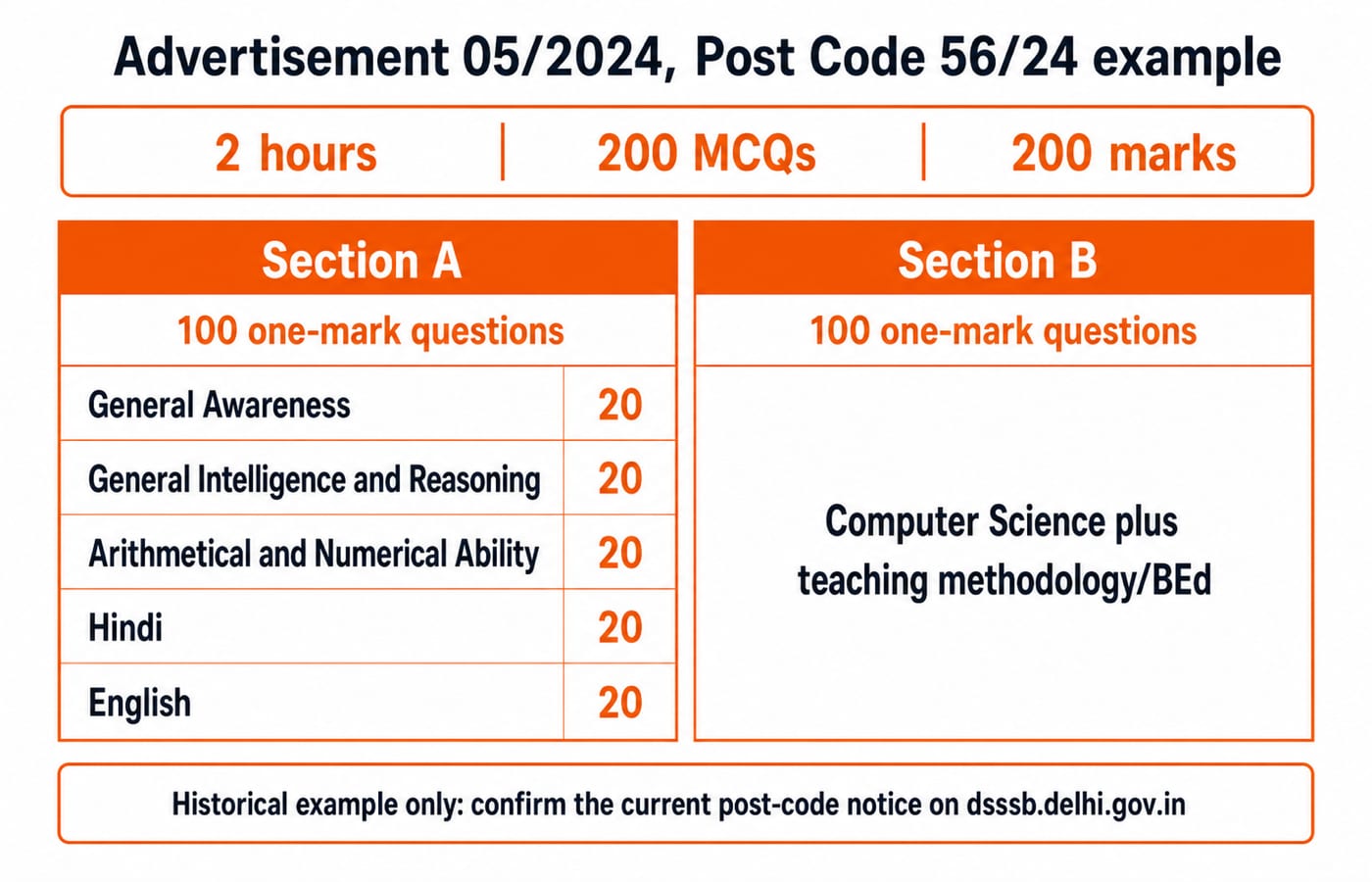
For 56/24, Advertisement 05/2024 specified a one-tier technical or teaching paper of 2 hours, 200 one-mark MCQs and 200 marks. Section A had 100 questions, 20 each from General Awareness, General Intelligence and Reasoning, Arithmetical and Numerical Ability, Hindi Language and Comprehension, and English Language and Comprehension. Section B had 100 subject questions, including teaching methodology or BEd.
Section A was five breadth blocks and Section B was the domain block, but that notice counted both for merit. Organise them with the DSSSB Section A subjects and strategy, the DSSSB Section A course, and the DSSSB TGT Computer Science Section B course.
Worked score example: negative marking changes the total
Advertisement 05/2024 deducted 0.25 mark for each wrong MCQ answer.
Section A: 70 correct, 20 wrong, 10 unattempted.
70 - (20 x 0.25) = 70 - 5 = 65.Section B: 62 correct, 18 wrong, 20 unattempted.
62 - (18 x 0.25) = 62 - 4.5 = 57.5.Combined raw score:
65 + 57.5 = 122.5 out of 200.
For one-tier technical or teaching posts, that notice applied mandatory minimums to Section B while counting both sections for merit. Its General/EWS minimum was 40 per cent, so 100 x 0.40 = 40. The example's 57.5 cleared 40 but did not prove selection. Cut-offs could be higher, and DSSSB could normalise scores if required.
An unanswered question cost 0, while four wrong answers cost 4 x 0.25 = 1 mark. Recompute if the current notice changes the value or penalty.
Selection map and final verification checklist
Advertisement 05/2024 described a computer-based exam, draft answer key, time-bound online objections, normalisation if required, and merit processing. Documents were sought later through e-dossier for user-department scrutiny. An accepted application remained provisional.
For the current cycle:
Download the official advertisement.
Confirm advertisement number, post code, post and department.
Mark the exact qualification route you claim.
Calculate age on the notice's cut-off date.
Copy the paper scheme, qualifying rule and penalty.
Save corrigenda, marksheets, certificates and recognition proof.
Fill every line from the open advertisement. Qualification wording, cut-off date, section split, penalty value and qualifying minimum are all set per post code and per cycle, so none of the 56/24 numbers transfers by default.
The short version
Verify the post code, then prepare the two blocks separately. Use the teaching Computer Science exams comparison for the wider choice. If the current notice confirms the same structure, prepare Section A and Section B as two separate tracks, and give the weaker track its own fixed slot every week. The DSSSB Section A and TGT Computer Science Section B courses each carry one of those tracks end to end.
Keep learning
DSSSB TGT Computer Science Exam Pattern and Marking Scheme: Sections, Scores and Timing
Understand how Section A and Section B contribute to the historical 39/22 scheme. Work through the negative-marking calculation, distinguish qualification from merit, and plan a timed mock.
30 Sep 20264 min read137 viewsDSSSB Computer Science
DSSSB Computer Science 16-Week Preparation Plan: 12 Hours a Week
Follow a practical 16-week timetable that balances Computer Science, Section A, questions, error repair and mock analysis, with a clear route back after missed sessions.
Updated 6 Aug 20265 min read194 viewsDSSSB Computer Science
DSSSB vs State PSC Teaching: A Route Guide for CS Graduates
Choose a primary government teaching route by checking your documents, transferable CS preparation, posting preference, and notification readiness.
Updated 3 Aug 20266 min readDSSSB Computer Science
DSSSB Computer Science DBMS, OS and Networks Question Playbook
Learn a repeatable way to solve DBMS dependencies, OS scheduling timelines and network address ranges, with three worked examples and an error-led practice routine.
Updated 31 Jul 20266 min read751 viewsDSSSB Computer Science