

Python for GATE: DA Syllabus, Observed Weightage and Prep Order
Settle the DA-versus-CS language question, see what one official DA paper contained, and build Python, data structures and algorithms in the right sequence.
KnowledgeGate Team
Exam prep & CS education
Updated 6 Nov 20265 min read

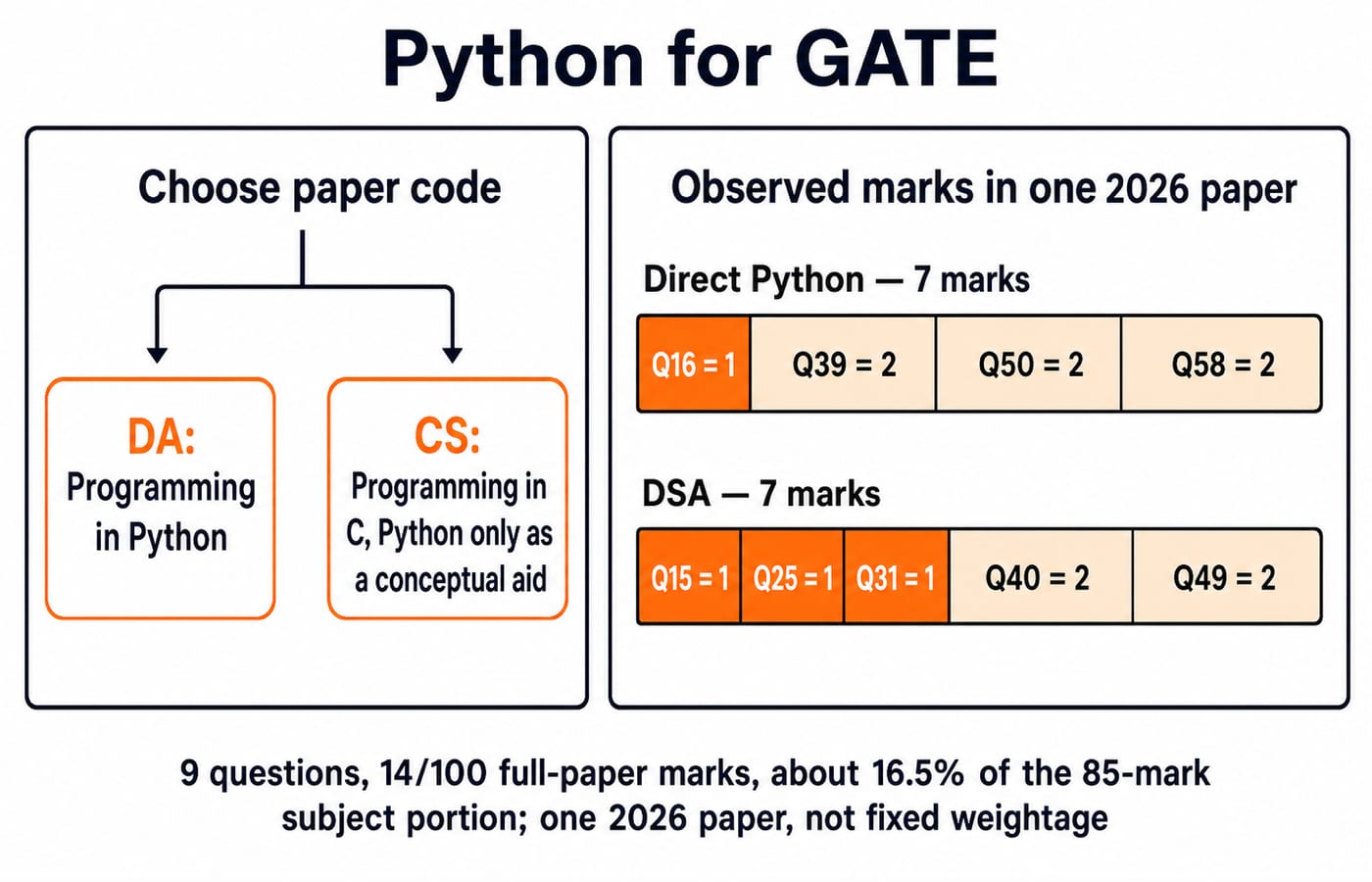
Treat the completed 2026 DA paper as a classification exercise, not a weightage forecast. Its Programming, Data Structures and Algorithms block accounted for 14 observed marks; the useful result is a syllabus-aligned 64-hour order and practice set.
The earlier Python for GATE: CS vs DA Syllabus, Past-Paper Evidence and a 10-Week Plan owns the paper-code choice, the direct-Python 7-mark audit and the longer plan. The narrower DA-only lens here combines direct Python with the data-structures and algorithms questions that share its syllabus block.
Use IIT Guwahati's GATE 2026 test papers and syllabus page for the official wording and replace it with the organising institute's page for a later attempt. The completed 2026 DA syllabus names Python; the completed CS syllabus names C.
GATE DA Python syllabus areas
Study the official Programming, Data Structures and Algorithms block in three bands:
Band | What to prepare |
|---|---|
Python foundations | Programming in Python; expressions, control flow, functions, recursion, mutation and scope |
Basic data structures | Stacks, queues, linked lists, trees and hash tables |
Algorithms and graphs | Linear and binary search; selection, bubble and insertion sort; mergesort and quicksort; graph basics, traversals and shortest path |
The syllabus names the structures and algorithms but not a Python prerequisite ladder. Learn execution state and calls first, then reason about stacks, trees, sorts and graphs. Web frameworks, file handling and data visualisation sit outside this block.
Try three checks: push 4, push 7, pop, push 2 leaves [4, 2]. Binary search for 19 in [3, 8, 12, 19, 27], with mid = (low + high) // 2, checks indices 2 and 3: two comparisons. BFS on edges A-B, A-C, B-D, C-E, with alphabetical neighbours, visits A, B, C, D, E.
Observed 14-mark Python and DSA footprint in one GATE DA paper
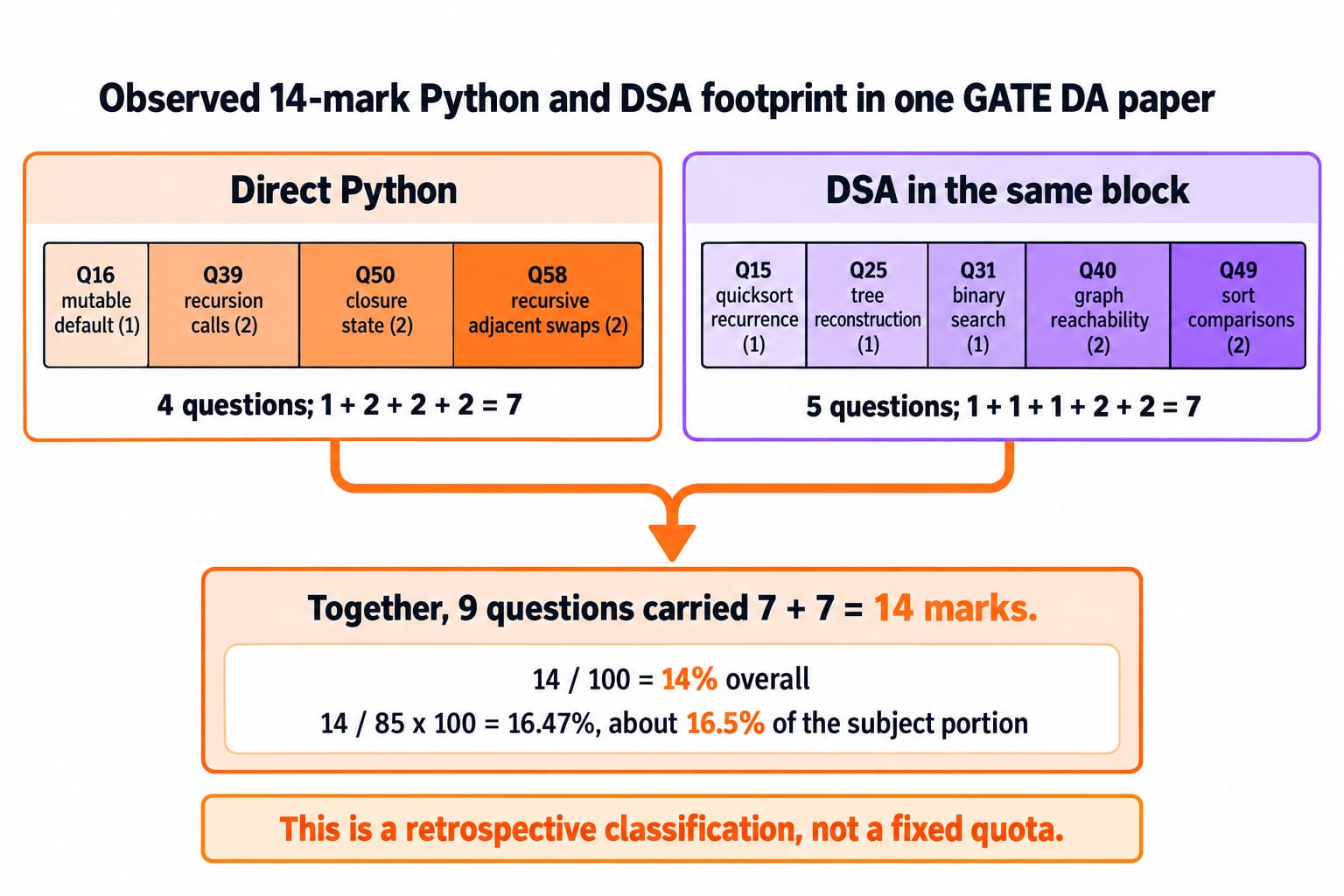
IIT Guwahati's 2026 DA master paper and answer key supply the questions, answers and marks. The two groups below are an editorial classification against the official syllabus block.
Classified group | Questions and concepts | Observed marks |
|---|---|---|
Direct Python | Q16 mutable default (1); Q39 recursion calls (2); Q50 closure state (2); Q58 recursive adjacent swaps (2) | 4 questions; 1 + 2 + 2 + 2 = 7 |
DSA in the same block | Q15 quicksort recurrence (1); Q25 tree reconstruction (1); Q31 binary search (1); Q40 graph reachability (2); Q49 sort comparisons (2) | 5 questions; 1 + 1 + 1 + 2 + 2 = 7 |
Together, 9 questions carried 7 + 7 = 14 marks. The paper had 15 General Aptitude marks and 85 subject marks within 100, so the block was 14 / 100 = 14% overall and 14 / 85 x 100 = 16.47%, about 16.5% of the subject portion.
This is a retrospective classification, not a fixed quota. Cover every named area and repeat the audit on the official paper for your attempt rather than forecasting from 2026.
Python code tracing: separate closure state
Trace the two closed-over lists before running the program:
def tracker():
    values = []
    def add(x):
        values.append(x)
        return len(values), sum(values)
    return add

alpha = tracker()
beta = tracker()
print(alpha(3))
print(alpha(5))
print(beta(4))
The first tracker call creates list A and returns alpha; the second creates distinct list B and returns beta. alpha(3) changes A to [3]. alpha(5) reuses A and changes it to [3, 5]. beta(4) changes only B to [4].
Output:
(1, 3)
(2, 8)
(1, 4)
A closure retains the object from its own enclosing call. Functions returned by different tracker calls do not share a list here, while repeated alpha calls do. Track function name, closed-over object and state.
GATE DA Python question practice
Build 12 questions: 4 output/mutation traces, 2 recursion traces, 2 stack/tree/hash operations, 2 search/sort traces and 2 graph/shortest-path questions. 4 + 2 + 2 + 2 + 2 = 12. This is practice, not official distribution.
For each question, record state, write the requested value, derive complexity only when asked, and check indexing, aliasing or base cases. Error log example: wrong assumption, alpha and beta share one list; correct rule, each tracker call creates its own closed-over list; retest, alpha(2), beta(6), alpha(1).
Use MCQ, MSQ or NAT? GATE Question Types Explained for answer-format discipline, without assuming a Python mix. KnowledgeGate has over 480 live Python practice questions, but they are not specific to DA; use only those that match the syllabus.
Common preparation mistakes and repairs
Wrong paper: search results omit paper codes. Write DA or CS atop the plan and check each topic against the official syllabus for your attempt.
Syntax without state tracing: familiar lines hide mutation, aliasing and recursion. Tabulate call, closed-over object, before, operation and after. For alpha: [] -> [3] -> [3, 5].
Permanent weightage from one paper: 14 marks feels stable. Treat it as evidence, cover all areas and check your cycle's official source.
Algorithms get postponed: runnable code gives quick feedback. Pair every Python week with a handwritten algorithm trace.
A 64-hour, eight-week preparation order
Week | Focus | Required output | Hours |
|---|---|---|---|
1 | Expressions, conditions, loops | 6 state traces | 8 |
2 | Functions, recursion, mutable objects, scope | 4 call-and-object tables | 8 |
3 | Stacks, queues, linked lists | 6 operation traces | 8 |
4 | Trees and hash tables | 4 tree reconstructions and 4 hash probes | 8 |
5 | Search and simple sorts | 6 index, comparison or swap traces | 8 |
6 | Mergesort, quicksort, complexity | 4 divide-and-conquer traces | 8 |
7 | Graphs, BFS, DFS, shortest paths | 4 traversal or reachability traces | 8 |
8 | Mixed practice and error repair | 3 mixed drills and 1 repaired retest | 8 |
Weekly rhythm: two 2-hour concept sessions, two 90-minute problem sessions and one 1-hour review. 2 + 2 + 1.5 + 1.5 + 1 = 8; 8 x 8 = 64. Move a missed 90-minute session to next week's first practice slot, dropping duplicate implementation rather than review. After missing at least 4 hours, add a week.
Resources and the short version
Need | Live resource | Honest role | Boundary |
|---|---|---|---|
Python practice | Concepts, MCQs and coding | Not an official GATE DA course or complete-coverage promise | |
Wider GATE CS prep | CS-focused route | Not a DA syllabus source |
For GATE DA 2026, prepare Python with the named data structures and algorithms.
For GATE CS 2026, C is the official programming language.
The DA audit found 14 combined-band marks, but one paper is calibration, not permanent weightage.
Confirm DA on the current official syllabus, reproduce the closure trace without running it, complete the 12-question mixed set, and begin Week 1.
Keep learning

Type Hints in Python: Functions, Collections and Checked Examples
Learn what Python type hints do, how to annotate common data shapes, and how a checker catches mistakes through exact, runnable examples.
Updated 5 Nov 20266 min readPython
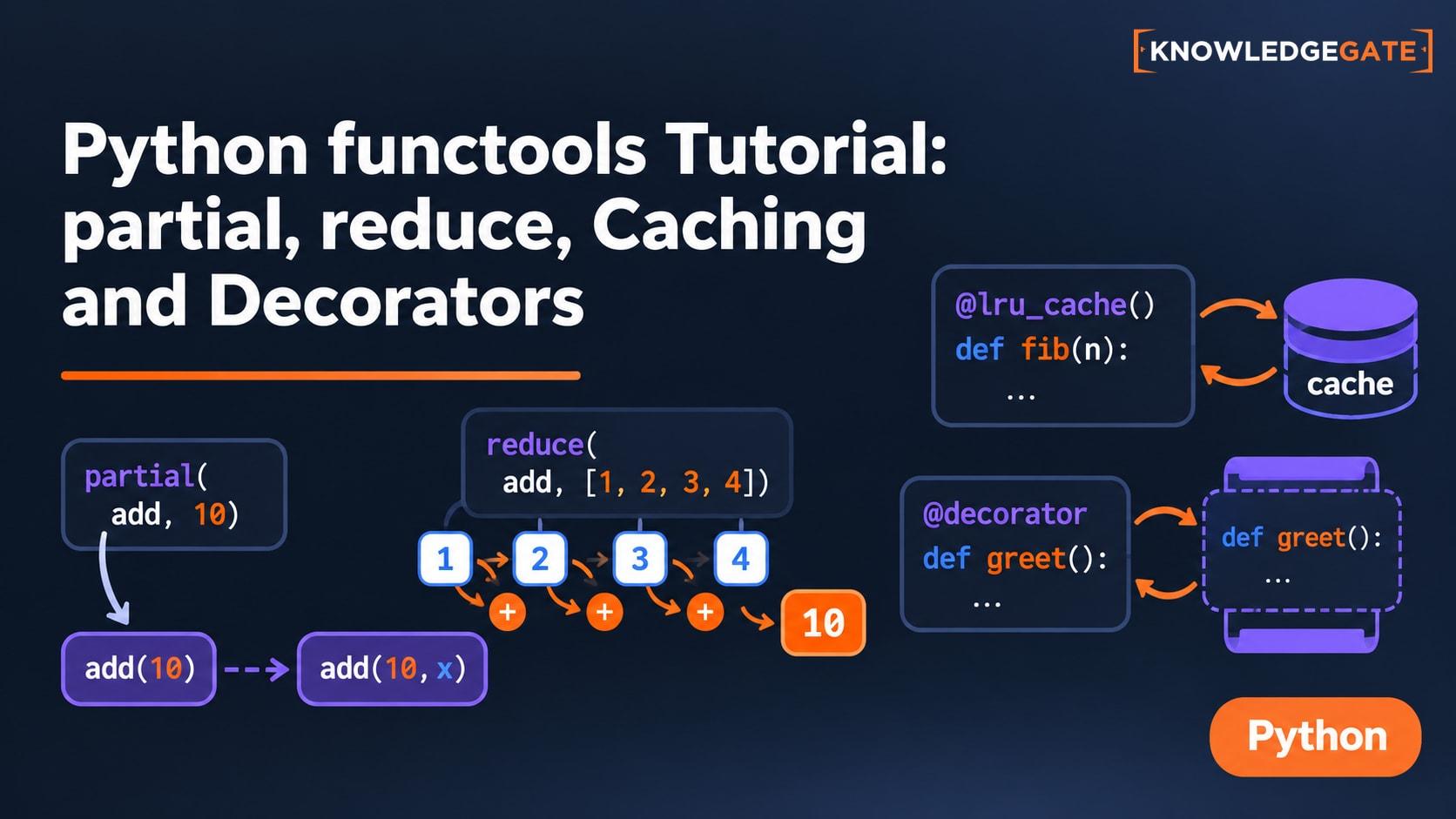
Python functools Tutorial: partial, reduce, Caching and Decorators
Learn when and how to use Python's main function tools through runnable examples with exact outputs, step-by-step traces, common mistakes and practice checks.
Updated 3 Nov 20266 min readPython

Python Standard Library Tour: Practical Tutorial with Examples
Choose Python modules by task, then combine paths, CSV, dates, counters, averages, and JSON in a runnable report.
Updated 2 Nov 20265 min readPython
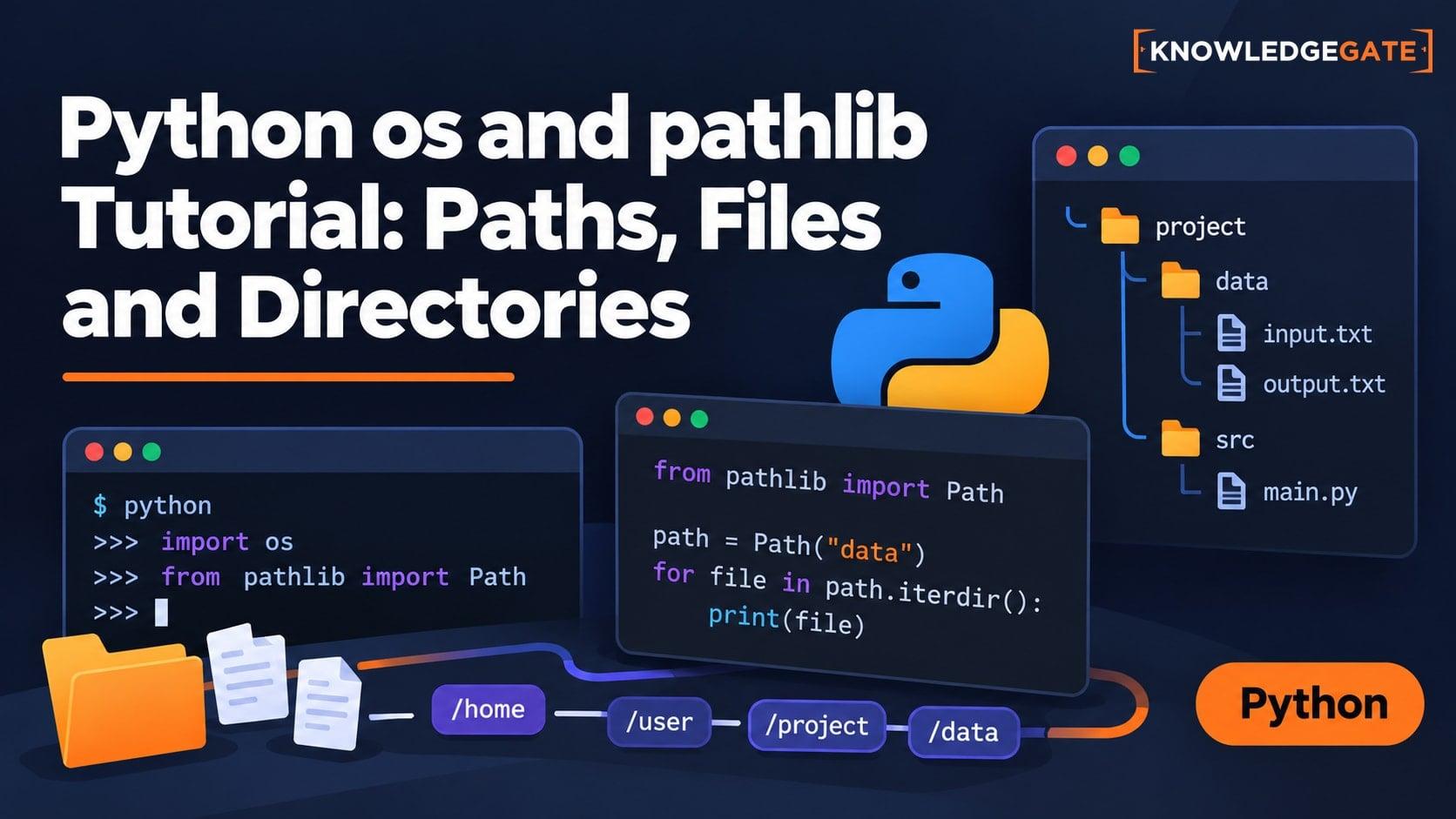
Python os and pathlib Tutorial: Paths, Files and Directories
Build one small Python workspace from start to finish. Learn portable paths, file operations, directory walks, safe renames, environment variables and deliberate cleanup.
Updated 1 Nov 20265 min readPython