You may remember each coordinate geometry formula and still lose time deciding which one a question needs. Is it asking for distance, midpoint, section, slope or a line equation? The reliable method is to write the coordinate changes first, choose the matching formula, keep every sign visible, and check the answer geometrically. The broader Aptitude Courses for Exams & Placements category can help you place this topic within a structured learning path.
Coordinate geometry formulas: build one usable map
Let A(x1, y1) and B(x2, y2). First calculate dx = x2 - x1 and dy = y2 - y1. These two changes expose negative signs and power several formulas.
Need | Formula | Decision cue |
|---|---|---|
Distance |
| Length or equidistance |
Midpoint |
| Point halfway along a segment |
Internal section | If | Point in a given ratio |
Slope |
| Direction or steepness |
Point-slope line |
| One point and a finite slope |
Triangle area |
| Area, or collinearity when it is zero |
The section formula is also P = A + m/(m+n)(B-A). A quick method is simply a shorter route through the same relationship. It does not replace the reasoning. The guide to Aptitude for Placements: Quant, Reasoning, Verbal places coordinate geometry inside a wider quantitative preparation sequence.
Distance and midpoint: calculate the coordinate changes once
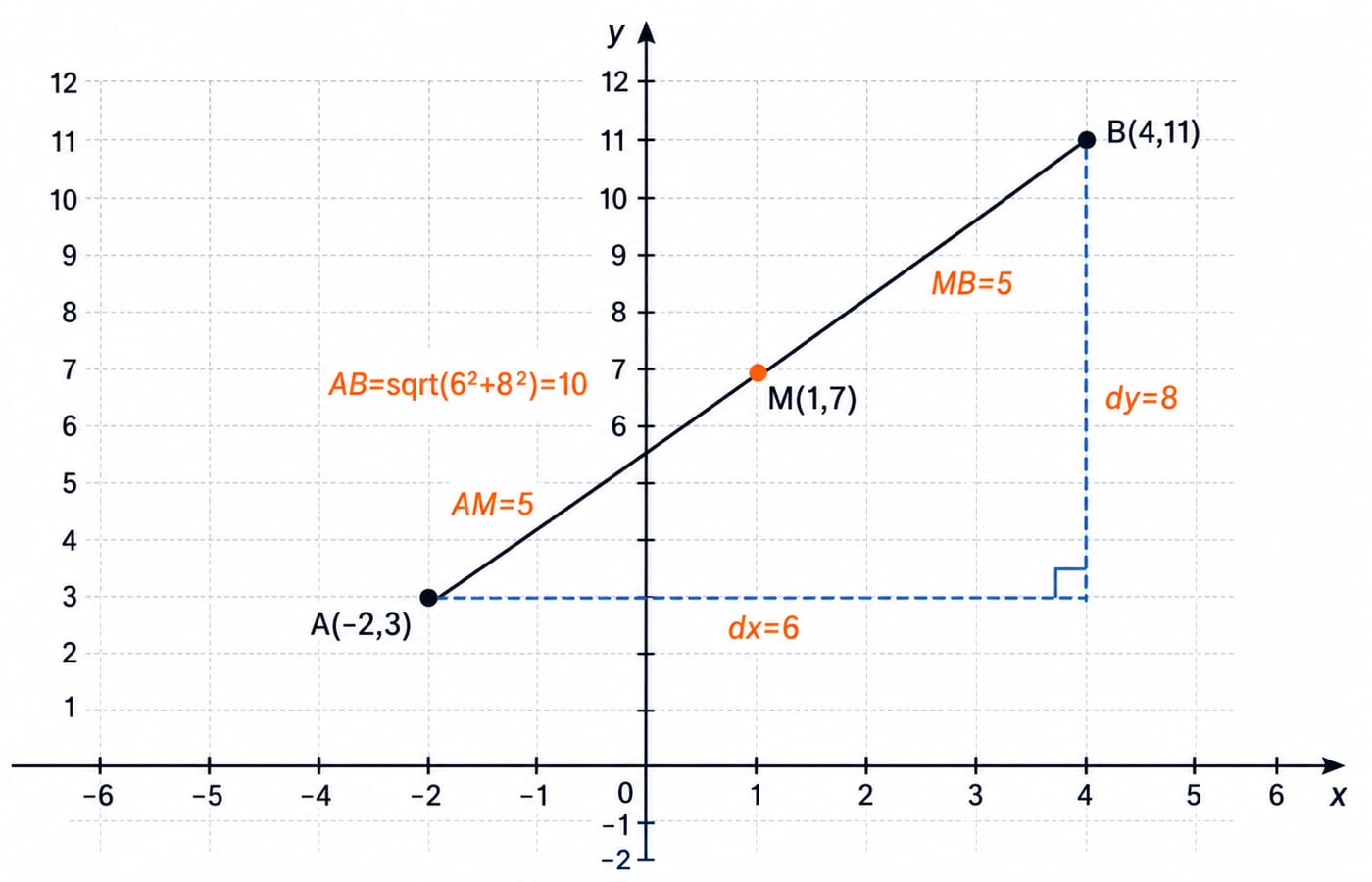
Take A(-2,3) and B(4,11).
dx = 4-(-2) = 6 and dy = 11-3 = 8.
So AB = sqrt(6^2+8^2) = sqrt(36+64) = sqrt(100) = 10. The 6, 8, 10 triangle is twice the familiar 3, 4, 5 triple, which is a useful speed check.
For the midpoint, average corresponding coordinates separately:
M = ((-2+4)/2, (3+11)/2) = (1,7).
Now verify it. From A to M, the changes are (3,4), so AM = sqrt(3^2+4^2) = 5. From M to B, they are also (3,4), so MB = 5. M lies within both endpoint coordinate ranges and splits AB equally.
When a common scale appears in dx,dy, factor it before squaring. For a midpoint, check that each coordinate lies between the corresponding endpoint values. Never average the two distances or mix an x-coordinate with a y-coordinate.
Section formula: let the ratio show how far to move
Let A(-1,2), B(5,8) and AP:PB = 2:1. The full movement is B-A = (6,6). Since AP is two of the three ratio parts,
P = A + 2/(2+1)(B-A)
= (-1,2) + 2/3(6,6)
= (-1,2) + (4,4) = (3,6).
Cross-check with weighting: P = (1*A+2*B)/3. Then xP = (1*(-1)+2*5)/3 = 9/3 = 3 and yP = (1*2+2*8)/3 = 18/3 = 6. Also, AP = sqrt(4^2+4^2) = 4sqrt(2) and PB = sqrt(2^2+2^2) = 2sqrt(2), so AP:PB = 2:1. P is closer to B, as it must be.
External division is different. For the same points, the external 2:1 point is E = (2B-1A)/(2-1) = (11,14). Here AE = 12sqrt(2) and EB = 6sqrt(2), confirming 2:1, with E beyond B. If the external parts are equal, m=n, the denominator is zero and there is no finite division point.
Slope shortcuts: read direction before multiplying formulas
For A and B from the distance example, m_AB = dy/dx = 8/6 = 4/3. Reversing both points gives (3-11)/(-2-4) = -8/-6 = 4/3. Reversing only one subtraction creates a wrong sign.
The line through U(2,-1) and V(2,5) has dx=0, so its slope is undefined and its equation is x=2. Through W(-3,4) and X(6,4), dy=0, so the slope is zero and the equation is y=4.
Through R(2,-1), a line parallel to AB has slope 4/3: y+1 = 4/3(x-2), or 4x-3y-11=0. A perpendicular line has slope -3/4: y+1 = -3/4(x-2), or 3x+4y-2=0. Both equations contain R. Use m1*m2=-1 only when both slopes are finite. For vertical and horizontal lines, use their directions directly.
Equations of a line: choose the form that matches the data
Using A(-2,3) and B(4,11), the two-point form is (y-3)/(11-3) = (x+2)/(4-(-2)), or (y-3)/8 = (x+2)/6. Cross-multiplying gives 6(y-3) = 8(x+2), which simplifies to 4x-3y+17=0.
Point-slope form reaches the same result: y-3 = 4/3(x+2). In slope-intercept form, this is y = 4/3*x+17/3. Substitute B: 11 = 4/3*4+17/3 = 33/3 = 11. Testing a known point quickly catches a lost constant or sign.
Find intercepts only if asked. Setting y=0 gives (-17/4,0), while setting x=0 gives (0,17/3). For a vertical line, the cross-multiplied two-point form is safer because it avoids division by x2-x1.
Mixed worked example: find a perpendicular bisector quickly
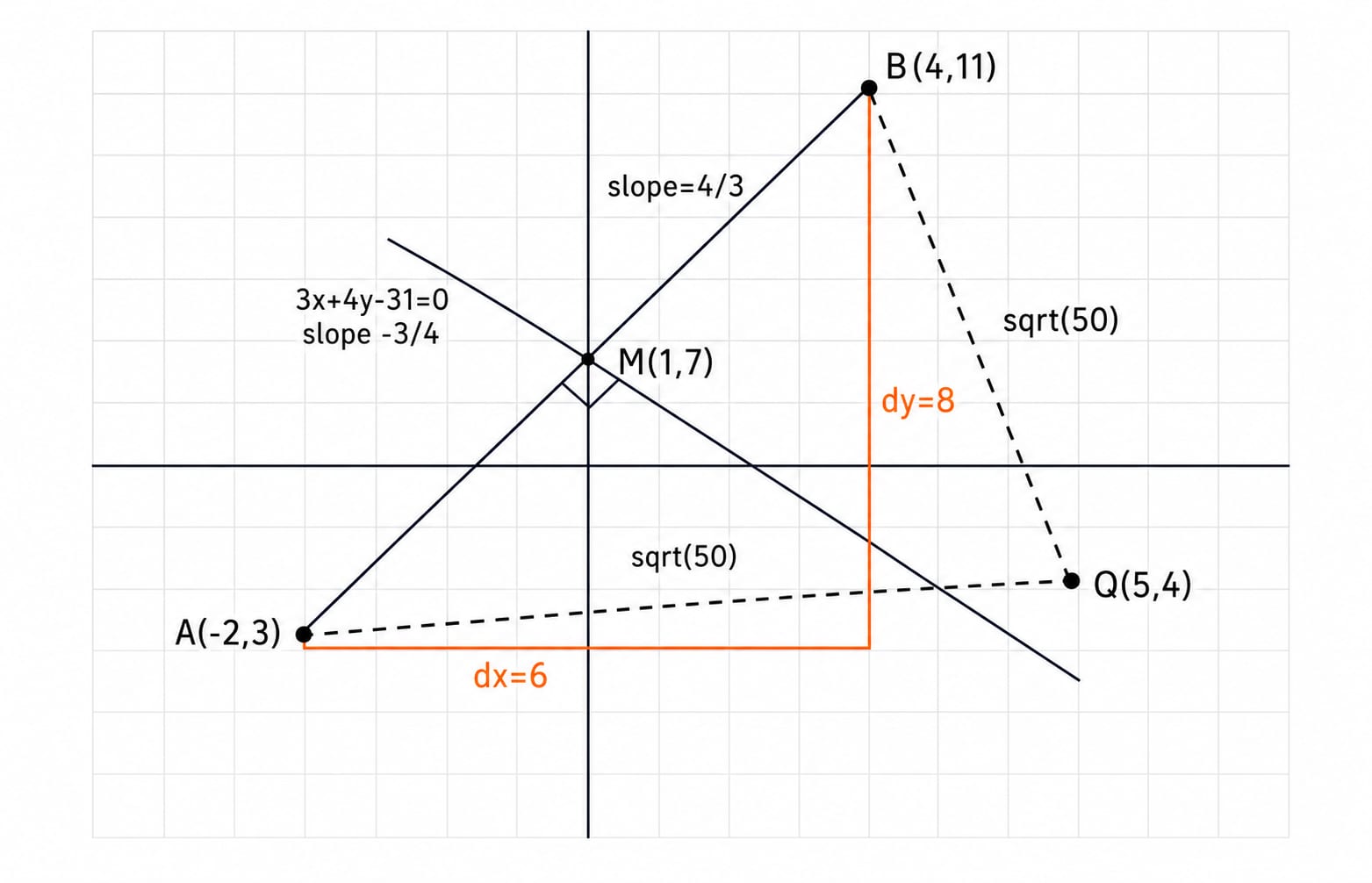
Find the perpendicular bisector of the segment joining A(-2,3) and B(4,11). Its midpoint is M(1,7), and AB has slope 4/3, so the required slope is -3/4.
y-7 = -3/4(x-1), hence 3x+4y-31=0.
There is also a no-fraction vector shortcut. The original change (dx,dy)=(6,8) is a normal to the perpendicular bisector, so 6(x-1)+8(y-7)=0. Dividing by 2 gives 3x+4y-31=0. M satisfies it because 3+28-31=0.
For a second check, Q(5,4) lies on the line since 3*5+4*4-31=0. Also, QA = sqrt((5+2)^2+(4-3)^2) = sqrt(49+1) = sqrt(50) and QB = sqrt((5-4)^2+(4-11)^2) = sqrt(1+49) = sqrt(50). Q is equidistant from A and B, exactly as a point on the perpendicular bisector should be.
Collinearity, triangle area and point-to-line distance
For C(1,2), D(4,8) and E(7,14), m_CD = (8-2)/(4-1) = 2 and m_DE = (14-8)/(7-4) = 2. Equal slopes show collinearity. The determinant numerator confirms it: 1(8-14)+4(14-2)+7(2-8) = -6+48-42 = 0, so the triangle area is zero. The determinant is safer when a vertical line could make slope undefined.
For J(1,2), K(5,4) and L(3,9), area = 1/2*|1(4-9)+5(9-2)+3(2-4)| = 1/2*|-5+35-6| = 1/2*24 = 12 square units. Apply the absolute value after adding the signed terms, not to each term separately.
The distance from (x0,y0) to ax+by+c=0 is |ax0+by0+c|/sqrt(a^2+b^2). From (2,1) to 3x+4y-20=0, it is |6+4-20|/sqrt(9+16) = 10/5 = 2. The 3,4,5 denominator provides a quick check.
Common coordinate-geometry mistakes and the short version
Trap | Repair |
|---|---|
Dropping brackets around a negative coordinate | Write |
Reversing only one subtraction in slope | Keep point order identical in numerator and denominator |
Reversing | Move |
Calling a vertical slope zero | Check |
Using | Recognise vertical-horizontal pairs by direction |
Trusting a line equation immediately | Substitute a known point |
Try three quick checks. For D(-3,1) and E(1,4), dx=4, dy=3, distance =5, and midpoint =(-1,5/2). A line through (0,2) with slope -3 is y=-3x+2. The point dividing (0,0) to (9,6) internally in 1:2 is (3,2) because it moves one-third of the segment from the first endpoint.
Under time pressure, use five steps: write both points, calculate dx and dy, choose length or position or direction, substitute with brackets, and verify by range, slope or point substitution. If you want this within a sequenced placement-aptitude path, continue with the Aptitude for Placement course.