

Data Arrangement Questions: Concepts, Shortcuts and Solved Examples
Turn names, cities, roles and scores into a clean grid. This guide shows safe shortcuts and solves one complete arrangement from clues to answer.
KnowledgeGate Team
Exam prep & CS education
Updated 11 Nov 20266 min read
Each clue in a data arrangement set looks harmless on its own. The puzzle becomes slow when those facts stay in prose and you try to remember several names, places, roles and values together. A table-first method fixes that problem: turn each clue into a pair, chain or exclusion, use one-to-one elimination only when justified, and verify the finished table. The worked set below uses Asha, Bharat, Charu and Deepak.
1. What data arrangement means, and what it does not mean
A data arrangement question is a finite matching problem. Named entities must be paired with one value from each category under the given clues. Our running model has four people, four cities, four roles and four scores. Every value is used exactly once because this problem explicitly says that all values are different.
Practice sets may use basic clue-to-table, tabular, attribute-based multi-variable or mixed arrangements. These are useful practice families, not an official syllabus. Data arrangement is different from seating arrangement, which adds physical position or facing direction, and data interpretation, which asks you to calculate from a supplied chart or table.
For broader practice, the placement preparation and coding courses page places this topic beside broader quantitative, reasoning and verbal preparation.
2. Convert prose into a grid before solving
Choose the entity set, usually people, as the rows. Give every other category its own column, then write the inventory of cities, roles and scores above the table. This prevents a value from silently disappearing. In scratch work, use check for confirmed, x for impossible and a blank for open.
Translate clues according to what they actually connect:
Bharat is the Analystfixes a person-role pair.The Designer scored 74fixes a role-score block, but does not identify a person.The person in Delhi scored 62fixes a city-score block.
Carry the last two blocks together until another clue identifies one of their values. For exclusion, suppose the open cities are Delhi, Jaipur and Kochi, while Esha lives in neither Delhi nor Kochi. Mark both cells x. Jaipur is the only candidate left, so place Esha there. That is elimination from an exhausted domain, not a guess.
3. The six-step shortcut: inventory, anchor, chain, eliminate, query, verify
Use this order every time:
Inventory: list all categories and confirm whether the values are one-to-one.
Anchor: enter direct person facts.
Chain: join non-person facts into blocks, then merge blocks sharing a value.
Eliminate: fill a row or column only when one candidate remains.
Query: answer from the completed table.
Verify: test every original clue and the uniqueness condition.
Start with the most constrained clues. Charu lives in Pune and scored 98, The Manager lives in Pune, and The Engineer scored 86 create stronger chains than a vague negative. Never branch while a forced placement remains. If a real either-or case survives, label both branches and discard one only when it breaks a clue. Options can confirm a result, but cannot replace the clue logic.
4. Fully worked data arrangement: four people, cities, roles and scores
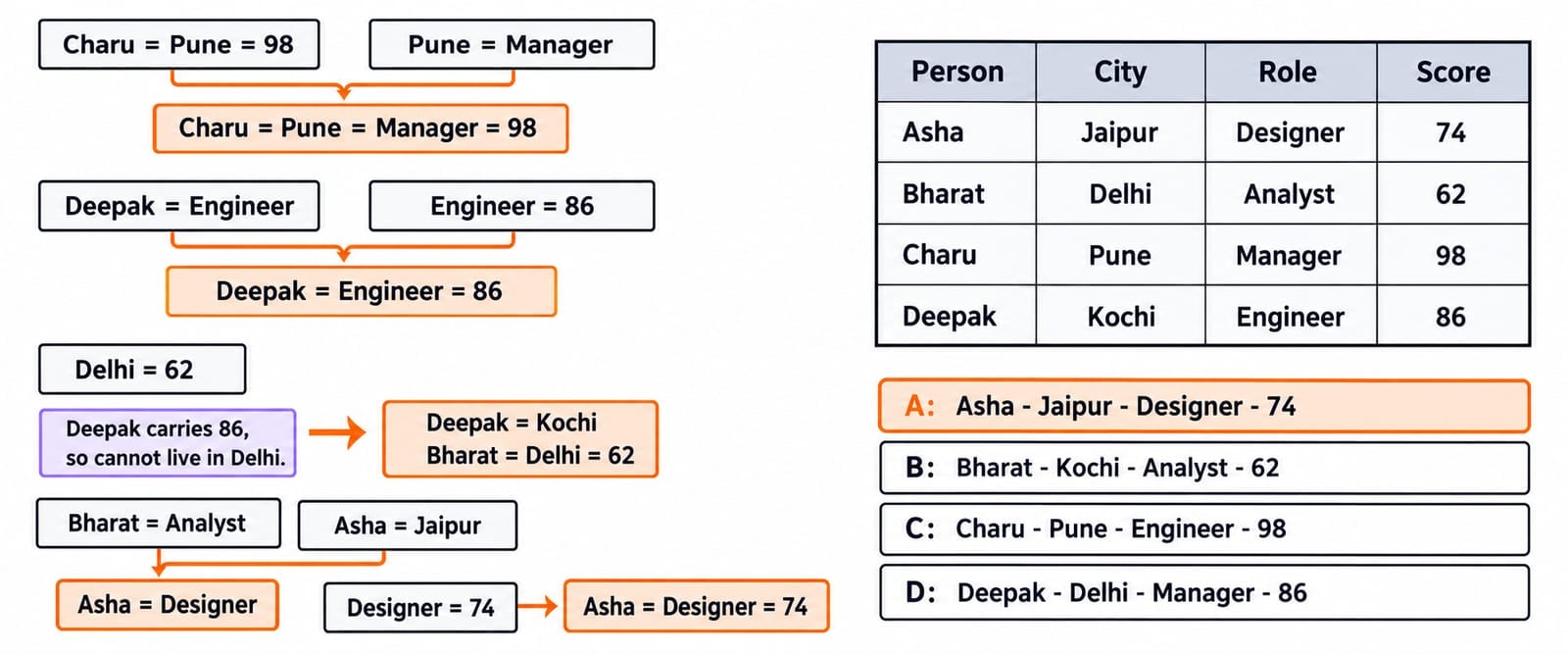
Asha, Bharat, Charu and Deepak live in different cities among Delhi, Jaipur, Pune and Kochi. They have different roles among Analyst, Designer, Engineer and Manager, and different scores among 62, 74, 86 and 98.
Charu lives in Pune and scored 98.Deepak is the Engineer.The person in Delhi scored 62.Bharat is the Analyst.The Designer scored 74.Asha lives in Jaipur.The Manager lives in Pune.The Engineer scored 86.
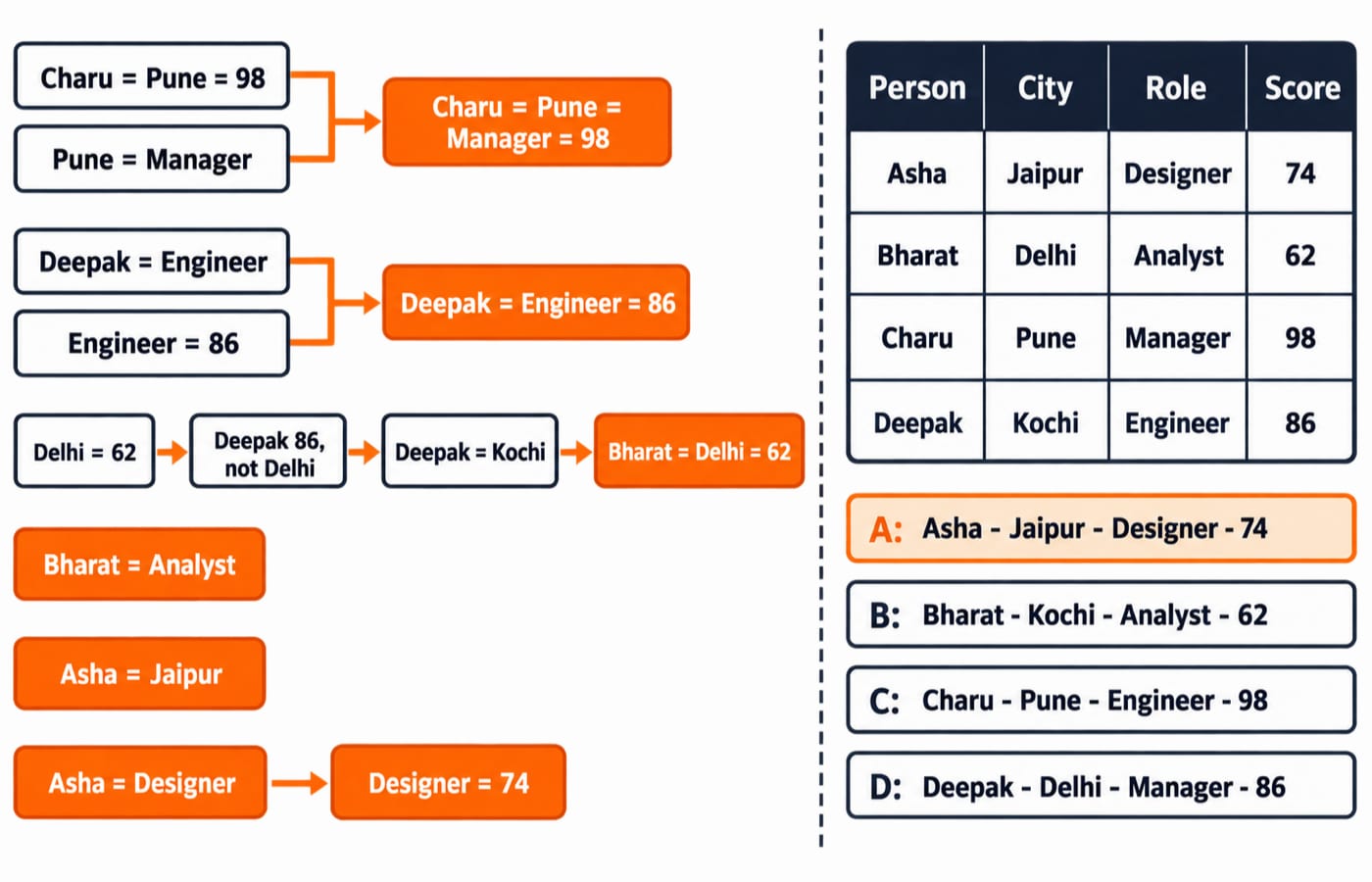
Clues 1 and 7 give Charu = Pune = Manager = 98.
Clues 2 and 8 give Deepak = Engineer = 86. Clues 4 and 6 separately fix Bharat = Analyst and Asha = Jaipur.
Asha already has Jaipur and Charu has Pune, so the only cities left for Bharat and Deepak are Delhi and Kochi. Delhi carries 62, but Deepak carries 86. Deepak therefore cannot live in Delhi. This forces Deepak = Kochi and Bharat = Delhi = 62.
Now use role elimination. Manager belongs to Charu, Analyst to Bharat and Engineer to Deepak. Designer is the only role left for Asha. The Designer-score block then gives Asha 74.
Person | City | Role | Score |
|---|---|---|---|
Asha | Jaipur | Designer | 74 |
Bharat | Delhi | Analyst | 62 |
Charu | Pune | Manager | 98 |
Deepak | Kochi | Engineer | 86 |
Which option is completely correct?
(a) Asha - Jaipur - Designer - 74
(b) Bharat - Kochi - Analyst - 62
(c) Charu - Pune - Engineer - 98
(d) Deepak - Delhi - Manager - 86
The answer is (a). In (b), Bharat lives in Delhi, not Kochi. In (c), Charu is the Manager, not the Engineer. In (d), Deepak lives in Kochi and is the Engineer.
5. Answer follow-up questions from the finished table, not from memory
Once the table is complete, lookup replaces deduction:
Who scored 74?Move from the score to its row: Asha.Who lives in Kochi?Move from the city to its row: Deepak.Where does the Analyst live and what did the Analyst score?Read two cells on Bharat's row: Delhi and 62.Who is the Manager?Move from the role to its row: Charu.
Now audit the table. Clues 1 to 8 respectively confirm Charu-Pune-98, Deepak-Engineer, Delhi-62, Bharat-Analyst, Designer-74, Asha-Jaipur, Manager-Pune and Engineer-86. Delhi, Jaipur, Pune and Kochi appear once each. So do all four roles and the scores 62, 74, 86 and 98. A complete-looking table is valid only after this check.
6. Shortcuts that save writing without losing logic
Keep Charu-Pune-Manager-98, Deepak-Engineer-86 and Delhi-62 as blocks instead of copying full sentences. When two blocks share Pune or Engineer, merge them immediately.
Use one-to-one cross-outs efficiently. After assigning Pune to Charu, cross Pune out for Asha, Bharat and Deepak. After assigning Manager to Charu, cross that role out for everyone else. This is legal only because the stem declares all values different. If repetition is allowed, one positive placement does not justify those cross-outs.
A useful page has two layers: a small area for unresolved blocks such as Designer-74, and one master table for confirmed person-level rows. This clean separation keeps tentative facts away from confirmed matches. Keep an error log with only three labels: missed anchor, broken chain or premature guess. Speed comes from fewer rewrites, not skipped verification.
7. Common traps and how competitive exams may frame the topic
Keeping clues in memory: externalise them in a grid.
Treating
Designer = 74as a named person: retain it as an unresolved block.Aligning category lists by written order: use only stated clues.
Filling a likely-looking blank: wait for one remaining candidate.
Stopping at one possible arrangement: check uniqueness and every clue.
Turning
not DelhiintoKochitoo early: eliminate every other open city first.
A question may ask for the complete row, a person from one attribute, two attributes on the same row, what must or cannot be true, or the number of complete arrangements satisfying all clues.
For a wider placement method, use Logical Reasoning for Placement Tests. Banking learners can order puzzle practice with Bank PO Reasoning, while SSC CGL Reasoning provides an SSC-oriented reasoning plan.
Exam formats, section structures and timings vary by examination and cycle. Check the relevant authority's current notification and instructions before relying on exam-specific details.
8. Data arrangement short version: build the table, then force the matches
Remember inventory -> anchors -> blocks -> elimination -> query -> audit. In this set, that chain produced Charu-Pune-Manager-98, Deepak-Kochi-Engineer-86, Bharat-Delhi-Analyst-62 and Asha-Jaipur-Designer-74.
For a simple learning drill, solve three small two-attribute sets, then three four-attribute sets. After every miss, label it anchor, chain or guess, and rebuild only the failed step. Do not redo correct work when one broken link caused the error. For structured placement and recruitment-test practice across aptitude, reasoning and verbal ability, continue with Aptitude for Placement.
Keep learning

Data Sufficiency: A 5-Step Method, Shortcuts and Solved Examples
Learn to test each statement independently, prove insufficiency with two valid cases, and stop as soon as the target becomes unique. Three worked problems make the method concrete.
Updated 15 Nov 20266 min readAptitude & Reasoning
Data Interpretation for Competitive Exams: Concepts, Shortcuts and 4 Solved Sets
Learn a repeatable way to read Data Interpretation sets, choose the correct base, calculate efficiently, and check your answer. Four worked sets cover table, bar, pie and line data.
Updated 23 Sep 20266 min read186 viewsAptitude & Reasoning

Coding-Decoding Concepts and Shortcuts with Solved Examples
Identify, validate and reverse coding-decoding rules through letter shifts, rearrangements, number codes and sentence substitution.
Updated 9 Nov 20265 min readAptitude & Reasoning
Trigonometry for Competitive Exams: Concepts, Shortcuts and Solved Examples
Build trigonometry from one right triangle, recover standard values safely, and solve identities, equations, and height-and-distance problems step by step.
Updated 8 Nov 20266 min readAptitude & Reasoning