

Laws and Identities of Algebra Questions: 12 Solved MCQs
Practise 12 algebra identity MCQs with fresh, line-by-line solutions. Learn when to factor squares and cubes, use reciprocal recurrences, and simplify symmetric expressions.
KnowledgeGate Team
Exam prep & CS education
Updated 12 Nov 20266 min read
Most algebra-identity MCQs are short, but they become slow when you expand every expression instead of spotting its factor or symmetric form. These 12 solved MCQs move from differences of squares and cubes to reciprocal powers and three-variable identities. Before reading each solution, choose an option and write the identity you plan to use.
KnowledgeGate has over 60 published questions on Laws & Identities of Algebra, within its wider Aptitude Courses for Exams & Placements collection. Question 6 has no individual solved page, so its further-reading route is the Important Algebraic Identities lesson.
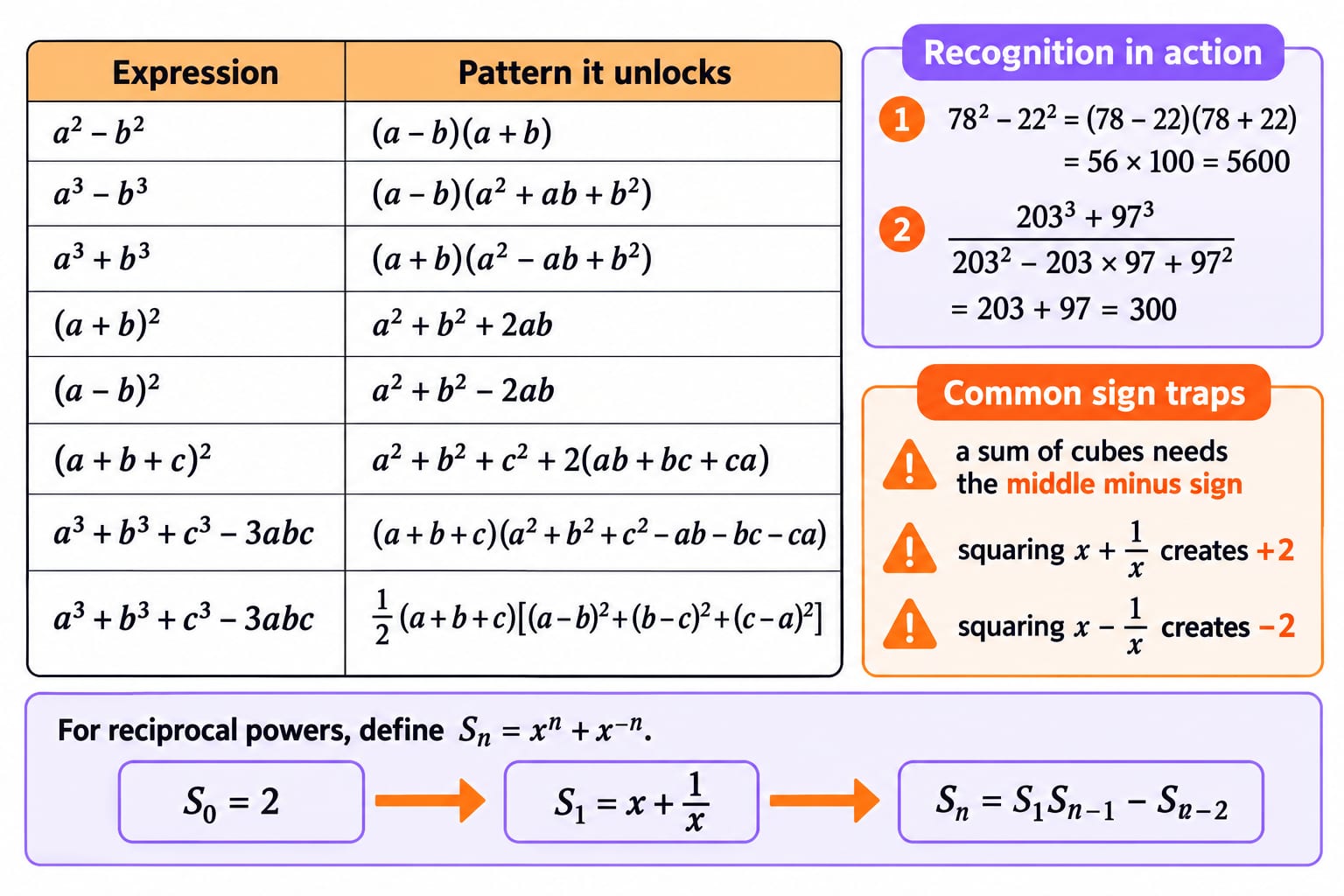
Algebra laws and identities to recognise before solving
Expression | Pattern it unlocks |
|---|---|
|
|
|
|
|
|
|
|
|
|
|
|
|
|
|
|
Two quick calculations show why recognition matters. First,
78^2-22^2=(78-22)(78+22)=56*100=5600.
The factors are easier than evaluating both squares. Second,
(203^3+97^3)/(203^2-203*97+97^2)=203+97=300.
Here the denominator is exactly the second factor in the sum-of-cubes identity.
For reciprocal powers, define S_n=x^n+x^(-n). If S_1=x+1/x, then S_n=S_1S_(n-1)-S_(n-2), starting with S_0=2. Watch two common traps: a sum of cubes needs the middle minus sign in its quadratic factor, and squaring x+1/x creates +2, while squaring x-1/x creates -2.
Solved algebra MCQs 1-3: differences, sums and squares
Question 1
If (x - 1/2)^2 - (x - 3/2)^2 = x + 2, then the value of x is:
(a) 2
(b) 4
(c) 6
(d) 8
Let A=x-1/2 and B=x-3/2. Then A-B=1 and A+B=2x-2, so
A^2-B^2=(A-B)(A+B)=2x-2.
Thus 2x-2=x+2, giving x=4, option (b). As a check, at x=4 the left side is 3.5^2-2.5^2=12.25-6.25=6, equal to the right side. See the Use the Important Algebraic Identities lesson (fallback; the solved page is unavailable)..
Question 2
The sum of two numbers is 33 and their difference is 7. Find the sum of their squares.
(a) 829
(b) 569
(c) 469
(d) 319
Let the numbers be a and b. Adding the squared relations gives
(a+b)^2+(a-b)^2=2(a^2+b^2).
Therefore a^2+b^2=(33^2+7^2)/2=(1089+49)/2=1138/2=569, option (b). The numbers are 20 and 13, and 400+169=569 confirms it. Continue on the Question 2 solved page.
Question 3
The sum of squares of 3 numbers is 170, while the sum of their products taken two at a time is 157.What is the sum of the numbers?
(a) 20
(b) 22
(c) 24
(d) 28
Use (a+b+c)^2=a^2+b^2+c^2+2(ab+bc+ca). Then
(a+b+c)^2=170+2*157=484.
The equation gives |a+b+c|=sqrt(484)=22, so the sum can be 22 or -22. The listed positive option is 22, option (b). Open the Question 3 solved page.
Solved algebra MCQs 4-6: cube factors and reciprocal powers
Question 4
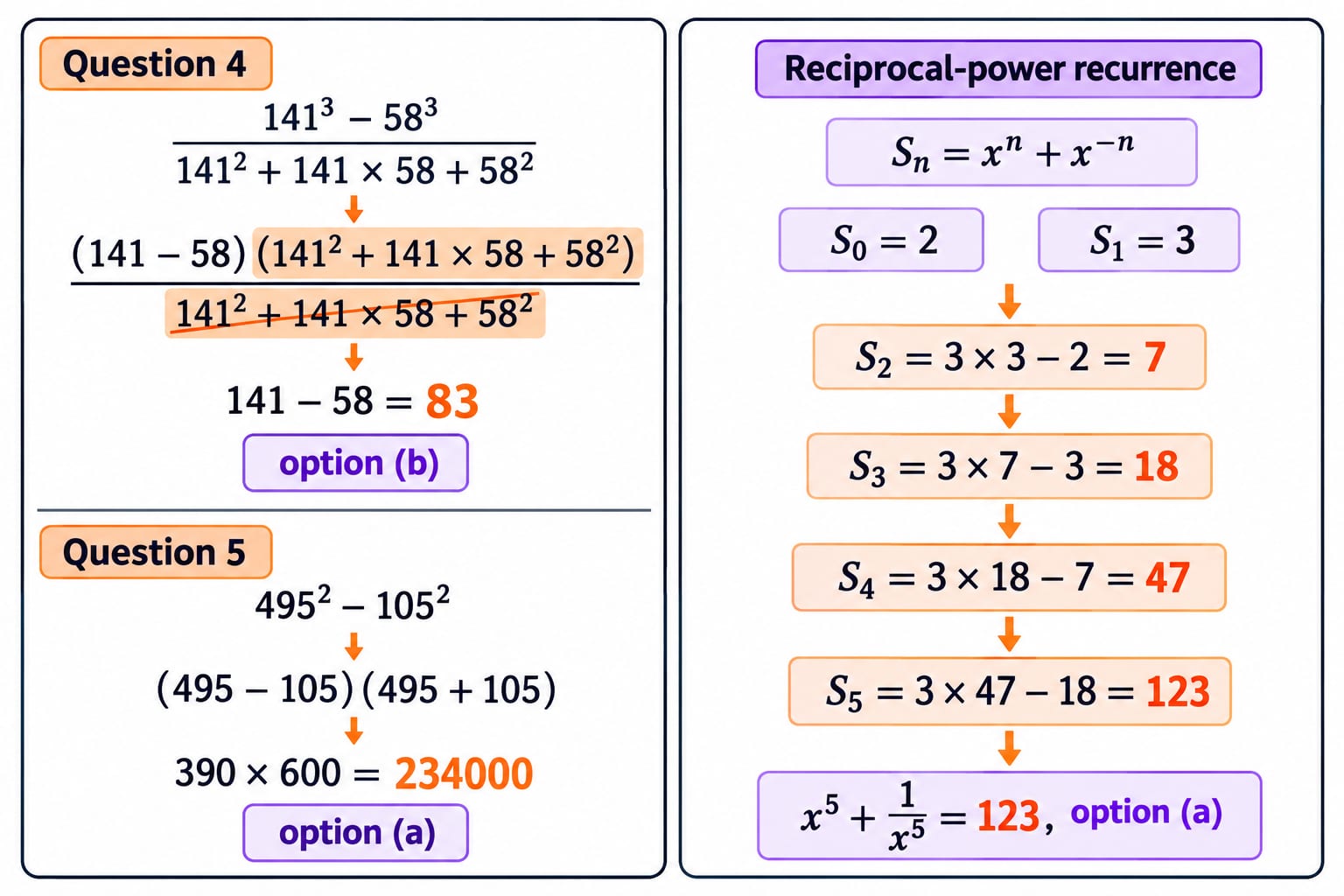
Which of the following is the output of (141 x 141 x 141 - 58 x 58 x 58) / (141 x 141 + 141 x 58 + 58 x 58) ?
(a) 67
(b) 83
(c) 98
(d) 90
The expression is (141^3-58^3)/(141^2+141*58+58^2). Factor the numerator. Its second factor matches the complete denominator, so it cancels:
(141-58)(141^2+141*58+58^2)/(141^2+141*58+58^2)=141-58=83.
The answer is option (b), without calculating either cube. See the Question 4 solved page.
Question 5
Which of the following is the output of 495 * 495 - 105 * 105?
(a) 234000
(b) 360000
(c) 300000
(d) 300009
Treat this as 495^2-105^2. Difference of squares gives
(495-105)(495+105)=390*600=234000.
The round sum of 600 is the clue that factorisation is intended. The answer is option (a). Check the Question 5 solved page.
Question 6
If (x + 1/x) = 3 then, the value of (x⁵ + 1/x⁵) = ?
(a) 123
(b) 132
(c) 213
(d) 231
Set S_n=x^n+x^(-n), with S_0=2 and S_1=3. Apply S_n=3S_(n-1)-S_(n-2):
S_2=3*3-2=7S_3=3*7-3=18S_4=3*18-7=47S_5=3*47-18=123
Therefore x⁵+1/x⁵=123, option (a).
Solved algebra MCQs 7-9: reciprocal and quartic identities
Question 7
The value of x^2 + 1/x^2 for x + 1/x = 5 is
(a) 25
(b) 24
(c) 23
(d) 20
Square the given relation: (x+1/x)^2=x^2+2+1/x^2=25. Hence x^2+1/x^2=25-2=23, option (c). The value 25 leaves the middle term untouched; 24 is a common one-unit slip. See the Question 7 solved page.
Question 8
If x + y + z = 4, x^2 + y^2 + z^2 = 6 and x^-1 + y^-1 + z^-1 = 1, where x, y, z are all non-zero, then the value of xyz is:
(a) 1
(b) 2
(c) 4
(d) 5
First use the square of the sum:
16=6+2(xy+yz+zx), so xy+yz+zx=5.
Next, x^-1+y^-1+z^-1=(xy+yz+zx)/xyz=1. Thus 5/xyz=1, giving xyz=5, option (d). There is no need to find the three variables. Visit the Question 8 solved page.
Question 9
If x⁴ + x^2y^2 + y⁴ = 29 and x^2 - xy + y^2 = 5, then what is the value of 5xy?
(a) 0
(b) 2
(c) -2
(d) -1
Factor the quartic:
x⁴+x^2y^2+y⁴=(x^2-xy+y^2)(x^2+xy+y^2).
The first factor is 5, so the second is 29/5. Subtracting them gives 2xy=29/5-5=4/5, hence xy=2/5. The question asks for 5xy, which is 2, option (b). Review the Question 9 solved page.
Solved algebra MCQs 10-12: three-variable and decimal identities
Question 10
If (a + b + c) = 14 and (a^3 + b^3 + c^3 - 3abc) = 98, then find the value of (ab + bc + ca).
(a) 60
(b) 64
(c) 65
(d) 63
Use a^3+b^3+c^3-3abc=(a+b+c)[(a+b+c)^2-3(ab+bc+ca)]. Put P=ab+bc+ca. Then
98=14(196-3P)
7=196-3P
3P=189, so P=63, option (d). See the Question 10 solved page.
Question 11
If a^3 + b^3 + c^3 - 3abc = 405 and (a - b)^2 + (b - c)^2 + (c - a)^2 = 54, find the value of (a + b + c).
(a) 15
(b) 45
(c) 9
(d) 27
Use the half-form directly:
405=1/2(a+b+c)[(a-b)^2+(b-c)^2+(c-a)^2].
Therefore 405=(1/2)(a+b+c)(54)=27(a+b+c), and a+b+c=405/27=15, option (a). Continue on the Question 11 solved page.
Question 12
Find the value of the given expression, correct to 2 decimal places.
(0.05*0.05*0.05 + 0.04*0.04*0.04) / (0.05*0.05 - 0.05*0.04 + 0.04*0.04)
(a) 0.19
(b) 0.09
(c) 0.90
(d) 0.85
Set a=0.05 and b=0.04. The fraction is (a^3+b^3)/(a^2-ab+b^2). The sum-of-cubes identity cancels the denominator, leaving a+b=0.05+0.04=0.09, option (b). Directly cubing the decimals only adds error risk. See the Question 12 solved page.
How to choose the right algebra identity under time pressure
Use three passes while practising. First, name the outer shape: difference of squares, cube numerator with a matching quadratic, x+1/x, or a symmetric three-variable form. Second, substitute the supplied values. Third, check the sign and the exact quantity requested before choosing an option.
Error from this set | What goes wrong | One-line correction |
|---|---|---|
Expanding | Long arithmetic hides the matching factor | Cancel |
Reporting 25 in Question 7 | The | Compute |
Stopping at | Question 9 asks for | Multiply the intermediate result by 5 |
Using a plus sign in Question 12's denominator | The factor no longer matches | Use |
Pattern recognition should come before advanced techniques, which is also the sequence explained in CAT Quant Preparation: Arithmetic and Algebra First. If you want a wider mathematics roadmap, use MCA Entrance Mathematics: Algebra to Calculus Order.
Short version and the next practice step
Factor before expanding.
Match the full quadratic factor in cube identities.
Convert sums and differences into squares.
Use symmetric sums instead of finding individual variables.
Keep the requested expression, such as
5xy, visible until the final line.
Now redo Questions 4, 6, 8 and 11 without looking. Write the governing identity first and check that you reach 83, 123, 5 and 15 respectively.
For structured aptitude teaching and practice, continue with Aptitude for Placement. If you only need the formulas, return to the identities lesson linked near the opening.
Keep learning
Boolean Algebra Laws & Optimization MCQs: 12 Solved Questions
Solve 12 published Boolean algebra questions step by step, with a compact law card and clear methods for consensus, factorisation, nested functions and K-map grouping.
Updated 29 Oct 20267 min readDigital Electronics MCQs

Algebra for Aptitude Tests: Fast Methods for Equations, Identities and Substitution
Learn how to recognise the algebraic structure in an aptitude question, choose the shortest valid method, and verify the result through worked examples.
Updated 21 Aug 20266 min readAptitude & Reasoning
Regex Design and Algebra Explained: Identities, Arden's Theorem, and Worked Examples
Build regular expressions from language constraints, simplify them with safe identities, prove the result, and solve a recursive equation with Arden's theorem.
Updated 24 Oct 20265 min readTheory of Computation

Digital Fundamentals and Boolean Algebra Explained: Gates, Laws and Simplification
Connect bits, gates, truth tables and Boolean expressions, then simplify a three-input majority function and verify that the reduced circuit is equivalent.
Updated 12 Sep 20265 min read126 viewsDigital Logic